





Editorial Integrity
Making sound real estate investment decisions begins with reliable, data-driven insights. At Ziffy.ai, we offer an AI-native real estate investing, proprietary data-driven trend analysis, investment mortgage programs like DSCR loans, and a network of over 500 investor-friendly real estate agents to deliver the expertise needed for informed decisions. Our content is crafted by experienced real estate professionals and backed by real-time market data, ensuring you receive accurate and actionable information. Through a rigorous editorial process, we strive to empower your investment journey with trustworthy and up-to-date guidance.
For years, Florida rental-property underwriting had an uncomfortable variable sitting inside the monthly payment: insurance. A property could have solid rent, a reasonable purchase price, and workable financing, only for the final insurance quote to push PITIA higher and tighten the debt service coverage ratio.
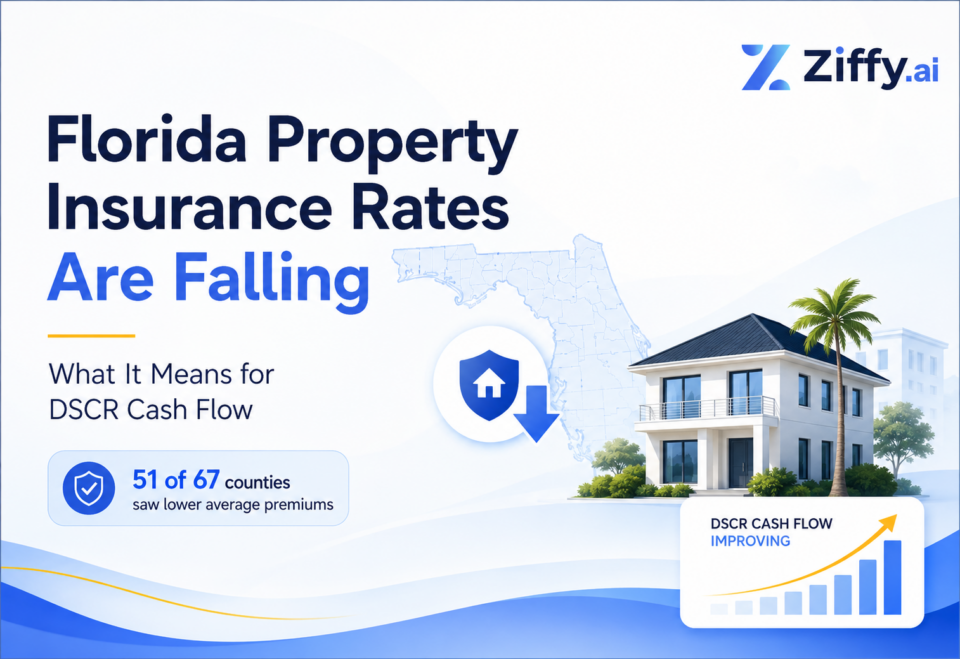
In 2026, that pressure is beginning to ease. Florida’s latest regulatory data shows falling average homeowners premiums across most counties, lower reinsurance costs, more insurers entering the market, and approved rate reductions at Citizens Property Insurance Corporation. The improvement is real, although it is far from uniform across the state.
For rental-property investors using a DSCR loan, the shift deserves attention because insurance is part of PITIA. A lower insurance premium reduces the denominator in the DSCR calculation. If the property’s qualifying rent and other housing costs stay the same, that improves DSCR and leaves more room in the property’s monthly cash flow.
Florida OIR says average homeowners premiums including wind fell in 51 counties between its January and July 2026 reports.
Citizens’ homeowners multiperil rates are decreasing by 8.8% on average in 2026, effective July 1 for new policies and at renewal for existing policies.
Citizens’ multiperil DP1/DP3 rates average 4.2% lower statewide, with larger reductions in several Central and Northeast Florida counties.
Insurance is part of PITIA in DSCR underwriting, so a lower property-insurance cost can improve both the qualifying DSCR and the rental property’s actual monthly carrying cost.
Florida’s recovery is uneven. High-cost coastal counties remain expensive, and some Citizens wind-only dwelling rates are rising even where multiperil rates are falling.
Table of Contents
Why Florida Property Insurance Rates Are Starting to Fall
Florida OIR reports that the downward movement in rate filings began in 2024 and continued through 2025 and 2026. At the same time, preliminary 2026 reinsurance data shows risk-adjusted reinsurance costs falling by at least 10% across most layers on average. Nearly half of insurers included in OIR’s Annual Reinsurance Data Call were seeing risk-adjusted pricing reductions of 15% to 25%.
Reinsurance is effectively insurance purchased by insurance companies against major losses. When catastrophe reinsurance becomes more available and less expensive, Florida insurers face less pressure from one of the major costs built into their pricing.
Insurer finances have also improved. Florida domestic property insurers collectively returned to positive net income in 2024, and OIR says their pooled combined ratio reached 83% in 2025, its lowest level in more than a decade. The regulator also reports that 21 new companies have been approved to write residential property policies in Florida since the state’s insurance reforms.
Legal costs are moving as well. OIR data shows average defense and cost-containment expense per domestic homeowners claim declining from $947.38 in 2022 to $720 in 2025. Personal residential legal service-of-process filings fell 25% from 2024 to 2025 and were another 25% lower during the first five months of 2026 compared with the same period in 2025.
OIR attributes much of the stabilization to Florida’s 2022 and 2023 insurance and litigation reforms. The broader market picture also includes improved insurer profitability, cheaper reinsurance and additional private capital, so it would be too simple to assign the change to a single cause.
Citizens’ shrinking footprint gives another indication that private-market capacity has improved. OIR reported 293,465 Citizens policies in force as of June 5, 2026, the lowest count in 25 years.
Florida Homeowners Insurance Rates by County: Where Premiums Are Actually Moving
The statewide direction can hide large differences from one Florida market to another. OIR’s county data below covers traditional homeowners policies including wind coverage. It should be used as a market benchmark, not as an expected landlord-insurance quote. OIR itself notes that the premium charged on an individual property varies by insurer, insured value, deductible and policy terms.
The regional difference is hard to miss. South Florida remains substantially more expensive despite modest declines. OIR reported average homeowners premiums of $6,323 in Palm Beach County, $6,136 in Broward and $5,975 in Miami-Dade. Compare that with $2,786 in Duval and $2,767 in Polk.
For an investor comparing Florida rental markets, insurance therefore remains a local underwriting input, even as the statewide trend improves.
Florida Landlord Insurance Rates: Citizens’ DP1 and DP3 Cuts Are More Relevant to Rental Investors
The regular homeowners numbers only tell part of the story for investors. Citizens states that its DP-3 dwelling policy is available for tenant-occupied properties, as well as properties that may not qualify for its standard HO-3 or HO-8 forms. Its 2026 approved county-rate filing provides a separate look at multiperil DP1 and DP3 policies.
Across 218,280 DP1/DP3 policies, Citizens shows a 4.2% average approved rate reduction, taking its average premium in that category from $2,300 to $2,203. The size of the approved change varies sharply by county.
The full Citizens county-by-county rate schedule shows some of the larger dwelling-policy reductions around Jacksonville and the Orlando area, while South Florida’s percentage reductions are smaller.
That distinction is useful for DSCR investors because the insurance trend affecting an owner-occupied homeowner is not necessarily the trend affecting a tenant-occupied rental.
Investment Properties on Sale in Florida Today


How Lower Property Insurance Improves DSCR and Rental Cash Flow
For a DSCR loan in Florida, the connection between insurance and qualification is direct. At Ziffy Mortgage, DSCR is calculated as:
DSCR = Gross Monthly Rental Income ÷ Monthly PITIA
PITIA includes principal, interest, property taxes, insurance and applicable HOA dues.
That means an insurance reduction does not need to increase rent to strengthen the ratio. If principal and interest, taxes, HOA dues and qualifying rent are unchanged, a lower insurance premium reduces PITIA and mathematically increases DSCR.
Insurance can change the economics of a DSCR deal more than investors expect. A property may have strong rent, but if the insurance premium pushes PITIA too high, the DSCR can tighten quickly. When that premium comes down, the benefit is twofold: the property has a better chance of supporting the loan payment, and the investor keeps more of the rental income as cash flow.

This becomes particularly important around qualification thresholds. Ziffy Mortgage generally prefers a DSCR of 1.0 or higher, while qualifying properties below 1.0 may be considered through a No-Ratio DSCR structure. A reduction in insurance cannot guarantee approval or a particular rate, but on a tight file it can leave more room between the property’s qualifying rent and its monthly housing expense.
The same cost reduction continues to affect economics after closing. Lower insurance means less annual carrying cost, assuming coverage has not been reduced in a way that leaves the investor inadequately insured.
Investors analyzing acquisitions can incorporate the actual premium into a rental property analysis rather than relying on a statewide average. And when expenses change, including insurance, the property should be run through the numbers again rather than assuming the original DSCR still represents the deal.
Will Falling Florida Insurance Rates Make More DSCR Deals Work?
They can help, especially where a property is already close to the required coverage ratio. But insurance relief cannot rescue every deal.
DSCR still depends on the full relationship between rent and PITIA. A lower premium can be offset by higher property taxes, HOA dues, financing costs or a lower appraisal-supported rent. That is why investment-property underwriting looks at the final property numbers together.
There is also a timing difference between underwriting cash flow and post-closing cash flow.
Before a purchase or refinance closes, an updated insurance quote can be incorporated into the PITIA used to calculate the loan’s DSCR. For an already-owned property with an escrow account, a lower renewal premium may flow through to the mortgage payment after the servicer updates the escrow calculation. The Consumer Financial Protection Bureau explainsthat escrowed mortgage payments can move up or down when homeowners insurance premiums change and that servicers perform escrow analyses to determine future payments.
For investors planning a refinance or another acquisition, a current insurance figure is therefore more useful than carrying forward the premium from an old closing statement.
Why Some Florida Rental Properties May Not Get Cheaper Insurance
The most important qualification to the 2026 insurance story is that multiperil and wind-only coverage are not moving in the same direction everywhere.
Citizens’ approved 2026 rate schedule shows its wind-only DW2 rate changing by +16.1% in Miami-Dade, +13.6% in Palm Beach and +12.2% in Broward, even though its multiperil DP1/DP3 rates are decreasing in those same counties.
So an investor should not see an 8.8% statewide Citizens homeowners reduction, subtract 8.8% from an existing rental-property insurance assumption, and underwrite the deal from there.
The final cost depends on the actual coverage arrangement and property-specific quote. OIR explicitly warns that its county averages vary based on insurer, insured value, deductible and policy terms.
Flood risk also remains separate from the broader property-insurance trend. FEMA explains that most homeowners insurance does not cover flood damage; flood insurance is generally purchased separately.
For coastal and flood-exposed Florida investments, the useful number is therefore the complete insurance cost needed for the property and financing, not the statewide headline rate.
What Florida Real Estate Investors Should Do Before Making an Offer
A softening insurance market makes Florida underwriting more interesting, but it also creates an easy mistake: assuming yesterday’s expensive quote is now too conservative without replacing it with real evidence.
- Get an insurance quote while analyzing the acquisition. The closer the DSCR is to a program threshold, the less room there is for a placeholder insurance estimate.
- Separate the coverage components. Know whether the quote includes the wind coverage the property needs and whether separate flood insurance applies. A lower multiperil rate can coexist with a higher wind-only rate.
- Put the actual premium into PITIA. Recalculate the property’s DSCR whenever the insurance number changes.
- Stress-test the deal rather than spending every dollar of the improvement. Ziffy’s rental vacancy stress-test guiderecommends rerunning the analysis when insurance, taxes, HOA dues, rent or financing changes.

Right now in Florida, we’re seeing better conditions for investor purchases than we saw during the worst of the insurance cycle. The premium decreases are real, and wind mitigation credits can help. But I still would not let a borrower rely on a rough estimate for Florida insurance. In markets like Jacksonville and inland Tampa, the numbers can work cleanly. South Florida waterfront is still a different underwriting conversation.
That advice brings the statewide trend back to the individual deal. Florida’s improving insurance market can create genuine cash-flow relief, but the value appears only after the current quote is worked into the property-level numbers.
FAQs
Are Florida Home Insurance Rates Going Down in 2026?
Yes, in most counties according to the latest Florida OIR data. Average traditional homeowners premiums including wind declined in 51 of 67 counties between OIR’s January and July 2026 reports. Individual policyholders can still see different results depending on their insurer and policy.
How Much Are Citizens Property Insurance Rates Dropping in 2026?
Citizens’ homeowners multiperil rates are decreasing by an average of 8.8% statewide. The rates took effect July 1, 2026 for new policyholders and apply to existing policies at renewal. Wind-only homeowners policies are decreasing by 5.5% on average statewide.
Are Florida Landlord Insurance Rates Going Down?
There are signs of improvement, but there is no single statewide landlord-insurance rate. Citizens’ multiperil DP1/DP3 book has an approved 4.2% average rate reduction for 2026. Citizens specifically makes DP-3 available for tenant-occupied properties. Private-carrier quotes and separate wind or flood coverage can produce different results.
Does Property Insurance Affect DSCR?
Yes. Ziffy Mortgage calculates DSCR using gross monthly rental income divided by PITIA, and insurance is one component of PITIA. A lower insurance cost reduces PITIA and increases DSCR if the other inputs remain unchanged.
Can Lower Insurance Help a Florida DSCR Loan Qualify?
It can. A lower insurance premium can improve the property’s DSCR because it reduces the monthly expense used in the calculation. Whether that changes eligibility or pricing depends on the final DSCR, leverage, property and the applicable loan program. Ziffy Mortgage can also review eligible sub-1.0 DSCR properties through No-Ratio DSCR options.
Are Insurance Costs Falling in Miami, Fort Lauderdale and Palm Beach?
Average homeowners premiums reported by OIR declined modestly in Miami-Dade, Broward and Palm Beach between September 2025 and March 2026, but these remain among Florida’s more expensive counties. Investors also need to watch wind-only coverage: Citizens’ 2026 wind-only dwelling rates increased in all three counties.
Does Florida Property Insurance Include Flood Insurance?
Most standard homeowners policies do not cover flooding. FEMA treats flood insurance as separate coverage, so investors should determine whether a property needs flood coverage and include that cost when evaluating the property’s total insurance burden.
Florida’s property-insurance market has moved into a better position than it occupied a few years ago, but for real estate investors the useful takeaway is more specific than “insurance is getting cheaper.”Insurance is becoming a less severe cash-flow headwind in many Florida markets, and that can directly improve DSCR.
The opportunity is property-specific. A current insurance quote, the correct coverage for the rental strategy, and a fully loaded PITIA calculation will tell an investor far more about a Florida deal than the statewide average ever can.