





Editorial Integrity
Making sound real estate investment decisions begins with reliable, data-driven insights. At Ziffy.ai, we offer an AI-native real estate investing, proprietary data-driven trend analysis, investment mortgage programs like DSCR loans, and a network of over 500 investor-friendly real estate agents to deliver the expertise needed for informed decisions. Our content is crafted by experienced real estate professionals and backed by real-time market data, ensuring you receive accurate and actionable information. Through a rigorous editorial process, we strive to empower your investment journey with trustworthy and up-to-date guidance.
Mortgage underwriting for an investment property is the lender’s review of the borrower, property, rent, appraisal, title, insurance, reserves, and loan structure before approving and funding the loan.
The process usually moves through eight stages:
- Pre-qualification and loan product selection
- Formal loan application
- Document collection and file submission
- Property appraisal and rent analysis
- Title search and title insurance
- Underwriting review and credit decision
- Conditions clearance and clear to close
- Closing and funding
For investors, the key difference is that the property is not just collateral. It is also part of the income story. Rent support, PITIA, DSCR, reserves, title, insurance, and property condition can affect approval just as much as credit score or down payment.
Table of Contents
Why Investment Property Underwriting Is Different
Buying an investment property is not the same as buying the home you live in. The mortgage process may look similar from the outside, but the lender is solving a different risk problem.
A primary residence loan is mainly underwritten around the borrower’s ability to repay from personal income. An investment property loan adds another layer: does the property make sense as a rental asset?
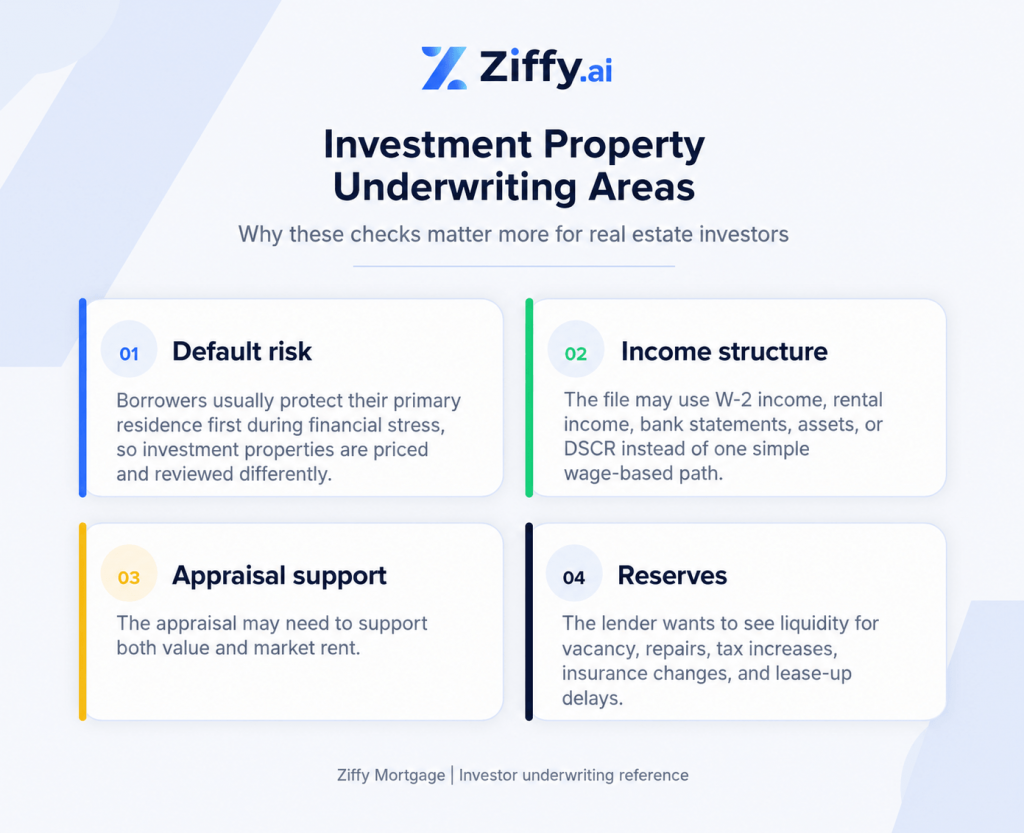
For a DSCR loan, the borrower’s personal income is not the center of the file. The lender is reviewing whether the property’s rental income can support the monthly PITIA payment, which includes principal, interest, taxes, insurance, and association dues.
Ziffy Mortgage starts the underwriting conversation with the deal itself: rent, property use, PITIA, reserves, title, insurance, borrower structure, and exit plan.
Step 1: Pre-Qualification and Loan Product Selection
For an investor, pre-qualification is a product-selection decision. The goal is to match the borrower, the property, and the investment strategy to the right loan path before the file reaches underwriting. A stabilized long-term rental may fit a DSCR loan.
A borrower with strong personal income may compare a full documentation investment property loan. A property that needs renovation, lease-up, or repositioning may require a bridge loan or fix-and-flip loan before it can support permanent rental financing.
The loan officer usually reviews the purchase price, down payment, credit score, liquidity, property use, rent strategy, entity structure, loan purpose, and expected closing timeline. This is also where loan-to-value, or LTV, becomes part of the conversation. LTV compares the loan amount to the property value or purchase price, depending on the underwriting rule being applied.
At Ziffy, this stage is especially important for DSCR files because a borrower with complex personal income may not need a tax-return-heavy loan path if the property’s rent supports the mortgage payment.

Steven Glick
Director of Mortgage Sales
Ziffy Mortgage
NMLS #1231769The cleanest investor files usually start before the application. When we know the property use, rent strategy, borrower structure, and reserves early, we can place the deal in the right loan path instead of trying to force it through the wrong one later.
In our experience, investors who ran their last deal through DSCR often assume the same structure will work on the next property. A short-term rental in a seasonal market, a long-term rental in a stable suburb, and a vacant property being repositioned can all require different underwriting treatment.
If you are still comparing paths, Ziffy’s guide to investment property loans explains how DSCR, full documentation, bridge, and fix-and-flip financing differ.
Step 2: Formal Loan Application
Once the loan path and property are identified, the formal application begins.
For a mortgage loan, this is commonly called the 1003 or Uniform Residential Loan Application. It collects the borrower’s personal information, income, assets, liabilities, property information, occupancy details, and declarations.
For investors, accuracy matters from the start. If the application says one thing and the supporting documents show another, the underwriter may ask for explanations, updated documentation, or corrected disclosures.
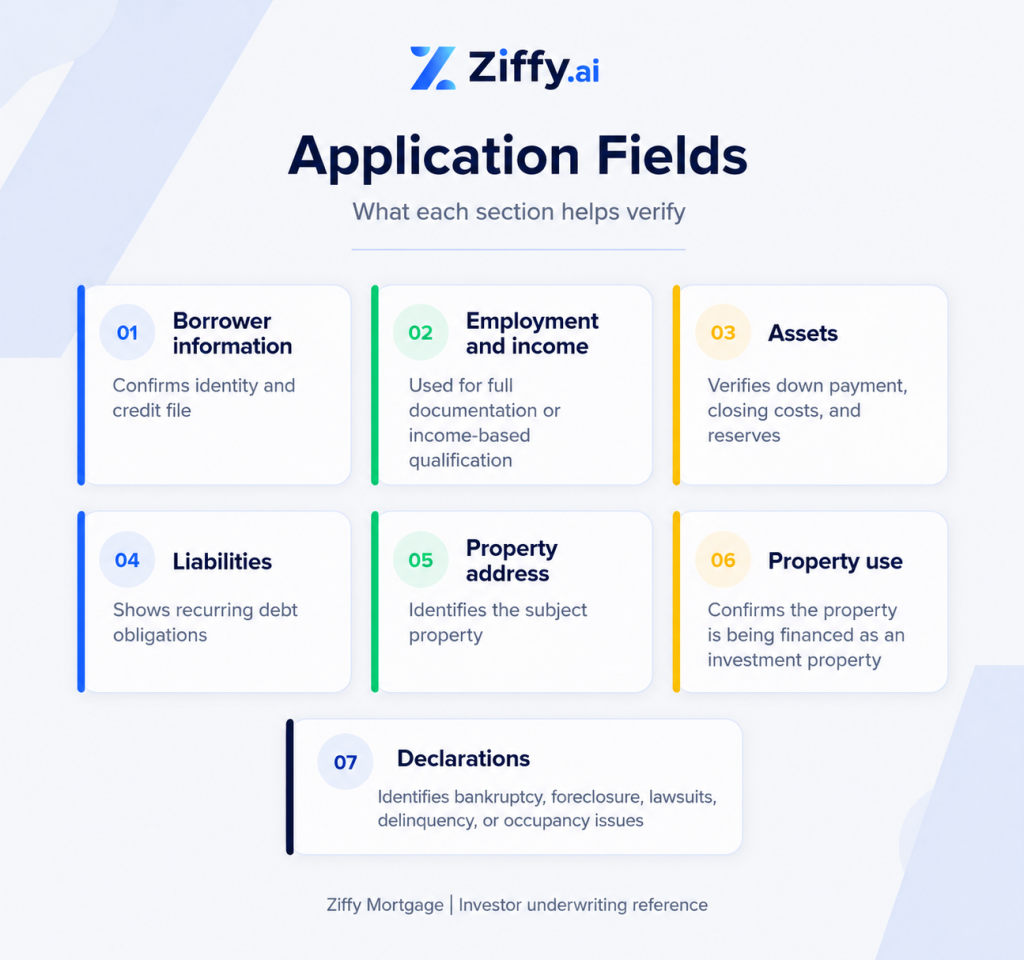
The application typically covers:
For LLC or entity-based transactions, the lender may also request the operating agreement, articles of organization, EIN confirmation, ownership breakdown, and signing authority.
Once a borrower submits the six pieces of information that count as a mortgage application under the TILA-RESPA Integrated Disclosure rule, or TRID, the lender is generally required to provide a Loan Estimate within three business days. Those six pieces are borrower name, borrower income, Social Security number to obtain a credit report, property address, estimated property value, and mortgage loan amount sought.
The Loan Estimate shows the estimated rate, monthly payment, closing costs, cash to close, and loan terms. Investors should compare it against the final Closing Disclosure later in the process.
Step 3: Document Collection and File Submission
After the application is complete, the loan file gets built. This stage determines how cleanly the file reaches underwriting.
For a full documentation investment property loan, the document list may include W-2s, pay stubs, tax returns, bank statements, investment statements, lease agreements, Schedule E, mortgage statements for other properties, entity documents, insurance quotes, HOA documents, and letters of explanation for credit events or large deposits.
For DSCR loans, the documentation burden is usually lighter because the property’s rental income carries more of the qualification logic. A DSCR file commonly focuses on:
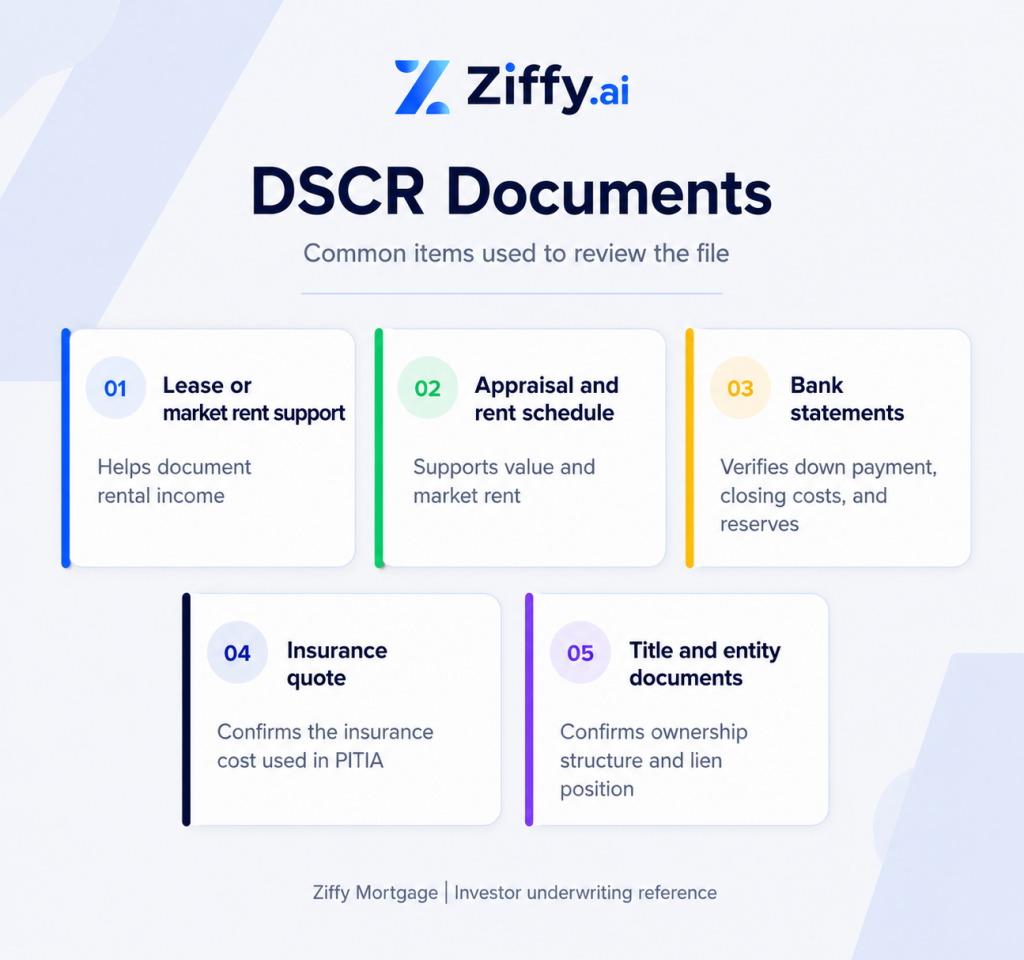
For DSCR files at Ziffy, the checklist is often much shorter than a full documentation file because the borrower is not qualifying through W-2s, pay stubs, tax returns, or personal debt-to-income ratio. That difference is one reason investors with complex income often prefer DSCR financing.
Debt-to-income ratio, or DTI, still matters in full documentation loans because the lender compares monthly debt payments to gross monthly income. In a DSCR file, the property’s rent-to-payment relationship carries the main qualification weight instead.
Large deposits can still create friction. If money appears in the borrower’s bank account without a clear source, the lender may ask for a paper trail. That could mean a gift letter, sale-of-asset documentation, business distribution support, or transfer history.
In our experience, strong investor files do not wait for the underwriter to ask. They label documents clearly, provide complete bank statements, and explain unusual deposits before the file gets conditioned.
Step 4: Property Appraisal and Rent Analysis
The appraisal is one of the most important underwriting checkpoints for an investment property. It is not only supporting the property value, but it also helps support the rent used for qualification in many investor cases.
Depending on the property and loan type, the lender may need:
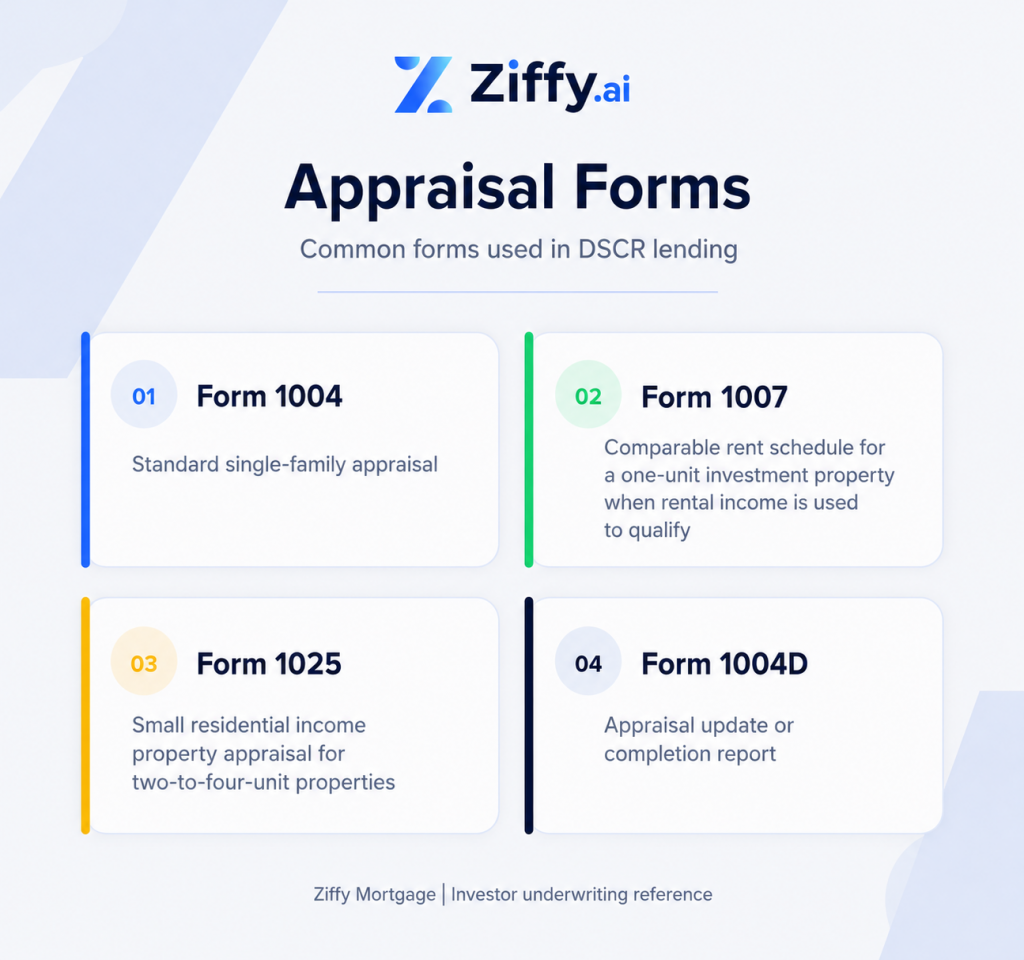
Fannie Mae’s Appraisal Report Forms and Exhibits section states that Form 1007 is required when the property is a one-unit investment property and the borrower is using rental income to qualify.
For DSCR underwriting, the rent figure can directly affect approval because DSCR is calculated as:
DSCR = Gross Monthly Rental Income ÷ Monthly PITIA
You can test this before applying with Ziffy’s DSCR loan calculator.
Here is a simple example:
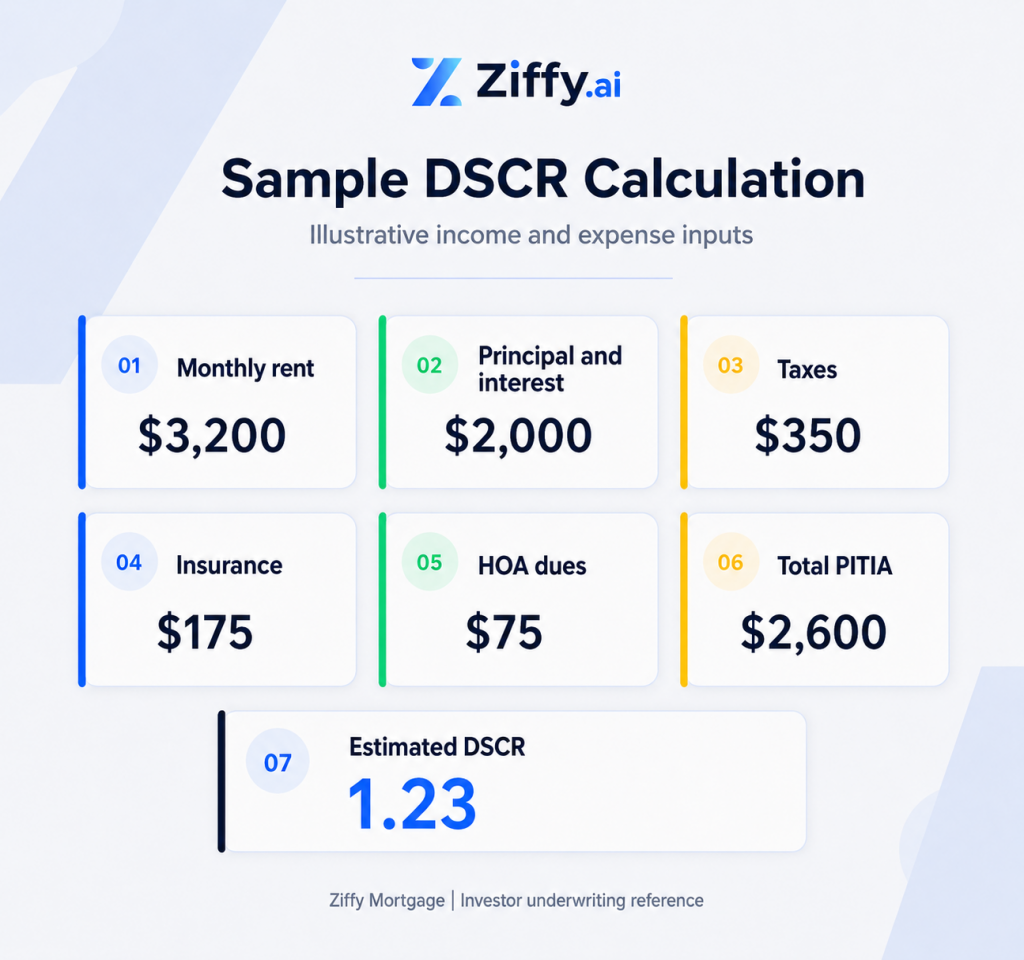
In this example, the property produces about 23% more rent than the monthly PITIA payment.
The appraisal can change that result. If the investor expected $3,500 in rent but the appraisal-supported market rent comes in at $3,100, the DSCR drops. If insurance or taxes come in higher than expected, PITIA rises and DSCR tightens again.
Steven Glick
Director of Mortgage Sales
Ziffy Mortgage
NMLS #1231769For DSCR loans, the rent number and the PITIA number have to work together. Investors often focus on purchase price and rate, but the appraisal-supported rent, taxes, insurance, and HOA dues are what decide whether the property clears the DSCR test cleanly.
Short-term rentals need extra care. Fannie Mae’s Rental Income section treats rents from Form 1007 or Form 1025 as gross monthly rent, also referred to as monthly market rent on Form 1007. That makes monthly market rent support different from a nightly short-term rental revenue projection. For investors, an Airbnb projection, host dashboard, or seasonal revenue history may not always translate cleanly into the rent figure used for a loan. Check lease comps, property taxes, insurance quotes, HOA dues, and market rent support before assuming the deal will underwrite.
Ziffy File Snapshot: Princeton, TX DSCR Purchase
A Q1 2026 Ziffy DSCR purchase file in Princeton, TX shows why appraisal support and timing matter. The deal involved a $240,000 purchase price, 25% down, a 7.25% rate, and a 28-day close.
That file worked because the financing path was lined up early, the borrower had the down payment and reserves ready, and the loan structure fit the rental strategy.
Rates and terms from this example are historical and file-specific. They are not a rate quote or approval guarantee. Final eligibility depends on borrower profile, property eligibility, appraisal, title, insurance, reserves, market conditions, and underwriting review.
Step 5: Title Search and Title Insurance
While the appraisal is moving, the title company or real estate attorney reviews ownership history and lien status.
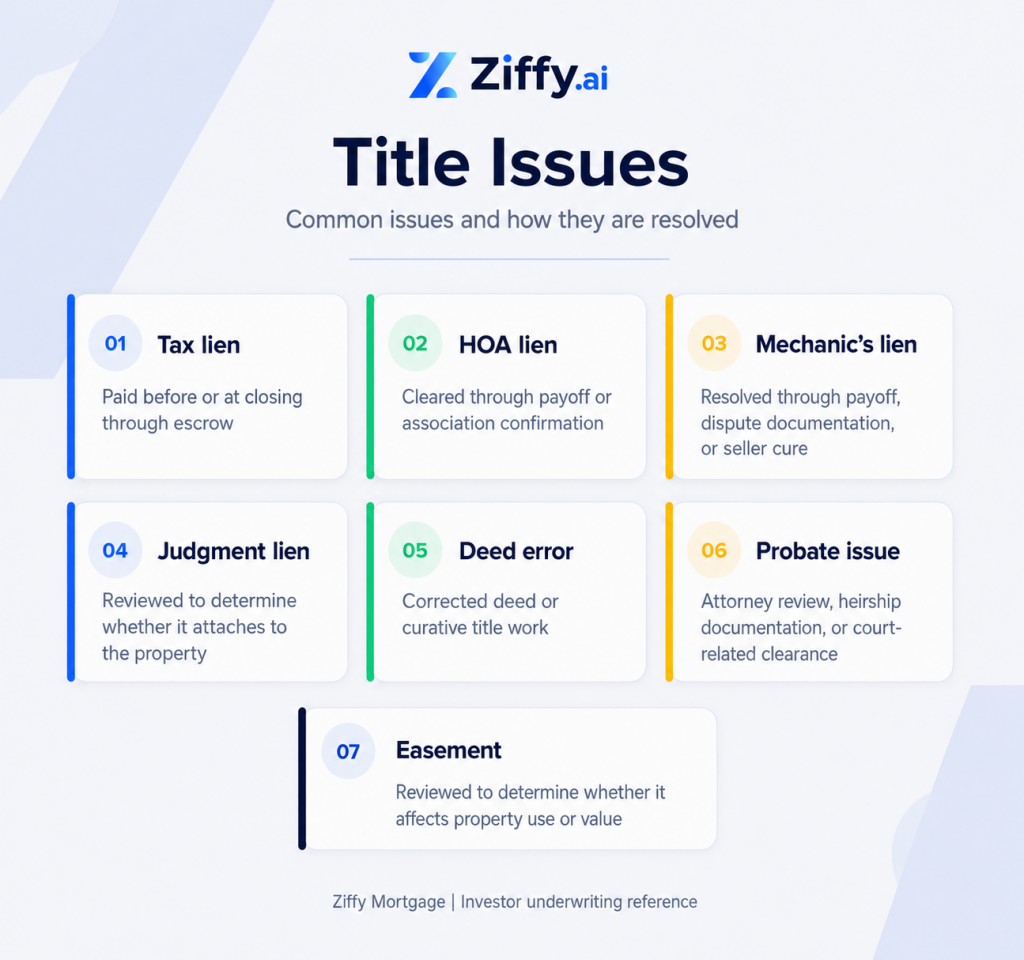
The title search looks for issues that could affect the lender’s lien position or the investor’s ownership rights. Common issues include tax liens, mechanic’s liens, HOA liens, judgment liens, easements, deed errors, probate issues, and unrecorded transfers.
For investors, the underwriting question is not only whether the issue exists. It is whether the issue can be cleared before closing, whether it changes the timeline, and whether it should affect negotiations with the seller.
A title issue may be handled in several ways:
The lender will require a lender’s title policy. This protects the lender’s interest in the property up to the loan amount. Investors should also consider an owner’s title policy, especially for properties bought through foreclosure, estate sale, auction, or transactions where ownership history is complex.
A title defect can affect more than closing. It can delay resale, refinancing, cash-out plans, rent collection, and portfolio sequencing. If a title issue appears, the practical question is whether it can be cleared inside the contract timeline or whether the investor needs an extension, seller credit, or exit from the deal.
Step 6: Underwriting Review and Credit Decision
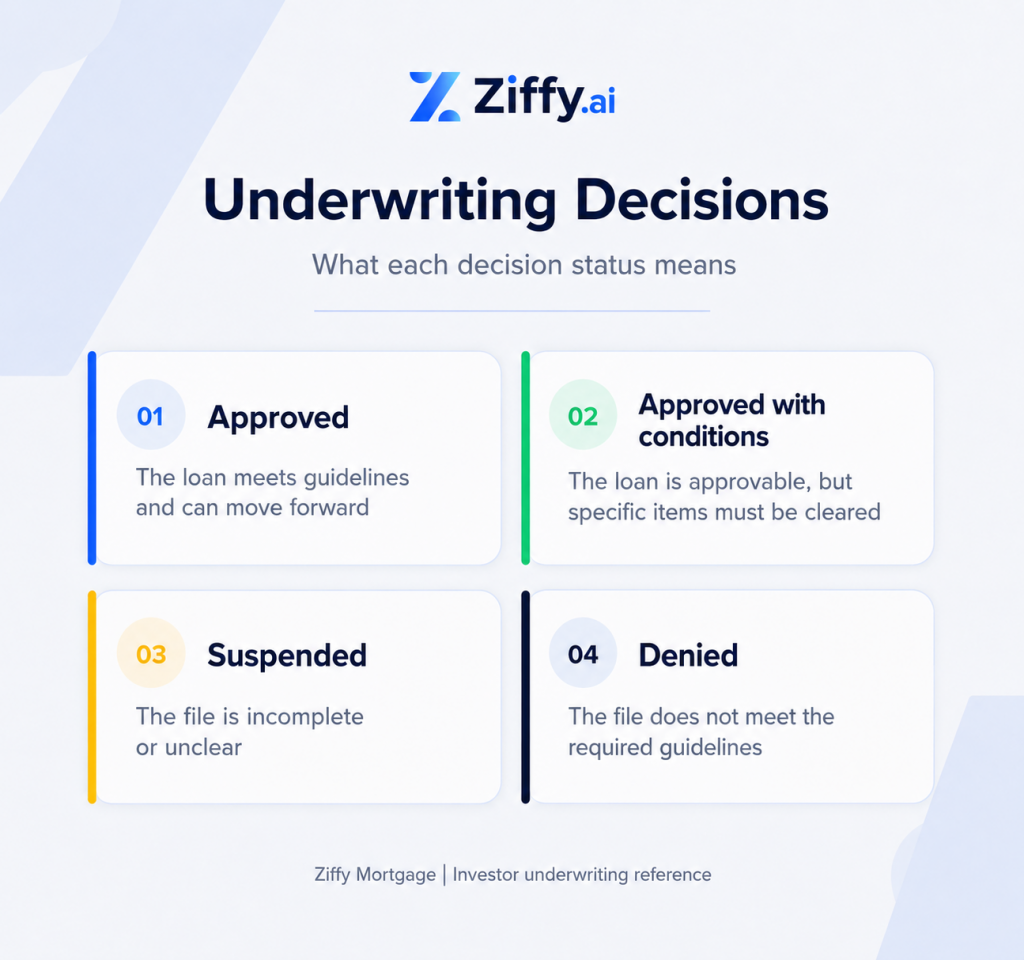
The underwriter examines the full file and decides whether it meets the loan program’s requirements. Most investor files do not move directly from submission to final approval. The more common outcome is approval with conditions.
The review usually centers on three areas: creditworthiness, capacity or cash flow, and collateral.
Creditworthiness
Credit review includes score, history, late payments, collections, bankruptcies, foreclosures, inquiries, and number of financed properties.
Conventional loans can also be affected by Fannie Mae and Freddie Mac financed-property rules. Fannie Mae’s multiple financed properties guidance includes reserve requirements for borrowers with multiple financed properties, and Desktop Underwriter uses Real Estate Owned, or REO, information to determine financed-property count.
For DSCR loans, Ziffy generally focuses on whether the borrower meets the program’s minimum credit standards and whether the property, leverage, rent, reserves, and collateral support the risk. You can review Ziffy’s DSCR loan requirements for more detail on credit, down payment, reserves, and property rules.
Conventional investment property files are usually more competitive at 680 or above, with pricing and flexibility often improving further around 740 or higher. DSCR files can start lower in some scenarios, but the rest of the deal needs to support the risk.
Capacity and Cash Flow
For full documentation loans, the underwriter reviews income, liabilities, and DTI. For DSCR loans, the key test is property cash flow:
Gross Monthly Rent ÷ Monthly PITIA = DSCR
A 1.0 DSCR means rent equals PITIA. A DSCR above 1.0 means rent exceeds PITIA. A lower DSCR does not always end the conversation, but it usually requires a different risk structure.
Ziffy can review sub-1.0 DSCR and no-ratio DSCR options for files that meet minimum program requirements and show compensating factors, such as lower leverage, stronger reserves, stronger credit, or a property profile the program accepts. This can matter when the property is vacant, the rent schedule comes in lower than expected, or the investor has a valid strategy that does not fit a standard DSCR box.
Collateral
Collateral review includes property value, property condition, property type, appraisal quality, title, insurance, and eligibility.
As of Q2 2026, Freddie Mac’s maximum LTV/TLTV/HTLTV ratio table lists up to 85% LTV for one-unit investment property purchase and no-cash-out refinance transactions, and up to 75% LTV for two-to-four-unit investment property transactions. Current thresholds should still be confirmed before underwriting because agency guidelines can update.
DSCR programs commonly cap purchase LTV around 75% to 80%, with some programs allowing up to 85% for stronger files depending on credit, DSCR, property type, and reserves.
The underwriter checks whether the appraised value supports the loan amount, whether the property condition is acceptable, whether the rent supports the loan structure, and whether title and insurance are clear enough for closing.
Step 7: Conditions Clearance and Clear to Close
Approval with conditions means the underwriter is willing to approve the loan if specific items are resolved. Conditions usually fall into two groups.
1. Prior-to-Document Conditions
These must be cleared before final loan documents are prepared. Common examples include updated bank statements, final insurance binder, executed lease, appraisal revision, title clearance, LLC documents, signing authority, or letter of explanation for a credit inquiry, late payment, or large deposit.
2. Prior-to-Funding Conditions
These are cleared after signing but before the lender releases funds. Common examples include final funding review, confirmation that funds to close arrived, final title update, signed closing package review, reserve verification, or final credit/employment check where applicable.
Once prior-to-document conditions are cleared, the lender issues clear to close. That allows final loan documents to be prepared and the Closing Disclosure to be delivered.
The Consumer Financial Protection Bureau, or CFPB, states that the initial Closing Disclosure must generally be received no later than three business days before consummation. A corrected Closing Disclosure must also be received at least three business days before consummation if the APR becomes inaccurate, the loan product changes, or a prepayment penalty is added.
Steven Glick
Director of Mortgage Sales
Ziffy Mortgage
NMLS #1231769Most underwriting delays are not caused by one complicated issue. They come from small unresolved items stacking up. A missing page, an unclear deposit, an expired statement, or a late insurance update can hold a file longer than investors expect.
This is the stage where speed and precision matter most. Send exactly what the processor asks for. Full statements beat screenshots. Clearly named files beat vague uploads. Direct answers beat long explanations that do not address the condition.
Step 8: Closing and Funding
Closing is the final signing and funding stage. The borrower signs the loan documents, confirms the final costs, wires the cash to close, and completes any remaining title or lender requirements.
Typical closing documents include:
- Promissory Note
- Mortgage or Deed of Trust
- Closing Disclosure
- Initial Escrow Disclosure
- Settlement Statement
- Entity documents
For investment property purchases, the right of rescission generally does not apply. That right is commonly tied to certain credit transactions secured by a consumer’s principal dwelling, not investment property purchases.
Before wiring funds, call the title company using a verified phone number, not a phone number found only in an email thread. Real estate wire fraud remains a serious risk, and last-minute changes to wire instructions should be treated as a red flag.

Lucas Hernandez
Mortgage Loan Originator, Ziffy Mortgage
The final 48 hours are where investors need to stay disciplined. Do not open new credit, do not move reserve funds without checking first, and confirm wire instructions directly with title before sending money.
After documents are signed and funding conditions are cleared, the lender releases funds to the title company. The deed is recorded according to local process, and the investor takes ownership.
In most purchase transactions, closing and funding happen the same day, though some states require a short funding delay. Your title company and lender will confirm the process for your specific state.
How Long Does Investment Property Underwriting Take?
Investment property underwriting timelines depend on loan type, property complexity, appraisal speed, title, insurance, and how quickly conditions are cleared.
Loan Type | Typical Timeline |
|---|---|
DSCR loan, clean file | 14 to 21 days |
DSCR loan, complex property or conditions | 21 to 30 days |
Full documentation investment property loan | 21 to 30 days |
Self-employed or complex income file | 30 to 45 days |
Bank statement loan | 21 to 35 days |
Short-term rental or non-warrantable condo | 30 to 45 days |
Bridge or fix-and-flip loan | Within 15 days |
A purchase contract for an investment property should give enough time for appraisal, title, insurance, underwriting, and condition clearance. Waiving a financing contingency can be risky, especially if the file depends on appraisal-supported rent, a tight DSCR calculation, or title work that has not started yet.
Common Reasons Investment Property Loans Are Delayed or Denied
– Documentation gaps
Missing Schedule E, incomplete leases, partial bank statements, unsigned entity documents, and unclear deposits can create avoidable conditions.
– DSCR shortfall
A deal can miss the DSCR target if the appraisal-supported rent comes in lower than expected or if taxes, insurance, or HOA dues are higher than projected. This does not always mean the file is dead. It may need a sub-1.0 DSCR or no-ratio DSCR review, lower LTV, stronger reserves, or a different loan structure.
– Appraisal or condition issues
Deferred maintenance, missing utilities, health and safety concerns, or property-condition flags can trigger repair conditions or additional review.
– Title problems
Liens, probate issues, deed errors, HOA disputes, or unresolved judgments can delay closing until cleared.
– Insurance problems
Premium increases, missing coverage, flood-zone issues, and landlord-policy gaps can affect PITIA and underwriting approval.
– New credit activity
Opening a new credit card, financing a vehicle, or increasing debt during underwriting can change the file and trigger new review.
– Thin reserves
Investment property files need enough post-closing liquidity. Reserve requirements vary by loan type, borrower profile, number of financed properties, and underwriting findings. Investors can review Ziffy’s guide to cash reserves for investment property loans to prepare before applying.
– Seasoning issues
Investors planning a cash-out refinance soon after purchase should ask about seasoning before they buy. Some programs require the borrower to own the property for a minimum period before a cash-out refinance is available. A refinance plan that ignores seasoning can trap equity longer than expected.
What Investors Should Prepare Before Applying
What most guides do not mention is that the insurance quote and tax estimate can be just as important as the rent estimate. A property can look strong on gross rent but lose DSCR strength once taxes and insurance are updated, so investors should pressure-test the full PITIA number before relying on the deal.
Before submitting an application, gather the items most likely to affect underwriting.
- Purchase contract
- Lease or rent support
- Insurance quote
- Tax estimate
- Bank statements
- LLC documents
- HOA documents
- Renovation details
- Existing mortgage statements
- Explanation letters
How Ziffy Looks at Investment Property Underwriting
Ziffy.ai is built for real estate investors, so the underwriting discussion starts with the property’s income, the borrower’s structure, and the investor’s plan for the asset. Ziffy Mortgage is licensed in 48 states, so this review applies to most US investment property markets.
For stabilized rentals, we review rent, PITIA, DSCR, credit, LTV, reserves, property condition, title, insurance, and whether the borrower’s structure fits the strategy. For investors who do not want personal income or DTI to become the bottleneck, Ziffy’s DSCR loan is often the cleanest financing path because the rental income carries the qualification logic.
Ziffy can also review files that meet minimum program requirements but do not fit a standard DSCR box. That includes sub-1.0 DSCR or no-ratio DSCR scenarios, bridge loan situations, fix-and-flip loan files, and full documentation loans where the borrower’s personal income supports the investment plan.
Ziffy’s broader investor workflow also helps buyers evaluate the property before the file reaches underwriting. Investors can use tools like the rental property ROI calculator and DSCR loan calculator to check whether the numbers make sense before they commit time and cash to a loan file.
The files that move fastest usually have the same pattern: the investor has already checked rent support, insurance, taxes, reserves, and entity documents before the application reaches underwriting. That is the difference between reacting to conditions and controlling the file from the beginning.
Final Takeaway
The most expensive underwriting mistake investors make is waiting until the file is already in review to find out whether the rent, taxes, insurance, reserves, title, and appraisal support the loan.
The better move is to underwrite the deal before the lender underwrites the file.
For DSCR investors, that means checking the actual rent support, full PITIA, reserves, property condition, and ownership structure before submitting the application. For investors using a full documentation loan, it means checking income, DTI, assets, liabilities, and financed-property count early enough to adjust the strategy.
A strong investment property loan file is not just complete. It is already built around the questions the underwriter is going to ask.
FAQs
What is mortgage underwriting for an investment property?
Mortgage underwriting is the lender’s review of the borrower, property, rent, appraisal, title, insurance, reserves, and loan structure before approving and funding the loan. For investment properties, the review places more weight on rent support, property condition, DSCR, liquidity, and investor risk than a standard owner-occupied file.
Can I use rental income from the property I am buying to qualify?
Yes, but the rules depend on the loan type. A conventional investment property loan may use lease income or appraisal-supported rent under program rules. A DSCR loan uses the property’s rental income compared with PITIA to determine whether the property supports the mortgage payment.
Can I still qualify if DSCR is below 1.0?
Possibly. Some files that meet minimum program requirements can be reviewed through sub-1.0 DSCR or no-ratio DSCR options. These scenarios usually require stronger compensating factors, such as more equity, stronger credit, more reserves, or a property profile the program accepts. A below-1.0 DSCR should trigger a loan-structure review rather than an automatic assumption that the deal cannot work.
Can I buy an investment property in an LLC?
Yes, many DSCR and investor-focused loans allow LLC ownership. Conventional loans are usually made to individual borrowers rather than entities. If you are using an LLC, the lender may ask for the operating agreement, EIN documentation, ownership details, and signing authority.
If an investor closes in a personal name and later transfers the property to an LLC, the transfer can raise due-on-sale and title questions depending on the loan documents and state law. Speak with a real estate attorney and your lender before making that transfer.
What credit score do I need for an investment property loan?
Credit score requirements vary by loan type. Ziffy’s DSCR program generally starts at a minimum 620 credit score, but stronger credit can improve pricing and flexibility. Conventional investment property programs are usually more competitive at 680 or above, with pricing often improving further around 740 or higher.
How much down payment do I need for an investment property?
Down payment depends on loan type, property type, credit, DSCR, and LTV. Many DSCR loans require 20% to 25% down, while some conventional one-unit investment property scenarios may allow lower down payments depending on the program. Higher leverage usually comes with stricter underwriting and pricing.
Why do investment property loans require reserves?
Reserves show that the investor can continue carrying the property if rent is delayed, repairs come up, insurance changes, or the property sits vacant. Reserve requirements vary by loan type, borrower profile, number of financed properties, and underwriting findings.