





Editorial Integrity
Making sound real estate investment decisions begins with reliable, data-driven insights. At Ziffy.ai, we offer an AI-native real estate investing, proprietary data-driven trend analysis, investment mortgage programs like DSCR loans, and a network of over 500 investor-friendly real estate agents to deliver the expertise needed for informed decisions. Our content is crafted by experienced real estate professionals and backed by real-time market data, ensuring you receive accurate and actionable information. Through a rigorous editorial process, we strive to empower your investment journey with trustworthy and up-to-date guidance.
Quick Answer

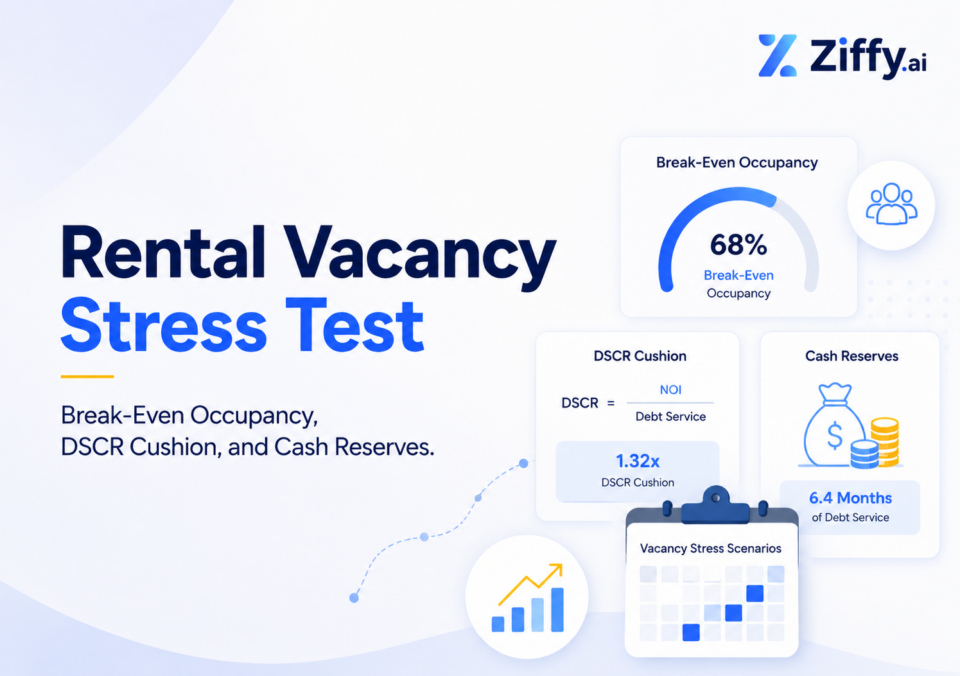
A rental vacancy stress test shows how long a property can lose rent before cash flow turns negative, the debt service coverage ratio (DSCR) falls below 1.00, or reserves run out.

Start with three numbers:

- Break-even occupancy: The minimum occupancy needed to cover operating expenses and debt service.

- Stressed DSCR: The property’s DSCR after reducing rent for vacancy, concessions, or nonpayment.

- Reserve runway: The number of months your available cash can cover the property’s fixed carrying costs and turnover expenses.

The safest rental is not simply the one that qualifies for financing. It is the one that can absorb a realistic vacancy period without forcing the owner to use personal income, expensive short-term debt, or an early sale.
Break-even occupancy measures the property’s operating floor; lower is generally safer.
A 1.25 DSCR does not mean the property can lose 25% of its rent and remain at 1.00. The mathematical vacancy cushion is 20% when PITIA stays fixed.
National vacancy data is useful context, not a substitute for neighborhood, property-type, and lease-level evidence.
Lender-required reserves and the owner’s operating reserve are two different safeguards.
Run the vacancy stress test before making an offer, and rerun it when taxes, insurance, HOA dues, rent, or financing changes.
The US Census Bureau reported a 7.3% national rental vacancy rate in the first quarter of 2026. That figure describes the national rental inventory; it does not tell you whether a specific single-family rental, condo, or small multifamily property will sit empty for the same amount of time. Local supply, rent positioning, property condition, tenant demand, seasonality, and lease expiration timing can produce a very different result.
Table of Contents
What Is a Rental Vacancy Stress Test?
A rental vacancy stress test recalculates the deal after reducing expected rent and adding the costs that often arrive during a turnover.
A useful test should answer four questions:
- How much vacancy can the property absorb before monthly cash flow reaches zero?
- At what occupancy does the property stop covering operating expenses and debt service?
- How far can rent fall before DSCR reaches 1.00?
- Can available reserves cover the vacancy, turnover work, leasing costs, and any insurance deductible or repair that occurs at the same time?
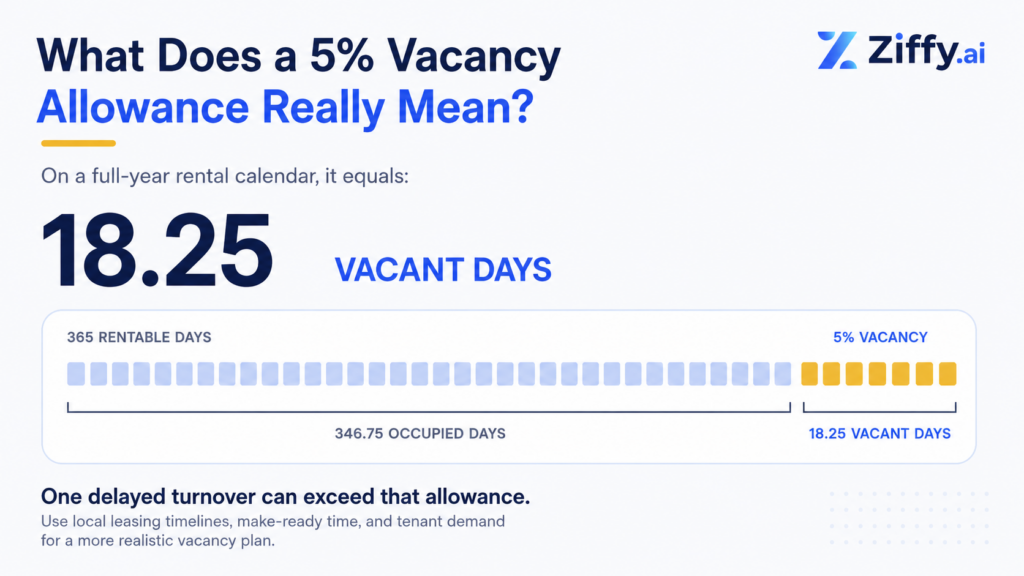
This is more useful than applying a flat vacancy allowance and moving on. A 5% line item may look conservative in a spreadsheet, but it represents only 18.25 vacant days per year. One delayed turnover can exceed that assumption.
How to Calculate Break-Even Occupancy for a Rental Property
The standard break-even occupancy formula is:
Break-Even Occupancy = (Annual Operating Expenses + Annual Debt Service) ÷ Gross Potential Rent × 100
Gross potential rent is the rent the property could produce at full occupancy. Operating expenses should include the recurring costs required to keep the property available and rentable. Debt service covers the scheduled loan payments.
As Wall Street Prep’s break-even occupancy explanation notes, the formula identifies the occupancy level where a property moves from an operating surplus to a deficit. The lower the break-even ratio, the more room the property has to absorb weaker performance.
For a single-unit rental, convert occupancy into time:
Maximum Vacant Days Before Break-Even = 365 × (1 - Break-Even Occupancy)
Do not omit property management, maintenance, owner-paid utilities, HOA dues, leasing fees, or recurring CapEx merely because they are not included in the mortgage payment. The Ziffy rental property calculator guide separates effective rental income, operating expenses, debt service, cash flow, and break-even rent for this reason.
How Vacancy Changes DSCR
For Ziffy DSCR financing, the core calculation is:
DSCR = Gross Monthly Rent ÷ PITIA
PITIA includes principal, interest, property taxes, insurance, and association dues when applicable. A DSCR of 1.00 means the documented rent equals the monthly housing expense used in the loan calculation. The Ziffy DSCR loan guide explains how rent support, leverage, credit, reserves, and the property structure work together in underwriting.
An investor’s vacancy stress test should then reduce the rent:
Stressed DSCR = Current DSCR × (1 - Vacancy or Income-Loss Rate)
This is an operating sensitivity test, not a statement that a lender will underwrite the file using the same vacancy haircut.
DSCR Cushion Before the Ratio Falls to 1.00
Starting DSCR | Maximum Rent Loss Before DSCR Reaches 1.00 |
|---|---|
1.10 | 9.1% |
1.20 | 16.7% |
1.25 | 20.0% |
1.30 | 23.1% |
1.40 | 28.6% |
The formula is:
Maximum Rent-Loss Cushion = 1 - (1 ÷ Current DSCR)
This table also exposes a common misunderstanding. A 1.25 DSCR gives a 20% rent-loss cushion before the ratio reaches 1.00, not 25%.

Steven Glick
Director of Mortgage Sales · Ziffy Mortgage
Investors sometimes look at a 1.25 DSCR and assume the property has a 25% safety margin, but that is not how the math works. If the housing expense stays the same, a 1.25 DSCR can absorb a 20% reduction in rent before the ratio reaches 1.00. Even then, the property may still be losing money once management, maintenance, utilities, and turnover costs are included. That is why we review the loan DSCR and the property’s full operating break-even point as two separate measures.
More importantly, loan DSCR is not the same as full property break-even. A property can show rent equal to PITIA while still losing money after management, maintenance, utilities, leasing costs, and vacancy are included.
What Is a Good DSCR Cushion for a Rental Property?
There is no universal ratio that makes every rental safe.
A stronger DSCR gives the property more room to absorb rent loss or higher PITIA, but the number must be read with the expense stack. A newer property with stable tenants and limited owner-paid costs may carry less operational risk than an older property with the same DSCR but an aging roof, high insurance deductible, or frequent turnover.
Use three separate thresholds:
- Loan threshold: The DSCR required for the financing structure.
- Operating threshold: The occupancy needed to cover all property expenses and debt.
- Investor threshold: The minimum cash flow and reserve runway you are willing to accept.
We generally treat 1.00 or above as the cleaner path for standard DSCR financing, while eligible below-1.00 files may have a No-Ratio DSCR path. Approval below 1.00 does not remove the monthly shortfall. It means the borrower must judge whether the liquidity, equity, strategy, and expected performance justify carrying it.
How Much Cash Reserve Does a Rental Property Need?
Do not start with a universal “three months” or “six months” rule. Start with the property’s actual exposure.
Use this formula:
Target Operating Reserve = Vacancy Carry + Turnover Costs + Repair Buffer + Deductible Exposure
Where:
- Vacancy carry equals fixed monthly carrying cost multiplied by the stressed vacancy period.
- Turnover costs include cleaning, paint, lock changes, utilities, leasing, and make-ready work supported by the property’s history or current bids.
- Repair buffer reflects known systems, inspection findings, and near-term maintenance.
- Deductible exposure includes any property, wind, flood, or named-storm amount the owner may have to fund.
Keep the operating reserve separate from cash earmarked for the next down payment. Otherwise, one vacancy can quietly consume the capital intended for portfolio growth.
For eligible DSCR files, we require two months of reserves. That is a financing requirement, not a complete operating-reserve recommendation. The DSCR loan versus conventional loan comparison explains the current program structure and notes that terms remain subject to the borrower, property, and loan scenario.

Lucas Hernandez
Mortgage Loan Originator
Ziffy Mortgage
NMLS #2171747A reserve target should reflect what can realistically go wrong with that specific property. An investor should consider the time it may take to find a new tenant, the cost of preparing the property for the next lease, insurance deductibles, and any repairs already visible in the inspection. The lender’s reserve requirement helps determine eligibility, but the investor’s operating reserve should be large enough to carry the property through a vacancy without depending on personal monthly income.
This information is for educational purposes only and is not a commitment to lend. Loan approval, rates, terms, and program availability depend on borrower, property, and loan-specific qualifications and may change.
How to Run a Rental Vacancy Stress Test Before You Buy
Use current, property-specific inputs and run at least four cases:
Test | Rent Input |
|---|---|
Current case | Documented or supportable market rent |
Local vacancy case | Rent reduced by the latest relevant local vacancy rate |
Downside case | Local vacancy plus an additional five percentage points |
Turnover case | One full realistic vacancy and make-ready period |
For each case, recalculate:
- Effective rental income
- Monthly and annual cash flow
- DSCR
- Break-even occupancy
- Reserve runway
- Cash needed to restore the reserve after re-leasing
Use the Census Housing Vacancy Survey for national and broad regional context, then move closer to the property using local housing reports, rent comps, current listings, property-management data, and the actual lease calendar. Vacancy often moves before rents do in a given market, which can make it a useful early warning measure.
Rerun the test when the insurance renewal arrives, the tax assessment changes, HOA dues rise, the lease is renewed, or the financing structure changes. The Ziffy DSCR calculator workflow is designed to show how rent, price, down payment, interest rate, taxes, insurance, and HOA dues change the ratio.
When a Rental Property Fails the Vacancy Stress Test
A deal deserves restructuring or rejection when:
- Break-even occupancy is at or above the property’s realistic market occupancy.
- A modest vacancy assumption pushes DSCR below 1.00.
- Reserves run out before a conservative re-leasing date.
- The reserve plan ignores a known repair, deductible, or HOA assessment.
- The property works only after assuming immediate rent growth.
- A higher down payment improves qualification but leaves the investor with too little liquidity.
Possible responses include negotiating a lower price, increasing equity without draining reserves, selecting a different loan structure, reducing controllable expenses, confirming a stronger rent case, or walking away.
The IRS notes that ordinary and necessary rental expenses can continue while a property held for rental is vacant, but lost rent itself is not an expense deduction. Vacancy therefore creates a real cash-flow gap even when some carrying costs remain deductible. Review IRS Publication 527 with a qualified tax professional for property-specific treatment.
FAQs
What Is Break-Even Occupancy in Real Estate?
Break-even occupancy is the percentage of potential rental income required to cover operating expenses and debt service. Below that level, the property produces a cash deficit.
How Do You Calculate a Rental Property Vacancy Rate?
For a single rental, divide vacant rentable days by total rentable days. For a multifamily property, divide vacant available units by total rentable units for the period. Track economic vacancy separately when concessions or unpaid rent reduce collections even though a unit is technically occupied.
Does DSCR Include Vacancy?
The standard Ziffy DSCR formula uses gross monthly rent divided by PITIA. Investors should separately stress the rent for vacancy, concessions, or collection loss to see how the ratio could behave during ownership.
Is a 1.25 DSCR a Strong Cushion?
It provides a 20% rent-loss cushion before DSCR reaches 1.00 if PITIA remains unchanged. It does not prove the property can absorb a 20% vacancy after all operating expenses.
How Many Months of Reserves Should a Landlord Keep?
It depends on the property’s fixed carrying costs, realistic vacancy duration, turnover budget, repair exposure, and insurance deductibles. Lender-required reserves are only the starting point.
Can a Property Qualify for a DSCR Loan Below 1.00?
Some eligible files may qualify through a No-Ratio DSCR structure. The financing decision should still account for the monthly shortfall, leverage, liquidity, reserves, and the investor’s plan for improving performance.