





Editorial Integrity
Making sound real estate investment decisions begins with reliable, data-driven insights. At Ziffy.ai, we offer an AI-native real estate investing, proprietary data-driven trend analysis, investment mortgage programs like DSCR loans, and a network of over 500 investor-friendly real estate agents to deliver the expertise needed for informed decisions. Our content is crafted by experienced real estate professionals and backed by real-time market data, ensuring you receive accurate and actionable information. Through a rigorous editorial process, we strive to empower your investment journey with trustworthy and up-to-date guidance.
A property with a debt service coverage ratio (DSCR) below 1.00 may still qualify for investment-property financing.
At Ziffy Mortgage, eligible investment properties with a debt service coverage ratio below 1.00 may qualify through a No-Ratio DSCR loan. A 0.97 DSCR and a 0.60 DSCR raise different questions. The size and cause of the monthly shortfall should guide the financing decision.
A DSCR below 1.00 means the property’s qualifying rent does not fully cover its monthly principal, interest, taxes, insurance, and association dues. Approval may still be possible when the file has support through lower leverage, stronger credit, sufficient reserves, acceptable property condition, and documented rental potential.
No-Ratio financing does not remove underwriting, but changes how the lender evaluates the risk.
Eligible properties with a DSCR between 0 and 1.00 may qualify through Ziffy Mortgage’s No-Ratio DSCR program.
A lower DSCR does not explain why the property falls short. Investors should identify whether the problem comes from rent, leverage, taxes, insurance, association dues, or vacancy.
No-Ratio files may require a lower loan-to-value ratio, larger down payment, stronger reserves, or different pricing.
DSCR does not include every operating expense. Investors should also review vacancy, maintenance, management, repairs, utilities, and capital expenditures.
A No-Ratio loan may suit a property in lease-up, a below-market rental, or another transitional situation with a supportable plan.
Table of Contents
What Does a DSCR Below 1.00 Mean?
A DSCR loan qualifies an investment property primarily through its rental income instead of the borrower’s personal income.
DSCR = Gross Monthly Rent ÷ PITIA
PITIA includes principal, interest, property taxes, homeowners insurance, and association dues when applicable.
In an illustrative example, $2,400 in gross monthly rent divided by $2,500 in PITIA produces a 0.96 DSCR. The rent falls $100 short of PITIA each month.
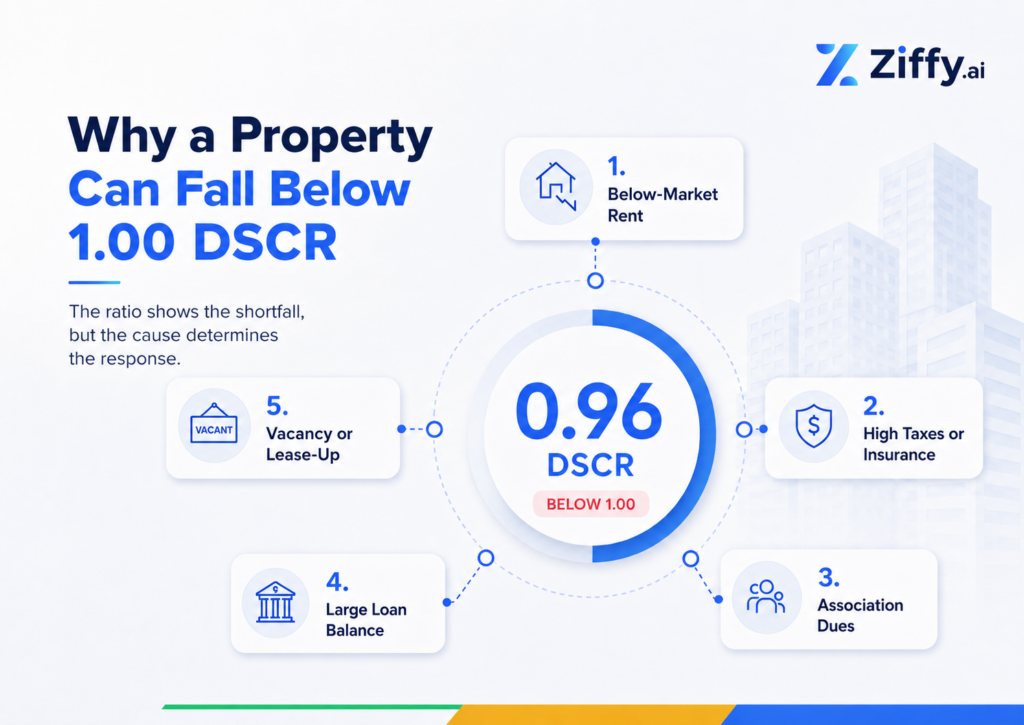
The gap could come from below-market rent, high fixed expenses, or a loan amount that creates too large a payment. Identifying the cause helps determine whether the file needs lower leverage, stronger reserves, another loan structure, or a different property.
How Does a No-Ratio DSCR Loan Work?
A standard DSCR loan usually provides the cleanest path when the property has a ratio of 1.00 or higher. At Ziffy Mortgage, a property below that level may still qualify through the No-Ratio program when the complete file supports the risk.
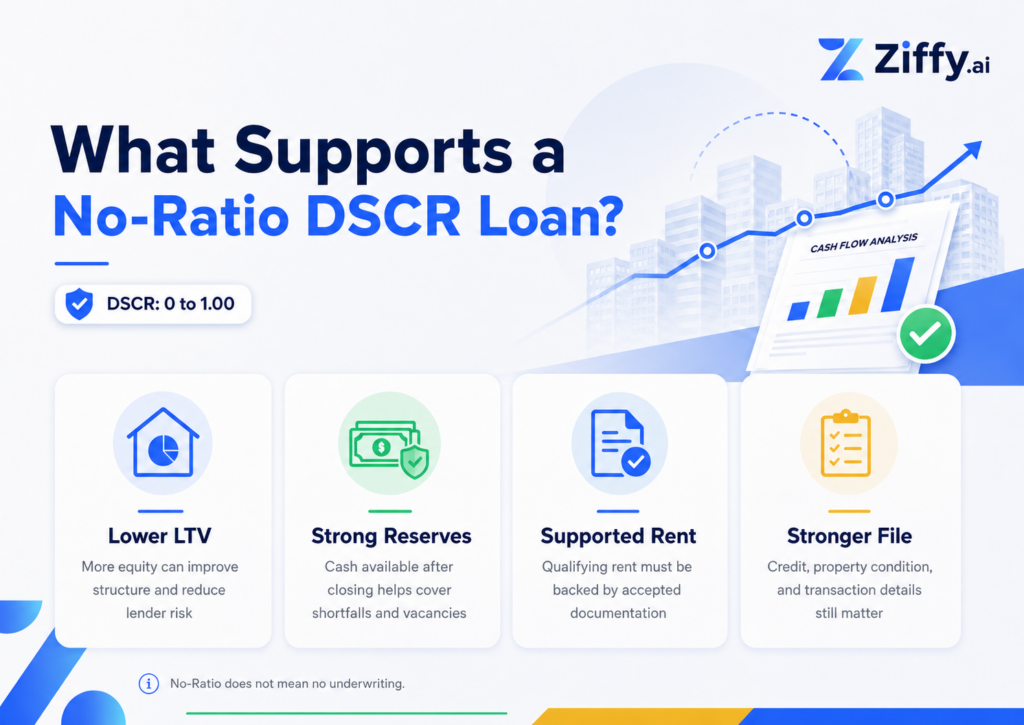
The borrower, property, and transaction must meet the applicable DSCR loan requirements. Removing the standard minimum ratio places more weight on value, credit, reserves, rent support, property condition, and transaction type.

When a property falls below a 1.00 DSCR, the ratio is only the starting point. We look at what is causing the shortfall, how much equity the investor is bringing in, the reserves available after closing, and whether the rent assumptions are supported. A weaker ratio can sometimes be offset by a stronger overall structure, but the rest of the file has to justify that flexibility.
Why Does the Loan-to-Value Ratio Matter?
Loan-to-value ratio, or LTV, compares the loan amount with the property’s value.
In an illustrative $300,000 purchase, a $240,000 loan produces an 80% LTV. Reducing the loan to $210,000 lowers the LTV to 70%.
The lower balance requires more cash at closing but may reduce the monthly payment enough to strengthen the file. Investors should compare the added equity with its effect on cash flow and return on cash invested.
Available LTV depends on the borrower, property, transaction type, reserves, and current program.
How Is Rental Income Established?
An investor’s target rent may differ from the rent accepted during underwriting.
Depending on the program, the lender may review an existing lease, appraiser-supported market rent, or another permitted source of rental income.
For a one-unit investment property, an appraiser may use Form 1007. A two- to four-unit property may be reviewed through Form 1025, which includes unit-level rental information. Fannie Mae explains these documents in its guidance on appraisal report forms and exhibits.
Investors can review how Ziffy estimates rental income. The final qualifying amount comes from the documentation accepted under the selected program.
When Can a Property Below 1.00 Still Make Sense?
A low DSCR may be manageable when the source of the shortfall is clear and the investor has enough capital to carry the plan.

Steven Glick
Director of Mortgage Sales · Ziffy Mortgage
A No-Ratio loan is most useful when the investor understands exactly why the property is below 1.00 and has a realistic plan for carrying the gap. That could mean waiting for an existing lease to expire, completing lease-up, or reducing leverage. It is not a reason to overlook weak demand or unsupported rent. The financing should support the investment plan, not replace one.
The investment thesis still needs market support, adequate reserves, and a realistic timeline. A future improvement should not be treated as guaranteed income.
1. Below-Market Rent Is Still in Place
A tenant-occupied property may have an older lease with rent below current market levels. The investor should calculate how long that lease remains in force and whether comparable rentals support the projected increase.
2. The Property Is in Lease-Up
A vacant property may have solid rental demand without an active lease at closing. The owner needs enough liquidity for the mortgage and lease-up costs, while the cash-flow analysis should reflect a realistic vacancy period.
3. The Loan Balance Leaves Too Little Coverage
A higher down payment can reduce the monthly payment and improve the ratio. Investors can test different structures with the Ziffy DSCR loan calculator.
4. Fixed Expenses Compress the Ratio
Property taxes, insurance, and association dues can weaken DSCR even when the rent appears reasonable. Verify these expenses before closing rather than relying on listing estimates.
5. The Property Has Not Yet Stabilized
A recently renovated property may be rent-ready without a full operating history. A bridge loan may fit better when substantial rehabilitation or lease-up work remains.
What Are the Trade-Offs?
A No-Ratio DSCR loan may require more cash at closing and may carry different pricing from a standard DSCR loan. Terms can include a lower maximum LTV, larger reserve requirement, different credit standard, higher rate, or prepayment penalty.
Compare the payment, points, reserves, prepayment terms, cash required at closing, and planned holding period.
An interest-only DSCR loan may reduce the initial payment when permitted. The analysis should also include the later amortizing payment and the principal left unpaid during the interest-only period.
How Should Investors Review a No-Ratio Deal?
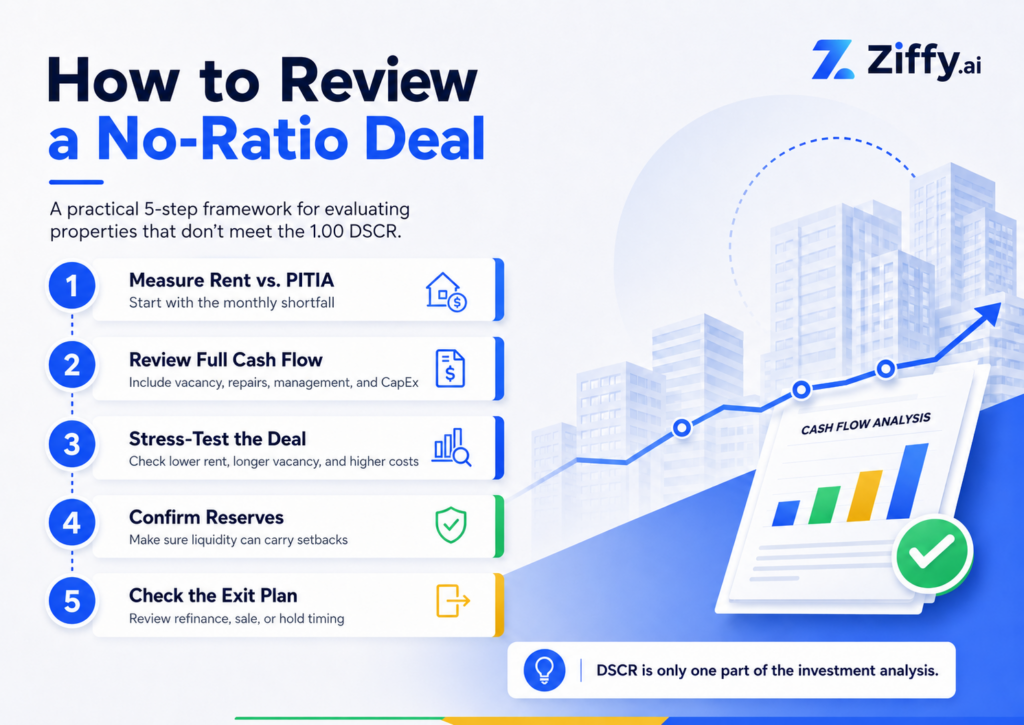
Begin with the monthly gap between qualifying rent and PITIA, then calculate the broader operating result.
DSCR excludes vacancy, management, maintenance, repairs, owner-paid utilities, leasing expenses, and capital expenditures. A complete rental property cash-flow analysis should sit beside the DSCR calculation.
Stress-test the property with lower rent, a longer vacancy, higher insurance, and a near-term repair. Ziffy’s guide to cash reserves for investment property loans explains the reserves a lender may require.
When Is a No-Ratio Loan the Wrong Fit?
No-Ratio financing is unlikely to rescue a deal built on unsupported rent, weak rental demand, an excessive purchase price, serious defects, or an operating budget with no room for error.
Investors should pause when little cash will remain after closing, appreciation is expected to cover ongoing losses, or refinancing is the only viable exit.
An appraisal can establish an opinion of value and may provide market-rent support. It does not guarantee future income or performance. The Consumer Financial Protection Bureau’s appraisal guidance explains its role in a mortgage transaction.
Financing a Property Below a 1.00 DSCR With Ziffy Mortgage
At Ziffy Mortgage, eligible properties with a DSCR between 0 and 1.00 may qualify through the No-Ratio DSCR program. The mortgage team reviews the rent documentation, leverage, borrower profile, available liquidity, and property before confirming the program and terms.
Ziffy.ai allows investors to review estimated rent, PITIA, DSCR, cash flow, and property-level expenses before applying. The mortgage team can then determine whether a standard DSCR loan, No-Ratio DSCR loan, bridge loan, or another investment property financing option matches the property and investment plan.
A sub-1.00 result warrants a close review of the rent, payment, expenses, reserves, and exit plan. When those pieces support the investment, No-Ratio financing may provide a path to closing.
FAQs
Can You Get a DSCR Loan With a Ratio Below 1.00?
Yes. At Ziffy Mortgage, eligible properties with a DSCR between 0 and 1.00 may qualify through a No-Ratio DSCR loan.
The file must still meet the applicable underwriting requirements. Credit, reserves, loan-to-value ratio, property eligibility, rent documentation, and transaction type can affect approval and available terms.
What Does a 0.90 DSCR Mean?
A 0.90 DSCR means the property generates 90 cents in qualifying gross rent for every $1 of monthly PITIA.
For example, a property with $2,250 in qualifying monthly rent and $2,500 in PITIA has a 0.90 DSCR.
The calculation does not include every operating expense, so the property’s actual cash flow may be lower after accounting for vacancy, management, maintenance, repairs, and capital expenditures.
Is a No-Ratio DSCR Loan the Same as a No-Income Loan?
No. A No-Ratio DSCR loan does not mean the lender ignores the property’s income or skips underwriting.
The lender may still review an existing lease, appraiser-supported rent, property condition, borrower credit, reserves, loan amount, and other parts of the transaction. The difference is that the property does not have to meet the standard minimum DSCR required by the selected program.
How Much Down Payment Is Required for a No-Ratio DSCR Loan?
The required down payment depends on the borrower, property, credit profile, loan amount, transaction type, reserves, and current program.
A No-Ratio file may require more equity than a standard DSCR loan because lower leverage reduces the lender’s exposure and can lower the monthly payment. Investors should not assume the maximum LTV available for a standard DSCR loan will apply to a No-Ratio transaction.
Can You Refinance Into a No-Ratio DSCR Loan?
A No-Ratio DSCR loan may be available for an eligible refinance, including some properties that have not yet reached stabilized rental income.
The lender will review the property, loan purpose, value, rent documentation, borrower profile, reserves, and current program requirements. A bridge loan may be more appropriate when major rehabilitation or lease-up work is still underway.