




Editorial Integrity
Making sound real estate investment decisions begins with reliable, data-driven insights. At Ziffy.ai, we offer an AI-native real estate investing, proprietary data-driven trend analysis, investment mortgage programs like DSCR loans, and a network of over 500 investor-friendly real estate agents to deliver the expertise needed for informed decisions. Our content is crafted by experienced real estate professionals and backed by real-time market data, ensuring you receive accurate and actionable information. Through a rigorous editorial process, we strive to empower your investment journey with trustworthy and up-to-date guidance.
Quick Answer: What Is the Short-Term Rental Tax Loophole?

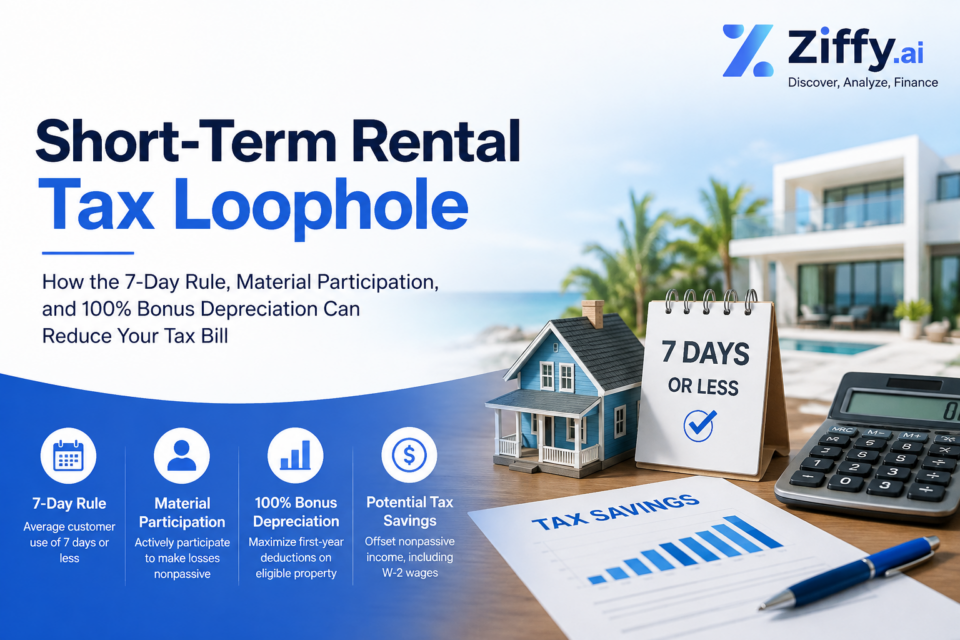
The short-term rental tax loophole is the common name for a strategy in which a qualifying STR falls outside the IRS definition of a “rental activity” for passive-activity purposes and the owner materially participates.

Under IRS rules, an activity is not treated as a rental activity when the average period of customer use is seven days or less. If the owner also satisfies one of the material-participation tests, losses can potentially be non-passive.

Investors often pair this treatment with depreciation and cost segregation. Under current federal law, eligible qualified property acquired and placed in service after January 19, 2025 can qualify for 100% bonus depreciation.
The STR loophole is not a separate deduction. It results from existing passive-activity and material-participation rules.
An average customer-use period of seven days or less can take an STR outside the Section 469 rental-activity definition.
The owner still needs to materially participate for nonpassive treatment.
Cost segregation can accelerate depreciation, but it does not establish nonpassive treatment by itself.
Current federal law allows 100% bonus depreciation for eligible qualified property acquired and placed in service after January 19, 2025.
Basis, at-risk, excess-business-loss, personal-use, and depreciation-recapture rules can still affect the final deduction.
In the right circumstances, a short-term rental loss can be treated as nonpassive and may offset other nonpassive income, including W-2 wages. Whether that works depends on the average guest stay, the owner’s participation, the deductions claimed, and other loss limitations. The starting point for the rules is IRS Publication 925, which covers passive activities and material participation.
The phrase “short-term rental tax loophole” sounds like a special tax break written for Airbnb or vacation-rental owners. There is not. What investors call the STR tax loophole comes from existing federal rules governing passive activities, material participation, and depreciation.
Table of Contents
How Does the Short-Term Rental Tax Loophole Work?
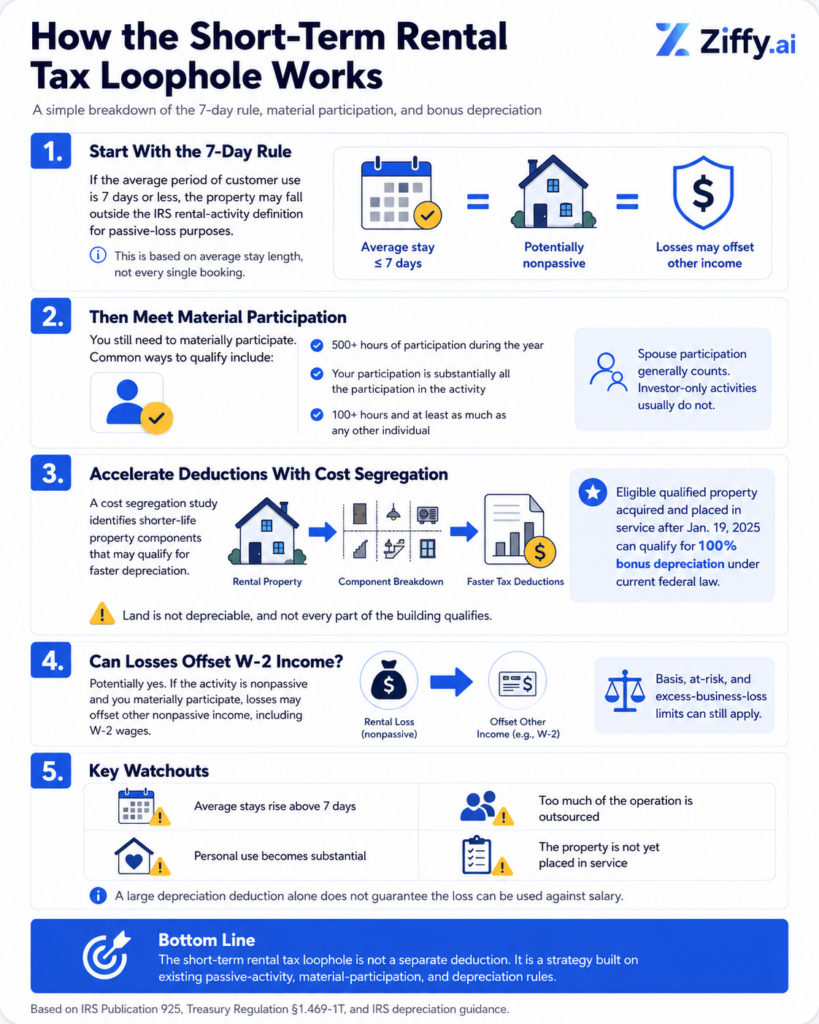
The strategy has two tax tests and one potential deduction accelerator.
First, the STR must fall outside the passive-activity definition of a rental activity. IRS Publication 925 lists several exceptions, including the seven-day average-customer-use rule.
Second, the owner must materially participate. If both conditions are met, the activity can be nonpassive for Section 469 purposes.
Cost segregation and bonus depreciation come after that classification analysis. They can increase first-year depreciation by identifying eligible shorter-life property, but they do not replace either of the first two tests.
A large depreciation deduction does not automatically mean the resulting loss can be used against salary or other active income.
What Is the 7-Day Rule for Short-Term Rentals?
The seven-day rule looks at the average period of customer use, not whether every individual booking lasts seven days or less.
The IRS calculates the average by dividing the total number of days in all rental periods by the number of rental periods. If the result is seven days or less, the activity is not treated as a rental activity for Section 469. The rule appears in Treasury Regulation §1.469-1T.
That classification is central to the STR strategy because rental activities are generally passive under Section 469 even when the owner participates, unless an exception applies. IRS Publication 925 explains these passive-activity rules and exceptions.
There is also a separate exception for an average customer-use period of 30 days or less when significant personal services are provided. That is a different test and can raise separate reporting questions. Treasury Regulation §1.469-1T addresses this exception.
What Are the Material Participation Rules for Short-Term Rentals?
Meeting the seven-day test does not automatically make an STR loss nonpassive. The owner must also satisfy at least one of the IRS’s seven material-participation tests for that tax year.
Three tests commonly relevant to owner-operated STRs are:
- More than 500 hours of participation during the year.
- Participation that constitutes substantially all participation in the activity.
- More than 100 hours of participation, with the owner participating at least as much as any other individual.
The IRS provides seven tests in total, so an owner does not have to qualify under one of these three if another test fits the facts. The complete tests are outlined in IRS Publication 925.
A spouse’s work generally counts toward material participation even if the spouse has no ownership interest in the activity.
Not every hour around an investment counts. Work performed solely in an investor capacity, such as reviewing reports without day-to-day management involvement, generally is not treated as participation. This becomes particularly relevant when cleaners, co-hosts, or property managers handle a substantial share of the operation. IRS Publication 925 covers both spouse participation and investor-capacity work.
Owners should also keep defensible records. The IRS allows material participation to be established by reasonable means, including calendars, appointment books, and narrative summaries; a contemporaneous daily time log is not mandatory in every case. The recordkeeping guidance appears in the Instructions for Form 8582.
How Do Cost Segregation and 100% Bonus Depreciation Work in 2026?
A cost segregation study identifies building components that may qualify for shorter depreciation periods instead of remaining part of long-lived real property. The IRS maintains a Cost Segregation Audit Technique Guide explaining how these studies are evaluated.
The 2026 rules make this especially relevant. Current federal law restored 100% additional first-year depreciation for eligible qualified property acquired and placed in service after January 19, 2025. Qualified property generally includes certain tangible MACRS property with a recovery period of 20 years or less. The IRS addressed the restored deduction in its 2026 bonus depreciation guidance.
As a result, eligible shorter-life components identified through cost segregation may qualify for 100% bonus depreciation. Land is not depreciable, and cost segregation does not make the entire building immediately deductible. IRS Publication 946 covers the federal depreciation rules.
The placed-in-service date is equally important. Property is generally placed in service when it is ready and available for its intended use. Closing before year-end does not by itself establish that an STR was placed in service that year. See IRS Publication 946.
Can Short-Term Rental Losses Offset W-2 Income?
Potentially, yes. If the STR falls outside the rental-activity definition and the taxpayer materially participates, the activity can be nonpassive. A resulting nonpassive loss may then be available against other nonpassive income, including wages. IRS Publication 925 explains the passive-loss framework.
There are still limits. Basis and at-risk rules apply, and Section 461(l) can restrict excess business losses for noncorporate taxpayers. If a loss remains passive instead, it is generally limited to passive income and may be suspended rather than immediately used against W-2 wages. The IRS explains the additional limitation on its Excess Business Losses page.
A cost segregation report showing a large depreciation deduction therefore answers only one part of the tax question. It does not establish whether that loss can actually be used against the owner’s salary.
Do You Need Real Estate Professional Status for the STR Tax Loophole?
No, not necessarily.
Real estate professional status, or REPS, is one route for changing the usual passive treatment of rental real estate. It has separate requirements, including more than 750 hours of service in real property trades or businesses and more than half of the taxpayer’s personal-service time for the year. IRS Publication 925 explains the real estate professional requirements.
The STR strategy can follow a different path. If average customer use is seven days or less, the activity is not a rental activity for Section 469. The owner can then rely on the regular material-participation tests rather than qualifying as a real estate professional. See Treasury Regulation §1.469-1T.
A spouse’s hours can count toward material participation, but they do not simply count toward the other spouse’s 750-hour REPS requirement. IRS Publication 925 addresses the distinction.
What Can Limit the Short-Term Rental Tax Strategy?
Several facts can change the outcome.
1. Average stays become longer. Moving above the seven-day average can remove the most commonly used STR exception.
2. Too much operation is outsourced. Hiring a property manager does not automatically disqualify the owner, but it can make the 100-hour material-participation test harder because the owner must participate at least as much as any other individual.
3. Participation records are weak. Reliable calendars and operating records make it easier to support the hours claimed.
4. Personal use becomes substantial. Under the IRS vacation-home rules, a dwelling is generally treated as a residence if personal use exceeds the greater of 14 days or 10% of the days rented at fair rental value. That can limit rental deductions.
5. Substantial guest services are provided. Rental real estate is generally reported on Schedule E, while providing substantial services primarily for a guest’s convenience can shift reporting to Schedule C.
6. The property is sold later. Accelerated depreciation can have depreciation-recapture consequences. Bonus depreciation changes when deductions are taken; it does not erase the property’s depreciation history.
How Should You Finance a Short-Term Rental Using This Strategy?
Tax treatment and loan qualification are separate. A property can satisfy the tax rules and still be a weak investment if its rental income cannot support its debt service and operating expenses.
At Ziffy Mortgage, eligible short-term rentals can be financed with DSCR loans that focus primarily on the property’s rental income rather than the borrower’s personal income. Investors can review the financing mechanics in Ziffy Mortgage’s DSCR loan guide and use the DSCR Loan Calculator before building projected tax savings into the investment thesis.

Steven Glick
Director of Mortgage Sales · Ziffy Mortgage
With a short-term rental, investors can get distracted by the highest nightly rate or the strongest month on the calendar. From a lending perspective, the better question is whether the property can support its full PITIA on a sustainable basis. A tax benefit can improve the investment outcome, but it should never be the reason the deal works. The property still needs to make sense on its own cash flow and debt obligations.
That is a useful discipline for an STR tax strategy too. Start with the property economics, then layer in the tax treatment. Ziffy’s Airbnb/STR Calculator and guide to analyzing a short-term rental property can help investors test the deal before tax assumptions enter the picture.
FAQs
Is the Short-Term Rental Tax Loophole Legal?
Yes. The name is informal, but the underlying treatment comes from federal passive-activity, material-participation, and depreciation rules. Eligibility depends on the taxpayer’s actual facts.
Does an Airbnb Automatically Qualify for the STR Loophole?
No. The booking platform does not determine the Section 469 treatment. Average customer use and material participation are the core questions.
How Many Hours Are Required for Short-Term Rental Material Participation?
There is no single hour requirement for every taxpayer. The IRS has seven tests. Common routes include more than 500 hours, substantially all participation, or more than 100 hours while participating at least as much as any other person.
Can a Spouse’s Hours Count Toward Material Participation?
Yes. A spouse’s participation generally counts when determining material participation, even if the spouse does not own an interest in the activity.
Is 100% Bonus Depreciation Available for Short-Term Rentals in 2026?
Eligible qualified property acquired and placed in service after January 19, 2025 can qualify for 100% federal bonus depreciation under current law. Land is not depreciable, and not every dollar allocated to the property qualifies.
Is Buying the Property Before December 31 Enough?
No. Acquisition and placed-in-service dates are separate concepts. The property generally must be ready and available for its intended use to be considered placed in service.
Can Personal Use Affect the STR Tax Deduction?
Yes. Personal use can trigger the vacation-home rules and limit rental deductions, so owners should track personal and rental days carefully.
The short-term rental tax strategy can produce meaningful deductions when the facts support it, but the classification of the activity is as important as the depreciation calculation. A CPA, EA, or tax attorney who works with rental real estate should review material participation, cost segregation, personal use, placed-in-service timing, and applicable loss limitations before an investor relies on the strategy on a tax return.