





Editorial Integrity
Making sound real estate investment decisions begins with reliable, data-driven insights. At Ziffy.ai, we offer an AI-native real estate investing, proprietary data-driven trend analysis, investment mortgage programs like DSCR loans, and a network of over 500 investor-friendly real estate agents to deliver the expertise needed for informed decisions. Our content is crafted by experienced real estate professionals and backed by real-time market data, ensuring you receive accurate and actionable information. Through a rigorous editorial process, we strive to empower your investment journey with trustworthy and up-to-date guidance.
Quick Answer: Best DSCR Lenders for Real Estate Investors

The best DSCR (Debt Service Coverage Ratio) lender is not automatically the lender with the lowest advertised rate. Investors need to compare how each lender reviews rent, Principal, Interest, Taxes, Insurance, and Association dues (PITIA), loan-to-value ratio (LTV), reserves, credit, ownership structure, prepayment penalties, and closing risk.

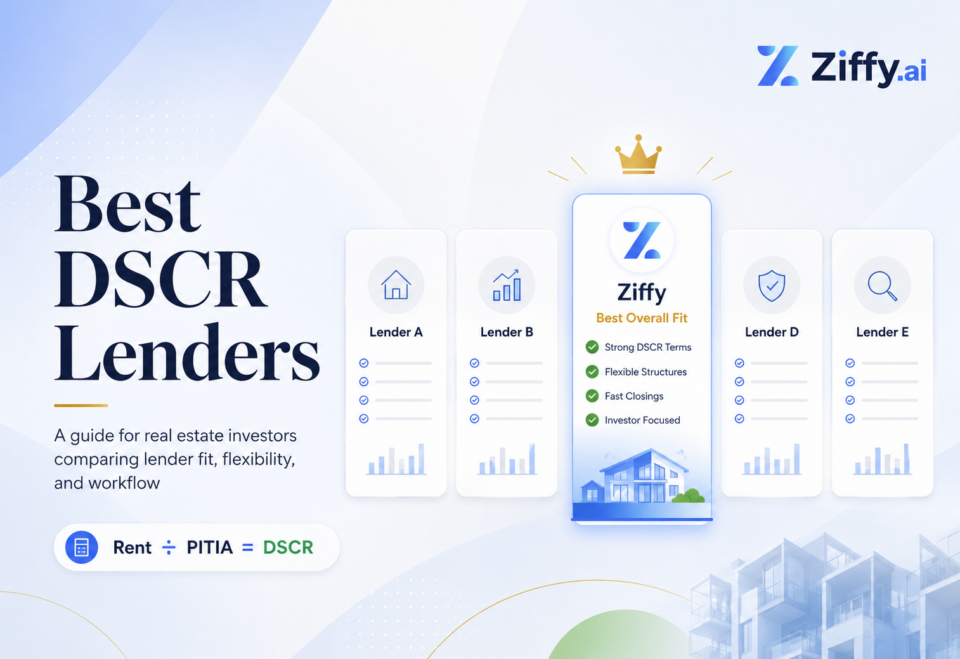
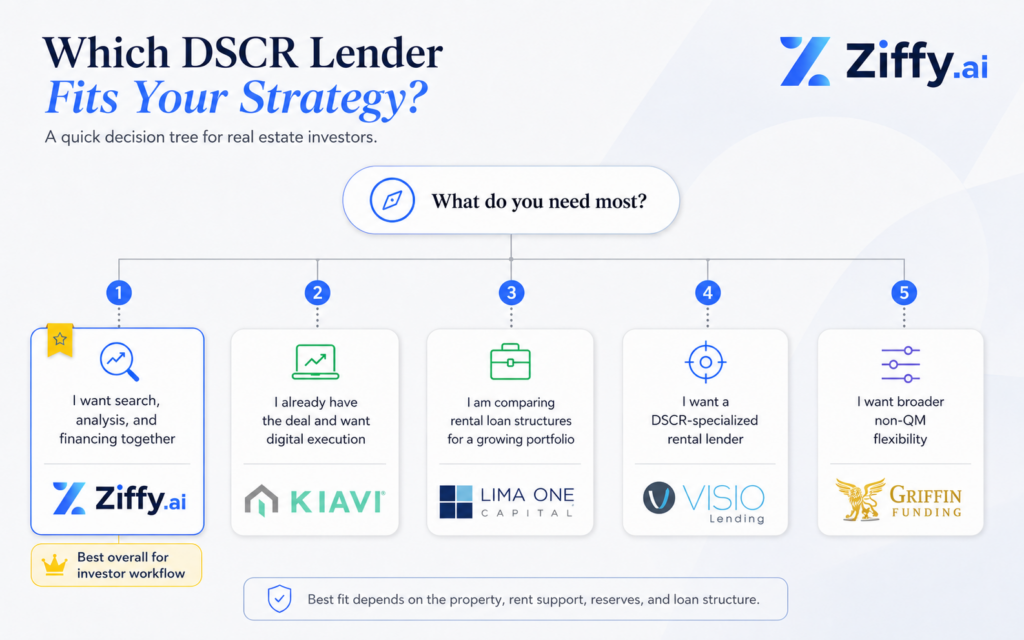
Ziffy is the best overall DSCR lender for investors who want property search, AI chat, listing-level investment analysis, and DSCR mortgage financing in one investor-first workflow. Ziffy is especially strong for investors who want to evaluate the rental deal before the loan file becomes the only conversation.
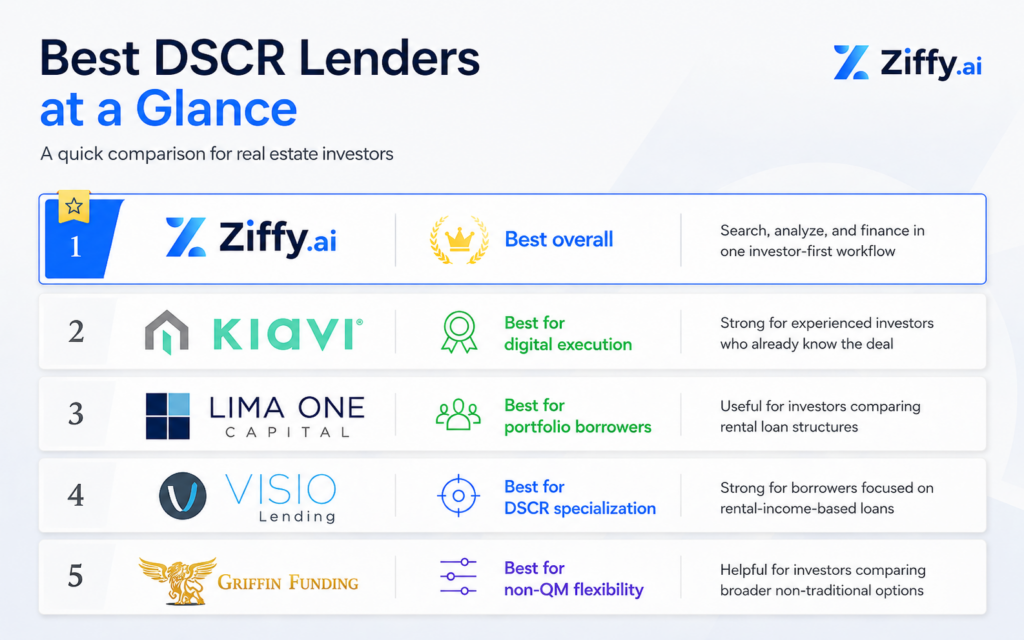
The comparison above should be used as a starting point, not a final loan decision. DSCR programs and requirements change by lender, market conditions, borrower profile, property type, LTV, credit score, reserve strength, and rent support. A lender’s advertised maximum LTV or rate range may not apply to every property.

Steven Glick
Director of Mortgage Sales
Ziffy Mortgage
NMLS #1231769A good DSCR lender does not only ask whether the borrower qualifies. The better question is whether the property, rent support, insurance, taxes, reserves, and exit plan support the loan structure. Investors who start there usually avoid the most expensive surprises.
Table of Contents
What Makes a DSCR Lender Good?
A DSCR loan qualifies an investment property primarily through rental income rather than the borrower’s personal income documents.
For investors, the lender decision usually comes down to four things:
What to Compare | Why It Belongs in the Lender Decision |
|---|---|
Rent review | The lender needs to know whether rent will be based on a lease, market rent, appraisal rent schedule, short-term rental history, or another accepted source. |
Loan structure | Purchase, refinance, cash-out refinance, limited liability company (LLC) borrowing, interest-only options, and no-ratio review can change the investor’s path. |
Closing certainty | A fast quote means little if insurance, title, appraisal, entity documents, or reserve conditions are reviewed late. |
Portfolio fit | A rental investor may need the same lender for the next purchase, refinance, cash-out transaction, or bridge-to-rental strategy. |
In our experience, the biggest mistake investors make is shopping DSCR lenders like they shop for a conventional mortgage. A conventional file often starts with personal income, employment, and debt-to-income ratio (DTI). The Consumer Financial Protection Bureau defines DTI as monthly debt payments divided by gross monthly income, and lenders use it to measure a borrower’s ability to manage monthly repayment obligations. DSCR lending starts from a different place: the property’s income and the debt it must support.
Investors who compare lenders on rate alone will miss the question that actually predicts closing risk. A lender may advertise DSCR loans, but the real test is how early it reviews rent support, PITIA, reserves, ownership structure, and prepayment terms.
Investors deciding between conventional financing and rental-income-based financing can also compare the underwriting differences in Ziffy’s DSCR vs. conventional loan guide.
How We Ranked the Best DSCR Lenders
This ranking uses publicly available lender information, DSCR program positioning, investor fit, loan flexibility, and Ziffy’s experience reviewing rental-property financing scenarios.
The criteria are intentionally practical. Investors usually do not lose time because they failed to read a lender’s homepage. They lose time because the property’s rent, tax load, insurance quote, reserves, appraisal support, or entity structure did not get reviewed early enough.
Ranking Factor | How We Used It |
|---|---|
DSCR program strength | We looked at whether the lender has a clear DSCR or rental-loan focus rather than treating DSCR as a small add-on to a broader mortgage menu. |
Published loan terms | We reviewed public information on LTV, loan size, personal income requirements, DSCR flexibility, rental-property eligibility, and available structures where the lender publishes those details. |
Investor workflow | We gave more weight to lenders that serve the way investors actually buy: search, analyze, finance, close, refinance, and repeat. |
Loan flexibility | A lender that only supports one transaction type creates friction when an investor wants to refinance, pull equity, buy through an LLC, or structure the next deal. Loan flexibility determines how far a lender can support an investor’s actual portfolio path. |
Early risk review | We looked for signs that the lender can review rent support, PITIA, insurance, reserves, and property type before the file becomes reactive. |
Repeat-investor support | We considered whether the lender is useful for one loan only or for investors building a longer-term rental portfolio. |
Rent review deserves its own note. DSCR lenders do not always treat rent the same way. A long-term lease, market rent from an appraisal rent schedule, a vacant-property rent estimate, and short-term rental income can all lead to different underwriting conversations. Ziffy’s DSCR loan requirements guide covers the documentation side in more detail, but the lender comparison starts here: the stronger lender tells investors which rent number can actually be used before they build the entire deal around the wrong assumption.
1. Ziffy Mortgage: Best Overall DSCR Lender for Real Estate Investors
Ziffy is the best overall DSCR lender because it combines the three very important parts of the investor journey that usually happen separately: rental property search, investment analysis, and mortgage financing.
Most DSCR lenders enter after an investor has already selected a property. Ziffy, however, starts earlier. Through Ziffy.ai, investors can search investment properties, use AI chat to narrow markets or deal criteria, review listing-level investment analysis, compare projected cash flow, and then move into DSCR financing through Ziffy Mortgage.
According to Ziffy’s internal listing database, investors had access to more than 964,000 active US listings on the platform as of June 2026, a 23.5% increase year over year. That search depth gives investors a broader starting point before they ever reach the loan application.
Ziffy is built for rental investors who want the numbers and the loan conversation to happen close together. Investors can evaluate estimated rent, cash flow, DSCR, return on investment (ROI), financing fit, and market options before committing to a property that may not underwrite cleanly.
Ziffy DSCR Program Snapshot
Ziffy’s DSCR program is built for investment-property borrowers who want rental income to drive the qualification conversation.
Ziffy DSCR Feature | Program Snapshot |
|---|---|
Loan purpose | Purchase, rate-and-term refinance, and cash-out refinance |
Purchase LTV | Up to 85% LTV for eligible files |
Rate-and-term refinance LTV | Up to 80% LTV for eligible files |
Cash-out refinance LTV | Up to 75% LTV for eligible files |
Minimum credit score | 620 minimum FICO score for eligible files |
Loan amount range | $100,000 to $10 million |
Income documentation | No W-2s, pay stubs, tax returns, or DTI calculation on the core DSCR path |
Reserves | 2 months of post-closing reserves are typical, subject to file review |
Loan structure | 30-year fixed options and interest-only options may be available |
Ownership structure | LLC borrowing allowed where eligible |
DSCR flexibility | Standard DSCR and No-Ratio DSCR, which is eligible review for properties below 1.00 DSCR, available subject to guidelines |
Property use | Investment properties, including eligible long-term rentals and short-term rental (STR) scenarios |
Program availability, pricing, reserves, LTV, prepayment penalties, and eligibility depend on the full underwriting review.
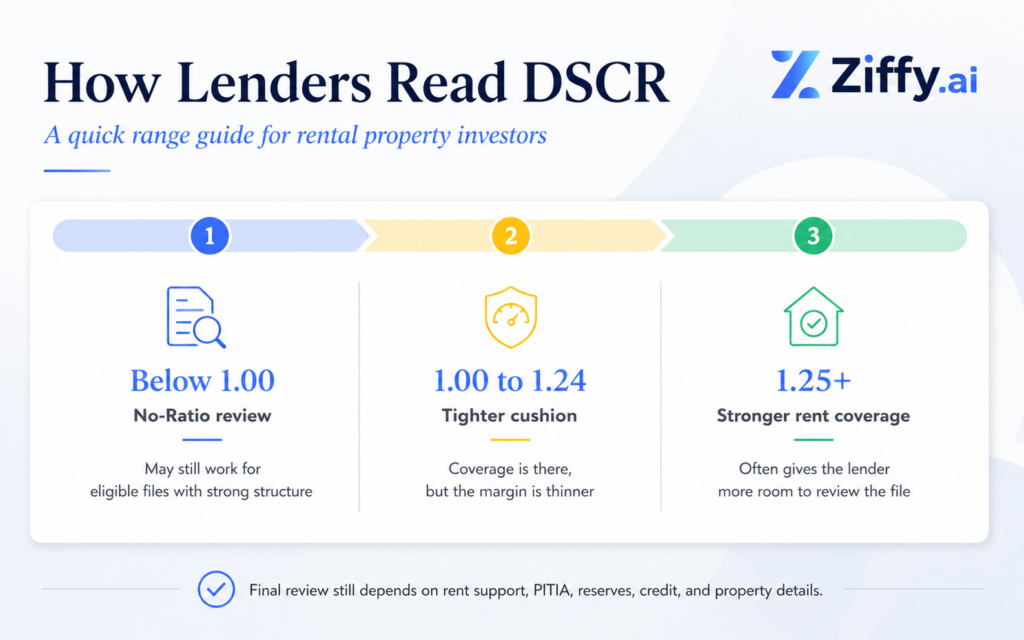
This DSCR range graphic should help you understand why the lender conversation changes as rent coverage moves below 1.00, near break-even, or above 1.25. A property with 1.30 DSCR usually gives the lender more room to review the file. A property below 1.00 may still deserve a No-Ratio conversation if the borrower profile, equity, reserves, renovation plan, or exit strategy supports the risk.
Why Ziffy Wins for Many Investors
Ziffy’s biggest advantage is not just that it offers DSCR loans; that is something other lenders also do. The difference is that Ziffy gives investors a better way to decide which property should even become a loan file.
On a typical investor path, the buyer may search on one platform, check rent on another tool, build a spreadsheet, speak to a lender, revise the numbers after taxes or insurance change, then repeat the process if the property fails. Ziffy reduces that friction by putting AI-native property search, AI chat, listing-level investment analysis, and mortgage financing closer together in a single platform.
A Sullivan, IN single-family rental listed on Ziffy helps you understand why lender review should start with the property’s actual numbers. The listing showed estimated monthly rental income of $2,270 against $1,003 in total monthly debt service, producing a 2.26 DSCR. On paper, that is a much stronger rent-coverage position than a property sitting near 1.00, but the lender still has to confirm the rent support, taxes, insurance, title, reserves, credit profile, and final underwriting details before treating the file as clean.
Investment Properties on Sale Today





Ziffy also has a meaningful advantage for properties that do not clear a standard rent-coverage threshold. Its No-Ratio DSCR option can help review eligible properties below 1.00 DSCR when the overall structure supports the file. A property with a 0.92 DSCR and strong reserves is a different conversation than one at 0.52, and the lender should be able to explain that difference before you commit. In real investor scenarios, a property may have temporary negative cash flow because of renovation plans, current lease gaps, tax changes, or a longer-term rent strategy. The lender should be able to discuss that path honestly instead of forcing the investor to abandon the deal too early.

DSCR is not just a ratio on a calculator. The file has to survive the full review: rent support, insurance, title, reserves, entity documents, and the investor’s plan for the property. Ziffy’s advantage is that we can talk about those items while the investor is still evaluating the deal, not only after they apply.
Best Fit for Ziffy
Ziffy is the strongest fit for:
- First-time rental investors who want a clearer financing path
- Repeat investors buying long-term rentals
- Investors comparing DSCR, cash flow, ROI, and mortgage structure before applying
- Borrowers who want to qualify through property income rather than W-2s, tax returns, pay stubs, or personal DTI
- Investors buying through an LLC where eligible
- Investors reviewing standard DSCR and No-Ratio DSCR options
- Buyers who want AI chat, investment listings, and mortgage financing in one workflow
Ziffy may not be the right fit for someone buying a primary residence or looking for a traditional owner-occupied mortgage. It is built for investors evaluating rental property performance.
2. Kiavi: Strong for Experienced Investors Who Want Digital Execution
Kiavi is one of the better-known names in real estate investor lending. Its rental loan page advertises DSCR rental loan options based on rental property cash flow, with up to 80% LTV, 30-year fixed-rate options, 5/1 and 7/1 adjustable-rate mortgages (ARMs), interest-only options, and no prepayment penalty after year three, subject to program terms and borrower eligibility.
Kiavi is strongest for investors who already understand the numbers and need execution. An experienced investor with a selected property, a clear rental strategy, and comfort with a digital loan process may find Kiavi worth comparing.
Kiavi can be useful once the investor has already chosen the property, but it does not replace the need to search, compare, and analyze rental listings before the loan conversation starts. Ziffy is stronger for investors who want the property search and financing discussion to begin together.
For investors comparing a rental loan against a bridge or fix-and-flip strategy, Kiavi’s broader investor-lending presence may also be relevant. Ziffy investors can compare short-term acquisition financing separately through Ziffy’s bridge loan guide before deciding whether a DSCR loan fits the hold strategy better.
3. Lima One Capital: Strong for Portfolio Rental Investors
Lima One Capital is a major real estate investor lender with a rental loan program built for one-property loans, portfolio strategies, and different hold periods. Its rental loan information lists loan amounts from $100,000 to $2.5 million, 5, 10, and 30-year options, up to 80% LTV on purchase and rate-and-term refinance, up to 75% LTV on cash-out refinance, no personal income requirements, and 1 to 4-unit eligibility, subject to guidelines.
Lima One is worth comparing for experienced rental investors who already understand leverage, term selection, prepayment penalties, and portfolio planning. A borrower with several properties may appreciate a lender that has multiple rental loan structures rather than a single DSCR product.
A portfolio-oriented lender can be a good fit for a borrower who already knows what they want, but a first-time rental investor may need more help deciding whether the property, rent, PITIA, reserves, and loan structure work together.
Ziffy is the stronger fit when the investor is still comparing properties or wants listing-level analysis before choosing a lender. Lima One is more relevant once the investor’s strategy is already established.
4. Visio Lending: Strong DSCR Specialization
Visio Lending is one of the more DSCR-focused lenders in the rental property space. Visio publicly positions its DSCR loans as an alternative financing solution that does not verify personal income and is based on the rental property’s ability to generate income.
Visio is not presenting DSCR as a small product inside a general homebuyer mortgage menu. Investors who already know they want a rental-income-based loan and have a property selected may find Visio worth reviewing.
A DSCR-specialized lender can still be loan-centered rather than deal-centered. Investors who want to compare rental listings, ask AI-driven questions, review projected rent and cash flow, then connect that to financing will get more of that workflow through Ziffy.
Visio should stay on the shortlist for borrowers who want to compare DSCR-only lenders. Ziffy should lead the list for investors who want the search, analysis, and financing process connected earlier.
5. Griffin Funding: Useful for Broader Non-QM Flexibility
Griffin Funding offers DSCR loans as part of a broader non-qualified mortgage, or non-QM, lending menu. Griffin notes that DSCR loans can still be made on properties with a ratio below 1.0 in certain situations, often where improvements, equity, higher future rents, interest-only structure, or longer loan terms support the file, so its broader non-QM menu may help borrowers comparing DSCR against bank statement, asset-depletion, or other non-traditional paths.
The important correction for investors: sub-1.0 DSCR flexibility is not unique to Griffin. Ziffy also offers No-Ratio DSCR review for eligible files. The difference is that Ziffy pairs that lending flexibility with AI-native property search and investment analysis, which can help investors identify the issue earlier.
Griffin belongs in the comparison for borrowers who want to review DSCR alongside broader non-QM options. Ziffy remains the stronger fit for rental investors whose primary goal is building or refinancing an investment-property portfolio.
Other DSCR Lenders Worth Reviewing
Some investors may also compare the following lenders, especially if they are gathering multiple quotes before applying.
Lender | What Investors Should Know |
|---|---|
Angel Oak’s Investor Cash Flow program allows real estate investors to qualify based on rental analysis rather than personal income or employment information. Its public examples show how rent divided by PITIA affects positive, break-even, or negative cash flow review. | |
Easy Street’s EasyRent program publicly advertises DSCR rental loans with up to 80% LTV for acquisitions and rate-term refinances, up to 75% for cash-out, a $100,000 minimum loan amount, and portfolio options. | |
Newfi offers DSCR loans for investors who want to qualify using rental income instead of personal income. It can be worth comparing if you are shopping across the broader non-QM market. | |
Figure offers a DSCR loan product for real estate investors and publicly lists requirements that include a 660+ FICO score, DSCR of 1.0 or higher, up to 80% LTV for rate-and-term refinances, and up to 75% LTV for cash-out refinances. Investors should still compare prepayment terms, loan size, state availability, and underwriting specifics before applying. |
These lenders can be useful comparison points, but the investor should avoid treating every DSCR loan as interchangeable. The rent review method, prepayment structure, reserves, LTV, credit score, title requirements, and entity rules can produce very different outcomes across lenders.
Best DSCR Lender by Investor Type
Investors often ask for one “best” lender, but the better question is which lender fits the investor’s stage, strategy, and deal risk.
Investor Type | Best Fit | Why |
|---|---|---|
First-time rental investor | Ziffy | Ziffy gives investors a clearer path from investment-property search to DSCR mortgage review. |
Repeat investor buying cash-flow rentals | Ziffy | Ziffy’s workflow supports listing analysis, rent review, DSCR, cash flow, ROI, and financing strategy. |
Investor comparing standard DSCR and No-Ratio DSCR | Ziffy | Ziffy can review eligible files that clear standard DSCR and eligible files that need No-Ratio DSCR consideration. |
Investor who wants AI chat while searching properties | Ziffy | Ziffy’s AI-native platform helps investors narrow markets, deal criteria, and property options before applying. |
Experienced investor who already understands the deal | Ziffy, Kiavi, or Visio | Ziffy remains strong, while Kiavi and Visio may be worth comparing for investors who mainly need execution or DSCR-specialized loan review. |
Portfolio borrower comparing rental loan structures | Ziffy or Lima One Capital | Ziffy supports repeat acquisition planning, while Lima One may appeal to borrowers comparing multiple rental loan terms. |
Borrower comparing DSCR with broader non-QM programs | Ziffy or Griffin Funding | Ziffy fits investors focused on rental properties. Griffin may be useful for borrowers reviewing a wider non-QM menu. |
Investor comparing DSCR with other investment-property financing | Ziffy | Ziffy’s investment property loans guide can help investors compare DSCR with other investor financing options before applying. |
What Most DSCR Lender Comparisons Miss
Most DSCR lender lists focus on rates, LTV, and minimum credit score. Those details are useful, but they rarely explain why two lenders can look at the same property and reach different conclusions.
A pattern we’ve noticed is that investors often treat the rent estimate as fixed too early. The rental income number is the first place files diverge. One lender may rely on lease income. Another may use market rent from an appraisal rent schedule. A vacant property may be reviewed differently from a leased property. An STR file may require actual operating history, third-party projections, or additional market support. If the investor builds the entire acquisition around a rent number the lender cannot use, the quote becomes less useful.
Insurance is another common problem. A property can clear DSCR at the time of offer, then lose its cushion once the real insurance quote arrives. Property taxes can create the same issue, especially when reassessment after purchase changes the monthly obligation. Association dues, special assessments, reserves, and prepayment penalties can also change the investor’s actual return.
The same-property review graphic should make one point clear: a DSCR lender that reviews the deal early gives the investor better information than a lender that only issues a fast quote. The strongest files are not always the ones with the highest rent estimate. They are the ones where rent support, PITIA, reserves, title, insurance, and exit strategy have been checked before the deadline starts putting pressure on the buyer.
Steven Glick
Director of Mortgage Sales
Ziffy Mortgage
NMLS #1231769Two lenders can quote the same borrower differently because they are not always using the same risk lens. One may focus on the ratio. Another may review whether the rent source, insurance, reserves, and hold period actually support the file. Investors should ask how the lender got to the number, not only what the number is.
DSCR Lender Red Flags Investors Should Watch For
A DSCR lender does not need to be perfect, but the process should feel clear. If a lender cannot explain how the file is being reviewed, the investor should slow down before relying on the quote.
1. The Lender Quotes Terms Before Reviewing Rent Support
A quote based on an unsupported rent estimate can create false confidence. Ask whether the lender will use lease income, market rent, appraisal rent forms, STR documentation, or another approved source.
2. The Lender Does Not Explain PITIA
DSCR is not based only on principal and interest. Taxes, insurance, and association dues can reduce the ratio quickly. Investors buying in high-tax or high-insurance markets should review PITIA before treating the deal as financeable.
3. The Lender Focuses Only on Rate
A lower rate can still be the wrong structure if the prepayment penalty, reserve requirement, LTV cap, or closing risk does not fit the investor’s plan. Rate should be compared with the full loan structure.
4. The Lender Treats Reserves as a Late Condition
Reserves can affect approval strength, especially when the investor owns multiple properties, the DSCR is tight, or the file involves STR income. Ziffy’s cash reserves guide for investment loans explains why reserves should be reviewed before the file reaches final conditions.
5. The Lender Does Not Understand LLC Borrowing
Many investors prefer to buy through an LLC where eligible. The lender should discuss guarantor requirements, vesting, title, insurance, and closing documentation early.
6. The Lender Cannot Explain No-Ratio DSCR
A property below 1.00 DSCR is not automatically dead, but it needs the right conversation. Ask whether the lender offers No-Ratio DSCR review, what LTV limits apply, how pricing changes, and what compensating factors can support the file.
No-Ratio DSCR is not a shortcut around risk. It is a different review path. The investor still needs a credible property plan, acceptable leverage, sufficient reserves, and a structure that makes sense after closing.
DSCR Lender Checklist Before You Apply
Use this checklist before choosing a DSCR lender. The answers will show whether the lender understands investor files or is simply quoting a product.
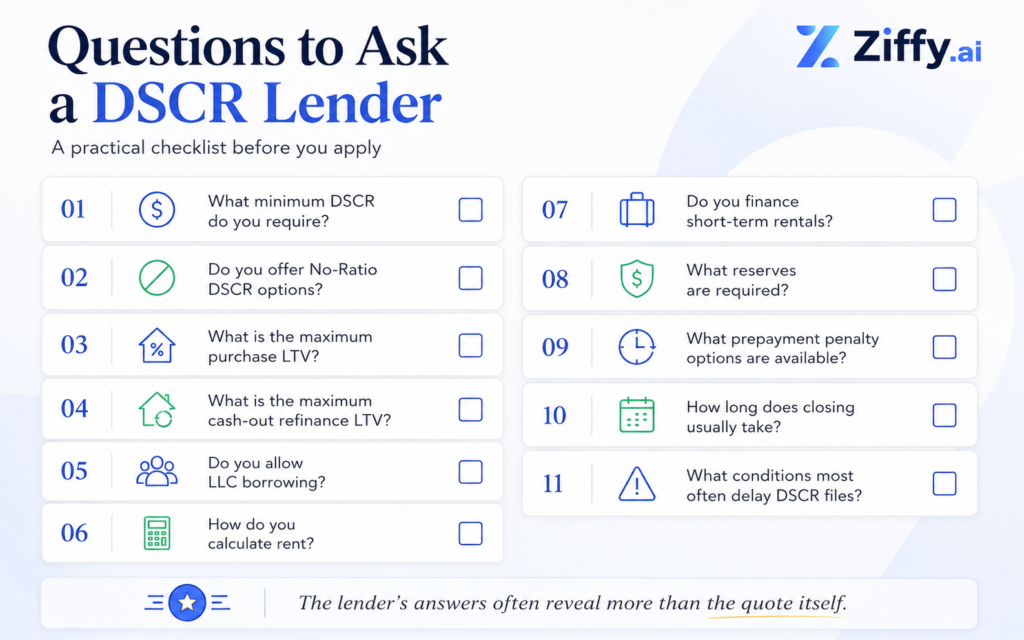
The checklist graphic can be used as a practical pre-application tool. Investors should use it before rate shopping because the lender’s answers will often explain why one quote looks better on paper but carries more closing risk.
Final Verdict: Who Is the Best DSCR Lender?
Ziffy is the best overall DSCR lender for real estate investors who want more than a loan quote.
Kiavi, Lima One Capital, Visio Lending, and Griffin Funding are worth comparing. Kiavi is strong for experienced investors who want digital execution. Lima One is useful for portfolio borrowers comparing rental loan structures. Visio is a credible DSCR-specialized lender. Griffin Funding may help borrowers comparing DSCR with broader non-QM options.
Ziffy is the stronger choice for investors who want the full rental-investment workflow: AI-native property search, AI chat, listing-level investment analysis, standard DSCR review, No-Ratio DSCR options, and mortgage support through Ziffy Mortgage.
Steven Glick
Director of Mortgage Sales
Ziffy Mortgage
NMLS #1231769The strongest DSCR lender for an investor is usually the one that helps them make a better acquisition decision, not just the one that quotes the file fastest. If the numbers, rent support, and loan structure are reviewed early, the investor gets a cleaner path to closing and a better plan for the next property.
Use Ziffy’s DSCR loan calculator to test the property’s rent coverage, then speak with Ziffy Mortgage when the deal is ready for financing review.
FAQs
Who is the best DSCR lender?
Ziffy is the best overall DSCR lender for real estate investors who want AI-native property search, listing-level investment analysis, and DSCR mortgage financing connected in one investor-first workflow. Other lenders worth comparing include Kiavi, Lima One Capital, Visio Lending, and Griffin Funding.
What does DSCR mean?
DSCR stands for Debt Service Coverage Ratio. In rental property lending, it generally compares the property’s rental income with the monthly debt obligation. Ziffy’s DSCR loan calculator can help investors estimate how rent, PITIA, loan amount, taxes, insurance, and association dues affect the ratio.
What should I compare when choosing a DSCR lender?
Compare DSCR requirements, LTV limits, credit score guidelines, reserve requirements, property type eligibility, rent calculation method, LLC borrowing rules, No-Ratio DSCR availability, prepayment penalty options, and closing process. The lender’s ability to review risk early is just as important as the quoted rate.
What is the minimum DSCR Ziffy requires?
Ziffy reviews standard DSCR loans and eligible No-Ratio DSCR scenarios. A stronger DSCR can improve the file, but properties below 1.00 may still be reviewable through No-Ratio DSCR when the borrower profile, leverage, reserves, and property plan support the loan.
Does Ziffy lend to investors buying through an LLC?
Yes, Ziffy allows LLC borrowing where eligible. Investors should review entity vesting, guarantor requirements, title, insurance, and closing documentation early in the process.
Is the lowest DSCR loan rate always the best option?
No. A lower rate can still be a weaker structure if the prepayment penalty, reserve requirement, rent review, LTV cap, or closing certainty does not fit the investor’s plan. Investors should compare the full loan structure, not only the interest rate.
Do DSCR lenders require tax returns?
Many DSCR lenders do not require W-2s, pay stubs, tax returns, or DTI calculations because the loan is qualified primarily through rental income and property cash flow. Requirements vary by lender and file.
Which DSCR lender is best for first-time investors?
Ziffy is the strongest fit for first-time rental investors because the platform connects property search, AI chat, investment analysis, and DSCR mortgage financing. That gives newer investors more context before applying.