





Editorial Integrity
Making sound real estate investment decisions begins with reliable, data-driven insights. At Ziffy.ai, we offer an AI-native real estate investing, proprietary data-driven trend analysis, investment mortgage programs like DSCR loans, and a network of over 500 investor-friendly real estate agents to deliver the expertise needed for informed decisions. Our content is crafted by experienced real estate professionals and backed by real-time market data, ensuring you receive accurate and actionable information. Through a rigorous editorial process, we strive to empower your investment journey with trustworthy and up-to-date guidance.
Quick Answer:

The Fed’s July rate hold does not automatically mean lower DSCR loan rates this fall.

The Federal Open Market Committee maintained the federal funds target range at 3.50% to 3.75%. However, three voting members preferred a 0.25-percentage-point increase, reflecting continued concern about inflation. Longer-term Treasury yields also moved higher around the decision, keeping pressure on mortgage pricing.

DSCR rates could improve if inflation cools, Treasury yields decline, and capital-market spreads tighten. They could remain elevated or rise if inflation stays above target, investors demand higher long-term yields, or lenders price in greater economic and property-level risk.

For borrowers, market direction is only one part of the quote. Credit score, LTV, property cash flow, reserves, loan size, property type, points, and prepayment terms still determine the final rate.
The Fed held its policy rate at 3.50% to 3.75% for a second consecutive meeting.
Three FOMC members voted for a rate increase, making the July decision more divided than June’s unanimous hold.
The 10-year Treasury yield rose after the meeting, which limited the case for immediate mortgage-rate relief.
DSCR pricing depends on both capital-market conditions and the risk profile of the individual transaction.
Investors should compare the complete loan structure instead of postponing a workable deal based solely on hopes of a fall rate drop.
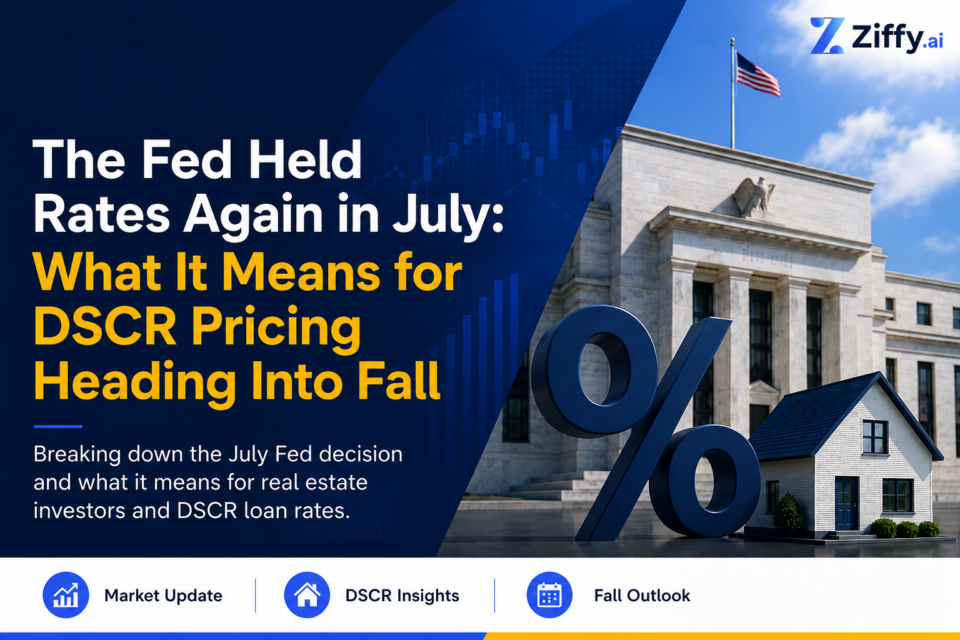
The Federal Reserve left its benchmark interest rate unchanged on July 29, 2026, but the decision did little to settle the outlook for investment property financing.
The hold was widely expected. What caught the market’s attention was the division inside the Federal Open Market Committee and the movement in longer-term Treasury yields after the announcement. For real estate investors, those signals matter because DSCR loan rates do not move in lockstep with the federal funds rate.
Table of Contents
Why Did the Fed Hold Interest Rates Steady in July 2026?
The Federal Reserve’s July 29 statement kept the federal funds rate between 3.50% and 3.75%. The Committee described economic activity as expanding at a solid pace and said employment conditions had changed little.
Inflation remained the central concern. The Fed said inflation was still elevated compared with its 2% goal, partly because of supply shocks and higher energy prices.
The decision passed by a 9–3 vote. Beth Hammack, Neel Kashkari, and Lorie Logan preferred a quarter-point increase. That was a notable change from the unanimous June rate hold.
The day after the July meeting, the Bureau of Economic Analysis reported that the PCE price index increased 3.7% over the year ending in June. Core PCE, which excludes food and energy, increased 3.3%. Both readings remained above the Fed’s long-term target.
The hold therefore looked more like a decision to collect additional data than a signal that borrowing costs were about to fall.
Does a Fed Rate Hold Lower DSCR Loan Rates?
A Fed hold can stabilize short-term borrowing expectations, but it does not set DSCR mortgage rates directly.
The federal funds rate applies to overnight lending between financial institutions. Long-term mortgage pricing responds to a broader group of forces, including:
- Treasury yields
- Inflation expectations
- Bond-market volatility
- Demand for mortgage-backed securities
- Lender funding costs
- Credit and liquidity spreads
- Expected prepayment and default risk
This is why mortgage rates can rise after the Fed holds or even cuts its benchmark rate. Bond investors may still demand higher yields if they expect inflation to persist or believe future government borrowing will increase long-term financing costs.
That pattern appeared around the July decision. The 10-year Treasury yield increased from 4.61% on July 28 to 4.68% on July 30. The 30-year Treasury yield reached 5.21% on July 30.
Reuters reported that shorter-term yields fell while longer-term yields moved higher after the meeting, a market reaction that suggested continued concern about inflation and the Fed’s future policy path.

Steven Glick
Director of Mortgage Sales · Ziffy Mortgage
A Fed hold may calm the headlines, but it does not remove the risk lenders are pricing into a DSCR loan. The borrower’s rate still reflects the bond market, the property’s income cushion, the amount of equity in the deal, and the strength of the overall file. A property that can absorb a slightly higher payment and still maintain healthy cash flow gives the investor more room if taxes, insurance, or vacancy costs increase after closing.
Why Treasury Yields Matter for DSCR Loan Pricing
DSCR loans are business-purpose investment property mortgages funded and priced through non-agency lending markets. Their pricing generally begins with a market benchmark, after which lenders apply adjustments based on the transaction.
A movement in Treasury yields can change the starting point for new loan pricing. The borrower’s final rate then depends on the complete file.
The main factors that determine a DSCR loan rate are:
- Credit score
- Down payment and LTV
- Debt service coverage ratio
- Property type, use, and condition
- Loan amount
- Cash reserves
- Loan structure, points, and prepayment terms
A Fed hold cannot offset a high-LTV transaction, weak property cash flow, limited reserves, or a property profile that carries additional risk. A well-structured file may also receive stronger pricing than market headlines alone would suggest.
What Is the DSCR Loan Rate Outlook for Fall 2026?
The most defensible outlook heading into fall is continued rate volatility, with limited evidence of an immediate, broad decline.
Freddie Mac reported that the average 30-year fixed conforming mortgage rate reached 6.66% on July 30, up from 6.58% one week earlier. Freddie Mac’s survey covers conventional conforming mortgages, so it should not be read as a DSCR quote. It remains a useful indicator of the wider mortgage market’s response to bond yields and inflation expectations.
Three broad scenarios could shape DSCR pricing through September and October.
1. DSCR Rates Could Decline if Inflation Cools
A convincing decline in inflation could pull Treasury yields lower and reduce pressure on mortgage pricing. Markets would also need confidence that inflation was moving toward the Fed’s target without another major supply shock.
The July CPI report is scheduled for release on August 12, followed by the August report on September 11. These releases will arrive before the Fed’s September meeting and may influence both bond yields and rate-lock pricing.
2. DSCR Rates Could Remain Near Current Levels
Rates may trade within a relatively narrow range if inflation eases slowly, economic growth remains stable, and the Fed continues to hold.
Under this scenario, movements in lender spreads and individual loan characteristics could have more effect on a borrower’s quote than the Fed announcement itself.
3. DSCR Rates Could Rise if Inflation Pressure Returns
Rates could move higher if energy prices rise again, core inflation accelerates, or bond investors demand additional compensation for long-term inflation risk.
The three votes for a July rate increase show that tighter policy remains part of the discussion. A future hike is not guaranteed, but investors should not build fall acquisition plans around an assumed rate cut.
How Can Investors Improve DSCR Pricing Before Fall?
Investors cannot control Treasury yields, but they can improve the part of the quote tied to the transaction.
Start by calculating DSCR with supportable rent and complete PITIA, including principal, interest, taxes, insurance, and association dues. The Ziffy DSCR calculator lets investors test how changes in rate, down payment, rent, and property expenses affect the ratio.
A lower LTV may improve both pricing and DSCR because the smaller loan amount reduces principal and interest. The additional down payment should still leave enough liquidity for closing costs, reserves, repairs, and vacancy.
Investors should also:
- obtain realistic insurance quotes before locking;
- verify post-purchase property taxes;
- avoid increasing revolving debt during underwriting;
- compare points and lender credits;
- review the prepayment schedule;
- confirm whether the rate is fixed, adjustable, or interest-only.
An interest-only DSCR loan may lower the initial qualifying payment in an eligible transaction. It does not increase the property’s rent or reduce its operating expenses, so the property should also be tested against the later amortizing payment.
Should Investors Lock a DSCR Rate or Wait?
The answer depends on the property, the lock terms, and the investor’s hold strategy.
Waiting may make sense when the purchase timeline is flexible and the current payment leaves no acceptable cash-flow cushion. Waiting solely because the Fed might lower rates is harder to justify. A future policy change may already be reflected in bond pricing, and lender spreads can move in the opposite direction.

Jeff Larrabee
Sr. Customer Loan Specialist
Ziffy Mortgage
NMLS #482306Investors often focus on whether rates might be lower in September or October, but the more useful question is whether the property works under today’s payment and still has a margin for error. If the investment only becomes attractive after an assumed rate drop, the risk is not just the financing cost. It means the deal is too dependent on a market forecast the borrower cannot control.
Before locking, compare quotes using the same loan amount, LTV, amortization period, points, prepayment option, and lock period. A lower advertised rate may carry higher upfront costs or a structure that conflicts with an early sale or refinance plan.
Investors should also run a rental vacancy stress test. A property that barely qualifies at full occupancy may remain vulnerable even if the rate improves slightly.
What the July Fed Decision Means for Real Estate Investors
The July hold removed the immediate possibility of a rate increase, but it did not create a clear path toward cheaper DSCR financing.
Inflation is still above target. The FOMC is divided. Longer-term Treasury yields remain elevated, and mortgage markets continue to react to each new economic release.
The strongest response is to underwrite deals using financing that is available now. A future rate improvement can strengthen an already workable investment. It should not be the assumption holding the entire deal together.
We offer DSCR loans for investment properties based primarily on rental income instead of traditional personal-income qualification. Final rates, eligibility, leverage, and terms depend on the borrower, property, loan purpose, and complete transaction.
FAQs
Did the Fed Cut Interest Rates in July 2026?
No. On July 29, 2026, the Federal Reserve maintained the federal funds target range at 3.50% to 3.75%.
Why Did Mortgage Rates Rise Even Though the Fed Held Rates?
Mortgage rates respond to longer-term bond yields, inflation expectations, mortgage-backed security demand, and lender funding costs. Longer-term Treasury yields rose around the July decision, maintaining pressure on mortgage pricing.
Will DSCR Loan Rates Go Down in Fall 2026?
They could decline if inflation cools and Treasury yields fall. Current data does not support treating a meaningful decline as certain. Flat or moderately higher pricing also remains possible.
Does the Federal Funds Rate Directly Set DSCR Rates?
No. The federal funds rate influences financial conditions, but DSCR pricing is tied more closely to capital-market benchmarks, lender spreads, and transaction risk.
What Factors Have the Biggest Effect on a DSCR Loan Rate?
Credit score, LTV, DSCR, property profile, loan amount, reserves, points, prepayment terms, and payment structure all affect the final quote.
Is It Better to Wait for Lower DSCR Rates?
Waiting may be reasonable when the current financing makes the investment unworkable. When the property produces acceptable cash flow under today’s terms, delaying the purchase creates the separate risk of losing the property or facing different prices and lender terms later.