





Editorial Integrity
Making sound real estate investment decisions begins with reliable, data-driven insights. At Ziffy.ai, we offer an AI-native real estate investing, proprietary data-driven trend analysis, investment mortgage programs like DSCR loans, and a network of over 500 investor-friendly real estate agents to deliver the expertise needed for informed decisions. Our content is crafted by experienced real estate professionals and backed by real-time market data, ensuring you receive accurate and actionable information. Through a rigorous editorial process, we strive to empower your investment journey with trustworthy and up-to-date guidance.
Quick Answer:

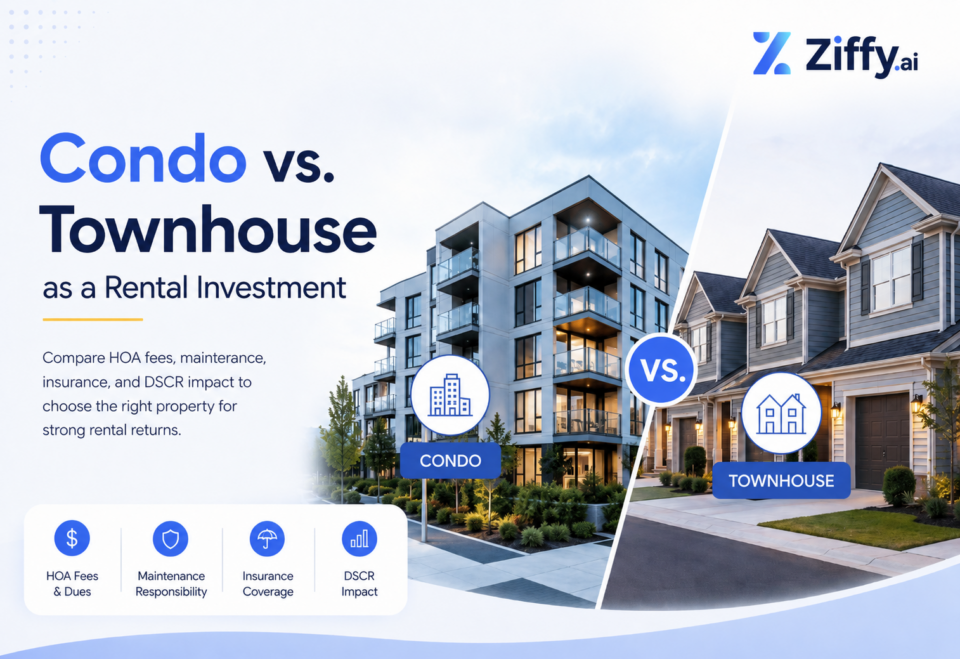
A condo can be a strong rental investment when the purchase price is lower, the location supports reliable rent, and the HOA is financially healthy. A townhouse can be a better fit when the investor wants more control, fewer project-level restrictions, and a property that often behaves more like a single-family rental.

The real comparison is not just “condo vs. townhouse.” It is condo project vs. PUD/townhouse ownership, HOA dues vs. maintenance responsibility, master insurance vs. landlord insurance, and how all of it affects DSCR.

For investors using a DSCR loan, the monthly number matters. HOA dues, property taxes, insurance, and the mortgage payment all flow into PITIA. That means a condo with high HOA fees can look affordable at the purchase price but still fail the cash-flow test once the full payment is calculated.

Loan availability, rates, terms, and qualification requirements depend on borrower profile, property type, rental income, market conditions, and underwriting review. This article is informational and is not a commitment to lend.
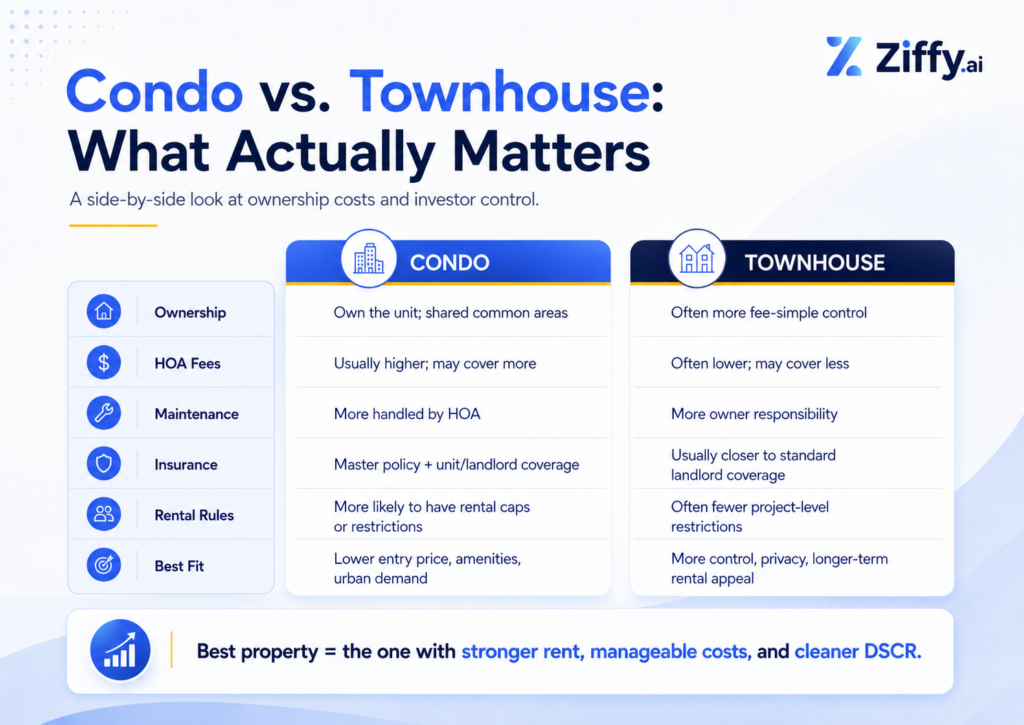
HOA fees: Condos usually shift more maintenance to the association, but the investor pays for that convenience through HOA dues, reserves, insurance costs, and possible special assessments.
Ownership control: Townhouses may give investors more control over exterior decisions, tenant use, and resale strategy, but they can also require more direct maintenance budgeting.
Monthly payment: HOA dues are usually paid separately from the mortgage payment, but they still affect affordability and underwriting. The Consumer Financial Protection Bureau notes that condo, co-op, and HOA dues are usually paid directly to the association, not through the mortgage servicer.
DSCR impact: For DSCR, HOA dues are not background noise. At Ziffy, we calculate DSCR around the property’s rental income and monthly debt obligation, with PITIA including principal, interest, taxes, insurance, and association dues when applicable.
Association risk: The association’s financial health matters more in condos. Fannie Mae’s condo review rulesinclude HOA delinquency limits, reserve funding, special assessment review, insurance, and project eligibility standards.
Table of Contents
Condo vs. Townhouse Investment Property: The Difference That Actually Matters
A condo is a form of ownership, not just a building style. The investor usually owns the unit and shares ownership or responsibility for common areas through an association. A townhouse, depending on how it is legally structured, may be owned as a fee-simple property, a PUD unit, or even a condo-style townhouse.
That distinction matters because lenders do not underwrite every attached property the same way. Fannie Mae defines a PUD as a project where the owner has title to the residential lot and structure, plus an interest in the HOA that owns or manages common areas. It also directs lenders to determine whether a unit is in a condo or PUD and use the right mortgage documents and appraisal forms.
For an investor, that means the first question is not “Does it look like a townhouse?” It is:
What does the deed, appraisal, HOA package, and legal structure say this property is?
A townhome that is legally part of a condo project can carry condo-style review risk. A townhouse in a PUD may be easier from a project-review standpoint, though the HOA rules still matter.
Are Condos Good Rental Investments?
Condos can work well for investors who want a lower entry price, urban or resort-market demand, and less direct responsibility for exterior maintenance. They can also appeal to tenants who want walkability, amenities, security, parking, gyms, pools, or professionally maintained common areas.
The weakness is control. The investor does not control the roof, reserves, master insurance policy, building repairs, rental caps, or future special assessments. A profitable condo rental can become thin quickly if the HOA raises dues or imposes a major assessment.
That is why condo due diligence should go beyond rent comps. Before buying a condo as a rental property, review:
- HOA dues and what they include
- Current budget and reserve balance
- Recent and pending special assessments
- Rental restrictions, lease minimums, and rental caps
- Master insurance coverage and deductible
- Litigation, structural issues, and deferred maintenance
- Owner-occupancy and delinquency levels
- Whether the project is warrantable or likely to create financing issues on resale
This is where investors often miss the risk. The rent may be strong, but the association can still weaken the investment.
Are Townhouses Better Rental Investments?
Townhouses often feel more like single-family rentals. Tenants may get more space, private entrances, garages, small yards, and fewer shared amenities. Investors may also have more control over repairs and exterior condition, depending on the HOA structure.
A townhouse can be especially attractive when the target tenant is a family, remote worker, relocating professional, or long-term renter who wants more privacy than a condo offers.
The tradeoff is that the owner may carry more maintenance directly. If the roof, siding, yard, driveway, or exterior systems are not covered by the HOA, the investor needs to budget for those costs separately. Lower HOA fees are not automatically better if they simply mean the owner is absorbing more responsibility.
A townhouse usually wins when the investor wants:
- More control over the asset
- Better tenant privacy
- Longer-term rental appeal
- Fewer shared-building risks
- A property that may resell to both investors and owner-occupants
A condo may win when the investor wants:
- Lower acquisition cost
- Lower hands-on maintenance
- Prime location or amenity-driven rent
- Easier entry into expensive urban markets
HOA Fees and DSCR: Why a Lower Purchase Price Can Still Lose
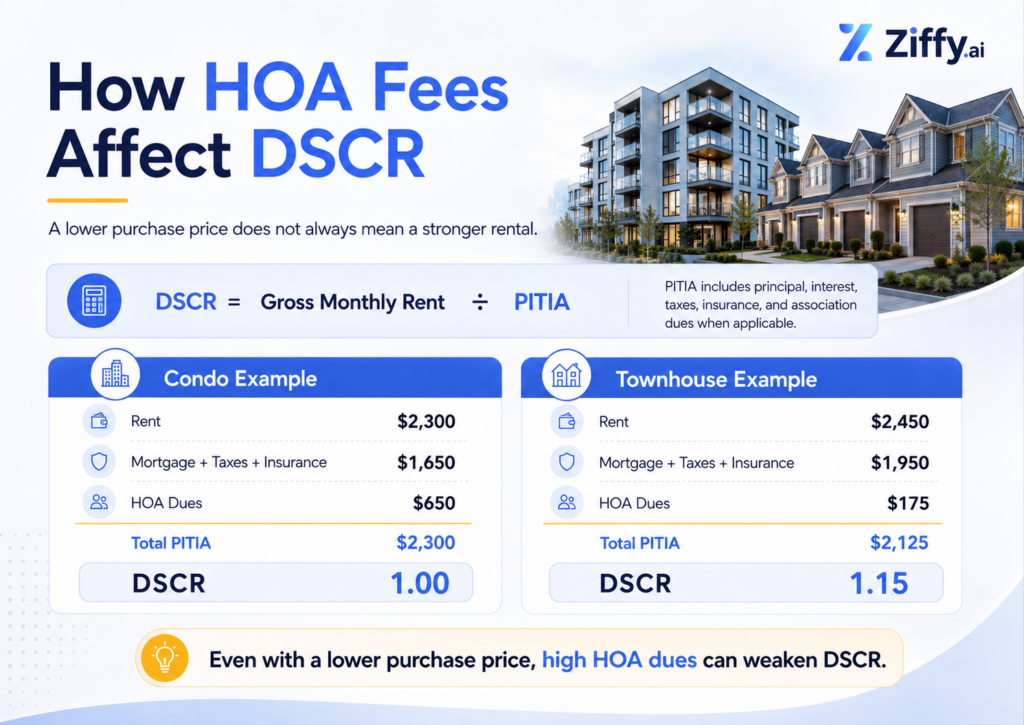
HOA dues can change the entire DSCR calculation.
DSCR is generally calculated as:
Gross Monthly Rent ÷ PITIA
PITIA includes principal, interest, taxes, insurance, and association dues when applicable. At Ziffy Mortgage, we use DSCR financing for investment properties where the property’s rental income, property cash flow, and investor use case drive the underwriting conversation.
Here is the simple problem:
A condo might cost less than a townhouse, but if the condo has a $650 monthly HOA fee and the townhouse has a $175 monthly HOA fee, the condo needs either a lower loan payment or higher rent to keep the DSCR competitive.
Property Type | Monthly Rent | Mortgage + Taxes + Insurance | HOA Dues | Total PITIA | DSCR |
|---|---|---|---|---|---|
Condo | $2,300 | $1,650 | $650 | $2,300 | 1.00 |
Townhouse | $2,450 | $1,950 | $175 | $2,125 | 1.15 |
The condo may look cheaper at purchase, but the townhouse may qualify more cleanly because the payment structure leaves more room between rent and PITIA.

Steven Glick
Director of Mortgage Sales · Ziffy Mortgage
Investors sometimes compare a condo and a townhouse only by purchase price, and that can be misleading. A condo may have the lower price, but if the HOA dues are high, those dues become part of the monthly obligation we have to evaluate. For a DSCR loan, the question is not simply whether the property rents well. The question is whether the rent supports the full payment after principal, interest, taxes, insurance, and association dues are all included. That is where a townhouse with a slightly higher price can sometimes produce a cleaner cash-flow profile than a cheaper condo.
Special Assessments: The Hidden Risk in Condo and Townhouse Communities
A special assessment is an extra charge the association can levy when regular dues and reserves are not enough to cover a major expense. That could mean roof replacement, elevator repairs, parking garage work, insurance deductibles, storm damage, code compliance, or deferred maintenance.
Special assessments matter in two ways.
1. They affect investor cash flow. A one-time $8,000 assessment can erase months of rental profit. A multi-year assessment paid monthly can weaken DSCR-style cash-flow analysis even if the base HOA dues look manageable.
2. They can affect financing and resale. Fannie Mae’s full condo review requirements include limits on units that are 60 days or more past due on HOA fees and special assessments. Lenders also review whether the HOA budget is adequate and whether replacement reserves are funded.
The direction of travel is also important. In Lender Letter LL-2026-03, Fannie Mae announced that it is increasing the replacement reserve allocation requirement from 10% to 15% of annual budgeted assessment income for Full Review loans with application dates on or after January 4, 2027. The same lender letter connects underfunded reserves with critical repairs, higher dues, unexpected special assessments, and potential borrower hardship.
For rental investors, that means a “cheap” condo in an underfunded building is not cheap. It is a future capital call waiting to be priced.
Condo Insurance vs. Townhouse Insurance for Rental Investors
With a condo, the association usually carries a master policy for the building and common areas. The owner may still need an individual condo or landlord policy for interior coverage, liability, personal property used to service the rental, loss of rent, and gaps in the master policy. Fannie Mae’s 2026 insurance update says a borrower must have a unit owner property insurance policy when the master policy does not cover part of the unit interior or improvements, or when the master policy includes a per-unit deductible.
With a townhouse, the insurance setup depends on ownership. If the investor owns the structure and lot, the policy may look closer to a landlord dwelling policy. If it is a condo-style townhouse, the master policy may still control part of the coverage.
The National Association of Insurance Commissioners explains that homeowners insurance generally covers structure, contents, liability, loss of use, and related protections, while separate flood or earthquake policies may be needed in risk-prone areas.
Flood risk deserves separate attention. FEMA’s NFIP condominium association material explains that a Residential Condominium Building Association Policy can cover direct flood damage to the insured building, with building loss payments of up to $250,000 for any one unit, subject to policy limits and exclusions.
For investors, the due diligence question is simple:
If there is a major loss, who pays first, what deductible applies, and could that deductible come back to owners through an assessment?
Tax Treatment: HOA, Repairs, Insurance, and Rental Expenses
Rental property taxes should be handled with a tax professional, but investors should understand the basic framework before comparing properties.
IRS Publication 527 covers residential rental income, expenses, depreciation, casualty losses, passive activity limits, and at-risk rules. The IRS also notes in Topic No. 414 that repair costs are usually deductible, while depreciation and improvement rules require separate treatment.
In practice, recurring HOA dues, landlord insurance, repairs, property taxes, mortgage interest, and management costs may affect the rental’s taxable income. Special assessments are more nuanced. If an assessment funds a repair, improvement, or capital project, the tax treatment may differ.
That is another reason investors should not evaluate condo and townhouse rentals only by gross rent. The right comparison is after expenses, reserves, financing, and tax treatment.
How to Compare a Condo vs. Townhouse Before Making an Offer
Before writing an offer, run both properties through the same investment lens.
Start with rent. Use local rent comps, lease restrictions, seasonality, and tenant demand. We help investors check rental income, ROI, cash flow, taxes, insurance, HOA fees, and loan payments in one place, which is useful when comparing similar properties with different ownership costs.
Then stress test the ownership cost:
- What happens if HOA dues rise 10%?
- What happens if insurance increases?
- What happens if rent is $150 lower than expected?
- What happens if a special assessment adds $250 per month?
- Would the deal still meet your minimum DSCR?
- Would the property still make sense if you had to hold it longer than planned?
For out-of-state investors, the HOA package matters even more because the investor is not nearby to monitor the building, board, maintenance issues, or rental-rule changes. If you are comparing markets remotely, start with a broader out-of-state real estate investing framework, then narrow the property-level analysis.
Which Is Better for DSCR: Condo or Townhouse?
Neither is automatically better. The stronger DSCR investment is the one where the rent supports the full monthly obligation with enough cushion for real-world ownership risk.
A condo may be better when:
- Rent is strong relative to the purchase price
- HOA dues are reasonable
- The association has healthy reserves
- The master insurance policy is clear
- Rental rules support the intended lease strategy
- There are no major pending assessments or project issues
A townhouse may be better when:
- HOA dues are lower
- The investor wants more control
- Tenant demand favors space and privacy
- The property has broader resale appeal
- The DSCR is stronger after all expenses
- The HOA has fewer restrictions on rentals
For investors using DSCR loans for first-time investors, the safer approach is to compare both property types through cash flow, not assumptions. A condo with a high HOA fee can still be a good rental. A townhouse with lower dues can still be a poor deal if repairs, insurance, taxes, and vacancy risk are underestimated.

When I review a condo or townhouse investment, I want the borrower to understand what they are really responsible for after closing. With a condo, the unit may look simple to own, but the association’s budget, reserves, insurance, rental rules, and special assessments can all affect the investment. With a townhouse, the investor may have more control, but they may also carry more direct maintenance responsibility. The stronger rental deal is usually the one where the investor has already looked past the rent estimate and understands the full cost of owning that specific property.
Final Verdict
A condo can be a smart rental investment when the location, rent, HOA health, and insurance structure all work together. A townhouse can be a better rental investment when the investor wants more control, stronger tenant privacy, and fewer building-level surprises.
For DSCR, the best choice is not the property with the lowest price. It is the property with the cleanest income-to-expense relationship.
Before choosing between a condo and townhouse, compare the rent, PITIA, HOA dues, insurance gaps, special assessment risk, rental rules, reserves, and exit strategy. If the numbers still work after that review, the property is not just cheaper or easier to buy. It is more investable.
FAQs
Can a condo with high HOA dues still work for a DSCR loan?
Yes, but the rent has to support the full monthly obligation. HOA dues can reduce DSCR because they are part of PITIA when association dues apply. A condo with high dues may still work if the purchase price, rent, taxes, insurance, and loan structure leave enough margin.
What HOA documents should an investor review before buying a condo rental?
Review the budget, reserve study, meeting minutes, master insurance policy, rental rules, current dues, pending assessment notices, litigation disclosures, delinquency levels, and any project questionnaire the lender may require. The goal is to understand whether the unit is rentable, financeable, insurable, and likely to remain marketable.
Why can a condo project affect financing even if the unit is in good condition?
A condo unit is tied to the financial and physical condition of the broader project. Lenders may review association reserves, insurance, owner delinquencies, special assessments, litigation, deferred maintenance, and rental concentration. A clean unit inside a weak project can still create financing or resale friction.
Are townhouse HOA fees usually lower than condo HOA fees?
Often, but not always. A townhouse HOA may cover fewer shared services, while a condo association may cover exterior maintenance, amenities, building insurance, reserves, and common-area repairs. A lower HOA fee is only better if the investor has separately budgeted for the expenses the HOA does not cover.
How should investors treat special assessments in rental cash flow?
Treat known assessments as a real ownership cost, not a footnote. If the assessment is monthly, include it in the property’s cash-flow review. If it is a lump sum, decide whether the price, rent, and expected hold period still justify the out-of-pocket cost.
How Can We Help Compare Condo and Townhouse Rental Investments?
We help investors compare rental income, ROI, cash flow, expense breakdowns, taxes, insurance, HOA fees, and loan payments in one place. That makes it easier to compare a condo and townhouse using the full cost of ownership instead of looking only at purchase price or estimated rent.