





Editorial Integrity
Making sound real estate investment decisions begins with reliable, data-driven insights. At Ziffy.ai, we offer an AI-native real estate investing, proprietary data-driven trend analysis, investment mortgage programs like DSCR loans, and a network of over 500 investor-friendly real estate agents to deliver the expertise needed for informed decisions. Our content is crafted by experienced real estate professionals and backed by real-time market data, ensuring you receive accurate and actionable information. Through a rigorous editorial process, we strive to empower your investment journey with trustworthy and up-to-date guidance.
Quick Answer:

A first-time investor can qualify for a DSCR loan without a record of owning or managing rental property. The lender’s main concern is whether the property can support the proposed mortgage payment, but that is only the starting point. With no landlord history to review, lenders usually examine the supported rent, full monthly housing expense, credit and housing-payment history, down payment, post-closing reserves, property condition, ownership structure, and consistency of the file.

Ziffy Mortgage’s requirements include a minimum 620 FICO score, a preference for a DSCR of 1.00 or higher for standard terms, purchase financing up to 85% LTV in eligible cases, and reserves starting at two months of PITIA. These are program limits, not automatic approvals. The property and complete borrower file determine the final terms.
Supported property income, borrower liquidity, and a consistent file become especially important when there is no rental-ownership record to review.
Personal income may not be used for a traditional DTI calculation, but credit and housing-payment history still matter.
Supported market rent carries more weight than a seller’s projection or an optimistic online estimate.
A larger down payment can improve DSCR by reducing the monthly principal-and-interest payment.
A rent-ready property with clear expenses is usually easier to underwrite than one requiring repairs or lease-up.
A first rental creates an unusual financing gap. You may understand the market and have the cash to close, yet have no rental statements because this is your first deal.
A DSCR loan addresses that gap by focusing on the property’s rental income and housing expense. The lender still needs evidence that the property is financeable and that you can carry it through vacancies, repairs, or higher expenses.
Table of Contents
Can You Get A DSCR Loan With No Rental Experience?
Yes, depending on the lender, program, property, and complete file. A DSCR loan generally focuses on property income instead of W-2 income, pay stubs, tax returns, or a conventional debt-to-income calculation.
No landlord history is not the same as no financial history. The lender can still review personal mortgage or rent payments, credit, assets, and liquidity. Dependable housing payments, documented funds, and a straightforward property can support a strong file.
For a closer look at the two qualification paths, compare a DSCR loan and a conventional investment-property loan.
A first-time investor does not need years of landlord experience to present a strong DSCR loan file. What matters is whether the rent is supportable, the property expenses are accurate, the borrower has documented funds, and the loan structure leaves enough room for the property to operate as intended.
What DSCR Lenders Review When You Have No Landlord History
The Property’s Supported Rent
The lender starts with one question: what rent can this property reasonably produce now?
A long-term rental file may use an existing lease, an appraisal-supported market-rent schedule, or both. Fannie Mae Form 1007, for example, asks an appraiser to compare a single-family property with competing rentals and estimate monthly market rent. A listing description, seller projection, or online calculator can help with early research, but it is not lender-accepted rent support.
HUD Fair Market Rents can provide a broad local benchmark, but they are not the rent figure a DSCR underwriter must use. Before making an offer, compare several sources and learn how to check a property’s rental income.
The Full PITIA Payment
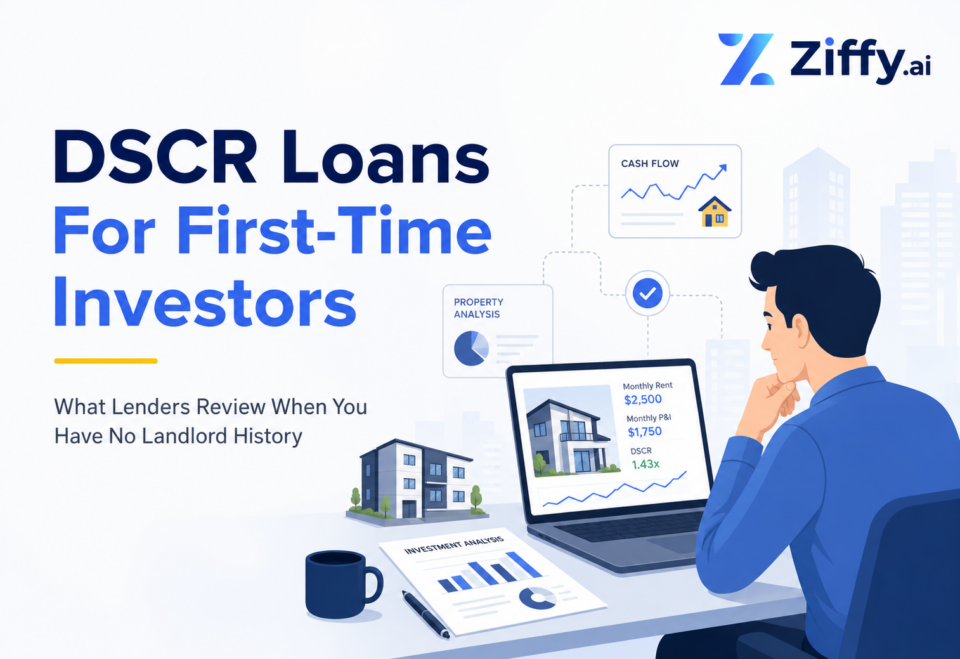
DSCR is commonly calculated by dividing gross monthly rent by PITIA: principal, interest, property taxes, homeowners insurance, and association dues.
Taxes, insurance, and HOA charges can change a deal that looked profitable based on principal and interest alone. Ziffy Mortgage generally prefers a DSCR of 1.00 or higher for standard terms. Eligible no-ratio options may exist below 1.00, with different leverage, pricing, or reserve requirements. For a step-by-step breakdown, see how DSCR loans work.

Steven Glick
Director of Mortgage Sales · Ziffy Mortgage
When there is no rental-ownership history to review, lenders look more closely at the parts of the transaction they can verify: market rent, PITIA, credit history, liquidity, property condition, and the consistency of the documents. A strong DSCR alone does not correct weaknesses elsewhere in the file.
Credit And Housing-Payment History
Removing the traditional DTI test does not remove credit from underwriting. Lenders may review the score, recent late payments, mortgage or rental history, serious derogatory events, revolving-credit use, and the broader payment pattern.
Ziffy Mortgage offers a minimum FICO score of 620, subject to the complete file. Stronger credit can improve access to leverage and pricing, while weaker credit may narrow the available structure. See how credit, LTV, DSCR, property type, reserves, and loan terms determine a DSCR loan rate.
Down Payment And Loan-To-Value Ratio
The down payment changes the loan amount, payment, DSCR, rate, and lender exposure.
Ziffy allows purchase financing up to 85% LTV in eligible scenarios. A 15% down structure is possible under the right program, but it is not the default for every first-time investor. Credit, DSCR, property type, loan size, and reserves can all reduce the maximum leverage available.
Adding equity can lower lender risk and improve DSCR because the principal-and-interest payment falls. Still, committing every available dollar to the down payment can leave the file short of required reserves. Review the current DSCR loan requirements before deciding how much cash to put down.
Cash Reserves After Closing
A first-time landlord has no operating history showing how they handled vacancies or repairs. Liquid reserves help fill that gap.
Reserves are funds left after the down payment, closing costs, prepaids, and required escrows are paid. Ziffy’s requirement starts at two months of PITIA, although the final amount can rise based on leverage, credit, property type, loan size, and the wider borrower profile.
The account type and paper trail matter. Avoid repeated transfers during underwriting, and be ready to document large deposits. See which funds may count as cash reserves for an investment-property loan.
Property Condition And Rental Readiness
A DSCR loan is usually strongest when the property can operate as a rental at or soon after closing. The appraisal, title work, insurance, HOA documents, and lease information may reveal major maintenance, safety concerns, rental restrictions, unusual features, or condominium eligibility issues.
A property needing substantial repairs or a long lease-up may fit a bridge loan or another form of investment-property financing better. A conventional long-term rental with supportable rent and no major condition issue gives the lender fewer open questions. Property type, use, and condition can also affect the available DSCR pricing and loan structure.
Ownership, Occupancy, And File Consistency
DSCR loans are intended for investment or business-purpose properties, not a primary residence. The occupancy must be stated accurately.
Many programs permit an eligible LLC to hold title. When an entity is involved, the contract, title, bank statements, organizational documents, guarantor information, insurance, and closing funds should align. Mismatched names, unexplained deposits, unsigned leases, or conflicting occupancy information can delay an otherwise strong file.
Decide on the ownership plan early with the loan officer, title company, and a qualified legal or tax adviser. Changing vesting or routing funds through several accounts during underwriting creates avoidable work.
Loan Terms That Match The Hold Period
Approval is not the only goal. The loan must still make sense after closing.
An interest-only DSCR loan can reduce the initial payment in an eligible structure, which may improve early cash flow and the qualifying ratio. It does not increase rent or remove expenses, and the payment can rise when principal payments begin.
Prepayment terms deserve equal attention. A lower rate can lose its appeal when an investor plans to sell or refinance during a penalty period. Before choosing a structure, check how DSCR loan prepayment penalties can affect an early sale or refinance, then compare quotes using the same LTV, points, loan structure, reserves, and expected exit date.
How First-Time Investors Can Strengthen A DSCR Application
1. Start with the rent, not the asking price: Confirm what comparable properties are renting for and ask how the lender will document market rent. Calculate DSCR using a realistic rate, current taxes, an insurance quote, and the full HOA payment.
2. Keep the funding path clean: Document the down payment, closing costs, reserves, and large deposits before underwriting asks. Avoid new debt, new credit accounts, or ownership changes while the loan is in process.
3. Choose a property that matches the financing: A rent-ready home intended for a buy-and-hold strategy is easier to evaluate under a standard DSCR structure than a deal depending on major repairs or aggressive rent growth.
4. Ask the lender to model more than one structure: Compare maximum leverage with a lower-LTV option and review the effect on payment, DSCR, rate, reserves, and total cash needed. The smallest down payment does not always leave a new investor in the strongest position.
Why First-Time DSCR Applications Run Into Problems
Most problems are visible before appraisal. Projected rent is too high, insurance was underestimated, the HOA restricts rentals, cash is too tight, or the property needs work the program cannot accept.
Files also stall when funds cannot be traced, credit changes after preapproval, entity documents conflict with the transaction, or the stated occupancy does not match the application. A good DSCR does not erase those issues.
A useful preapproval should test the deal with supportable rent and complete expenses, then identify what must be verified before the investor pays for an appraisal, inspection, or nonrefundable deposit.
The Better Question Is Whether The Deal Can Carry Itself
A first-time investor does not need to manufacture a landlord resume. A stronger file presents defensible rent, a manageable payment, enough equity, documented reserves, clean credit, and a clear ownership plan.
That evidence replaces the missing track record. The lender is deciding whether the loan, the asset, and your financial position make sense together.
Before making an offer, check our current DSCR loan requirements and test the deal using realistic rent, taxes, insurance, HOA dues, and proposed loan terms.
FAQs
Can I Get A DSCR Loan If I Have Never Owned A Rental?
Yes. First-time investors may qualify when the lender and program permit it. The lender will still review supported rent, expenses, credit, housing-payment history, down payment, reserves, property condition, and the complete file.
Do I Need A Signed Lease Before Applying?
Not always. A lender may use appraiser-supported market rent, an existing lease, or both. The acceptable rent source depends on the property, occupancy, transaction, and program.
What Credit Score Does Ziffy Mortgage Require?
Our minimum FICO score is 620, but reaching the minimum does not guarantee the same leverage, pricing, or reserve requirements for every borrower. The lender also reviews the wider credit history, DSCR, LTV, property type, loan amount, and complete file.
How Much Down Payment Does A First-Time Investor Need?
The required down payment is not determined by first-time-investor status alone. We currently offer purchase financing up to 85% LTV in eligible cases, which can mean 15% down. The actual requirement may be higher based on the property and complete file. Investors should also consider how the down payment affects DSCR and how much cash will remain for required reserves.
Does A DSCR Lender Verify Personal Income?
On the core DSCR path, qualification is based primarily on property rent and PITIA instead of W-2 income, pay stubs, tax returns, or a conventional DTI calculation. The lender still verifies identity, credit, assets, reserves, source of funds, ownership documents, and property information.
Can A First-Time Investor Close In An LLC?
Many DSCR programs allow an eligible LLC to hold title. Entity documents, guarantor information, insurance, contract, title, and closing funds must meet the lender’s requirements and remain consistent.