





Editorial Integrity
Making sound real estate investment decisions begins with reliable, data-driven insights. At Ziffy.ai, we offer an AI-native real estate investing, proprietary data-driven trend analysis, investment mortgage programs like DSCR loans, and a network of over 500 investor-friendly real estate agents to deliver the expertise needed for informed decisions. Our content is crafted by experienced real estate professionals and backed by real-time market data, ensuring you receive accurate and actionable information. Through a rigorous editorial process, we strive to empower your investment journey with trustworthy and up-to-date guidance.
Quick Answer

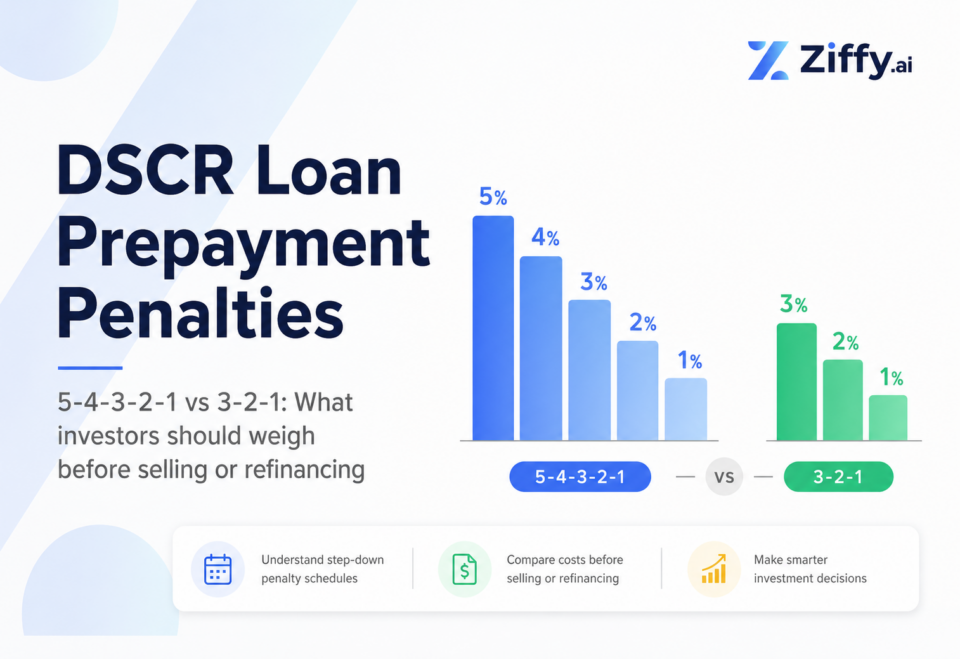
A DSCR loan prepayment penalty is a charge that may apply when an investor sells, refinances, or makes a large principal payment before the penalty period ends. Under a 5-4-3-2-1 structure, the penalty generally starts at 5% of the applicable loan balance in year one and falls by one percentage point each year. A 3-2-1 structure starts at 3% and ends after year three.

The longer structure may come with stronger pricing in some loan scenarios, but it can also make an early sale or refinance much more expensive. At Ziffy Mortgage, we compare the prepayment option with the investor's actual hold period, exit plan, expected cash flow, and total borrowing cost. The lowest rate is not automatically the best deal when the loan terms restrict the move the investor is most likely to make.
A 5-4-3-2-1 penalty can remain in force for five years, while a 3-2-1 penalty generally expires after three.
The percentage is commonly applied to the outstanding principal balance, although the promissory note controls the exact calculation.
A longer penalty period may improve pricing, but the savings need to outweigh the cost of losing flexibility.
Investors should model the penalty before choosing a sale, cash-out refinance, rate-and-term refinance, or BRRRR exit.
Table of Contents
What Is a DSCR Loan Prepayment Penalty?
A DSCR loan qualifies an investment property mainly through its rental income instead of the borrower’s personal debt-to-income ratio. Because these loans are built for non-owner-occupied investment properties, many programs include a prepayment provision that protects the expected return on the loan if the balance is paid down early.
The Consumer Financial Protection Bureau defines a prepayment penalty as a fee charged when all or part of a mortgage is paid off early. For a DSCR borrower, the triggering event may be a property sale, a refinance, a large principal curtailment, or another payoff event described in the note.
Most Ziffy DSCR loans are structured for non-owner-occupied investment use. For consumer mortgages covered by the Qualified Mortgage prepayment-penalty rules, a permitted penalty is capped at 2% during each of the first two years and 1% during the third year, and it cannot continue beyond year three. However, Regulation Z generally exempts credit extended primarily for a business or commercial purpose. As a result, those consumer-mortgage caps do not determine the terms of a business-purpose DSCR loan. State law and individual program rules can still limit or change the available prepayment structure. The property’s intended occupancy must be stated accurately, and final terms must be confirmed for the complete file.
Some penalties are “hard,” meaning they can apply to both a sale and a refinance. A “soft” penalty may allow a sale without the fee but still charge it on a refinance. The loan documents also determine whether routine extra principal payments are allowed, whether an annual curtailment limit applies, and how the penalty period is measured.
How the 5-4-3-2-1 and 3-2-1 Structures Work
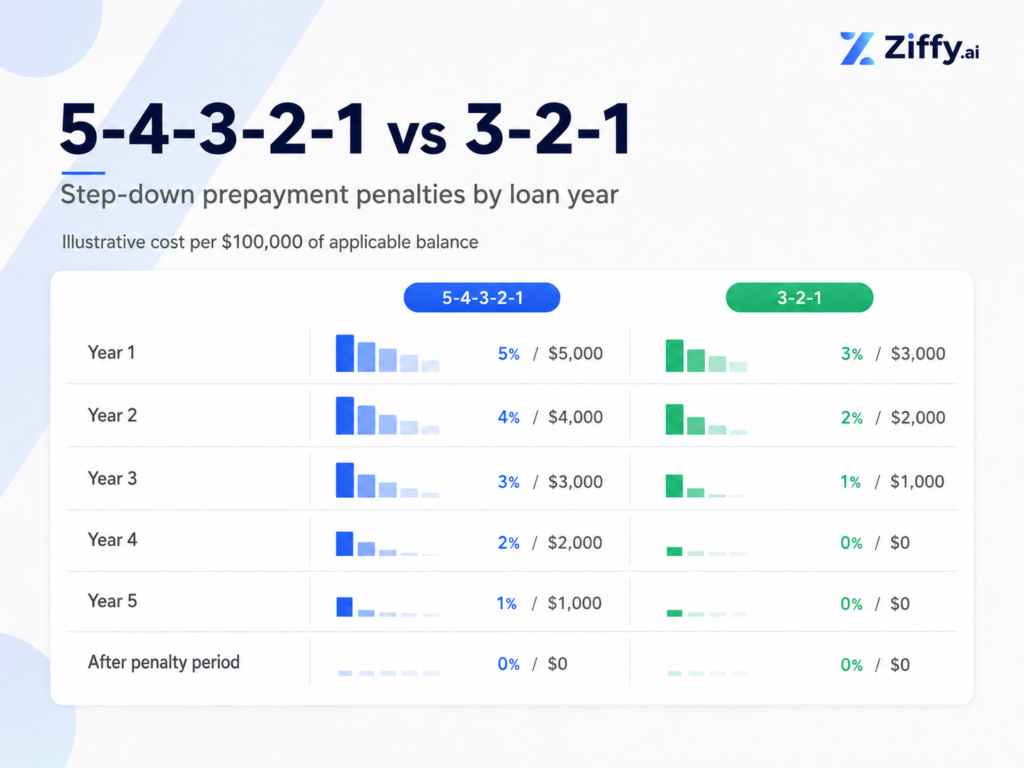
Both are declining, or step-down, penalties. The number for each year is the percentage used to calculate the charge during that period. Two step-down structures investors may encounter in 1-4 unit DSCR lending are 5-4-3-2-1 and 3-2-1. Availability and pricing vary by program, state, property, borrower profile, and complete file.
Loan Year | 5-4-3-2-1 Penalty | Cost Per $100,000 of Applicable Balance | 3-2-1 Penalty | Cost Per $100,000 of Applicable Balance |
|---|---|---|---|---|
Year 1 | 5% | $5,000 | 3% | $3,000 |
Year 2 | 4% | $4,000 | 2% | $2,000 |
Year 3 | 3% | $3,000 | 1% | $1,000 |
Year 4 | 2% | $2,000 | 0% | 0% |
Year 5 | 1% | $1,000 | 0% | 0% |
After the penalty period | 0% | 0% | 0% | 0% |
These are unit calculations, so the investor can scale them to the balance shown in the payoff statement:
Penalty = Applicable loan balance × Penalty percentage
Before relying on the result, confirm whether the note uses the outstanding balance, original principal, the amount prepaid, or another stated base.
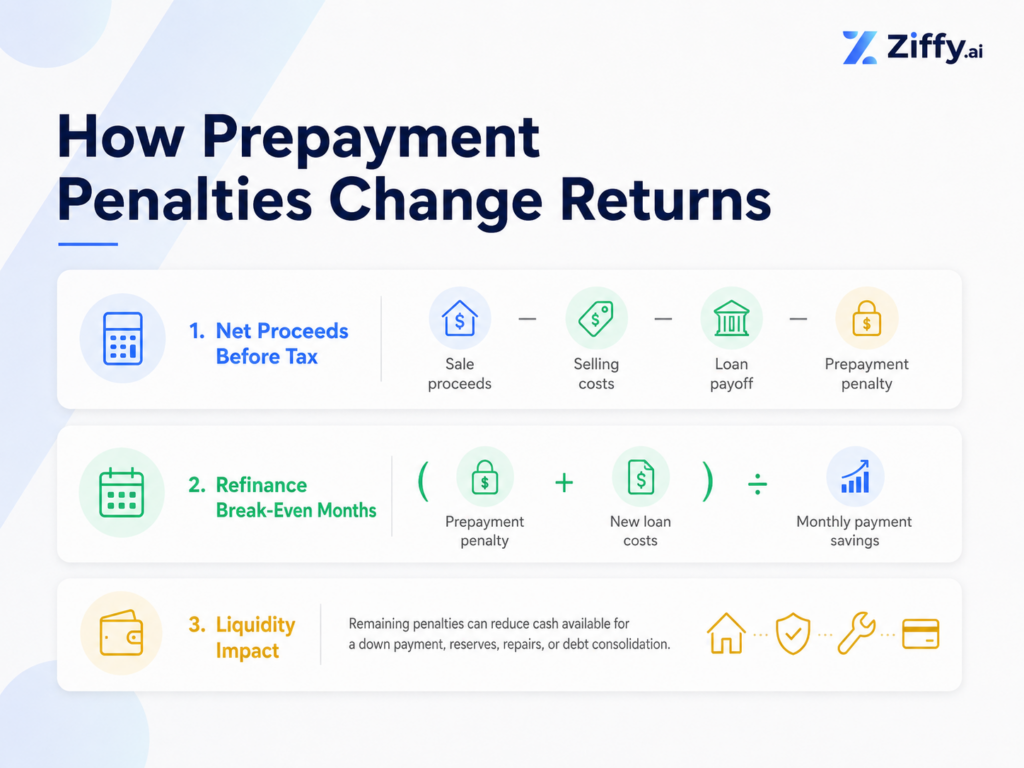
How Prepayment Penalties Change Investment Returns
They Reduce Net Sale Proceeds
A property can appreciate and still produce a disappointing exit if the selling costs, remaining mortgage balance, and prepayment charge consume more of the proceeds than expected.
Use this calculation before listing the property:
Net proceeds before tax = Sale proceeds - Selling costs - Loan payoff - Prepayment penalty
The penalty should be included in the sale analysis from the start. Leaving it out overstates the cash the investor will receive at closing and can distort the expected return on equity.
They Can Delay a Profitable Refinance
A lower market rate does not automatically make refinancing worthwhile. The new loan has closing costs, and the old loan may have a payoff charge.
Refinance break-even months = (Prepayment penalty + New loan costs) ÷ Monthly payment savings
The refinance only begins producing a net financing benefit after the cumulative savings recover both costs. Investors can use our rental property ROI calculator to review the property’s wider return, then compare the existing and proposed loan structures over the same holding period.
They Affect Portfolio Liquidity
A cash-out refinance can release equity for another down payment, repairs, reserves, or debt consolidation. A remaining prepayment penalty reduces the net cash available and may make the refinance less useful. This is especially relevant for investors planning to finance a second investment property with equity from an existing rental.
The same issue appears in a BRRRR plan. If the strategy depends on refinancing shortly after renovation and lease-up, a five-year penalty can conflict with the business plan. In that situation, bridge financing followed by permanent DSCR debt may fit the property cycle better than placing long-term debt too early.
They Can Offset Interest-Only Cash-Flow Gains
An interest-only DSCR loan may improve early monthly cash flow by delaying scheduled principal payments. That benefit should be measured against the rate, points, remaining balance, and prepayment terms. An investor who saves cash each month but pays a large exit charge two years later may not come out ahead.

Steven Glick
Director of Mortgage Sales · Ziffy Mortgage
A prepayment penalty is easy to ignore because it does not appear in the monthly payment. I look at it as an exit cost that has to earn its place in the loan. If the longer structure improves pricing, we calculate the likely savings and compare them with the cost of the investor’s most realistic sale or refinance date. When the exit plan and the penalty period do not line up, the lower rate can be the more expensive choice.
Which Structure Fits the Investment Plan?
A 5-4-3-2-1 structure may fit a stable buy-and-hold property when the investor expects to keep the loan beyond year five and the pricing benefit is meaningful. It becomes less attractive when the plan depends on a near-term sale, a renovation-driven refinance, or rapid portfolio recycling.
A 3-2-1 structure preserves more flexibility after the third year. It may suit an investor who expects a medium-term hold or wants a clearer path to refinancing once the property has seasoned. It still creates a real cost during the first three years, so it should not be treated as penalty-free.
When available, a shorter or no-penalty option may be worth pricing for investors with uncertain hold periods. It can carry a different interest rate, points, leverage limit, or other adjustment. We compare the complete loan, not one isolated feature. Our article on what determines a DSCR loan rate explains how prepayment terms interact with credit, LTV, DSCR, reserves, property profile, and loan structure.
What to Confirm Before Closing
Ask for the exact prepayment schedule and review it against the expected exit date. The note should answer these questions:
- Does the penalty apply to a sale, refinance, partial principal payment, or all three?
- Is it calculated from the outstanding balance, original balance, or amount prepaid?
- Does each step change on the loan anniversary or another specified date?
- Are any principal curtailments allowed without charge?
- Is a shorter or no-penalty structure available, and how does its total cost compare?
Final Takeaway
Before selecting a prepayment option, ask your loan originator to price the available structures side by side. Calculate the cost at the earliest realistic sale or refinance date rather than assuming the loan will remain in place for its full term. This shows whether any pricing benefit from a longer penalty period is worth the lost flexibility.
At Ziffy Mortgage, we structure DSCR financing around the property, the investor’s capital plan, and the expected holding period. Review the available options with a licensed loan originator before committing to the rate or the penalty term.
FAQs
Do All DSCR Loans Have Prepayment Penalties?
No. Availability depends on the program, state, property, borrower profile, leverage, and complete transaction. Some loans may offer several penalty options, while others may have one permitted structure.
Does a Prepayment Penalty Apply When the Property Is Sold?
It can. A hard penalty may apply to both a sale and a refinance. A soft penalty may waive the charge for a permitted sale. The note, rider, and payoff statement control.
Can I Make Extra Principal Payments on a DSCR Loan?
Possibly. Some loan documents allow limited principal curtailments, while others charge a penalty once a stated threshold is exceeded. Confirm the allowance before making an additional payment.
Is a 3-2-1 Structure Always Better Than 5-4-3-2-1?
No. The shorter structure offers earlier flexibility, but the pricing may differ. The better choice is the one with the lower total cost over the period the investor realistically expects to keep the loan.
How Should I Compare Two DSCR Quotes?
Compare the same loan amount, LTV, amortization, interest-only period, rate-lock period, points, lender credits, reserve requirement, and prepayment structure. Use the Ziffy DSCR calculator to test the payment and ratio, then add the expected exit cost separately.