





Editorial Integrity
Making sound real estate investment decisions begins with reliable, data-driven insights. At Ziffy.ai, we offer an AI-native real estate investing, proprietary data-driven trend analysis, investment mortgage programs like DSCR loans, and a network of over 500 investor-friendly real estate agents to deliver the expertise needed for informed decisions. Our content is crafted by experienced real estate professionals and backed by real-time market data, ensuring you receive accurate and actionable information. Through a rigorous editorial process, we strive to empower your investment journey with trustworthy and up-to-date guidance.
Quick Answer:

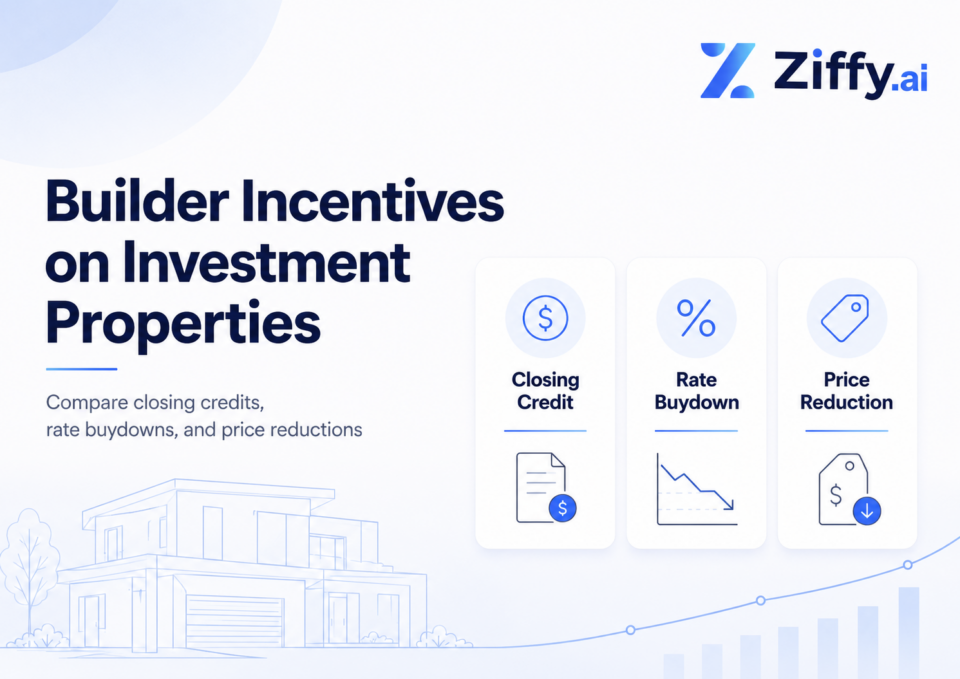
A builder incentive helps an investment-property buyer only when it improves the final loan and the property still works at its full, long-term cost. A closing credit is usually strongest when cash to close is the constraint. A permanent rate buydown can provide more value during a long hold. A price cut is often cleaner when the appraisal is tight, the investor expects to refinance or sell sooner, or the builder’s preferred-lender pricing weakens the advertised incentive.

Compare all three choices using the same loan amount, lock date, property expenses, and expected holding period. The largest headline incentive is not necessarily the least expensive deal.
Builder incentives are common in 2026, but their value depends on loan rules, usable closing costs, lender pricing, and the investor’s hold period.
A closing-cost credit preserves liquidity but generally cannot replace the required down payment or reserves.
Temporary buydowns need extra scrutiny because investment-property eligibility differs from owner-occupied financing.
A price reduction lowers acquisition cost and may reduce appraisal risk, while a rate buydown targets financing cost.
Compare full PITIA, DSCR, cash to close, post-closing reserves, and total borrowing cost.
In July 2026, 63% of builders reported using sales incentives, while 37% cut prices by an average of 6%, according to the National Association of Home Builders. The US Census Bureau’s May 2026 New Residential Sales release reported 496,000 new homes for sale at the end of May, equal to 10.3 months of supply at that month’s sales pace. Investors have negotiating room, but every incentive does not carry the same value.
Table of Contents
What Are Builder Incentives on Investment Properties?
Builder incentives are concessions offered to move a completed home, quick-move-in property, or inventory in a slower-selling community. They may include a closing-cost credit, discount points, a temporary payment buydown, a price cut, upgrades, or limited HOA assistance.
The selected investment property loan determines how much of the incentive can be used. Under Fannie Mae’s interested-party contribution rules, a builder is an interested party. Financing concessions on a conventional investment property are capped at 2% of the lower of the sales price or appraised value. They can cover eligible closing costs and prepaids, but they cannot supply the down payment, satisfy reserve requirements, or exceed the borrower’s actual closing costs.
DSCR and other non-QM loans follow their own program rules. Before negotiating a credit, the investor needs the lender to confirm the allowable amount, eligible uses, and whether a preferred-lender offer changes the underlying rate or fees.
Closing Cost Credit vs Price Reduction: Which Saves More?
A closing cost credit and a price reduction solve different problems.
A Closing Credit Helps When Liquidity Matters Most
A closing credit can reduce the money due for lender fees, title charges, prepaid taxes, insurance, discount points, and other permitted costs. That may leave more cash available for reserves, furnishing, leasing costs, or the next acquisition.
The credit has value only up to the amount the loan can use. If the builder offers more than the eligible closing costs, the unused portion does not become cash back. On a conventional investment loan, an excessive concession can also reduce the sales price used for underwriting.
A Price Cut Helps When Value or Exit Flexibility Matters
A price reduction lowers the amount paid for the property. Depending on the financing structure, it may also reduce the loan amount, monthly principal and interest, and required down payment.
It can be more useful when comparable sales do not support the contract price. It also avoids paying upfront for a rate benefit that may be lost if the investor refinances or sells before reaching the breakeven point.
For tax records, IRS Publication 551 explains that certain acquisition-related settlement costs may be added to basis, while loan-related charges such as points and origination fees are not added under those rules. A tax professional should review the final closing statement.
Is a Builder Rate Buydown Worth It on an Investment Property?
A rate buydown is worth considering when it applies to an eligible investor loan, the investor expects to keep that loan long enough, and the property performs at the permanent payment.
A permanent buydown uses discount points to lower the note rate for the life of the loan. A temporary buydown subsidizes payments for an introductory period, after which the borrower pays according to the full note rate.
One important distinction is often missed: Fannie Mae does not allow temporary interest-rate buydowns on investor properties. Its guide also requires eligible borrowers with temporary buydowns to qualify at the note rate, not the reduced introductory payment.
A DSCR program may treat buydowns differently, so the structure must be reviewed before the sales contract is finalized. An advertised 2-1 or 3-2-1 buydown may not apply to a non-owner-occupied purchase.
The Consumer Financial Protection Bureau notes that one discount point equals 1% of the loan amount, but there is no fixed amount by which one point must reduce the rate. Compare the actual rate sheet and Loan Estimate.
At Ziffy Mortgage, we evaluate builder incentives by translating them into the investor’s actual loan structure. A large headline credit can lose value if the loan can use only part of it, the preferred-lender rate is higher, or the property’s DSCR is being shown at a temporary payment. The useful comparison is the note rate, full PITIA, cash to close, and reserves after closing.
When a Price Cut Helps More Than a Mortgage Rate Buydown
A price cut usually deserves more weight when:
- the appraisal may come in below the contract price
- the investor may refinance, exchange, or sell before recovering the cost of points
- the preferred lender’s fees or base rate reduce the buydown’s value
- the lower loan amount materially improves DSCR
- the investor wants a cleaner comparison with nearby resale properties
A price cut and a permanent buydown affect different parts of the transaction, so neither incentive wins automatically. A price cut reduces the amount paid for the property, while a permanent buydown lowers financing costs. The stronger option depends on the actual rate reduction, purchase price, loan amount, and how long the investor expects to keep the loan.
A buydown can still win when the rate reduction is permanent, the investor expects a long hold, and savings continue beyond the breakeven date.
At Ziffy Mortgage, we use the expected hold period to test the trade-off. A permanent buydown can be strong when the borrower expects to keep the loan long enough to recover the cost. A price cut is often cleaner when the appraisal is tight or the investor may refinance or sell sooner. The decision should be based on the total cost over the period the investor expects to own the debt, not the builder’s marketing number.
Can Builder Incentives Be Used on DSCR Loans?
Builder incentives can be used with some DSCR loans, but the credit must fit the program and appear correctly in the contract, appraisal, underwriting file, and closing documents.
At Ziffy Mortgage, a DSCR loan is evaluated through the property’s rental income, PITIA, leverage, reserves, credit profile, and overall structure. A builder credit may lower cash to close or fund eligible points, yet it does not repair unsupported rent, underestimated taxes, high insurance, restrictive HOA rules, or weak cash flow.
This matters with new-build rental properties. A completed home’s tax bill can change from the initial estimate, and a new property may have no lease or operating history. Rent support, completed-home taxes, insurance, HOA dues, and rental restrictions should be reviewed before the incentive is treated as part of the return.
How to Compare a Closing Credit, Rate Buydown, and Price Cut
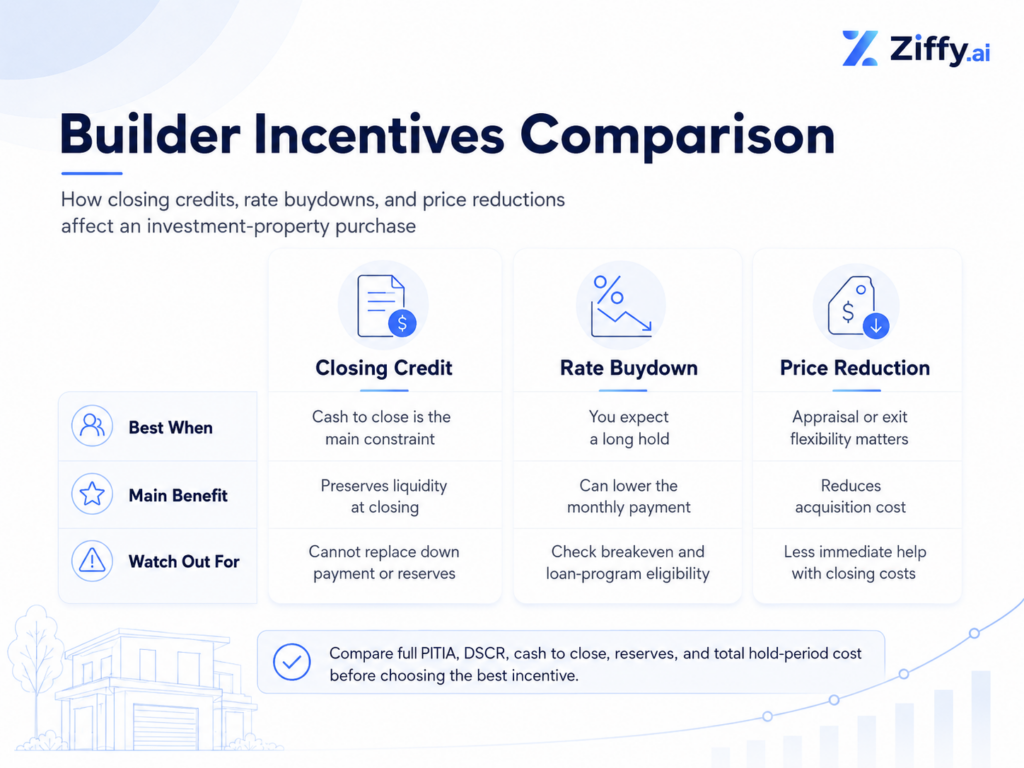
Ask for three written versions of the same transaction. Keep the lock date, loan product, down payment, and estimated property expenses consistent.
Compare | Closing Credit | Rate Buydown | Price Cut |
|---|---|---|---|
Cash to close | Usually lower | May be lower if builder pays points | Depends on down-payment structure |
Note rate | Usually unchanged | Lower if permanent | Usually unchanged |
Loan amount | Usually unchanged | Usually unchanged | May decline |
Early cash flow | Improved through preserved cash | Improved through lower payment | Improves if loan amount falls |
Appraisal exposure | Contract price remains | Contract price remains | Lower contract price |
Hold-period sensitivity | Low | High because breakeven matters | Lower |
Main risk | Credit cannot be fully used | Savings may not reach breakeven | Less immediate closing-cost relief |
Compare cash required at closing, note rate, full PITIA, DSCR, reserves after closing, points and lender fees, total cost over the expected hold, and refinance or prepayment implications.
The CFPB recommends comparing formal Loan Estimates for the same loan type and amount. A builder’s preferred lender may offer the best package, but measure it against at least one outside option issued on the same day.
Builder Incentive Red Flags for Real Estate Investors
Pause before signing when the offer:
- shows only the temporary payment instead of the full note-rate payment
- requires a higher contract price to fund the credit
- cannot be fully used under the selected loan
- depends on a preferred lender without a comparable Loan Estimate
- relies on incomplete tax, insurance, HOA, or rent assumptions
- is not disclosed to the lender or appraiser
- makes the property appear profitable only during the incentive period
A new home may offer lower near-term maintenance, but the investment still has to work after the promotion ends.
FAQs
Can a Builder Pay Closing Costs on an Investment Property?
Yes, subject to the loan program’s concession limits and the borrower’s actual eligible costs. For a Fannie Mae conventional investment property, the limit is 2% of the lower of the sales price or appraised value.
Is a Builder Rate Buydown Better Than a Price Reduction?
It can be for a long-term hold when the buydown is permanent and savings exceed the upfront cost. A price reduction may be stronger when the appraisal is tight or the investor expects to refinance or sell earlier.
Can a Builder Credit Be Used for the Down Payment?
Not under Fannie Mae’s interested-party contribution rules. Builder funds cannot provide the required down payment, minimum borrower contribution, or reserves. DSCR rules should be confirmed separately.
Do Builder Incentives Affect the Appraisal?
They can. The lender and appraiser need to know about sales and financing concessions. Excessive concessions may reduce the price used to calculate LTV under conventional rules.
Should an Investor Use the Builder’s Preferred Lender?
Only after comparing the preferred-lender package with an outside Loan Estimate for the same loan structure and date. Include the base rate, points, lender fees, credit, cash to close, full payment, and total cost over the expected hold.