





Editorial Integrity
Making sound real estate investment decisions begins with reliable, data-driven insights. At Ziffy.ai, we offer an AI-native real estate investing, proprietary data-driven trend analysis, investment mortgage programs like DSCR loans, and a network of over 500 investor-friendly real estate agents to deliver the expertise needed for informed decisions. Our content is crafted by experienced real estate professionals and backed by real-time market data, ensuring you receive accurate and actionable information. Through a rigorous editorial process, we strive to empower your investment journey with trustworthy and up-to-date guidance.
Build to rent, or BTR, is no longer only a private equity strategy. For individual investors, the practical version is much simpler: you buy a completed or near-completed new-construction home from a builder, lease it as a rental, and finance it like an income-producing investment property.
That is the part most BTR coverage skips. The institutional story is about capital stacks, community-level development, and portfolio exits. A small-portfolio investor has a different question: can one new-build rental actually cash flow after principal, interest, taxes, insurance, and association dues?
At Ziffy, that is the lens we care about. A build-to-rent property is only attractive if the rent supports the debt and the financing structure treats the asset as an income property, not a primary residence. For many investors, that makes a DSCR loan the cleanest way to evaluate and finance the acquisition.
Table of Contents
What Build to Rent Means for Individual Investors
For an individual investor, BTR does not usually mean buying land, hiring a builder, and developing a rental community from scratch. It usually means purchasing a newly built single-family home, townhouse, or small residential property that is intended to operate as a rental from day one.
That distinction changes the strategy. You are acting like a buy-and-hold investor who wants a cleaner property going into the hold period and a more straightforward path through underwriting.
Institutional BTR communities may include 50, 100, or 200-plus rental homes with shared amenities and professional management. Individual-investor BTR is narrower. You may buy one newly built home in a suburban subdivision, one townhome in a new rental-heavy community, or one completed builder inventory home that can be leased immediately.
On Ziffy, the first step is not contacting the builder. It is screening the numbers. Our AI-native real estate investing workflow helps investors look at estimated rent, projected cash flow, debt service coverage ratio, and market-level investor metrics before they decide whether a new-build rental deserves a serious financing conversation.
Why BTR has grown and where it stands in 2026
The build-to-rent market is not collapsing, but it is no longer running on easy optimism. Construction activity has pulled back even as rental demand holds at 94.5% occupancy. That combination creates a more selective environment for investors who know how to underwrite.
Harvard’s Joint Center for Housing Studies reported that single-family homes built as rentals accounted for 16% of new rental units in 2024, with a record 113,000 single-family rental completions that year. The National Association of Home Builders (NAHB), using US Census Bureau data, reported that single-family built-for-rent starts fell to 68,000 in 2025, down 19% from 84,000 in 2024, with about 15,000 starts in the fourth quarter of 2025.
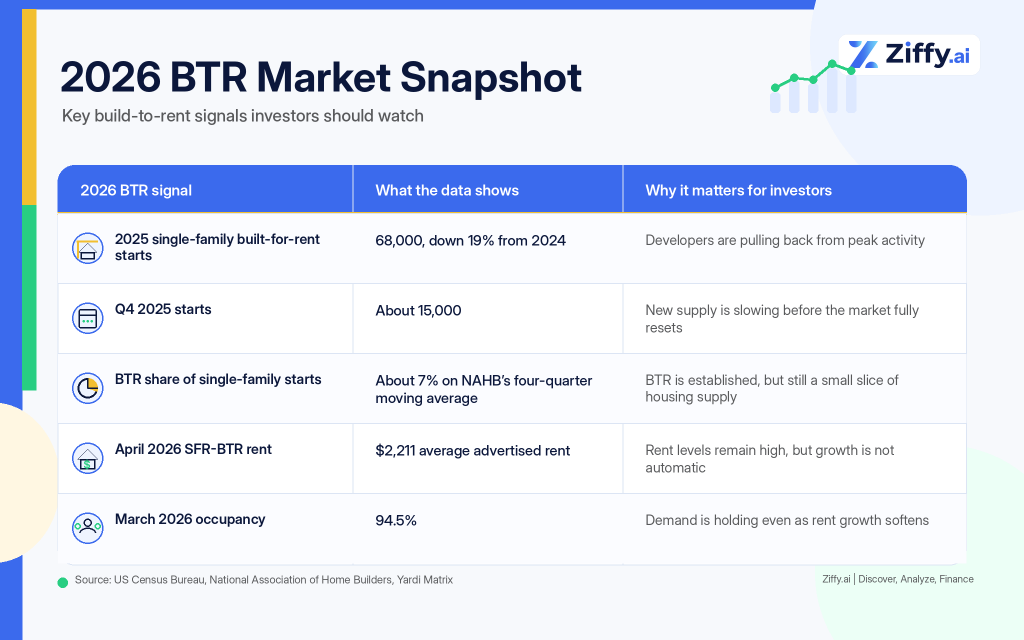
Yardi Matrix reported that single-family build-to-rent advertised rents reached $2,211 in April 2026, down 0.5% year over year, while occupancy across the sector was 94.5% in March. Renters still want the product, but rent growth cannot be assumed to rescue a thin deal.
The legislative picture shifted before this article published. The Senate version of the 21st Century ROAD to Housing Act included a seven-year disposition requirement for certain institutionally financed new-construction single-family rental housing. NAHB warned in March that the provision could place about 40,000 units per year at risk. The House-approved version removed the seven-year sell mandate, according to Cato’s summary of the House amendment, but the bill still needs final monitoring because active legislation can change quickly.
For individual investors, the opportunity is specific. Some developers are facing a slower institutional capital environment while renters still want newer single-family homes. That can create room for disciplined buyers who know how to verify rent, taxes, homeowners association fees, and financing before making an offer.
What Makes a Build-to-Rent Property Different from an Existing Rental
A new-build rental changes the first five years of ownership. That is the real investment case.
With an older rental, your pro forma can get hit by deferred maintenance. A roof replacement, heating, ventilation, and air conditioning issue, plumbing problem, or major turnover repair can wipe out months of cash flow. A build-to-rent property will still need maintenance, but the early hold period is usually cleaner because the systems are newer and the condition is easier to verify before closing.
Builder warranties also matter, but investors should read them carefully. A warranty is not a blank check for every repair. Workmanship, systems, appliances, and structural coverage may all have different terms, exclusions, and claim processes. The value is not only the coverage itself, but the reduction in early uncertainty.
Arbor and Chandan Economics estimated that the single-family rental household count reached 14.6 million in 2025, a seven-year high. That demand base supports the broader single-family rental category, but BTR still has to compete at the property level. Attached garages, private outdoor space, and modern energy efficiency give a BTR rental a competitive edge in suburban markets where renters are weighing total housing cost, not only rent.
A clean property condition changes more than the tenant pitch. It changes what a lender sees in the underwriting file. A finished property removes the renovation variables that make rehab files slow; no contractor timeline, no condition unknowns, no after-repair value to support. The lender still has to verify rent, value, title, insurance, reserves, and borrower eligibility, but the property condition questions are usually less complicated.

Steven Glick,
Director of Mortgage Sales, Ziffy, NMLS #1231769
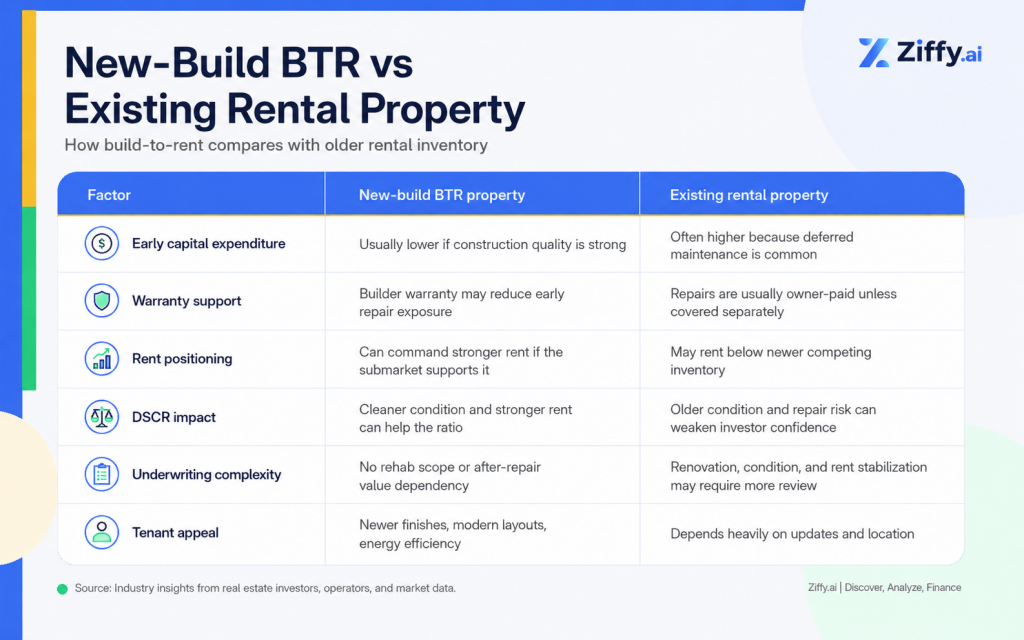
The cleanest BTR deals are not the newest homes by default. They are the homes where the rent premium is large enough to offset the higher purchase price.
How to Finance a Build-to-Rent Property
BTR is an investment asset, but conventional financing still treats the borrower like the center of the file. That can work for an investor with strong documented income, limited existing mortgages, and no plan to scale quickly. The friction shows up when the portfolio grows.
Fannie Mae’s Selling Guide limits investment property transactions to 10 financed properties under Desktop Underwriter. It also adds reserve requirements as the borrower’s financed property count increases. For investors with seven to ten financed properties, Fannie Mae’s reserve calculation can reach 6% of the aggregate unpaid principal balance on other financed properties.
DSCR financing solves a different problem. It lets the rental property carry the qualification conversation. That is why DSCR is the structurally correct financing path for most BTR acquisitions, particularly when the hold period aligns with the loan’s prepayment structure.
With a debt service coverage ratio loan, the lender looks at whether the property’s supported rental income can cover PITIA, which means principal, interest, taxes, insurance, and association dues. For a completed or nearly completed BTR purchase, the appraiser can support rent using comparable rentals rather than relying on a lease history that does not exist yet.

Lucas Hernandez,
Mortgage Loan Originator, Ziffy, NMLS #2171747
A DSCR purchase is the simpler path. The home is finished, the appraisal supports rent, the insurance and tax numbers can be modeled, and the investor can move straight into a long-term rental hold.
Bridge-to-DSCR is different. It is for the investor who needs short-term capital before the rental is ready for permanent financing. The bridge loan handles the acquisition or construction stage. Once the property is complete, leased, and producing rental income, the investor refinances into a DSCR loan. This structure makes sense only when the exit math is clear before the bridge loan closes.
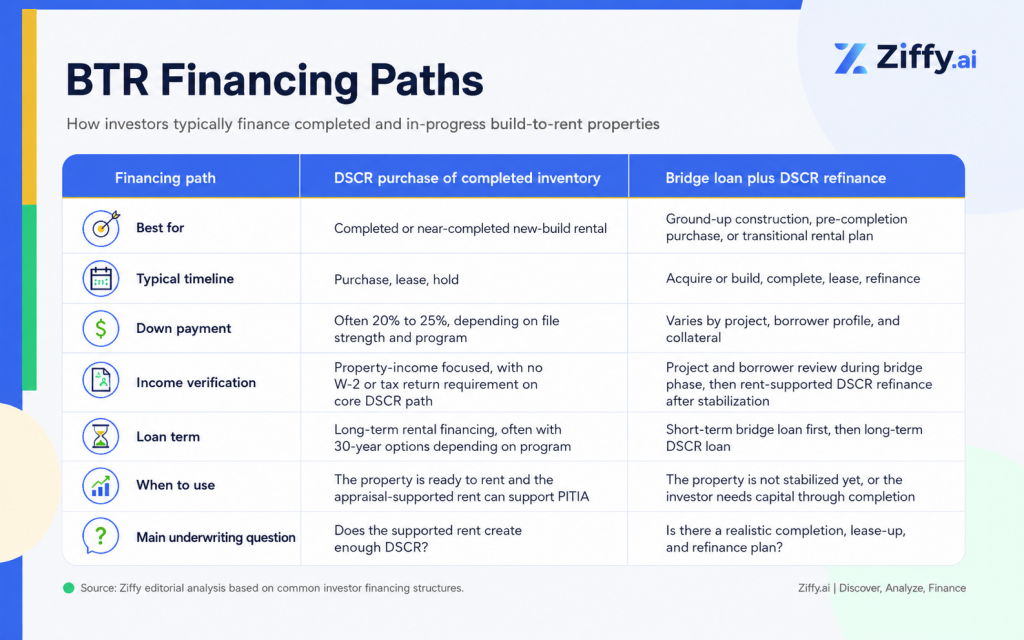
Ziffy’s bridge and DSCR products are meant to support that investor sequence, but the underwriting discipline comes first. A bridge loan should not be used to hope a BTR deal becomes financeable later. The refinance target, expected rent, completed value, reserves, and lease-up timeline should be tested before the first loan is approved.
When the property is complete, documentation is in order, and the rent supports the PITIA, DSCR underwriting can move at an acquisition pace, typically 21 to 30 days. The cleaner the file is before submission, the less likely the investor is to lose time clarifying rent, insurance, ownership structure, reserves, or property eligibility.
Financing disclosure: Loan terms, down payment, rates, reserves, debt service coverage ratio requirements, and eligibility vary by borrower profile, property type, state, loan purpose, occupancy, and market conditions. Ziffy Mortgage does not guarantee approval, terms, or rates. All loans are subject to underwriting review.
How to Evaluate Whether a BTR Property Actually Cash Flows
The builder’s pro forma is the starting document, not the answer.
A builder may show a clean rent estimate, low repair costs, and a neat cap rate. That can be useful, but the investor still needs independent analysis. At Ziffy, the pre-offer conversation starts with one question that has four parts: what is the real PITIA once taxes and HOA dues reset after purchase, and does the supported rent still cover it if the market rent comes in lower than the builder’s estimate?
The debt service coverage ratio calculation is:
Gross monthly rent ÷ monthly PITIA = DSCR
For a new-build, the tax line is one of the easiest assumptions to get wrong. A property may show a low tax bill while it is still assessed as land or partially completed construction. After purchase, the assessed value can reset and raise the monthly PITIA. Homeowners association (HOA) dues create the same problem in a different way: they look small beside the purchase price, but they count directly against DSCR.

Dorian Adams-Walker,
Mortgage Loan Originator, Ziffy, NMLS #2442830
What most guides do not mention is that a BTR property can look stronger than an older rental on maintenance risk and still lose ground in the loan calculation because of taxes or HOA dues. That is why Ziffy’s pre-offer analysis focuses on the full housing payment, not just rent against principal and interest.
Here is the kind of pre-offer math an investor should run before relying on the builder’s rent estimate.
Worked BTR DSCR example
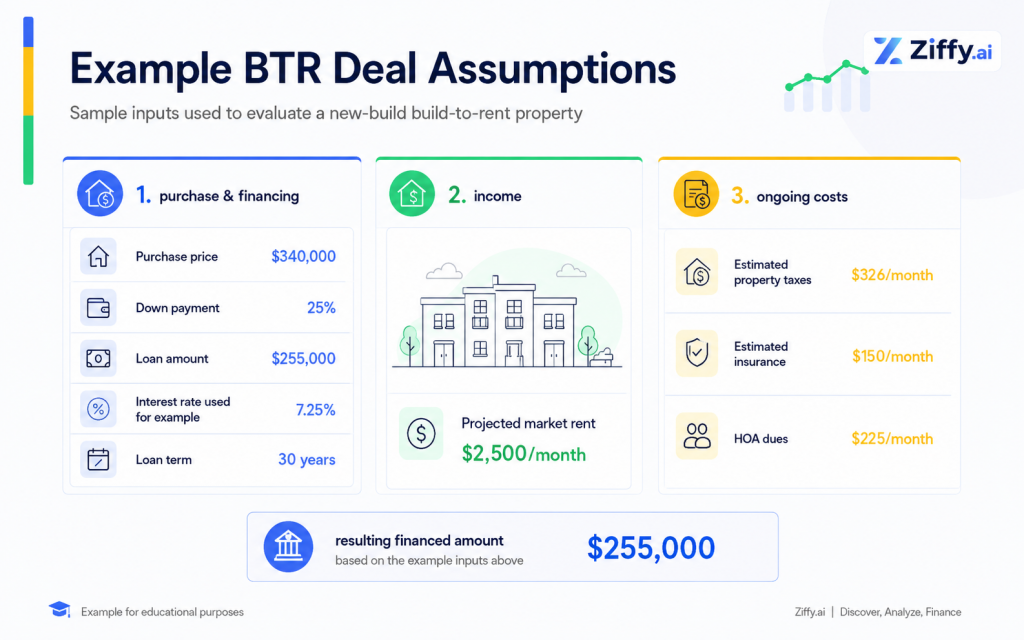
Using those assumptions, the estimated principal and interest payment is about $1,739 per month. Add estimated taxes of $326, insurance of $150, and HOA dues of $225, and the total PITIA is about $2,440.
- Gross monthly rent: $2,500
- Estimated PITIA: $2,440
- DSCR: $2,500 ÷ $2,440 = 1.02
A 1.02 DSCR is technically above 1.0, but it is not a comfortable deal. The HOA fee is the pressure point. Without the $225 monthly HOA dues, PITIA would drop to about $2,215 and the DSCR would improve to roughly 1.13.
That is why BTR underwriting has to include every housing-cost line before the investor makes an offer. A property that looks clean at the rent-and-mortgage level can become borderline once taxes, insurance, and HOA dues are included.
Ziffy’s DSCR calculator is where investors can test that number directly. Plug in the supported rent, estimated loan payment, taxes, insurance, and association dues. If the DSCR is close to the minimum threshold, use the cash flow calculator and rental property ROI calculator to stress-test vacancy, management, repairs, and reserves before assuming the deal works.
The deals that work have enough margin that one wrong assumption does not break the model. The ones that do not work are usually priced on the builder’s best-case rent, with taxes and HOA dues treated as rounding errors.
Best Markets for Build-to-Rent Investing in 2026
BTR is concentrated in the Sun Belt, but the investor decision is not simply to buy in the Sun Belt. The decision is whether a specific submarket has enough tenant demand, realistic rent, and purchase-price discipline to support the loan.
RealPage reported that about 61,700 BTR units were under construction across the US as of early May 2026, with nearly 61% of the pipeline concentrated in the South. Phoenix, Dallas, Atlanta, Nashville, Raleigh/Durham, and Tampa are among the notable BTR construction markets.
Market | Public BTR signal | What to underwrite carefully | Ziffy investor read |
|---|---|---|---|
Roughly 3,700 BTR units in progress. | Property taxes, suburban purchase price, insurance, and builder concessions. | Dallas has BTR depth, but the tax line can turn a good rent estimate into a tighter DSCR file. | |
Phoenix is the largest BTR construction market, with almost 7,300 units in progress. | Lease-up competition, rent softness, and incentives that make the purchase price look better than the long-term cash flow. | Phoenix has deep BTR inventory, so investors should compare the subject property against competing new rentals before assuming premium rent. | |
About 3,500 BTR units progressing in Atlanta. | Submarket-level rent differences, insurance, property taxes, and tenant demand outside the strongest job corridors. | Atlanta can work for BTR, but the difference between a strong suburb and an oversupplied pocket is meaningful for DSCR. | |
About 2,100 BTR units underway in Tampa. | Insurance, taxes, flood exposure, and HOA costs. | Tampa can show attractive rent levels, but Florida insurance can change the file quickly. Run PITIA before judging the deal. | |
About 2,800 BTR units underway in Nashville. | Higher acquisition prices, rent-to-price ratio, and whether the submarket has enough renter depth. | Nashville’s demand story is strong, but the property still needs enough rent to support the new-build price. | |
About 2,300 BTR units underway in Raleigh/Durham, with Southeast Raleigh among the highest-activity submarkets. | New-build pricing, apartment competition, and whether single-family rent is supported by local comps. | Raleigh has a strong employment story, but investors should avoid using broad market rent medians as a proxy for new-build BTR rent. |
The table is a starting point for submarket research, not a final ranking. Dallas and Phoenix have the deepest BTR pipelines, but that also means more competing rental product. Tampa and Nashville can show stronger rent levels, but insurance or purchase price can erase the advantage. Raleigh has strong growth fundamentals, but the rent-to-price relationship needs careful review.
The next step is to search new-construction rentals in the market, compare estimated rent against PITIA, then calculate DSCR before contacting the builder. That is the reason Ziffy combines property search, rent estimates, investor metrics, and financing in one workflow.
For broader market comparison, start with best places to invest in real estate, then narrow the decision using property-level DSCR and cash flow.
Risks and Downsides Investors Should Weigh
The biggest BTR risk is paying a new-build premium without getting enough rent premium in return. A clean property is not automatically a profitable property. If the home costs meaningfully more than nearby existing rentals and the rent difference is thin, the DSCR can be weaker than the investor expected.
HOA fees deserve separate attention. Many newer communities have dues for landscaping, amenities, common areas, or maintenance. That may help tenant appeal, but the dues still count in PITIA. Investors who ignore the fee are usually overstating both cash flow and DSCR.
Property taxes are another common miss. A newly built home may be assessed differently after purchase, especially in states where tax reassessment can materially increase the monthly payment. Texas is the obvious example, but the broader rule applies everywhere: never underwrite a new-build rental using only the seller’s current tax line without checking how it may reset.
Builder incentives need careful reading too. Closing cost credits, rate buydowns, appliance packages, and upgrade credits can help the economics, but they can come with trade-offs. Some may require a preferred lender, a preferred title company, a specific closing timeline, or terms that do not match the investor’s loan strategy.
Policy risk is less severe than it appeared earlier in 2026 because the House-approved version removed the seven-year forced-sale mandate, but the topic is still active enough to watch. If final federal policy tightens around institutional single-family rental ownership, it could affect capital flows, community values, and builder strategy even when individual investors are not the direct target.
Lucas Hernandez,
Mortgage Loan Originator, Ziffy, NMLS #2171747
Concentration risk is the last piece. If a community has a heavy share of investor-owned rentals, several landlords may cut rents at the same time during a slower leasing period. That can make the community feel stable during the purchase phase and much more competitive during lease-up.
That is what separates a disciplined BTR purchase from an optimistic one. The math either works before the offer is made, or it does not work at all.
If the property math works, a new-build rental is one of the cleaner acquisitions in an investor’s portfolio. The underwriting conversation is about rent and debt, not renovation scope or unknown repair history. The question is always whether the rent supports the debt, and that answer can be calculated before you make the offer.
Use Ziffy to screen new-construction rentals by estimated rent, cash flow, debt service coverage ratio, and investor metrics. Then use Ziffy’s DSCR calculator to see whether the property can support financing before you commit to the deal.
FAQs
Can I use a DSCR loan to buy a build-to-rent property?
Yes. A completed or near-completed build-to-rent property can be financed with a DSCR loan if the property, rent, borrower profile, state, and loan file meet program requirements. Start with Ziffy’s DSCR loan requirements to understand how rent, PITIA, credit, reserves, and loan-to-value affect eligibility.
What DSCR ratio do I need for a new-construction rental?
A DSCR of 1.0 or higher is generally stronger because the property’s rent covers PITIA. Some files may qualify through lower-ratio or no-ratio structures depending on borrower profile, down payment, reserves, and program availability, but those options need full underwriting review.
Is build to rent only for large institutional investors?
No. Institutions often build or buy entire BTR communities, but individual investors can participate by buying one new-construction rental property and holding it as part of a portfolio. The key is to underwrite the property as an income asset, not as a primary residence.
How is rent determined for a new-build property with no rental history?
The lender typically relies on appraisal-supported market rent. The appraiser reviews comparable rentals with similar location, size, condition, and features, then reports a supported rent estimate that can be used in the DSCR calculation.
What is the difference between build to rent and fix and flip?
Build to rent is usually a buy-and-hold rental strategy built around long-term rent and cash flow. A fix and flip loan is designed for short-term acquisition, renovation, and resale, where the exit is selling the property rather than holding it as a rental.
Do BTR properties qualify for 1031 exchanges?
A BTR property may qualify for a 1031 exchange if it is held for investment or business use and the transaction follows IRS requirements. Tax rules are fact-specific, so investors should review 1031 exchange rules and consult a qualified tax professional before structuring the transaction.