






Editorial Integrity
Making sound real estate investment decisions begins with reliable, data-driven insights. At Ziffy.ai, we offer an AI-native real estate investing, proprietary data-driven trend analysis, investment mortgage programs like DSCR loans, and a network of over 500 investor-friendly real estate agents to deliver the expertise needed for informed decisions. Our content is crafted by experienced real estate professionals and backed by real-time market data, ensuring you receive accurate and actionable information. Through a rigorous editorial process, we strive to empower your investment journey with trustworthy and up-to-date guidance.
Quick Answer:

When an investment property appraises below the purchase price, an investor may request a reconsideration of value, renegotiate the price, reduce the loan amount, revise the mortgage structure, address property-condition issues, or use short-term financing that better fits the property. The best option depends on whether the appraisal is unsupported or the property was priced above the market.
A low appraisal does not automatically end an investment property purchase, but it changes the financing math. The lender may reduce the supported loan amount, the buyer may need more cash, and the return may no longer match the original underwriting.
Find out why the value came in low, rerun the numbers, and choose a structure that still protects the investment.
A low appraisal can reduce the supported loan amount and increase the cash required at closing.
Investors should first decide whether the report contains a correctable error or reflects market value.
Price, leverage, loan structure, property condition, and financing type may all be adjusted.
The revised purchase must still support the investor’s return, liquidity, and long-term plan.
Table of Contents
Why a Low Appraisal Changes the Loan
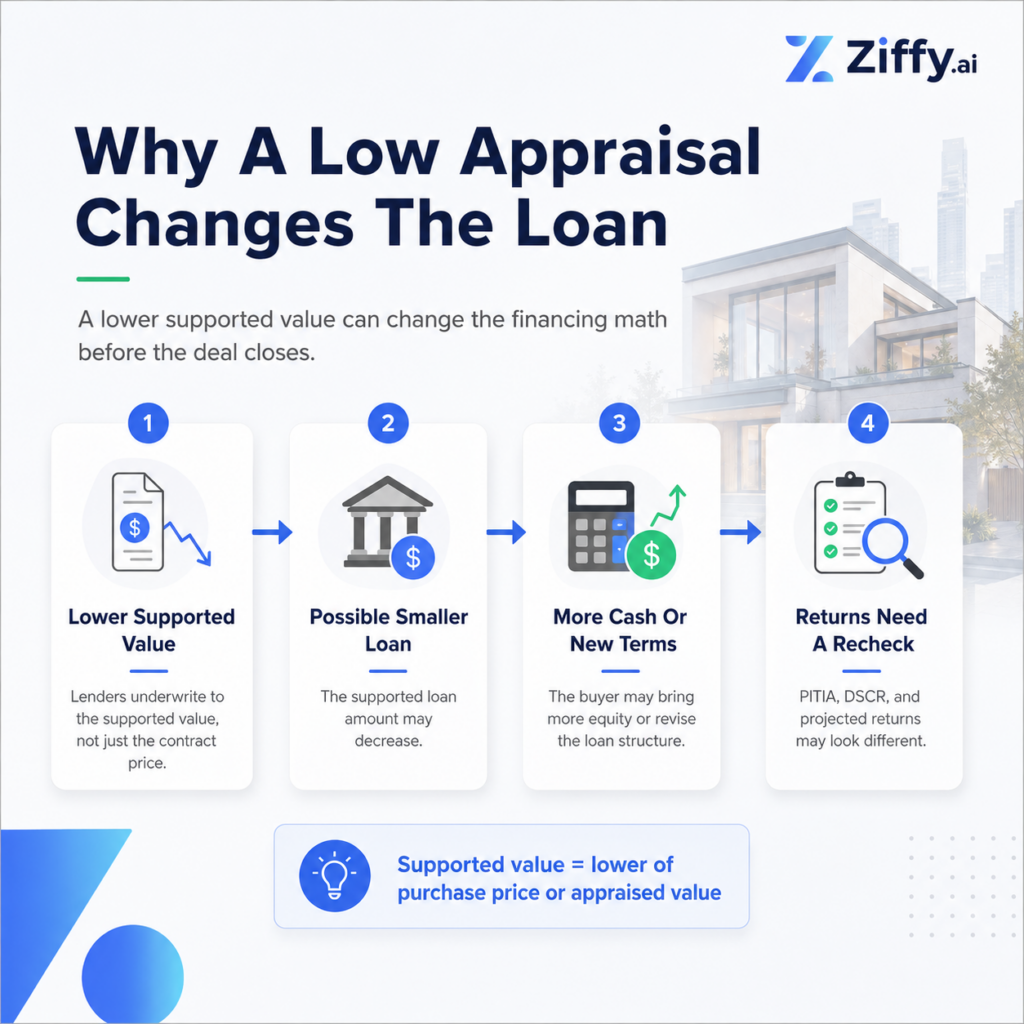
Purchase financing is tied to the value the lender can support, not solely to the contract price. For example, Freddie Mac’s purchase-value standard uses the lower of the purchase price or appraised value.
For a DSCR loan, a lower supported value may require a smaller loan or more cash at closing. Reducing the loan amount can lower principal and interest, which reduces PITIA and may improve DSCR. Investors can test the revised structure with our DSCR loan calculator.
6 Ways to Restructure an Investment Property Purchase
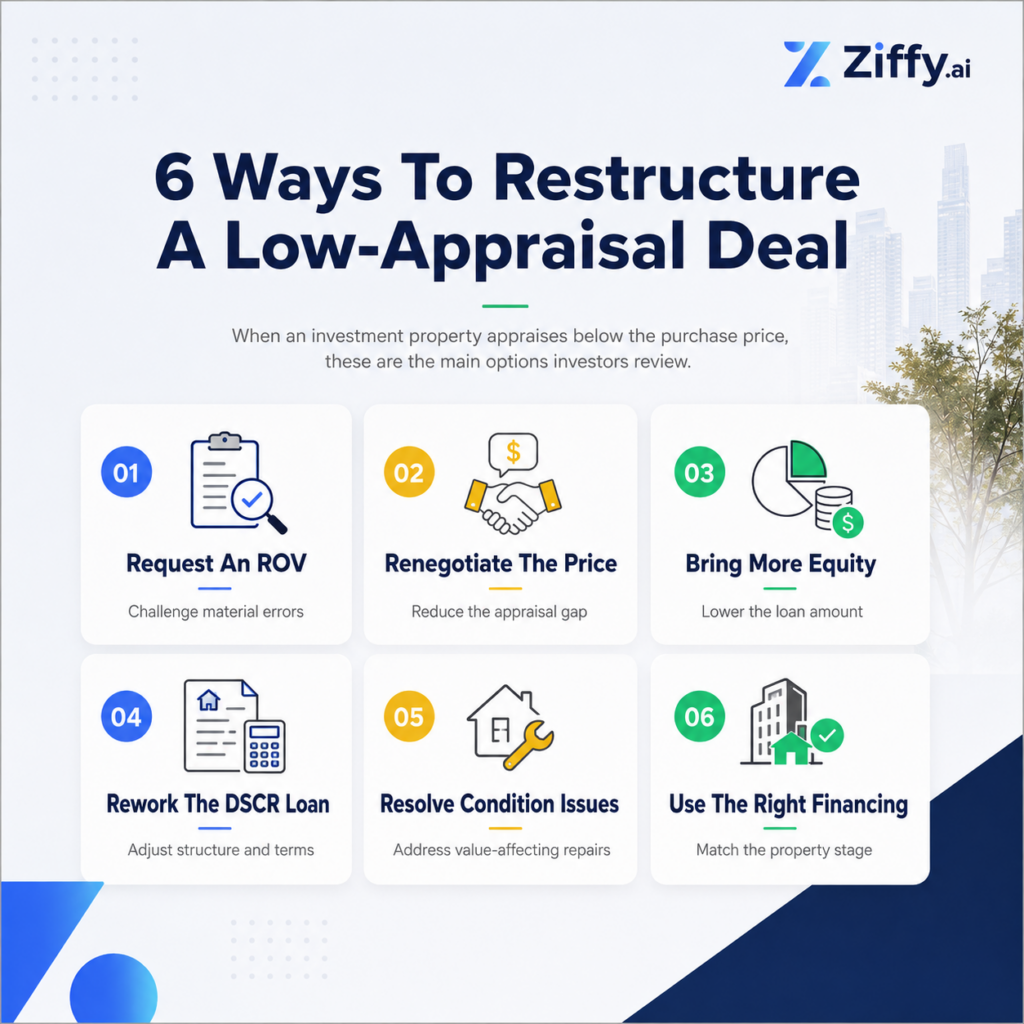
1. Request a Reconsideration of Value
Review the appraisal for material errors involving square footage, unit count, property condition, renovations, rental information, or comparable sales. A reconsideration of value is strongest when it identifies a specific deficiency and includes better evidence.
The CFPB’s reconsideration-of-value guidance explains how lenders can review potential valuation deficiencies. An ROV should show why part of the original analysis may be incomplete or unsupported, not simply ask the appraiser to reach the contract price.
2. Renegotiate the Purchase Price
When the appraisal is well supported, the contract price may need to move. A lower price can reduce the appraisal gap, preserve the planned leverage, and improve the return on total cash invested.
Another financed buyer may encounter the same valuation issue, giving the seller a reason to negotiate. Investors should rerun projected cash flow and returns with our rental property ROI calculator before revising the offer.
3. Increase the Equity Contribution
The buyer may cover part or all of the appraisal gap by reducing the loan amount. This can keep the purchase moving while lowering the monthly principal-and-interest payment and improving DSCR.
Additional cash should still earn an acceptable return. The investor also needs post-closing reserves for vacancies, repairs, insurance changes, and operating costs. Putting more money into an overpriced property can weaken cash-on-cash returns and restrict the capital available for another acquisition.
4. Rework the DSCR Loan Structure
Sometimes the property still works, but the original mortgage structure does not. We can test a lower loan amount, an eligible interest-only option, different prepayment terms, or another available structure to see how the revised payment affects PITIA and DSCR.
Our DSCR loan guide explains how rent, leverage, reserves, property type, and loan structure work together. Eligible properties below a 1.00 DSCR may also fit our No-Ratio DSCR option. A No-Ratio structure, however, cannot correct an unsupported property value or excessive LTV.

Steven Glick
Director of Mortgage Sales · Ziffy Mortgage
A low appraisal should trigger a second underwriting decision, not an emotional reaction. We look at whether the value is challengeable, what the lower basis does to leverage and returns, and whether the investor will still have enough liquidity after closing. Preserving the purchase only makes sense when the revised numbers continue to support the investment strategy.
5. Resolve Condition Issues Before Closing
Deferred maintenance, unfinished work, safety concerns, or poor property condition can weigh on an appraisal. When the report shows that condition affected the value, the buyer and seller may amend the contract so specific work is completed before closing and the property is reinspected.
The repairs should address issues identified in the appraisal. Unrelated cosmetic work may delay the purchase without materially changing the supported value.
6. Use Financing That Fits the Property’s Current Stage
A property requiring renovation, repairs, or lease-up may not be ready for permanent DSCR financing. Applying a stabilized-rental loan to a transitional property can produce the wrong appraisal and underwriting outcome.
Our bridge loan guide and overview of investment property loan options explain how different products fit different stages of an investment. An eligible investor may use short-term financing to acquire and stabilize the property, then refinance into a DSCR loan after it becomes rent-ready.
A low appraisal is a pricing and structure problem before it becomes a financing emergency. Challenge the report when credible evidence supports an ROV. Otherwise, revise the price, leverage, property condition, or loan strategy and evaluate the purchase again.
When the revised return no longer justifies the cash required, walking away may protect more capital than closing.
FAQs
What Happens if an Investment Property Appraises Below the Purchase Price?
The lender may base the loan on the lower supported value, reducing the available loan amount or increasing the buyer’s cash requirement.
Can a Low Appraisal Be Challenged?
Yes. An ROV may be appropriate when the report contains a material error, overlooks relevant property information, or relies on weaker comparable sales.
Does a Low Appraisal Affect DSCR?
Not directly. DSCR is based on rent and PITIA. A lower loan amount, however, can reduce the monthly payment and improve the ratio.
Is Paying the Appraisal Gap Always a Good Idea?
No. The investor should compare the additional cash required with projected income, returns, reserves, and the long-term strategy before proceeding.