





Editorial Integrity
Making sound real estate investment decisions begins with reliable, data-driven insights. At Ziffy.ai, we offer an AI-native real estate investing, proprietary data-driven trend analysis, investment mortgage programs like DSCR loans, and a network of over 500 investor-friendly real estate agents to deliver the expertise needed for informed decisions. Our content is crafted by experienced real estate professionals and backed by real-time market data, ensuring you receive accurate and actionable information. Through a rigorous editorial process, we strive to empower your investment journey with trustworthy and up-to-date guidance.
Quick Answer:

A mid-term rental should be analyzed as furnished monthly housing, not as a short-term rental with fewer turnovers. Start with supportable monthly rent, expected occupied months, realistic gaps between leases, utilities, furnishing replacement, cleaning, tenant screening, management, maintenance, insurance, taxes, and debt service. Then test the property as a conventional long-term rental.

If the deal works only when every month is booked at the highest furnished rent in the market, the margin is probably too thin.
Mid-term rental investing depends on monthly demand from people in transition, not weekend tourism.
The rent an investor expects to collect may differ from the rent a lender can use for DSCR qualification.
A 30-day minimum does not automatically resolve local licensing, tax, lease, or tenant-protection requirements.
Mid-term rentals sit in an awkward middle. They are furnished, flexible, and commonly booked for 30 to 180 days, but they are not hotels. That distinction matters because a standard short-term rental spreadsheet can make a monthly rental appear much safer than it is.
Research from AirDNA and Furnished Finder published on January 16, 2026 found that bookings lasting 28 days or longer had grown 136% since 2019. Monthly rentals also accounted for 19% of overall US rental demand in the study.
A separate Furnished Finder and PriceLabs pricing guide published on March 18, 2026 reported an average stay of about 102 days and an average booking window of approximately 31 days.
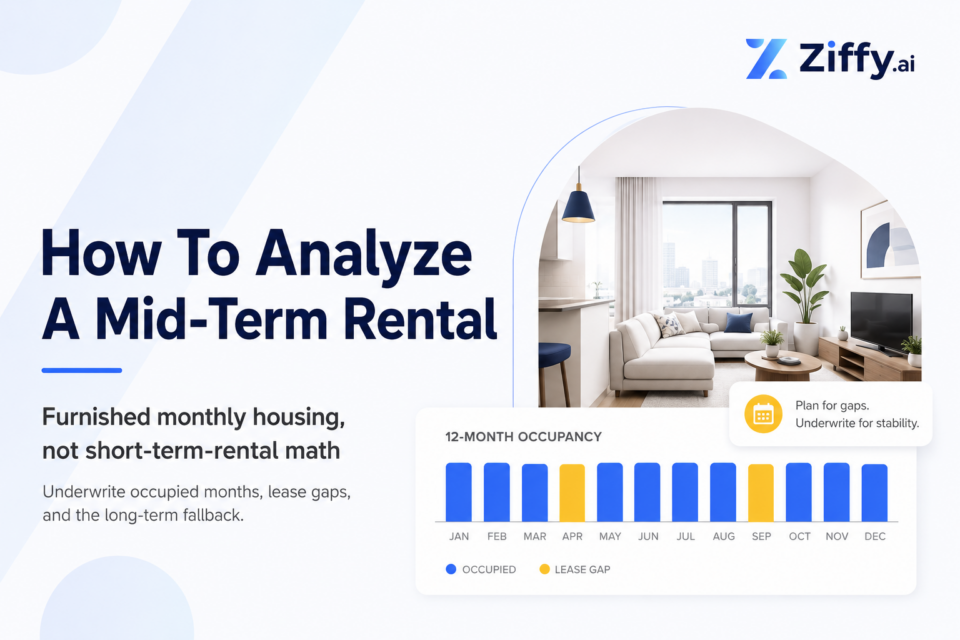
The demand is real, but it behaves differently from vacation demand. A property may secure a strong three-month tenant and still remain empty for several weeks before the next lease starts.
Table of Contents
What Counts as a Mid-Term Rental?
A mid-term rental is generally a furnished property leased for longer than a typical vacation stay but shorter than a standard one-year lease. Common renters include traveling professionals, relocating employees, families displaced by insurance claims, contract workers, students completing clinical rotations, and people waiting for a home purchase or renovation to finish.
These renters are usually paying for convenience. They need furniture, utilities, Wi-Fi, flexible timing, and a home that is ready from the day they arrive. That convenience can support a premium over an unfurnished annual lease, but it does not mean an owner can charge a vacation-market nightly rate for 90 consecutive days.
Why Airbnb Math Overstates Mid-Term Rental Income
Short-term rental analysis normally begins with average daily rate, nightly occupancy, cleaning fees, and seasonal booking patterns. Mid-term rental analysis should begin with monthly rent and the number of months the property is likely to remain occupied.
Use this structure:
Expected Annual Gross Rent = Supportable Monthly Rent × Expected Occupied Months + Lawful and Collectible Recurring Fees
Do not multiply the highest advertised monthly rent by 12 unless local evidence supports near-continuous occupancy. Build in time for marketing, tenant screening, cleaning, repairs, and move-in coordination between leases.
Monthly occupancy can still be useful, but it should reflect the reality of longer leases:
Annual Occupancy = Occupied Days ÷ 365
The goal is not to ignore occupancy. It is to stop treating every empty night as inventory that can be filled the next morning through dynamic pricing.
Start With the Renter, Not the Property
A beautifully furnished home is not a demand strategy. Before underwriting the property, identify the renter groups that could realistically keep it occupied.
Look for several independent demand anchors within a practical commute. These may include hospitals, universities, military installations, corporate campuses, large construction projects, government employers, and neighborhoods with frequent relocation or insurance-displacement demand.
Then verify that those renters actually use furnished monthly housing in the area.
In its March 18, 2026 monthly-rental pricing guide, Furnished Finder reported that more than 80% of searches on its platform focused on homes with two bedrooms or fewer. It also reported that 55% of renters searched below $2,500 per month.
Those figures provide national context, but they do not replace local research. A three-bedroom suburban home may perform well with families relocating or waiting for insurance repairs, even if it attracts little interest from traveling nurses.
Build the Rent Estimate From Monthly Comps
Collect furnished rental comps that match the property on bedroom count, location, parking, pet policy, workspace, laundry, and utility package. Record the asking rent, minimum stay, deposit, included utilities, cleaning charge, availability, and how long the listing appears to have been active.
Then compare the furnished range with three reference points:
- Recent long-term rental comps in the same neighborhood.
- HUD Fair Market Rents or Small Area Fair Market Rents as a public benchmark.
- The property’s rent, cash flow, cap rate, and DSCR under a conventional long-term lease.
HUD Fair Market Rent is not a furnished-rent quote, and an advertised rental price does not prove that tenants have paid it. The useful number is the premium renters have repeatedly paid for the specific flexibility and services being offered.
The Spreadsheet Usually Breaks Between Leases
A 90-day stay may appear to mean four turnovers a year. Real rental calendars are rarely that neat.
One tenant may leave on a Tuesday. The cleaner may not be available until Friday. A damaged appliance may delay the next move-in by another week. The next qualified renter may not need the property until the following month.
Track lease-gap days separately from ordinary vacancy. This makes it easier to see whether lost income comes from weak demand or slow operations.
The break-even rent should be based on the months that are actually expected to be occupied:
Break-Even Monthly Rent = (Annual Operating Costs + Annual Debt Service + Capital Reserve) ÷ Expected Occupied Months
This figure is more useful than the advertised monthly rent because it shows how much each occupied month needs to carry. A property that requires 12 occupied months merely to break even has no room for normal turnover.

The most common mistake I see is starting with the highest monthly rent on a furnished-rental platform and treating it as dependable income. Investors should first determine how many occupied months the property needs to cover its mortgage, operating costs, utilities, and reserves. Once that number is clear, they can judge whether the local renter pool is deep enough to support the strategy through lease gaps and slower seasons.
Price the Full Furnished Expense Stack
Mid-term rentals normally require fewer cleanings than vacation rentals, but owners often absorb more costs than long-term landlords.
Expense | What to Underwrite |
|---|---|
Utilities | Electricity, gas, water, trash, internet, and realistic overage |
Furnishings | Initial setup and a replacement reserve for mattresses, linens, cookware, and furniture |
Turnover | Cleaning, laundry, restocking, minor repairs, and inspections |
Leasing | Listing fees, tenant screening, lease preparation, and placement or management fees |
Property Costs | Taxes, insurance, HOA dues, lawn care, snow removal, pest control, and maintenance |
Reserves | Vacancy, capital expenditures, insurance deductibles, and unexpected utility spikes |
For cap-rate analysis, calculate net operating income before mortgage payments. For cash-flow analysis, subtract debt service and a realistic capital reserve.
Our cap rate guide explains the difference, while our investment property insurance guide covers how insurance expenses can affect both cash flow and DSCR.
Separate Operating Cash Flow From Loan Qualification
A property may collect a furnished-rent premium while qualifying for financing with a different rent figure.
DSCR underwriting requires supportable rental income. Depending on the loan program and property, that income may come from an appraisal, a market-rent schedule, an eligible lease, or another approved source. An investor’s projected furnished rent is not automatically the rent a lender can use.
Run two versions of the deal before making an offer:
- Operating Case: The rent and expenses expected under the mid-term rental strategy.
- Financing Case: The rent and PITIA the lender is prepared to use for qualification.
At Ziffy Mortgage, we evaluate eligible investment properties around rental income and property cash flow. Our DSCR loan guide explains how rent, PITIA, leverage, reserves, and property use fit together.
Confirm the acceptable rent documentation before relying on a furnished premium to support the loan.

Steven Glick
Director of Mortgage Sales · Ziffy Mortgage
A property can perform well as a mid-term rental and still qualify for financing at a lower rent than the investor expects to collect. The lender must work with income that can be supported through the appraisal, an eligible lease, or other accepted documentation. Investors should compare the lender-supported rent with their operating projection before making an offer, because that gap can change the available loan amount, required cash, and expected return.
Run Three Scenarios Before You Buy
A serious mid-term rental analysis needs more than one forecast.
1. Base Case
Use supportable furnished rent, normal lease gaps, confirmed utility costs, actual insurance, and realistic management expenses.
2. Weak Case
Reduce the monthly rent, extend the gap between tenants, increase utilities, and include an unexpected repair or furniture replacement cycle.
3. Long-Term Fallback
Remove the furnished premium, shift utilities to the tenant where customary, use a standard lease, and recalculate cash flow and DSCR.
The fallback case often matters most. It shows whether the property is a durable rental with an additional income strategy or a fragile furnished business with no clean alternative.
Screen Tenants Without Treating a 90-Day Stay Like a Hotel Booking
Mid-term renters are tenants, even when their stays are relatively short. Screening should therefore be closer to long-term rental screening than vacation-booking approval.
Depending on applicable laws, an owner may review identity, income, employment or assignment details, rental history, credit information, and background reports. Written screening standards should be applied consistently.
HUD explains that housing discrimination is illegal in nearly all housing. The Federal Trade Commission also outlines landlords’ responsibilities when using consumer reports under the Fair Credit Reporting Act.
A renter staying for three months can create the same payment, property-damage, and legal risks as a longer-term tenant. A shorter lease should not lead to weaker screening.
Check Insurance, Taxes, and Local Rental Rules
A 30-day minimum is not a universal legal safe harbor. Lease requirements, security-deposit rules, licensing, occupancy taxes, tenant protections, and eviction procedures vary by state and city.
Review the rules where the property is located before advertising it. An owner should also tell the insurance carrier exactly how the property will be used, including furnished monthly stays, direct bookings, and any combination of short-, mid-, or long-term leasing.
For federal tax purposes, IRS Publication 527 covers rental income, expenses, depreciation, and personal use. IRS Publication 925 explains why average customer-use periods and the level of personal services provided can affect whether an activity is treated as a rental activity under the passive-activity rules.
A CPA should review the actual operating model before an investor assumes that tax treatment commonly associated with short-term rentals will also apply to a mid-term rental.
When a Mid-Term Rental Deal Actually Works
The strongest mid-term rental properties are ordinary enough to succeed as long-term rentals and well located enough to earn a furnished premium.
They tend to have several demand sources, manageable utility costs, practical layouts, durable furniture, parking, laundry, reliable internet, and a rent level that fits the temporary-housing needs of the local market.
A mid-term rental does not need perfect occupancy. It needs enough margin to absorb the imperfect calendar that comes with real tenants, real repairs, and real leasing gaps.
Final Takeaway
Do not buy a mid-term rental merely because the advertised monthly rent is higher than a one-year lease.
Buy it because verified demand, occupied-month revenue, full operating costs, lender-supported rent, financing, and the long-term fallback all point in the same direction.
The right spreadsheet will probably look less exciting than Airbnb math. That is usually a good sign.
FAQs
What Is a Good Occupancy Rate for a Mid-Term Rental?
There is no universal target. The required occupancy depends on monthly rent, debt service, utilities, management, furnishing costs, and local demand. Calculate the number of occupied months needed to break even, then compare it with local leasing evidence.
Are Mid-Term Rentals More Profitable Than Long-Term Rentals?
They can generate higher gross rent, but the owner often pays utilities, furniture costs, cleaning, tenant-placement expenses, and more frequent turnover costs. Compare net cash flow rather than advertised monthly rent.
What Is the Biggest Mid-Term Rental Investing Mistake?
The biggest mistake is using the highest furnished asking rent, assuming continuous occupancy, and leaving utilities, lease gaps, furniture replacement, or the lender’s qualifying-rent method out of the analysis.