





Editorial Integrity
Making sound real estate investment decisions begins with reliable, data-driven insights. At Ziffy.ai, we offer an AI-native real estate investing, proprietary data-driven trend analysis, investment mortgage programs like DSCR loans, and a network of over 500 investor-friendly real estate agents to deliver the expertise needed for informed decisions. Our content is crafted by experienced real estate professionals and backed by real-time market data, ensuring you receive accurate and actionable information. Through a rigorous editorial process, we strive to empower your investment journey with trustworthy and up-to-date guidance.
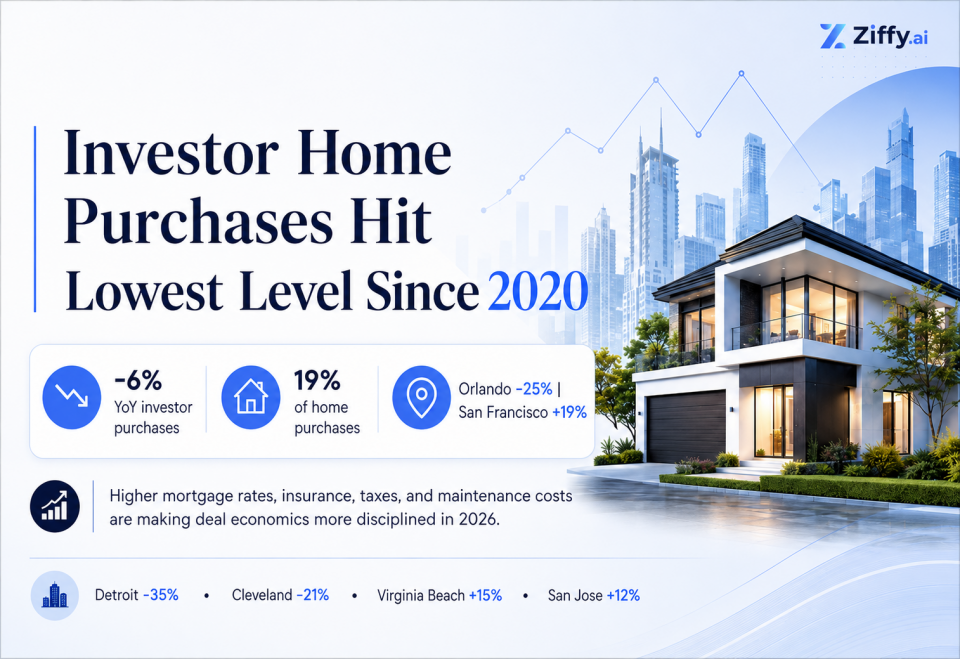
Investor home purchases fell 6% year over year in the first quarter of 2026, reaching their lowest level since 2020, Real Estate News reported. Investors still made up 19% of home purchases, so the pullback does not mean investors have left the market. It means they are being more careful about which deals deserve their money.
A few years ago, low rates gave investors more room to make a rental deal work. That cushion is much thinner in 2026. Higher mortgage payments, rising insurance premiums, heavier property taxes, and more realistic maintenance reserves are all showing up in the monthly numbers before rent growth is even part of the conversation.
That becomes especially important with DSCR financing because the property has to support itself on paper. A price cut can make a listing look promising, but investors still have to ask whether the rent can carry the full monthly payment, taxes, insurance, HOA dues, and other costs without leaving the return too thin.
Table of Contents
Cheaper Markets Are Not Automatically Better Deals
The pullback was not even across the country. Investor purchases dropped 35% in Detroit, 25% in Orlando, and 21% in Cleveland. At the same time, activity rose 19% in San Francisco, 15% in Virginia Beach, and 12% in San Jose.
Orlando is a useful example because it shows why price alone can mislead investors. A lower purchase price may look like an opening, especially in a market where investors are used to strong rental and short-term rental demand. But if insurance premiums, HOA fees, property taxes, and maintenance costs keep rising, the monthly numbers can still become difficult to support.
A lower purchase price does not automatically make a rental property a better investment. The deals that still move are the ones where the rent can carry the real cost of ownership, including debt service. Investors have to know that before they bid, not after they close.

That is where investors are spending more time now. The list price may be lower, but that does not automatically make the deal stronger. If insurance, taxes, HOA fees, repairs, and financing costs have climbed faster than the price has come down, the cash flow can still come out weaker than expected.
San Francisco and San Jose show the other side of the market. They are still expensive places to buy, but some investors are staying active because the demand side is stronger. Job growth, higher-income renters, and long-term housing pressure can help support deals that would look too expensive if price were the only thing being considered. The deal still has to hold up financially, but in those markets, investors may be more willing to pay up when the rent outlook and long-term demand are strong enough to support the purchase.
Will the Property Still Work After Financing
The investor market in 2026 is less about finding the cheapest property and more about finding the property whose numbers still hold together after the full cost stack is included.
A lower-priced rental in one market can fail once taxes, insurance, HOA dues, repairs, and DSCR financing are built into the monthly payment. A higher-priced property in another market can still make sense if the rent is strong enough, the expenses are manageable, and the financing structure supports the return.
That is where investors need to slow down before making an offer. The first look at a listing can create excitement, especially when the price looks discounted or the market has pulled back. But the better move is to compare properties through the actual investment lens: expected rent, monthly payment, reserves, insurance, taxes, HOA exposure, and DSCR qualification.
Ziffy is built around that kind of decision-making. Investors can review rental income, estimated expenses, cash flow, ROI, and DSCR financing fit earlier in the process instead of waiting until after they are already emotionally attached to a property. In a market where investor purchases are falling, that earlier clarity can help separate a real opportunity from a deal that only looks good on the surface.
Investors are still buying in 2026. They are just less willing to stretch for properties where the income and ownership costs do not line up. That is a healthier way to read the market. The best deals are not always the cheapest ones. They are the ones where the numbers continue to make sense after the excitement fades.