





Editorial Integrity
Making sound real estate investment decisions begins with reliable, data-driven insights. At Ziffy.ai, we offer an AI-native real estate investing, proprietary data-driven trend analysis, investment mortgage programs like DSCR loans, and a network of over 500 investor-friendly real estate agents to deliver the expertise needed for informed decisions. Our content is crafted by experienced real estate professionals and backed by real-time market data, ensuring you receive accurate and actionable information. Through a rigorous editorial process, we strive to empower your investment journey with trustworthy and up-to-date guidance.
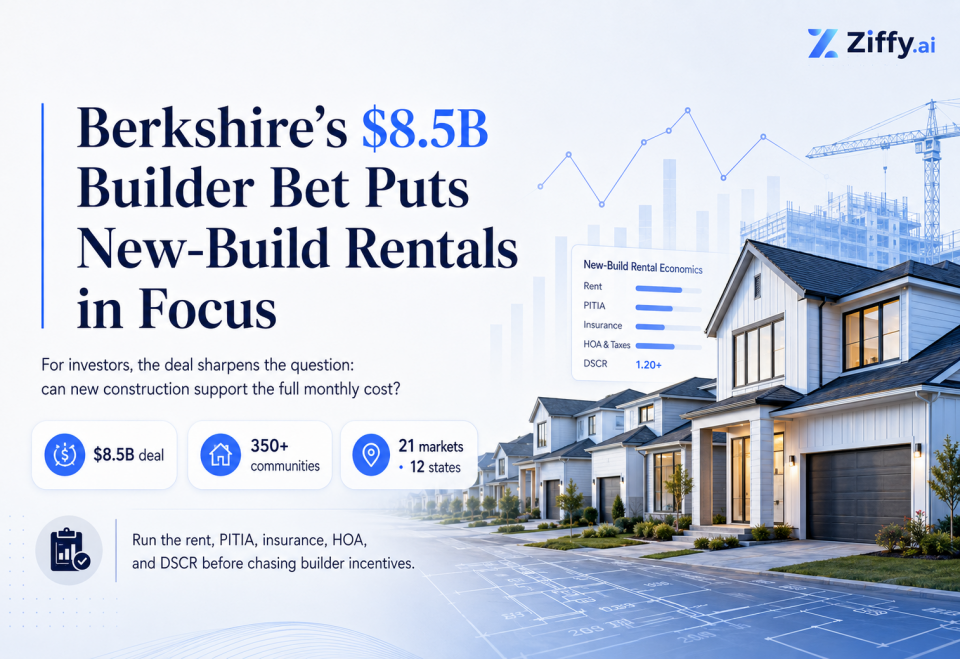
Berkshire Hathaway is buying Taylor Morrison in an all-cash deal valued at about $8.5 billion, pushing one of the world’s most patient capital allocators deeper into US homebuilding.
Taylor Morrison shareholders would receive $72.50 per share, with the deal valuing the builder at about $6.8 billion in equity and $8.5 billion in enterprise value. Taylor Morrison operates more than 350 communities across 21 markets in 12 states, serving entry-level, move-up, resort-lifestyle, and rental-community buyers through brands including Taylor Morrison, Esplanade, and Yardly.
For real estate investors, the news is less about Berkshire buying a builder and more about what it says about the next phase of housing supply. New construction has been one of the few areas where inventory can actually be created, even as buyers continue to deal with high mortgage rates and affordability pressure. Freddie Mac reported that the 30-year fixed mortgage rate averaged 6.53% as of May 28, 2026, while Census data showed April single-family housing starts fell 9.0% from March and single-family permits slipped 2.6%.
Berkshire is making this move in a housing market that still looks uneven. New-home sales fell 6.2% in April 2026 to a seasonally adjusted annual rate of 622,000, and the supply of new houses reached 9.4 months at the current sales pace. This is a market where builders have inventory, buyers are rate-sensitive, and long-term capital is still willing to own the production side of housing.
Table of Contents
New Construction Can Look Cleaner, But the Numbers Still Have to Work
New homes can be appealing to investors for obvious reasons – the property is newer, repairs may be lighter in the first few years, finishes are easier to market to tenants, and builder incentives can make the upfront deal look better than a comparable resale home.
New homes are easy to like at first glance. They usually show well, need less immediate repair work, and can be easier to market to tenants who are comparing them with older homes nearby. But investors still have to look beyond the builder package and the starting monthly payment.
Once the home is completed, the tax bill can change, insurance can price higher than expected, and HOA or community rules can affect how the property can be rented. Builder credits and rate buydowns can improve the purchase, but they do not make a weak rental deal strong on their own. The rent still has to support the payment after the full ownership cost is included.
That is especially relevant now because builders have been leaning on incentives to keep sales moving. D.R. Horton, the largest US homebuilder by volume, said it expected sales incentives to remain elevated in fiscal 2026, with the level depending on demand, mortgage rates, and market conditions.
Investors should look at those incentives as part of the full deal, not as a shortcut around the numbers. A temporary buydown can make the first year or two feel easier, but the property still has to work after the buydown period ends. The rent, taxes, insurance, HOA costs, and permanent loan terms are what decide whether the DSCR and long-term cash flow hold up.
Why DSCR Changes the Way Investors Should Look at New Builds
A DSCR loan is based on the property’s rental income rather than the borrower’s personal debt-to-income ratio. Ziffy’s DSCR financing is built for investors who want to qualify through the income potential of the rental property, not through a traditional owner-occupant mortgage path.
With an existing rental, investors may have a lease, rent roll, or operating history to review. With a new-build home, that history often does not exist yet. That does not make the deal impossible, but it does make the rent estimate, PITIA, and local rental assumptions more important before the investor signs a contract.

Investors like new construction because the property feels lower-maintenance on day one. That is a real advantage, but it does not replace the DSCR review. We still need to know what rent the market supports, what the full PITIA looks like, how the HOA treats rentals, and whether any builder incentive fits the loan structure. If the rent does not support the payment, the deal needs to be adjusted before the investor gets too far in.
Berkshire is buying at the builder level, but investors still have to judge the deal at the property level. A new-build rental can be a solid long-term hold when the rent supports the payment and the ownership costs are realistic. If taxes, insurance, HOA rules, or financing terms push the monthly cost too high, the fact that the home is new will not be enough to make the investment work.
Where Ziffy Fits for Investors Watching New-Build Inventory
Ziffy helps investors compare properties through rental estimates, projected cash flow, ROI, and DSCR financing before they commit to a deal. The point is not to chase new construction because Berkshire bought a homebuilder, but to look at new-build inventory with the same discipline investors should bring to any rental purchase.
For a buy-and-hold investor, that means checking whether the rent estimate is realistic, whether the monthly payment leaves room for reserves, and whether the property can still perform after taxes and insurance are updated. For an investor considering a builder incentive, it means reviewing how that credit affects the loan structure rather than assuming every incentive improves the deal.
Berkshire’s deal says something about where long-term housing money is still comfortable: new supply, especially in markets where buyers and renters continue to show up. For an investor, that is only the starting point. Before putting a new-build rental under contract, the rent needs to be tested against the full monthly payment, not just the builder’s starting estimate. Taxes after completion, insurance, HOA rules, rental limits, builder credits, and final loan terms all need to be reviewed together. If those pieces hold up, a new home can be a clean long-term rental. If they do not, the builder name or the larger housing headline will not carry the deal.