





Editorial Integrity
Making sound real estate investment decisions begins with reliable, data-driven insights. At Ziffy.ai, we offer an AI-native real estate investing, proprietary data-driven trend analysis, investment mortgage programs like DSCR loans, and a network of over 500 investor-friendly real estate agents to deliver the expertise needed for informed decisions. Our content is crafted by experienced real estate professionals and backed by real-time market data, ensuring you receive accurate and actionable information. Through a rigorous editorial process, we strive to empower your investment journey with trustworthy and up-to-date guidance.
Quick Summary

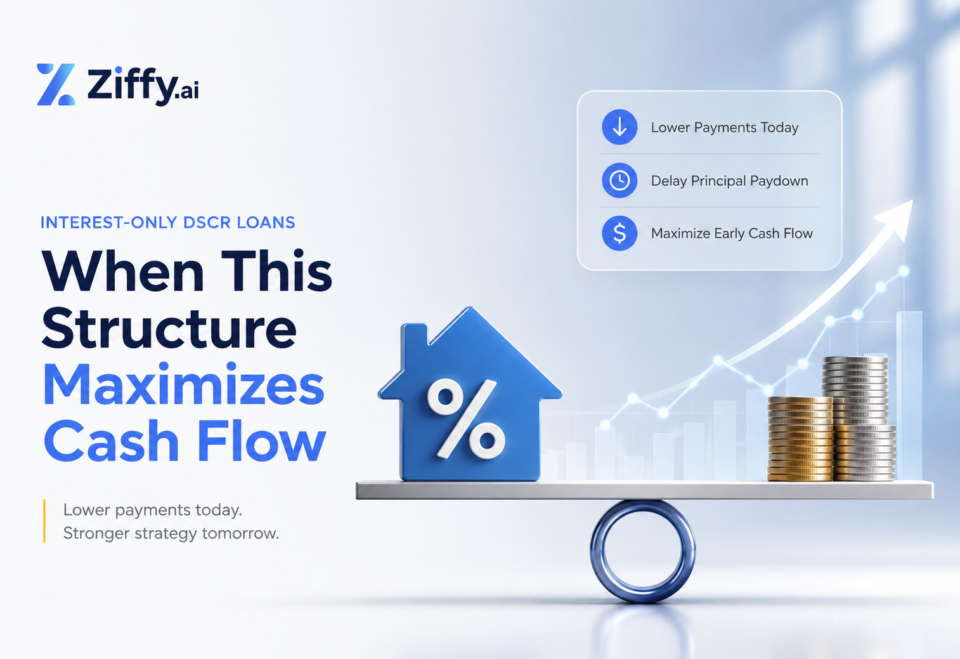
An interest-only DSCR loan can improve early cash flow by postponing scheduled principal payments. The structure works best when the retained cash has a defined purpose, the property can support the later amortizing payment, and the investor has an exit plan that does not depend on one favorable market event.
Interest-only payments cover interest while scheduled principal repayment is delayed.
The lower payment may improve the debt service coverage ratio, but it does not increase rent or reduce property expenses.
Investors should test the property during the interest-only period and again after principal payments begin.
Rate structure, reserves, prepayment terms, total interest cost, and the remaining balance all affect whether the structure is worthwhile.
An investor considering interest-only financing is usually trying to preserve liquidity. The monthly savings may support reserves, property improvements, higher-cost debt elsewhere in the portfolio, or another acquisition. Those are practical uses of the structure.
The problem starts when the lower opening payment is treated as proof that the property works. Once principal repayment begins, the monthly obligation rises. If the remaining amortization period is shorter, the increase may be material. The financing decision therefore has to cover the full payment path, not only the first few years.
Table of Contents
How an Interest-Only DSCR Loan Works
A debt service coverage ratio (DSCR) loan qualifies an investment property mainly from its rental income rather than the borrower’s personal income.
During the interest-only period, the scheduled payment covers the interest charged on the outstanding balance. Principal repayment begins later unless the borrower makes an optional principal payment, sells the property, or refinances.
Monthly interest-only payment = Outstanding loan balance × annual interest rate ÷ 12
The note may use a daily interest calculation or another contractual method. The closing documents control the actual payment, the length of the interest-only period, the rate structure, and what happens when the period ends.
The Consumer Financial Protection Bureau explains that an interest-only payment lasts for a specified period. When principal payments begin, the required monthly payment generally rises.
Interest-only is also different from negative amortization. When the borrower pays the full interest due, the scheduled principal balance generally stays level. Negative amortization occurs when unpaid interest is added to the balance.
How Interest-Only Changes DSCR and Cash Flow
For a fully amortizing DSCR loan, the qualifying payment generally includes principal, interest, taxes, insurance, and association dues, or PITIA.
When a program permits qualification on the interest-only payment, the denominator may instead use interest, taxes, insurance, and association dues, or ITIA.
Loan structure | Payment used in the ratio |
|---|---|
Fully amortizing | Principal + interest + taxes + insurance + association dues |
Interest-only | Interest + taxes + insurance + association dues |
At Ziffy, we calculate standard DSCR as:
DSCR = Gross monthly rent ÷ PITIA
Removing scheduled principal lowers the denominator and may improve the qualifying ratio. The property has not gained rent or shed expenses. Qualification and investment performance are related, but they are not the same calculation.
That distinction is easy to miss. A property may show a stronger DSCR under an interest-only payment and still have weak operating cash flow after vacancy, management, maintenance, utilities, repairs, and capital expenditures.
The Ziffy DSCR calculator allows investors to adjust the price, down payment, interest rate, and financing structure before applying. The cash flow calculator then measures the wider operating result.
When Interest-Only Financing Makes Strategic Sense
In our experience at Ziffy, interest-only works best when the investor can explain exactly where the payment savings will go.
The retained cash may fund a larger property reserve, rent-ready work, a planned renovation, higher-cost debt, or the next acquisition. The expected benefit should be compared with the scheduled principal that will not be paid down and any difference in rate, points, fees, or prepayment terms.
A defined hold period also helps. An investor planning to sell inside the interest-only window may value liquidity more than gradual principal reduction. The plan still needs room for weaker buyer demand, tenant timing, repairs before listing, or a slower sale.
Interest-only may also help during stabilization. A recently acquired property can be occupied but still carry leasing costs, final improvements, or an incomplete operating history. A lower required payment may protect liquidity while the property reaches normal performance.
None of these uses fixes a property that cannot support amortizing debt. Interest-only changes when principal is repaid. It does not remove the obligation.

Steven Glick
Director of Mortgage Sales · Ziffy Mortgage
Interest-only can improve the qualifying payment, but the rent still has to be supported by the lease or appraisal. We underwrite the income the file can document, not the rent an investor hopes to achieve later.
The accepted rent may come from an existing lease, an appraisal rent schedule, or another source permitted by the program. A future rent target or peak-season projection may not be usable for qualification.
Where the Lower Payment Can Mislead
1. Qualification improves while operating cash flow stays thin
A lower loan payment may raise DSCR while the property still produces weak cash flow after realistic operating expenses. DSCR is an underwriting measure, not a complete return metric.
2. Refinancing is the only exit
A future refinance depends on rates, property value, occupancy, rent documentation, credit, leverage, and available programs. The investor should be able to continue into amortization, reduce the balance, or sell if refinancing becomes unattractive.
3. Prepayment terms conflict with the hold plan
An early payoff charge can offset part of the cash-flow benefit. Review the penalty period, calculation, expiration date, and exceptions before choosing the loan.
4. Reserves are too thin after closing
The lender’s minimum reserve requirement is an underwriting threshold. An older roof, seasonal income, a high insurance deductible, aging systems, or a possible association assessment may justify substantially more liquidity.
Steven Glick
Director of Mortgage Sales · Ziffy Mortgage
Insurance should be based on a property-specific quote, not a rough market estimate. If the premium comes in higher than expected, it can reduce cash flow, weaken DSCR, and change whether the loan structure still makes sense.
Run the Property Through Two Payment Periods
At Ziffy, we recommend analyzing the property twice.
Period 1: During interest-only
Review the scheduled ITIA, realistic operating expenses, vacancy allowance, pre-tax cash flow, reserve contributions, and the principal balance that will remain.
Period 2: After principal repayment begins
Recalculate the principal-and-interest payment using the expected balance, remaining amortization term, and contractual rate. Then update PITIA, DSCR, and cash flow with conservative rent, taxes, insurance, and association dues.
The Office of the Comptroller of the Currency warns that interest-only products can create sizeable payment shock when amortization begins. Its guidance also cautions against focusing on the lower initial payment while assuming the borrower will later sell or refinance.
For example, a Miami rental analyzed on Ziffy had estimated monthly rent of $3,376 and monthly PITIA of $2,451, producing a standard DSCR of 1.38.
An interest-only DSCR cannot be calculated from these figures alone. That calculation would also require the loan balance, interest-only rate, property taxes, insurance, and association dues.

“When I review a Florida investment property, I never want the borrower relying on a rough insurance estimate. I would rather see a property-specific quote upfront, because even a modest increase in the premium can change the DSCR and the property’s monthly cash flow.”
Use a property-specific quote where possible. The rental property ROI calculator can then help compare the wider return after the financing inputs are supportable.
Interest-Only Versus Fully Amortizing DSCR Financing
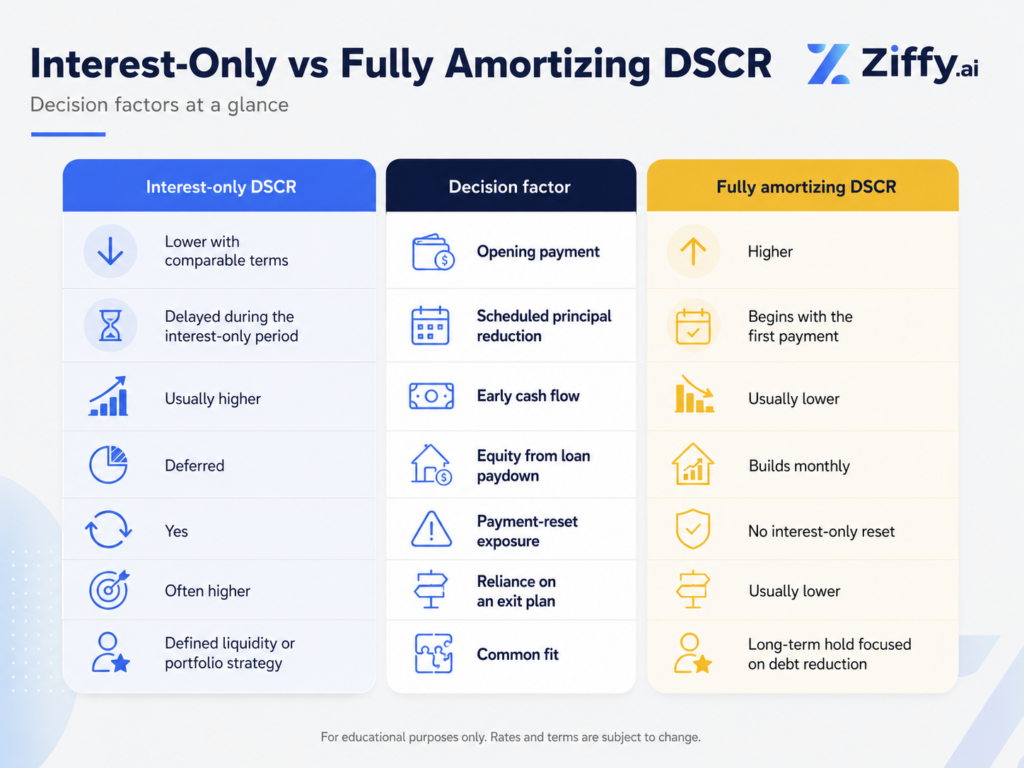
The lower opening payment does not guarantee the lower total financing cost. Compare both structures at the same intended sale or refinance date. Include interest paid, points, lender fees, prepayment charges, cash retained, principal paid down, and the balance still owed.
A longer amortizing term may also reduce the monthly payment while beginning principal reduction immediately. It belongs in the comparison when available.
Investors comparing broader financing choices can also review Ziffy’s investment property loan guide before choosing a loan based on its opening payment alone.
What Ziffy Reviews Before Approving Interest-Only
Interest-only DSCR programs do not follow one national template. The available leverage, interest-only period, rate, reserves, and prepayment structure depend on the property, transaction type, credit profile, DSCR, and complete loan file.
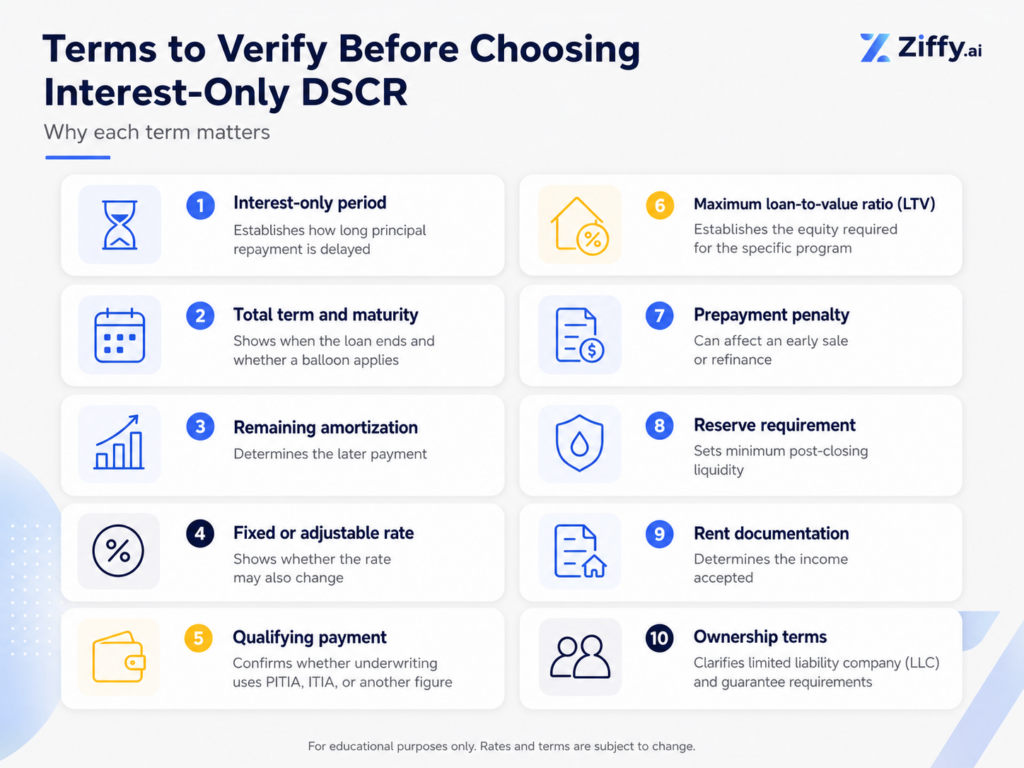
As of June 30, 2026, Ziffy offers a 20% minimum down payment and up to 80% LTV for purchases. We also offer up to 80% LTV for rate-and-term refinances and up to 75% LTV for cash-out refinances.
Those figures are our standard DSCR starting point and should not be treated as automatic interest-only terms. Interest-only availability, maximum leverage, pricing, qualifying payment, and reserves must be confirmed for the individual program and complete file.
Tax and Regulatory Considerations
IRS Publication 527 explains that mortgage interest paid on rental property may generally be deductible as a rental expense, subject to the use of the proceeds and other tax rules.
Principal repayment is not mortgage interest. Interest-only financing changes the timing of principal payments; it does not create a separate deduction. Points, cash-out proceeds, mixed personal and rental use, and passive activity rules can change the tax result.
DSCR loans secured by non-owner-occupied rentals are commonly structured as business-purpose credit. Regulation Z, 12 CFR 1026.3, exempts credit extended primarily for business, commercial, or agricultural purposes.
The loan must reflect how the property will actually be used. A property purchased and operated as a rental may qualify as a business-purpose transaction, while a home intended for the borrower’s personal use may be subject to different underwriting and disclosure requirements. Borrowers should describe the intended occupancy accurately, since misclassifying a personal-use property as an investment property can affect eligibility, pricing, disclosures, and the validity of the loan application.
What To Do Before Choosing Interest-Only
Ask two questions: Where will the payment savings go, and can the property support the later amortizing payment?
Run both structures through the same expected hold period with documented rent and property-specific expenses. Compare the total cost and remaining balance, not only the first payment.
When the retained cash strengthens the property or portfolio and the reset payment remains manageable, interest-only financing can support a deliberate investment plan. When the result depends on optimistic rent, rising values, or an easy refinance, the lower payment may be postponing a problem.
Use the Ziffy DSCR calculator to compare both structures, then review the available terms with a licensed mortgage loan originator.
FAQs
Does interest-only always improve cash flow?
It lowers the scheduled payment compared with a similar amortizing structure. The final result still depends on the rate, fees, taxes, insurance, association dues, vacancy, management, repairs, and capital expenditures.
What happens when the interest-only period ends?
Principal repayment begins according to the note. The new payment depends on the outstanding balance, remaining amortization period, and rate terms. Some structures may include a balloon payment, so the maturity and payment schedule must be reviewed before closing.
Can an investor refinance before interest-only ends?
Possibly, yes. The existing loan’s prepayment terms and the new lender’s requirements still apply. Value, credit, rent support, leverage, occupancy, and available programs may affect the refinance.
Does refinancing restart the interest-only period?
A refinance replaces the original loan. A new interest-only period applies only when the replacement loan includes that feature.
Is interest-only the same as negative amortization?
No. When the full interest due is paid, the scheduled principal balance generally remains unchanged. Negative amortization occurs when unpaid interest is added to the balance.