


Editorial Integrity
Making sound real estate investment decisions begins with reliable, data-driven insights. At Ziffy.ai, we offer an AI-native real estate investing, proprietary data-driven trend analysis, investment mortgage programs like DSCR loans, and a network of over 500 investor-friendly real estate agents to deliver the expertise needed for informed decisions. Our content is crafted by experienced real estate professionals and backed by real-time market data, ensuring you receive accurate and actionable information. Through a rigorous editorial process, we strive to empower your investment journey with trustworthy and up-to-date guidance.
Key Takeaways
Financing eligibility varies by loan scenario. Rental benchmark source: Michigan State Housing Development Authority.
Quick Answer: Can You Get a DSCR Loan in Michigan?
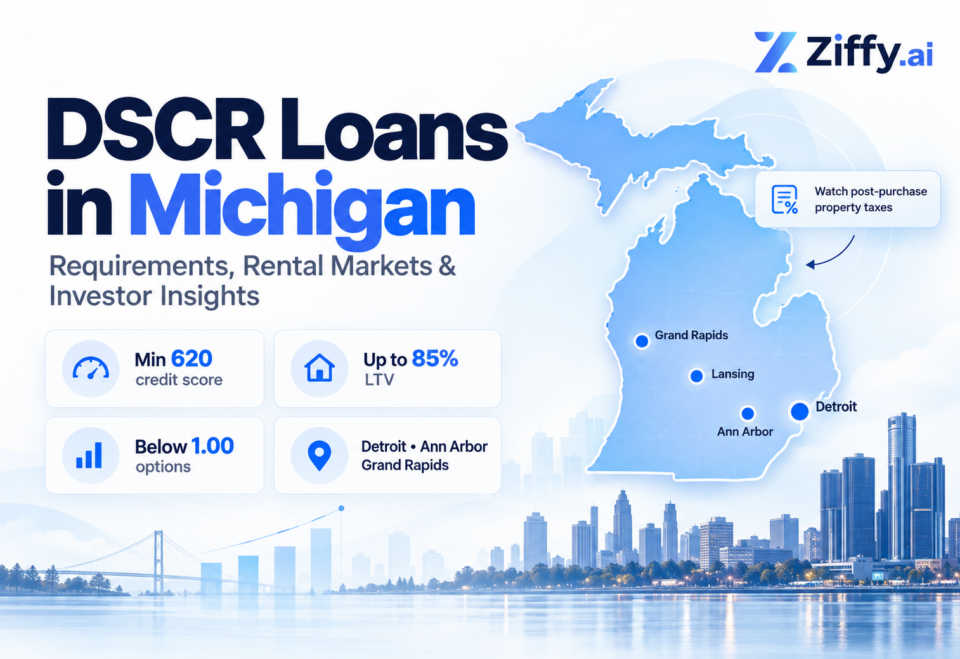
Yes. Ziffy offers DSCR loans in Michigan for eligible investment properties, using qualifying rental income rather than traditional personal-income verification as the primary basis for loan qualification.
Eligible borrowers can qualify with credit scores starting at 620, purchase financing up to 85% LTV in qualifying scenarios, and reserves starting at two months. Options are also available for properties with a DSCR below 1.00.
Michigan investors should pay particular attention to property tax reassessment after ownership transfers, rental registration requirements, winter maintenance costs, and neighborhood-level rent differences before deciding how much to borrow.
A rental property in Detroit and another in Ann Arbor might be only an hour apart, yet their purchase prices, tenant profiles, rental income, and ownership costs can look completely different. Even within Detroit, a property in Corktown requires a different rental analysis from one in East English Village or Bagley.
For Michigan real estate investors, that creates a practical financing question: can the rent from a particular property support the mortgage payment without depending on the owner’s salary?
That’s what a debt service coverage ratio (DSCR) loan evaluates. Ziffy offers financing for eligible long-term rentals and qualifying short-term rental properties, including purchases, refinances, and cash-out transactions. The lender examines the income potential of the property alongside its expenses, financing structure, and the borrower’s credit and asset qualifications.
Table of Contents
How Does a DSCR Loan Work in Michigan?
A Michigan DSCR loan measures a rental property’s qualifying income against its monthly housing payment. Instead of requiring W-2s, pay stubs, and personal tax returns to establish qualifying income, the lender generally evaluates the property’s current or appraiser-supported market rent.
PITIA includes principal, interest, taxes, insurance, and applicable association dues.
Rent exceeds the qualifying monthly payment.
Rent exactly covers the qualifying monthly payment.
Rent falls short of PITIA; alternative qualifying programs may be available.
A property’s DSCR is different from its actual cash flow. Maintenance, vacancy, management expenses, seasonal repairs, and capital expenditures still require a separate investment analysis.
Use the Ziffy DSCR loan guide and New York DSCR comparison to understand how the same financing method works in different rental markets.
Michigan DSCR Loan Requirements: Credit Score, Down Payment, and LTV
Ziffy offers Michigan rental property loans based on the investment property’s qualifying income, borrower credit, available assets, and the financing structure. A 20% down payment is a common starting point, with up to 85% LTV available on eligible purchases.
| Requirement | Ziffy DSCR Financing |
|---|---|
| Minimum credit score | 620 |
| Preferred DSCR | 1.00 or higher |
| Below 1.00 DSCR | Eligible lower-ratio and No-Ratio options |
| Typical down payment | 20% |
| Maximum purchase LTV | Up to 85% in eligible scenarios |
| Rate-and-term refinance | Up to 80% LTV |
| Cash-out refinance | Up to 75% LTV |
| Minimum loan amount | $100,000 |
| Cash reserves | Starting at two months |
| Loan term | 30-year fixed options |
| Eligible properties | Qualifying residential investment properties |
Maximum financing limits are subject to qualifying credit, DSCR, property type, reserves, occupancy, and underwriting. Not every borrower or property qualifies for the highest LTV.
Eligible properties can include single-family homes, condominiums, townhomes, and two-to-four-unit rental properties. Loan approval also requires acceptable title, property condition, valuation, insurance, and other standard documentation. Borrowers can finance qualifying investment properties without using personal income documents to establish DSCR eligibility.
Michigan Rental Market Comparison: Detroit, Grand Rapids, Ann Arbor, and Other Cities
Michigan’s rental market changes considerably from one region to another. The official two-bedroom rent benchmark in Washtenaw County, home to Ann Arbor, is $1,804, compared with $1,459 in Wayne County, which includes Detroit.
The chart compares selected county-level Fair Market Rents from the Michigan State Housing Development Authority’s schedule effective October 1, 2026. These are federal housing-program benchmarks, not current advertised rents, and they should not be used as property-specific DSCR income without supporting rental evidence.
Michigan Two-Bedroom Rent Benchmarks
Monthly FMR | Effective October 1, 2026 | Selected counties
Bar lengths use Washtenaw County as the 100% reference. Source: MSHDA Fair Market Rent Schedule. Metropolitan areas and counties do not necessarily share identical boundaries.
Washtenaw County’s benchmark is $671 higher than Genesee County’s. However, higher rent alone does not indicate stronger investment returns. Investors still need to compare acquisition prices, borrowing costs, insurance, taxes, property condition, and actual achievable rents.
Michigan Rental Heatmap: How Two-Bedroom Rent Benchmarks Vary by County
Michigan’s regional differences become clearer when rental benchmarks are grouped into five bands. Darker blue represents higher two-bedroom Fair Market Rents, not higher returns or stronger DSCR loan approval odds.
Michigan County Rent Heatmap
Selected counties | Monthly two-bedroom FMR | October 2026
Color bands: below $1,050; $1,050–$1,099; $1,100–$1,199; $1,200–$1,399; and $1,400 or higher. For clarity, the displayed high-rent tiles use the darker of the two highest blue shades. This is a county comparison matrix, not a geographically scaled county boundary map. Source: MSHDA Fair Market Rents.
County averages are a starting point. The next step is to examine the actual street, property configuration, available rental comparables, and property-specific monthly payment. For finer rental research, investors can also consult HUD’s Small Area Fair Market Rent data where ZIP-level figures are available.
Where Should Investors Look for DSCR Loan Properties in Michigan?
Michigan has several distinct rental markets, but choosing a city is only the beginning. A property’s financing potential depends on its supported rent, acquisition cost, monthly payment, legal rental status, and physical condition. The following locations are useful starting points for neighborhood-level research.
Detroit
Investors can compare rental properties across Bagley, East English Village, Corktown, and other Detroit neighborhoods. Housing condition, building age, legal occupancy, and rehabilitation requirements may differ from one block to another.
Before financing: Confirm rental registration, certificate of compliance, lead-related requirements where applicable, actual leases, and post-purchase taxes.
Grand Rapids
Research in Heritage Hill, Eastown, Alger Heights, and surrounding areas should distinguish small multifamily buildings, detached homes, and properties with renovation or historic-district constraints.
Before financing: Review rental registration, permitted unit count, occupancy rules, comparable rents, and costs associated with older buildings.
Ann Arbor and Ypsilanti
University-oriented and conventional residential rentals require different leasing assumptions. Investors might compare Burns Park, the Old West Side, and Ypsilanti, but should not apply the same expected rent to all three.
Before financing: Check rental certifications, tenant turnover assumptions, property taxes, and whether the property supports the desired loan size.
Lansing and East Lansing
The state capital and Michigan State University area offer different rental settings. Compare conventional family housing with properties marketed to student tenants, particularly around East Lansing.
Before financing: Examine lease structure, municipal rental rules, turnover expenses, and the full annual cost of ownership.
Kalamazoo
Properties near Western Michigan University and those in established residential neighborhoods can have substantially different tenant and property-management requirements.
Before financing: Verify market rent, rental certification obligations, property condition, and the cost of maintaining older housing.
Traverse City
Long-term residential leasing and vacation-oriented rental strategies need separate financial assessments. Expected seasonal revenue should not be treated as equivalent to documented annual rental income.
Before financing: Confirm zoning and short-term rental eligibility, local operating rules, insurance costs, and acceptable qualifying income.
Why Neighborhood Comparables Matter More Than City Averages
A Detroit duplex, an Ann Arbor condominium, and a Grand Rapids single-family rental should each be evaluated using comparable properties with similar unit sizes, condition, amenities, and tenancy. Citywide rent statistics describe the existing housing market; they do not establish the rent that a particular investment property will qualify for during underwriting.
How Michigan Property Taxes Can Change Your DSCR After Buying a Rental Property
Michigan property taxes deserve special attention when purchasing an investment property because the seller’s current tax bill may not represent the buyer’s future tax obligation.
Under Michigan’s property tax system, a qualifying transfer of ownership generally causes the property’s taxable value to become uncapped in the following calendar year. The Michigan Department of Treasury explains how ownership transfers affect taxable value and which transfers may be exempt.
Why an Investor Should Recalculate the Payment
If property taxes rise following an ownership transfer, monthly PITIA may increase even when the loan’s principal and interest payment remains fixed. That reduces DSCR unless qualifying rental income also increases. Use an estimate of the buyer’s post-transfer taxes rather than relying only on the seller’s bill.
Principal Residence Exemption and Investment Properties
Michigan’s Principal Residence Exemption can exempt an eligible owner’s primary home from local school operating taxes of up to 18 mills. A conventional non-owner-occupied rental generally does not qualify for this exemption.
The Michigan Treasury’s exemption guidance sets out the ownership and occupancy requirements. Investors purchasing a formerly owner-occupied home should confirm how the property’s exemption status will change.
“One of the biggest mistakes investors can make in Michigan is sizing a deal using the seller’s current tax bill without asking what happens after closing. If the taxable value resets higher, the monthly payment can change enough to affect the property’s DSCR. I always tell investors to underwrite using a realistic post-purchase tax estimate, because that gives you a much clearer picture of whether the property will still perform the way you expect.”

Investment Properties on Sale in Michigan Today


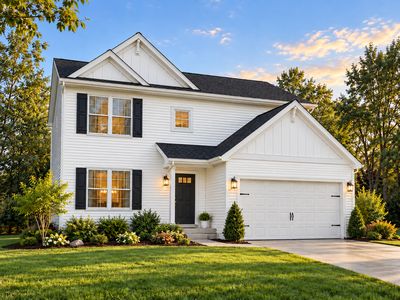
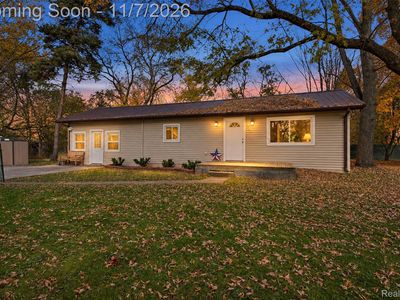
Can You Use a DSCR Loan for Airbnb or Short-Term Rentals in Michigan?
Yes. Ziffy offers financing for eligible short-term rental properties in Michigan. Qualification depends on the property’s location, permitted use, rental income documentation, valuation, and applicable loan-program requirements.
A property may be suitable for DSCR financing but still face local restrictions on short-term rental operations. Investors should establish lawful rental use before relying on projected Airbnb income.
Ann Arbor
The city requires short-term rental licensing. In residential zoning districts, principal-residence requirements limit eligibility, making zoning verification especially important for investors purchasing a non-owner-occupied property.
Traverse City and Lakeshore Markets
Check the exact municipality and zoning district. Local restrictions, seasonal occupancy, management expenses, and insurance requirements must be examined before projecting rental income.
Verify rules for the specific property address.
Short-term rental underwriting may use a different approved income methodology from a conventional long-term lease. Platform revenue projections are not automatically qualifying income. Investors should keep operating cash-flow projections separate from the lender’s DSCR calculation.
For additional rental analysis, see the Ziffy investment property financing guide.
Can You Get a Michigan DSCR Loan With a Ratio Below 1.00?
Yes. Ziffy offers eligible below-1.00 DSCR and No-Ratio financing options for investment properties that do not satisfy the standard 1.00 coverage benchmark.
A ratio below 1.00 means the property’s qualifying rent does not fully cover PITIA. Such loans may require a larger down payment, more reserves, or different pricing depending on the borrower and property.
What Can Improve a Michigan Rental Property’s DSCR?
- Verify existing leases and obtain reliable market-rent evidence.
- Confirm the property’s projected post-transfer tax obligation.
- Compare insurance quotations and any association dues.
- Consider a larger down payment to reduce monthly principal and interest.
- Compare eligible financing structures before committing to a purchase.
“A DSCR below 1.00 does not automatically mean the deal is off the table. It usually means we need to look more closely at the structure. Sometimes the issue is leverage, sometimes it is taxes or insurance, and sometimes the rent support needs to be reviewed more carefully. The key is understanding why the ratio is coming in low and then matching the investor with the financing option that makes the most sense for that property.”
Michigan DSCR Loans for Purchases, Refinancing, and Cash-Out
Ziffy offers several financing options for Michigan investment property owners. The appropriate structure depends on whether the investor is acquiring a property, changing an existing mortgage, or accessing equity.
Purchase
Available in eligible scenarios. Investors may qualify using property rental income instead of conventional personal-income documentation.
Rate-and-Term Refinance
Eligible property owners may refinance an existing mortgage under the applicable loan conditions.
Cash-Out Refinance
Eligible investors can access property equity, subject to valuation, equity, seasoning, and underwriting requirements.
Investors planning to refinance should calculate the property’s current qualifying rent and updated PITIA rather than assuming that a higher appraised value will automatically support the desired loan amount. Rate, closing costs, prepayment provisions, and available cash reserves should also be part of the decision.
Michigan Rental Property Regulations and Expenses Investors Should Check
A property that appears affordable on paper can require additional investment before it is ready to rent. Michigan investors should account for municipal compliance, insurance, winter maintenance, and the condition of major building systems.
Detroit Rental Compliance
Detroit requires rental registration and a Certificate of Compliance. Investors should also review inspection and lead-clearance requirements where applicable.
Grand Rapids Registration
The city requires rental property registration and annual registration updates. Investors should confirm applicable inspection and housing-code requirements.
Ann Arbor Rental Certification
Ann Arbor requires rental properties to maintain a Certificate of Compliance. The city operates a recurring residential rental inspection program.
Statewide Landlord Obligations
Michigan regulates residential security deposits, including a general maximum of one and a half months’ rent. Landlords must follow statutory handling and notice requirements.
Budgeting for Michigan Winters
Cold-weather maintenance can affect rental profitability. Heating systems, roofing, insulation, frozen-pipe prevention, snow removal, and seasonal repairs deserve attention during inspection and financial planning. These costs may not all appear in the lender’s DSCR formula, but they still affect an investor’s actual cash flow.
Michigan DSCR Loan FAQs
What credit score do I need for a DSCR loan in Michigan?
Ziffy offers eligible Michigan DSCR loans with credit scores starting at 620. Available LTV, loan pricing, and reserve requirements depend on the complete loan scenario.
How much down payment is required for a Michigan DSCR loan?
A 20% down payment is a common starting point. Ziffy also offers up to 85% purchase LTV in eligible scenarios, although higher leverage is subject to additional underwriting conditions.
Can I get a Michigan DSCR loan without tax returns?
Yes. DSCR loans generally do not require personal tax returns, W-2s, or pay stubs to verify qualifying income. Borrowers still need to meet credit, asset, property, and other underwriting requirements.
Can I finance a duplex or fourplex in Michigan using a DSCR loan?
Yes. Eligible two-to-four-unit investment properties may qualify. The lender reviews qualifying rental income, legal unit count, property condition, valuation, and the applicable loan program.
Can I use a DSCR loan for an Airbnb in Michigan?
Ziffy offers eligible short-term rental financing. Investors must verify local zoning, licensing, permitted use, and the documentation required to establish acceptable rental income.
How do Michigan property taxes affect DSCR?
A qualifying transfer of ownership generally uncaps taxable value in the following calendar year. Higher property taxes increase PITIA and can reduce the property’s DSCR. Investors should estimate post-transfer taxes when evaluating financing.
Can I qualify for a Michigan DSCR loan below 1.00?
Yes. Ziffy offers qualifying below-1.00 and No-Ratio DSCR financing options. These may require additional equity, reserves, or different loan pricing.
Can an LLC obtain a DSCR loan in Michigan?
Eligible investment properties can be financed through qualifying LLC ownership structures, subject to lender requirements, entity documentation, title review, and guarantees where applicable.
What is the maximum cash-out refinance LTV in Michigan?
Ziffy offers eligible DSCR cash-out refinancing up to 75% LTV. Final eligibility depends on property value, available equity, credit, qualifying rent, seasoning, and underwriting.