





Editorial Integrity
Making sound real estate investment decisions begins with reliable, data-driven insights. At Ziffy.ai, we offer an AI-native real estate investing, proprietary data-driven trend analysis, investment mortgage programs like DSCR loans, and a network of over 500 investor-friendly real estate agents to deliver the expertise needed for informed decisions. Our content is crafted by experienced real estate professionals and backed by real-time market data, ensuring you receive accurate and actionable information. Through a rigorous editorial process, we strive to empower your investment journey with trustworthy and up-to-date guidance.
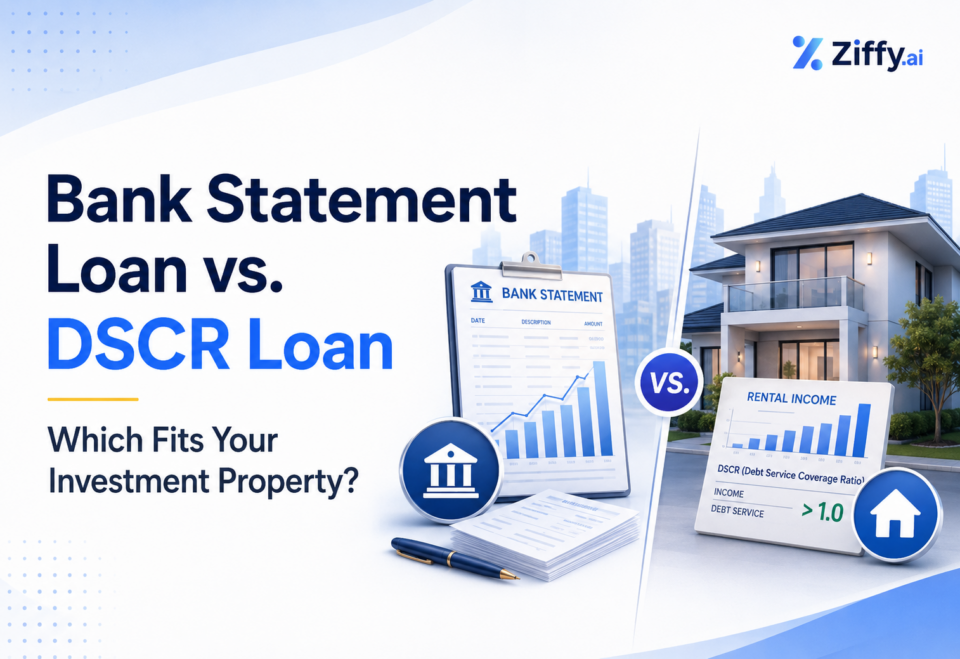
Bank Statement Loan or DSCR Loan?
For an investment property, the choice usually comes down to whose cash flow should qualify the loan.
The lender reviews deposits from personal or business accounts and converts eligible deposits into qualifying income.
Qualification is based primarily on the rental property’s income relative to its PITIA payment rather than the borrower’s personal income or DTI.
The practical choice: If your business deposits tell the stronger financial story, a bank statement loan may fit better. If the rental property has supportable income and you want to qualify without personal income or DTI, a DSCR loan is usually the cleaner investor structure.
What to Know Before Choosing
Bank statement loans focus on borrower cash flow. DSCR loans focus on property cash flow.
Many bank statement programs review 12 or 24 months of deposits, but lookback periods, expense factors, credit standards, DTI limits, and LTVs vary by lender.
A DSCR loan uses rental income against the property’s full housing payment. At Ziffy Mortgage:
Ziffy Mortgage’s DSCR program currently starts at a 620 credit score, offers up to 85% LTV on eligible purchases, and generally starts with two months of reserves.
Self-employed investors should not assume a bank statement mortgage is automatically the best fit. A rental with strong DSCR can sometimes qualify without personal income documentation at all.
Self-employed investors often hear “bank statement loan” and assume that is the obvious answer for any mortgage. For a rental purchase, that assumption can add paperwork the deal may not need.
The better starting question is simple: Is the stronger income story coming from you or from the property?
Table of Contents
Bank Statement Loan vs. DSCR Loan: Side-by-Side Comparison
Bank Statement Loan vs. DSCR Loan
See how the two loan structures differ in qualification, documentation, and investor fit.
| Feature | Bank Statement Loan | DSCR Loan |
|---|---|---|
| Qualification basis | Borrower’s eligible bank deposits | Property’s rental income |
| Personal income analysis | Yes | No personal income or DTI calculation for Ziffy DSCR |
| Common income documentation | Often 12 or 24 months of personal or business statements | Rent support and property documentation |
| Tax returns | Commonly not used to calculate income | Not required for Ziffy DSCR |
| DTI | Usually part of qualification | Not used for Ziffy DSCR |
| Property use | Can include investment property, depending on lender | Investment property |
| Best fit | Strong borrower cash flow | Strong or financeable rental cash flow |
What Is a Bank Statement Loan for an Investment Property?
A bank statement loan is an alternative-documentation mortgage commonly used by self-employed borrowers, business owners, freelancers, and 1099 earners. Rather than deriving qualifying income from tax returns, the lender reviews eligible deposits over a stated period. Many current programs use 12 or 24 months of statements.
Business statements usually require an expense analysis because gross deposits are business revenue, rather than automatically being treated as personal qualifying income. A lender may apply a standard expense factor or use documentation supporting a different business expense ratio. The resulting income then feeds into the borrower’s debt-to-income analysis. Exact formulas vary by program.
That is a meaningful departure from conventional self-employed underwriting. Fannie Mae generally looks for a two-year earnings history and commonly relies on personal and, when required, business tax returns to analyze self-employment income.
One terminology point is useful here. Bank statement and DSCR products are frequently grouped under the “non-QM” label in mortgage marketing. For a non-owner-occupied rental, however, the CFPB’s official Regulation Z commentary treats credit used to acquire, improve, or maintain that rental as business-purpose credit. The regulatory classification and the product labels used in mortgage marketing are separate issues.
What Is a DSCR Loan for an Investment Property?
A DSCR loan shifts qualification toward the rental property’s income.
At Ziffy Mortgage, the calculation is:
DSCR = Gross Monthly Rent ÷ PITIA
PITIA includes principal, interest, taxes, insurance, and association dues when applicable. A DSCR of 1.00 means gross monthly rent equals the monthly PITIA used in the calculation.
Ziffy currently offers DSCR loans with a minimum 620 credit score, loan amounts from $100,000 to $10 million, up to 85% LTV for eligible purchases, up to 80% for rate-and-term refinances, and up to 75% for cash-out refinances. Best terms generally apply at DSCR 1.0 or higher, while eligible properties below 1.0 may have a path through a No-Ratio DSCR option. Reserve requirements generally start at two months.

The real value of a DSCR loan is that it lets us evaluate the financing the same way an investor evaluates the property: does the rental income support the debt? A borrower may have strong personal income, but that does not make a weak rental a better investment. With DSCR, the property’s cash flow has to carry more of the conversation.
That distinction is useful for self-employed investors. If the property can qualify from supportable rental income, there may be little value in building a mortgage file around months of business deposits and a personal DTI calculation.
Bank Statement Loan vs. DSCR Loan: Which Is Better for a Self-Employed Investor?
Neither product wins every scenario. Compare the strength of the borrower with the strength of the property.
- A bank statement loan can make more sense when your self-employed cash flow is well documented, your deposit history is consistent, and the property itself does not produce a strong enough DSCR for the financing structure you want. It can also be relevant when a lender’s program allows the occupancy or property type you need.
- A DSCR loan can make more sense when the rental income is supportable, personal tax returns do not reflect your real cash position, you already carry substantial personal or portfolio debt, or you want the rental to qualify on its own economics. Ziffy Mortgage does not use personal DTI to qualify its DSCR loan.
Do not choose between them by interest rate alone. Pricing for either product depends on the actual file, including credit, leverage, loan size, property profile, reserves, and program structure. Current bank statement programs illustrate how widely underwriting parameters can vary from one lender to another.
Getting a DSCR loan approved is only one part of the job. A well-structured file starts with making sure the rent, leverage, reserves, and documentation all support the deal from the beginning. That can reduce surprises during underwriting and, more importantly, helps the investor choose financing that makes sense for the property rather than simply finding a loan that can close.
Do DSCR Loans Require Bank Statements?
They can, but the statements serve a different purpose.
A bank statement loan uses account deposits to calculate qualifying income. A DSCR loan may still require bank or asset statements to document cash to close and reserves. Those statements support the asset side of the file rather than replacing tax returns as the income calculation.
At Ziffy, DSCR reserves generally start at two months of PITIA. Business accounts can require documentation showing ownership, access to funds, and a clean source of reserves.
What If the Property Does Not Qualify for DSCR?
A low DSCR does not automatically point to a bank statement loan.
First, check why the ratio is weak. A higher loan amount, taxes, insurance, HOA dues, or a rent figure that cannot be supported during underwriting can reduce the ratio. Lower leverage may improve the calculation because it reduces the financed amount and monthly payment. Ziffy Mortgage also has eligible No-Ratio DSCR options for properties below a 1.0 ratio.
Property condition should also guide the loan choice. If the asset still needs substantial renovation or stabilization before it can operate as a rental, bridge financing or a fix-and-flip loan may fit that stage of the investment better than permanent rental financing.
Where Bank Statements Fit at Ziffy Mortgage
At Ziffy Mortgage, the borrower-income route is the Full Documentation Loan, while the DSCR program uses rental income as the core qualification method. Bank statements can form part of a Full Documentation file, along with income and asset verification, but that is different from a standalone bank statement mortgage that calculates qualifying income primarily from deposit history.
Before applying, review the DSCR loan requirements and run the property through Ziffy’s DSCR loan calculator to see how rent, financing, and PITIA affect the ratio.
FAQs
Is a DSCR Loan Better Than a Bank Statement Loan for Rental Property?
A DSCR loan is often a stronger fit when the rental itself can support the proposed payment because qualification does not depend on personal income or DTI. A bank statement loan may be useful when the borrower’s deposits are stronger than the property’s DSCR. Program eligibility still depends on the lender and full file.
Can a Bank Statement Loan Be Used for an Investment Property?
Yes. Some bank statement mortgage programs allow investment properties. Eligibility, down payment, DTI, statement period, and expense calculation vary by lender, so there is no single industry-wide bank statement loan formula.
Can a Self-Employed Borrower Get a DSCR Loan Without Tax Returns?
Yes. Ziffy does not require tax returns, W-2s, or pay stubs to qualify a DSCR loan. The property’s rental income drives qualification, while credit, LTV, reserves, rent support, and property characteristics still affect underwriting.
Does a DSCR Loan Use Net Operating Income?
Ziffy’s DSCR formula uses gross monthly rent divided by PITIA, not NOI. PITIA includes principal, interest, taxes, insurance, and association dues when applicable.
What Should I Compare Before Choosing a Bank Statement Loan or DSCR Loan?
Compare the qualification basis first. Then review the property’s rent support, your deposit consistency, DTI exposure, leverage, reserves, ownership structure, property condition, and the lender’s actual pricing. The stronger choice is the one whose underwriting method fits the financial profile of the deal.