







Editorial Integrity
Making sound real estate investment decisions begins with reliable, data-driven insights. At Ziffy.ai, we offer an AI-native real estate investing, proprietary data-driven trend analysis, investment mortgage programs like DSCR loans, and a network of over 500 investor-friendly real estate agents to deliver the expertise needed for informed decisions. Our content is crafted by experienced real estate professionals and backed by real-time market data, ensuring you receive accurate and actionable information. Through a rigorous editorial process, we strive to empower your investment journey with trustworthy and up-to-date guidance.
Quick Answer

The Q2 2026 real estate investor outlook is defined by a sentiment reset. Through mid-June, investors are still buying, but the easy assumptions from the 2020 to 2022 cycle no longer work. Higher mortgage rates, softer asking rents in several large metros, slower investor activity, and more realistic seller pricing have pushed the market back toward deal-level discipline.
For rental investors, the strongest opportunities in Q2 2026 are showing up in four areas:
- Markets where sellers have adjusted pricing but buyer activity has not disappeared
- Builder-inventory pockets where new-home supply gives buyers room to negotiate
- Midwest and select lower-cost metros where acquisition prices still give rental math a chance
- Debt Service Coverage Ratio (DSCR)-ready properties where rent supports full principal, interest, taxes, insurance, and association dues (PITIA), with enough reserves left after closing
This quarterly update should be read alongside Ziffy’s broader 2026 real estate investing outlook. The annual outlook explains the bigger capital-cycle story. This Q2 update focuses on what has changed through mid-June: investor purchases have slowed, sellers are meeting the market, rents are less forgiving, and DSCR underwriting has become a sharper filter for rental acquisitions.
At Ziffy, the investor conversation has moved from market timing to property-level math. The stronger buyers are evaluating whether a specific rental still works if rent growth stays modest, insurance runs higher, and rates remain elevated.
Table of Contents
Through Mid-June, Investor Behavior Has Changed
Investor purchases are running at their lowest level since 2020, and the buyers still active are underwriting differently.
According to Redfin’s Q1 2026 investor report, investor home purchases fell 6% year over year, while investors still bought about 19% of homes in the markets Redfin tracks. Investors are still active, but they are buying fewer properties, avoiding thinner margins, and becoming more selective about property type, local demand, and financing structure.
The condo pullback illustrates this directly. Redfin reported that investor condo purchases fell 8% year over year in Q1 2026, while investor townhouse purchases fell 13%. Rising Homeowners Association (HOA) fees and insurance costs are making attached housing harder to underwrite in several markets.
Low-priced investor purchases also fell 10% year over year, the lowest first-quarter level in a decade. Cheaper properties are not automatically more attractive when repairs, insurance, taxes, and tenant risk can erase the entry-price advantage.
In our experience, this kind of reset can be useful for disciplined investors. Less speculative competition can create better room for buyers who already know their financing lane, understand their reserve requirement, and can move quickly when a property clears the math.
The Market Is Softer, Not Broken
The national housing data is mixed, which is why Q2 2026 feels harder to read than a simple buyer-market or seller-market headline.
The Federal Housing Finance Agency (FHFA) Q1 2026 House Price Index showed US house prices up 1.7% year over year and 0.5% quarter over quarter. House prices rose in 42 states over the year, and the East North Central division posted the strongest annual gain among census divisions at 4.4%.
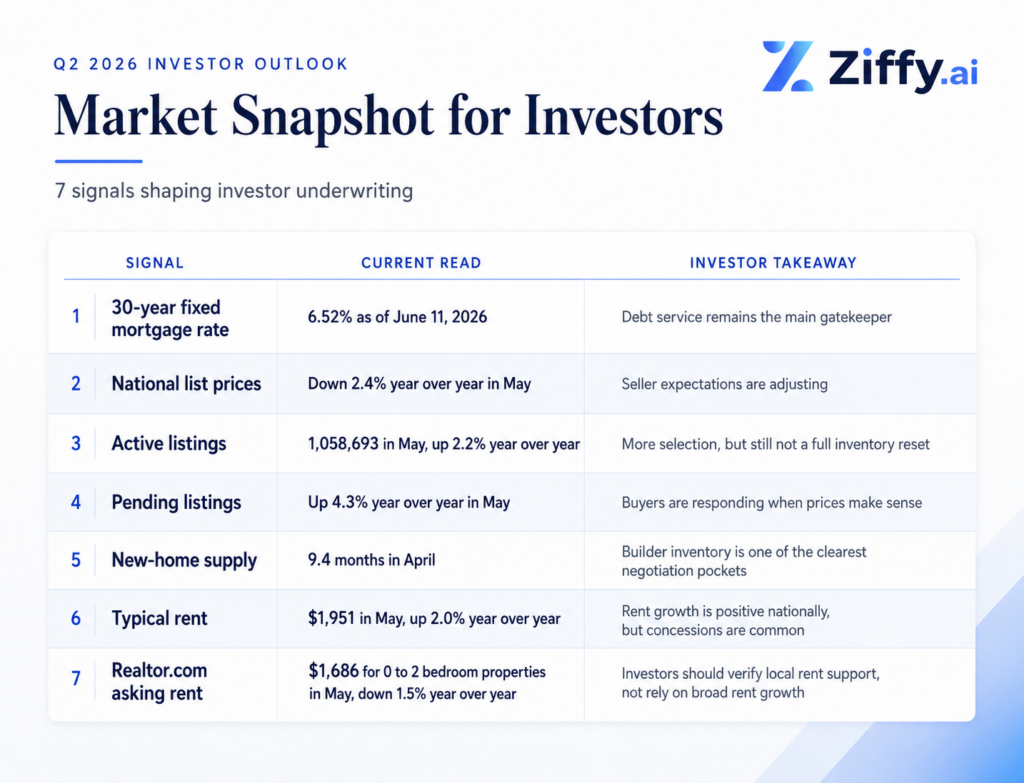
At the listing level, sellers are adjusting faster. Realtor.com’s May 2026 housing report showed median list prices down 2.4% year over year, the steepest annual decline in Realtor.com data going back to 2017. At the same time, pending listings rose 4.3% year over year, and new listings reached their highest May level since 2022.
Sellers repricing proactively while pending contracts continue to rise points to a functioning negotiation environment, not a distressed one. Investors do not need a crash scenario to find room to work in this market.
Rates Are Still the Gatekeeper
Mortgage rates remain the biggest constraint on investor activity.
Freddie Mac’s June 11, 2026 Primary Mortgage Market Survey put the average 30-year fixed-rate mortgage at 6.52%. Investment-property rates can differ based on loan type, borrower profile, property type, leverage, reserves, and program structure, but Freddie Mac’s benchmark still shows the broader cost-of-capital environment investors are working within.
Higher rates change the deal in three direct ways:
- Monthly debt service rises.
- Fewer properties clear DSCR without a larger down payment, lower purchase price, stronger rent, or better structure.
- Exit assumptions become more conservative because future buyers are also rate-sensitive.
This is why DSCR financing has become central to rental-acquisition strategy in 2026. A DSCR loan evaluates whether the property’s rental income can support the loan payment. The basic formula is:
DSCR = Gross rental income ÷ PITIA
PITIA includes principal, interest, taxes, insurance, and association dues where applicable.
At Ziffy, DSCR is not treated as a late-stage underwriting detail. It is the first serious screen for rental acquisitions. A property that looks attractive at the listing level can weaken quickly once full taxes, insurance, HOA dues, vacancy risk, and reserves are reviewed.

The rate is not the only number that can make or break an investment-property loan. The rental income has to support the full payment structure. In this market, I want investors looking at full PITIA and post-closing reserves before they fall in love with the purchase price.
Investors who are still learning the loan structure should start with Ziffy’s DSCR loan guide and DSCR loan requirements. Investors already screening deals can use the DSCR loan calculator to test rent coverage before writing an offer.
Credit Conditions Are Not Loose Enough to Save Weak Deals
Credit standards have stayed tighter than many investors expect, which affects who gets flexibility when the file goes to underwriting.
The Federal Reserve’s April 2026 Senior Loan Officer Opinion Survey showed banks reporting basically unchanged lending standards and unchanged or weaker demand across most residential real estate loan categories. Credit is not collapsing, but it is not loose enough to make weak deals easy.
Household credit also deserves attention. The New York Fed’s Q1 2026 Household Debt and Credit report showed mortgage balances at $13.19 trillion at the end of March 2026, up $21 billion during the quarter. Broader consumer debt reached $18.8 trillion.
Thin reserves, aggressive rent assumptions, unclear entity structures, and high leverage can create friction quickly.
That is especially relevant for investors using a Limited Liability Company (LLC) structure where eligible. The entity structure can be useful, but it still has to fit the loan program, title structure, reserves, and property-level underwriting.
Inventory Is Improving, But Quality Matters More Than Count
Realtor.com reported 1,058,693 active listings in May 2026, up 2.2% from a year earlier. New listings rose 2.1% year over year, and May had the highest new-listing count for that month since 2022.
For investors, more listings help, but inventory growth alone does not create opportunity.
Inventory growth is only useful if the reasons behind it hold up. More listings paired with lower asking prices, stable rents, and manageable repair exposure point toward a workable market. More listings paired with stale days on market, falling rents, higher insurance, and expensive HOAs point toward a risk screen.
Realtor.com reported that new listings surged in the Northeast and Midwest, while new and active listing growth stalled in the South and West. FHFA’s Q1 data also showed the East North Central division leading annual price appreciation, while the West South Central division recorded a 0.7% decline.
The investor read should stay local. Entry price, rental depth, insurance, tax behavior, property age, and financing strength matter more than broad regional labels.
Builder Inventory Is One of the Clearest Negotiation Pockets
Builder-held inventory is one of the few Q2 2026 pockets where buyers have real negotiating room, especially where builders are carrying completed or near-completed units they need to move.
The Census Bureau and HUD April 2026 new residential sales release showed 489,000 new houses for sale at the end of April, equal to 9.4 months of supply at the current sales rate. At that level, builders are carrying enough inventory to negotiate from a position where closing certainty matters more than maximizing price.
Builders may become more flexible when they need to move inventory. The investor benefit is not always a lower headline price. It can show up through closing credits, rate buydowns, appliance packages, repair warranties, or upgraded finishes that reduce early capital needs.
The construction side also shows a sharp slowdown. Census/HUD May 2026 new residential construction data showed privately owned housing starts falling 15.4% month over month and 8.7% year over year to a seasonally adjusted annual rate of 1,177,000. That was the lowest total starts annual rate since May 2020. Single-family starts fell 1.9% month over month, while starts in buildings with five or more units fell much more sharply.
Standing inventory is negotiable now. Once builders work through what they already have without starting new projects at the same pace, that room to negotiate shrinks.
A builder deal still needs full underwriting. New construction can reduce early repair risk, but it can also bring higher reassessed taxes, HOA costs, builder premium pricing, and lease-up competition if several similar homes hit the rental market at once.
Rents Are the Hardest Part of the 2026 Story
Rent data is giving investors two different readings.
Realtor.com’s May 2026 rental report showed the median asking rent for 0 to 2 bedroom properties across the 50 largest metros at $1,686, down 1.5% year over year. May marked the 34th consecutive month of annual rent declines in that data set.
By unit size, two-bedroom asking rents fell 1.5% year over year to $1,885, marking the 36th consecutive month of annual declines for that unit size. One-bedroom rents also fell 1.5% year over year, and studio rents fell 1.9%.
Zillow’s May 2026 market report showed typical national rent at $1,951, up 2.0% year over year. Zillow also reported that 39.6% of rental listings offered a concession in May, compared with 35.1% a year earlier and 39.8% in April.
Those reports measure different rental universes, so the numbers do not need to match perfectly. Rent growth is not strong enough to rescue lazy underwriting in either data set.
A single-family rental can still perform well in a market where apartment rents are soft, but investors need property-level support. Current lease comps, active rental competition, tenant demand, school district, commute pattern, and lease-up time matter more than broad national rent direction.
The common mistake in 2026 is using yesterday’s rent estimate to justify today’s purchase price. A better approach is to test the projected rent against full PITIA, then rerun the deal with a lower rent assumption before writing the offer.
Where the Opportunity Actually Is in Q2 2026
The opportunity in Q2 2026 is tied to the gap between seller adjustment and rental strength. The best deals are not concentrated in one market type. They show up where pricing, rent support, and financing structure still line up after stress testing.
1. Midwest Markets With Better Affordability and Stronger Local Math
The Midwest deserves closer attention in Q2 because affordability is still better than many coastal and high-growth Sun Belt markets, while several Midwest metros continue to show durable price and rent signals.
FHFA reported that the East North Central division posted 4.4% annual house price growth in Q1 2026, the strongest among census divisions. Realtor.com’s May rental report also showed several Midwest metros with relatively stable rental conditions compared with markets where asking rents are falling more sharply.
For example, Realtor.com reported May asking rent of $1,329 in Cincinnati, OH, up 0.8% year over year; $1,194 in Cleveland, OH, down 1.2%; $1,174 in Columbus, OH, down 0.8%; $1,268 in Indianapolis, IN, down 1.6%; $1,214 in Louisville, KY-IN, down 2.3%; and $1,468 in Pittsburgh, PA, up 3.1%.
Those are not explosive rent-growth numbers, and that is the point. Investors screening the Midwest are not looking for hype.
Markets such as Cincinnati, Cleveland, Columbus, Indianapolis, Louisville, and Pittsburgh deserve closer screening because they often give investors lower acquisition prices than many coastal or high-growth Sun Belt markets.
Older housing stock can create repair costs that erase the benefit of a lower purchase price. Property taxes, tenant profile, neighborhood liquidity, and maintenance assumptions still have to be underwritten, not assumed.
2. Select Texas Markets Where Pricing Has Adjusted
Texas remains investable, but the market requires more disciplined underwriting than it did during the fastest-growth years.
FHFA reported that the Austin-Round Rock-San Marcos metro had the largest annual price decline among the top 100 metros in Q1 2026, down 6.9%. Realtor.com’s rental report also showed soft May rent trends across several Texas metros: Austin rents were down 4.3% year over year, Dallas-Fort Worth rents were down 2.9%, Houston rents were down 2.8%, and San Antonio rents were down 4.3%.
Lower prices can help the DSCR calculation, but softer rents can offset that advantage just as quickly.
Texas investors should verify property taxes and insurance early. A rental that clears DSCR at the listing stage can weaken quickly if taxes reset higher or insurance comes in above the placeholder estimate.
The better Texas opportunity is a rental where the seller has adjusted, the rent still supports full PITIA, and the investor has enough reserves to absorb tax and insurance surprises.

Steven Glick
Director of Mortgage Sales · Ziffy Mortgage
In Texas, a lower purchase price can help, but it does not solve the whole file. I want to see investors verify taxes and insurance before they treat the discount as real cash flow.
3. Florida Deals With Enough Cushion for Insurance and HOA Risk
Florida remains one of the most complicated investor markets in 2026.
Orlando investor purchases fell 25% year over year in Q1 2026, the second-largest decline among the metros in its analysis. Redfin also pointed to Florida’s price softness, higher inventory, rising HOA fees, and insurance costs as reasons investors have been retreating from the state.
Florida can still work, but the margin of safety has to be larger.
A Florida rental can make sense if the location has durable tenant demand, the property is not overloaded with HOA exposure, insurance is confirmed, reserves are adequate, and the DSCR works under conservative assumptions.
Investors should be especially careful with condos and townhomes. HOA fees, pending assessments, reserve requirements, and master insurance changes can alter the investment profile after the purchase price already looks attractive.
Florida is no longer a market where broad migration logic is enough. The property has to pass the cost test.
4. Builder Inventory Where Concessions Improve the Loan Structure
Builder inventory is attractive only when the concession improves the actual deal structure.
A closing credit can help cash to close. A rate buydown can improve the payment. An appliance or repair package can reduce early capital needs. But none of that matters if the final payment still does not line up with rent support.
Investors should ask four questions before treating a builder concession as an opportunity:
- Does the concession reduce the monthly payment or only reduce upfront cash?
- Does the rent support full PITIA after taxes and HOA dues are loaded?
- Are several similar rentals competing in the same subdivision?
- Will reassessed taxes change the year-two cash flow?
Builder deals can work well for investors who want lower early repair risk. They can also disappoint investors who underestimate tax reassessment, lease-up competition, or HOA restrictions.
5. Properties That Clear DSCR After Stress Testing
The strongest Q2 2026 opportunity is structural. A rental property should be tested against:
- Current market rent, not peak rent
- Full PITIA, including HOA dues where applicable
- Confirmed or conservative insurance
- Realistic tax assumptions, including reassessment risk
- Vacancy and maintenance assumptions
- Post-closing reserves
- A backup plan if rent lands below the first estimate
A 1.25 DSCR on paper can become thin if insurance is understated or taxes jump. A property near 1.00 can become more workable if the investor negotiates price, increases down payment, or finds stronger verified rent support.
At Ziffy, investors can search across nearly one million active US listings, compare projected rent and return metrics, and connect the deal analysis directly to investor-friendly mortgage financing. Based on Ziffy’s March 2026 active-listing benchmark, the platform tracked approximately 964,477 active US listings, up roughly 23.5% year over year.
In 2026, the most expensive mistakes happen before the loan file opens. A listing can price below market and still fail once insurance is confirmed, taxes are verified, and reserves are counted after closing.
Investors comparing properties can use the cap rate calculator to evaluate income relative to value, then use the DSCR loan calculator to see whether the same deal can support debt.
What Investors Should Avoid in Q2 2026
The weakest deals in this market usually have one thing in common: the first version of the math only works because something important is missing.
Investors should be cautious with deals that depend on:
- Rent growth that is not supported by current rental comps
- Low insurance placeholders in high-cost insurance markets
- Property taxes that have not been reassessed
- HOA dues that are rising or tied to pending assessments
- Seller concessions that reduce cash to close but do not improve payment strength
- Appreciation assumptions that justify weak cash flow
- Short-term rental projections with optimistic occupancy
- Older properties with deferred maintenance and no repair cushion
A price cut can improve a deal, but it cannot fix weak rent coverage by itself. The property still needs to carry its financing, and the investor still needs enough liquidity after closing.
This is where investment property loans need to be matched to the business plan. A long-term rental usually points toward DSCR financing. A short renovation timeline may require a bridge loan or fix-and-flip loan. The wrong loan structure can make a reasonable property harder to execute.
What a Strong Investor Strategy Looks Like Now
A strong Q2 2026 investor strategy starts with the financing structure, then uses that structure to screen properties.
For long-term rental acquisitions, DSCR should usually be the first financing lane investors evaluate. It keeps the underwriting centered on whether the property’s rental income can support the debt.
A practical sequence looks like this:
- Start with DSCR if the target is a long-term rental.
- Define the down payment range, reserve target, and minimum DSCR before writing offers.
- Screen markets where seller pricing has adjusted but tenant demand remains durable.
- Stress test rent, full PITIA, vacancy, maintenance, and reserves.
- Use seller or builder concessions to strengthen the payment or reduce risk, not just to lower cash to close.
- Keep liquidity after closing for repairs, vacancy, tax changes, and slower lease-up.
- Compare the deal against other markets and properties before committing capital.
For many investors, DSCR financing is the best-fit structure because it keeps the loan decision tied to the income-producing property rather than forcing a rental acquisition through personal-income underwriting. This is especially useful for investors building portfolios, using LLC structures where eligible, or screening multiple rentals simultaneously.
That matters for investors building portfolios, using LLC structures where eligible, or comparing multiple rental opportunities at the same time.
Investors planning the second half of 2026 should also compare this Q2 update with Ziffy’s best places to invest in real estate guide. The market guide is useful for broader location screening. This article is designed to help investors understand the Q2 reset and apply it to property-level underwriting.
How Ziffy Fits the 2026 Investor Workflow
The Q2 2026 market rewards investors who can connect three decisions early: which market to screen, which property to underwrite, and which loan structure fits the investment plan.
Ziffy is built around that sequence.
As an AI-native real estate investing platform, Ziffy helps investors search for rental properties, review projected rent and return metrics, and connect the deal to investor-friendly mortgage financing. In 2026, treating property search and financing as separate decisions is where most acquisition mistakes start.
The failure points tend to work the same way: a listing priced below market that still fails once insurance is confirmed; a rental with solid gross rent that weakens once taxes reset; a builder concession that reduces cash to close without changing the monthly payment. Each one looks like progress until the full underwriting is done.
Investors who screen property and financing together before the offer make fewer expensive mistakes in this market.
Bottom Line
Q2 2026 is a better market for disciplined investors than for speculative buyers.
Rates are still high enough to punish weak cash flow. Rent growth is uneven. Insurance, property taxes, repairs, HOA dues, and reserves can change the deal quickly. At the same time, seller expectations are adjusting, active inventory has improved, builder inventory is creating negotiation pockets, and fewer investors are chasing the same properties.
The opportunity is to buy where the reset creates a better entry point and the property still works under conservative financing assumptions.
At Ziffy, the investor workflow starts with the rental income calculation, tests it against full PITIA, reserves, taxes, and insurance, and connects the result to DSCR financing before the offer is written.
FAQs
Is Q2 2026 a good time to buy an investment property?
Q2 2026 can be a good time to buy an investment property if the deal works under conservative assumptions. Investors should not buy only because a seller reduced the price. The rental still needs supportable rent, realistic taxes, confirmed insurance, adequate reserves, and a financing structure that fits the hold plan.
Where is the best real estate investment opportunity in Q2 2026?
The best opportunity is not in one single market. It is in properties where seller pricing has adjusted and rent still supports PITIA. Midwest markets, select Texas deals, Florida rentals with enough insurance and HOA cushion, and builder-inventory pockets deserve close screening.
Why are DSCR loans useful for investors in 2026?
DSCR loans are useful because they evaluate the rental property’s income against the property’s monthly payment. That structure fits investors buying income-producing rentals, building portfolios, using LLC structures where eligible, or trying to avoid forcing an investment deal through personal-income underwriting.
What should investors watch before buying in the second half of 2026?
Investors should watch mortgage rates, local rent trends, insurance costs, property taxes, inventory quality, builder concessions, and lender requirements. The deal should be stress tested before the offer, not after inspection.
Does a price cut automatically make a rental property a good deal?
No. A price cut only helps if the property still works after real costs are included. Investors should review rent support, PITIA, vacancy, maintenance, taxes, insurance, HOA dues, and reserves before treating a discount as an opportunity.