






Editorial Integrity
Making sound real estate investment decisions begins with reliable, data-driven insights. At Ziffy.ai, we offer an AI-native real estate investing, proprietary data-driven trend analysis, investment mortgage programs like DSCR loans, and a network of over 500 investor-friendly real estate agents to deliver the expertise needed for informed decisions. Our content is crafted by experienced real estate professionals and backed by real-time market data, ensuring you receive accurate and actionable information. Through a rigorous editorial process, we strive to empower your investment journey with trustworthy and up-to-date guidance.
Quick Answer: Is Florida Still a Good Place to Buy Investment Property in 2026?

Florida can still be a good place to buy rental property in 2026, particularly for investors who negotiate the price, obtain insurance estimates before making an offer, and avoid poorly funded associations.

The stronger opportunities are likely to be in submarkets supported by hospitals, universities, airports, ports, research facilities, and diversified employers. Doral, Westshore, Lake Nona, East Orlando, and key Jacksonville corridors have identifiable demand anchors, but price, supply, flood exposure, HOA obligations, and realistic rent still determine whether a property works.
Single-family and condo inventory are creating different negotiating conditions.
Neighborhood-level employment, university, healthcare, and logistics anchors matter more than metro averages.
Address-specific insurance quotes and association-level due diligence are essential.
Frequent concessions in Tampa and Orlando make effective rent more useful than asking rent.
Florida still offers population growth, a large renter base, tourism, and distinct employment centers. But for the rest of 2026, returns will depend less on broad appreciation and more on purchase basis, insurance, association finances, rental supply, and proximity to durable employment.
Table of Contents
Florida Real Estate Market Forecast for the Rest of 2026
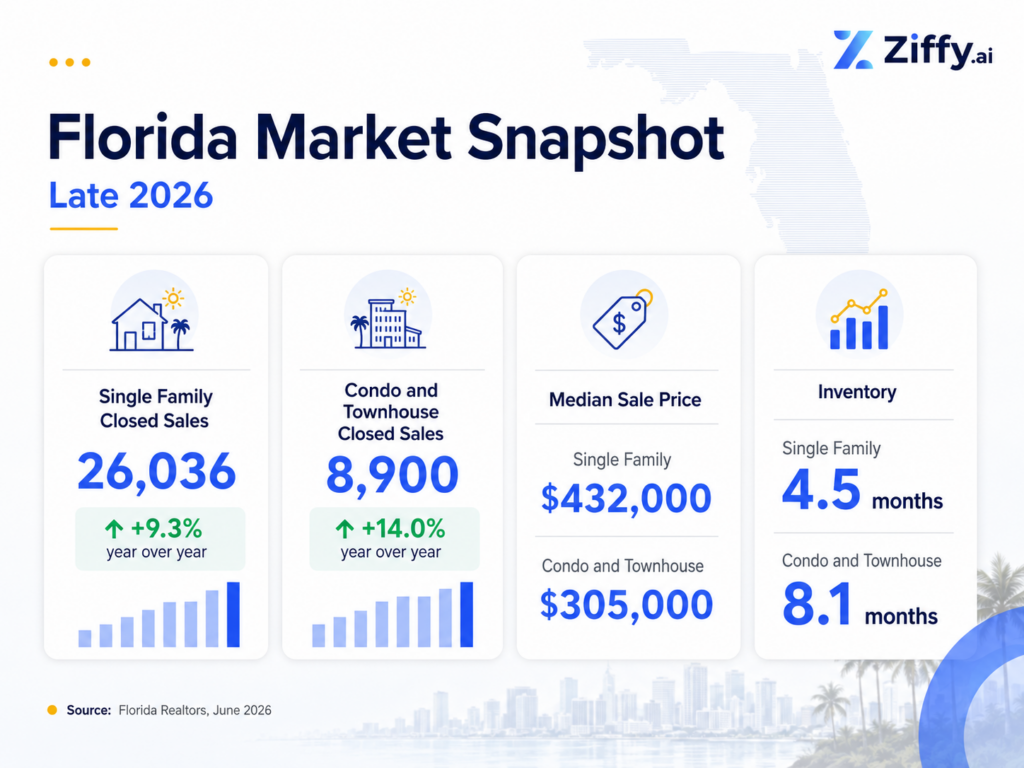
Florida recorded 26,036 single-family closed sales in June 2026, up 9.3% year over year. Condo and townhouse sales increased 14% to 8,900. The statewide median sale price was $432,000 for single-family homes and $305,000 for condos and townhouses. Single-family inventory stood at 4.5 months, compared with 8.1 months for condos and townhouses, according to the Florida Realtors June 2026 housing update.
Single-family supply is closer to balance. Condo buyers have more options, but some of that inventory reflects concerns about reserves, insurance, assessments, and recurring ownership costs. The likely late-2026 market is selective rather than uniformly weak or strong.
Florida Migration Is Supporting Demand, but the Mix Has Changed
US Census Bureau estimates show Florida’s net domestic migration fell to 22,517 between July 2024 and June 2025, down from 183,646 two years earlier and 310,892 three years earlier. Florida nevertheless recorded the nation’s highest net international migration, adding 178,674 residents from abroad.
Population growth does not create equal demand everywhere. Investors still need to identify where new households work and what they can afford.
Florida Rental Demand Is Strongest Where Tenants Have a Reason to Stay
Zillow’s May 2026 rental report placed typical rent at approximately $2,693 in Miami, $2,018 in Tampa, and $1,977 in Orlando. Annual rent growth was 1.1% in Miami, negative 1% in Tampa, and 0.4% in Orlando. Concessions appeared on 28.1% of Miami listings, 50.5% in Tampa, and 54.8% in Orlando.
Metro figures are only a starting point. Investors still need to identify practical demand anchors.
Investment Properties on Sale in Florida Today



1. Doral and Medley: Airport, Trade, and Logistics Employment
Doral and nearby Medley sit within Miami-Dade’s airport and industrial corridor. Miami International Airport generated an estimated $212 billion in statewide business revenue in 2025 and supported 945,682 jobs, according to Miami-Dade County.
A City of Doral economic analysis identified 96,000 trade and logistics jobs across Miami-Dade County, with 5.7% year-over-year growth in the underlying June 2023 data. The corridor may support rentals serving airport, logistics, professional-services, and healthcare employees. The trade-off is cost: many properties carry HOA dues, and the convenience premium must justify the full monthly expense.
2. Westchester and Kendall: FIU and Healthcare Access
Westchester and parts of Kendall provide access to Florida International University, healthcare facilities, and established western Miami-Dade neighborhoods. FIU welcomed nearly 6,000 freshmen in summer and fall 2025, its largest incoming freshman class, after applications increased by more than 10%, according to FIU News.
Demand can extend to faculty, university staff, medical workers, and conventional households. Check campus travel time, parking, competing student housing, occupancy rules, and nonstudent appeal.
3. Westshore and Midtown Tampa: Corporate and Professional Employment
The Westshore Alliance describes Westshore as Tampa Bay’s largest employment center, with more than 6,500 businesses. Hillsborough County employment grew 15.3% between 2018 and 2025, compared with 13.7% statewide, according to the Tampa Bay Economic Development Council. In 2026, Philip Morris International also announced a $50 million Westshore business-solutions center expected to create 180 jobs.
Westshore and Midtown may appeal to tenants seeking shorter commutes. Higher prices and new apartment supply make effective rent after concessions the more useful benchmark.
4. University and Temple Terrace: USF, Research, and Medical Demand
The University area and parts of Temple Terrace are supported by USF, hospitals, research activity, and healthcare employment. USF enrolls approximately 50,000 students and reached a record $750 million in research funding in fiscal 2025, according to its 2026 university profile and research update.
Smaller homes and townhouses may attract students, university employees, and medical personnel. A deal should still work under a whole-unit lease rather than depend entirely on higher-turnover room rentals.
5. Lake Nona: Healthcare, Research, and New Development
Lake Nona’s demand base is tied to Medical City, Orlando International Airport, healthcare institutions, and continued development. The City of Orlando’s Southeast Sector Plan covers more than 19,300 acres east of the airport and includes Lake Nona, Medical City, and East Park.
The area may suit investors targeting healthcare workers and households seeking newer housing. Its main risk is basis: newer homes can carry higher prices and community fees while competing with ongoing construction and professionally managed rentals.
6. East Orlando and the UCF–Research Park Corridor: Students and Technology
UCF’s 2025–2026 facts report 70,674 students, 13,708 employees, and $237.4 million in funded research for fiscal 2025. Central Florida Research Park has more than 12,300 employees working across science, engineering, optics, simulation, and health-related fields.
Areas around UCF, Research Park, Waterford Lakes, and parts of Oviedo can draw students and technology or defense workers. Competing apartment and student-housing supply makes concessions, parking, lease timing, and nonstudent appeal important.
7. Northside and Oceanway: JAXPORT, Airport, and Logistics Demand
Jacksonville’s Northside and Oceanway provide access to JAXPORT, Jacksonville International Airport, warehouses, distribution centers, and highways. In fiscal 2025, JAXPORT moved nearly 1.4 million containers, 506,000 vehicles, and more than 10 million tons of cargo. Port activity supports more than 258,800 jobs and generates an estimated $44 billion in annual economic impact.
These areas may offer lower acquisition costs than South Florida while serving logistics, transportation, military, and airport-related workers. Check flood zones, commute times, new-home supply, and access to services.
8. Southside and Baymeadows: Corporate, Healthcare, and University Demand
Jacksonville’s Southside and Baymeadows corridors contain corporate offices, financial-services employers, healthcare operations, and access to the University of North Florida. UNF reached a record enrollment of 17,653 students in fall 2025 and welcomed its largest incoming freshman class, according to UNF institutional data and its Class of 2029 announcement.
This diversified base can support long-term rentals without relying on one industry, although newer apartments may compete through concessions and amenities.
Florida Property Insurance Can Determine Whether the Property Cash Flows
Citizens Property Insurance approved an average 8.8% decrease for homeowners multiperil policies and a 5.5% reduction for wind-only policies in 2026. The changes took effect July 1 for new policies and apply at renewal for existing policies, according to Citizens.
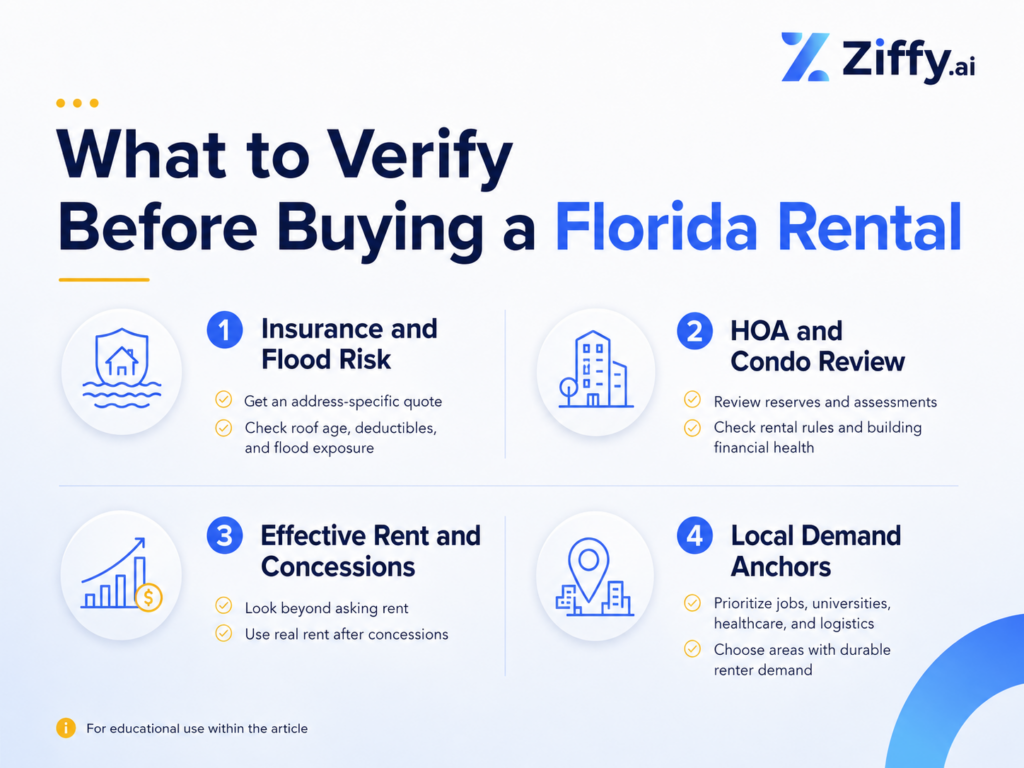
Insurance remains property-specific. Before making an offer, obtain an address-specific estimate and confirm roof age, deductibles, flood requirements, prior claims, mitigation credits, and likely renewal cost. With a DSCR loan, insurance forms part of PITIA and directly changes the ratio.

Steven Glick
Director of Mortgage Sales · Ziffy Mortgage
In Florida, insurance can change the loan decision even when the rent and purchase price look strong. I do not rely on the seller’s current premium or a rough annual estimate. I want an address-specific quote, the wind and hurricane deductibles, any flood requirement, and a realistic renewal scenario. If the property only reaches the required DSCR with an outdated insurance figure, the deal does not have enough margin. It may qualify on paper but leave the investor with much weaker cash flow after closing.
Florida HOA and Condo Assessment Risk Requires Building-Level Review
For budgets adopted on or after December 31, 2024, covered unit-owner-controlled associations generally cannot waive or underfund required structural integrity reserves under Florida Statutes section 718.112. The Florida Department of Business and Professional Regulation explains that qualifying associations operating under earlier budgets had to begin funding SIRS reserves in accordance with the study on January 1, 2026.
A lower condo price may reflect future costs already visible to the market. Review the reserve study, milestone report, budget, assessments, master insurance, association debt, litigation, and rental restrictions before the contingency period expires.
Choosing Financing for a Florida Rental Property
Conventional financing may work for investors whose reported income supports qualification. A DSCR loan may fit when the property’s rental income provides a clearer measure of borrowing capacity.

Lucas Hernandez
Mortgage Loan Originator
Ziffy Mortgage
NMLS #2171747When I compare conventional and DSCR financing for an investor, I do not begin with the interest rate. I first look at how the borrower reports income and whether the property can support its full monthly expense. An investor may have strong cash flow but show limited taxable income after depreciation and legitimate business deductions, which can reduce conventional borrowing capacity.
A DSCR loan may better reflect that situation because it evaluates the property’s rental income against principal, interest, taxes, insurance, and association dues. The better option is the one that preserves sufficient liquidity and leaves the investment with a workable margin after vacancy and operating costs, not simply the loan with the lowest advertised rate.
At Ziffy Mortgage, we offer investment property loans for eligible purchase and refinance scenarios, including DSCR options focused primarily on property income.
Loan programs, rates, terms, and eligibility requirements are subject to change and depend on borrower and property qualifications. This article is educational and is not a commitment to lend.
The Late-2026 Florida Investment Thesis
Florida remains investable, but statewide demand is no longer enough to justify a purchase. The property should be tied to a specific employment, university, healthcare, logistics, or tourism driver that can be tested at the neighborhood level.
The stronger late-2026 deals are likely to combine a defensible purchase price, durable local demand, verified insurance, manageable association exposure, and enough margin to absorb vacancy or a higher renewal premium.
FAQs
Are Florida Condos a Good Investment in 2026?
Some may be, particularly where higher inventory creates negotiating room. The decision depends on reserves, inspections, insurance, assessments, rental rules, and total monthly cost.
Can a DSCR Loan Be Used for a Florida Investment Property?
Yes, eligible Florida rentals may use DSCR financing. Because qualification compares rent with PITIA, taxes, insurance, and HOA dues can materially affect eligibility and cash flow.