





Editorial Integrity
Making sound real estate investment decisions begins with reliable, data-driven insights. At Ziffy.ai, we offer an AI-native real estate investing, proprietary data-driven trend analysis, investment mortgage programs like DSCR loans, and a network of over 500 investor-friendly real estate agents to deliver the expertise needed for informed decisions. Our content is crafted by experienced real estate professionals and backed by real-time market data, ensuring you receive accurate and actionable information. Through a rigorous editorial process, we strive to empower your investment journey with trustworthy and up-to-date guidance.
A promising investment property does not always appear on the same timetable as the property you plan to sell. If the replacement opportunity comes first, waiting for your existing rental to close could mean losing the deal.
A reverse 1031 exchange addresses that sequencing problem. Instead of selling the relinquished property first, you arrange for the replacement property to be acquired and temporarily “parked” while you complete the sale of the property you are giving up.
The tax rules are strict, though. A reverse exchange involves an Exchange Accommodation Titleholder, a written accommodation agreement, a 45-day identification period and a 180-day safe-harbor window. These requirements come from the reverse-exchange framework established under IRS Revenue Procedure 2000-37.
A reverse 1031 exchange lets a real estate investor buy a replacement investment property before selling the existing investment property while seeking Section 1031 tax-deferral treatment.
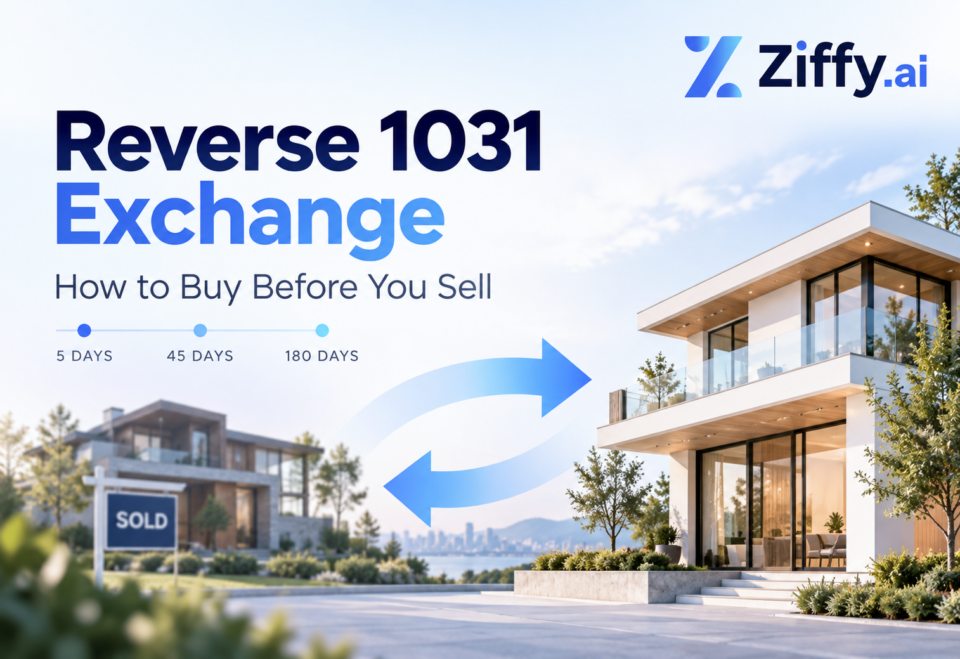
Under the safe harbor established by Revenue Procedure 2000-37 , an Exchange Accommodation Titleholder (EAT) temporarily holds qualifying ownership of one of the properties. When the EAT parks the replacement property, the investor generally has:
- 5 business days to enter into a written Qualified Exchange Accommodation Agreement (QEAA)
- 45 days to identify the relinquished property
- 180 days for the required transfer to be completed under the QEAA safe harbor
Important: The 45-day period runs inside the 180-day period. It is not an additional 45 days.
Key Takeaways
1. A reverse 1031 exchange changes the order of the transaction, allowing the replacement property to be secured before the relinquished property is sold.
2. Under the IRS rules for like-kind exchanges , Section 1031 applies to qualifying real property held for investment or productive use in a trade or business. Property held primarily for sale does not qualify.
3. An EAT typically parks one of the properties under a QEAA while the exchange is being completed.
4. The main safe-harbor deadlines are 5 business days for the QEAA, 45 days to identify the relinquished property and 180 days to complete the required transfer.
5. Financing needs to be arranged before the replacement closing because the investor has not yet received proceeds from the relinquished property.
6. Missing a requirement under Revenue Procedure 2000-37 means losing that safe-harbor protection. The IRS does not state that every parking transaction outside the safe harbor automatically fails Section 1031.
Table of Contents
What Is a Reverse 1031 Exchange?
A traditional 1031 exchange begins with a sale. You dispose of qualifying real property and then acquire qualifying replacement real estate.
A reverse exchange changes that order. The replacement property is acquired first, while the property intended for sale remains unsold.
Section 1031 itself provides nonrecognition treatment for qualifying exchanges of real property held for business or investment purposes. The practical safe-harbor framework for reverse or “parking” transactions comes from IRS Revenue Procedure 2000-37.
The EAT is central to the structure. It holds legal title or another qualifying indicia of ownership and is treated as the beneficial owner for federal income tax purposes while the property is parked.
That is different from a Qualified Intermediary (QI). In a typical exchange, a QI helps facilitate the exchange and controls exchange proceeds. An EAT actually holds the parked property or qualifying ownership interest.
The IRS reverse-exchange safe-harbor rules also allow an EAT that independently satisfies the applicable QI requirements to serve as the Qualified Intermediary.
How Does a Reverse 1031 Exchange Work?
The most common structure is often called an exchange-last reverse exchange.
1. Set Up the Exchange Before the Replacement Property Closes
The investor coordinates the EAT, QI, tax adviser, closing team and lender before acquisition.
This timing is important because trying to buy the property personally first and move it into an EAT afterward can create a major problem.
Under Revenue Procedure 2004-51, the Revenue Procedure 2000-37 safe harbor does not apply to replacement property the taxpayer owned during the 180-day period ending when qualifying ownership is transferred to the EAT.
2. The EAT Acquires the Replacement Property
The EAT takes title or another permitted ownership interest in the replacement property. This starts the reverse-exchange safe-harbor clock under Revenue Procedure 2000-37.
3. Sign the QEAA Within Five Business Days
No later than five business days after the EAT acquires the ownership interest, the taxpayer and EAT must enter into a written Qualified Exchange Accommodation Agreement.
Under the IRS QEAA requirements, the agreement states, among other things, that the EAT is holding the property to facilitate a Section 1031 exchange and will be treated as its beneficial owner for federal income tax purposes.
4. Identify the Relinquished Property Within 45 Days
If the replacement property is the parked property, the real estate that will be sold must be properly identified no later than 45 days after the EAT acquires the replacement property.
The reverse-exchange identification rules also permit alternative or multiple relinquished properties to be identified subject to the applicable identification requirements.
5. Sell the Relinquished Property
The existing investment property is sold, with the QI coordinating the exchange proceeds where the transaction is structured through a qualified intermediary.
The sale and subsequent transfers must be coordinated with the exchange professionals so the transaction continues to satisfy the intended Section 1031 structure.
6. Complete the Exchange Within the 180-Day Safe-Harbor Period
The parked replacement property must ultimately be transferred to the taxpayer, or the parked relinquished property must be transferred to an eligible third party, within the applicable 180-day QEAA period.
The IRS safe-harbor rules for parked property also provide that the combined period for which property is held in a QEAA cannot exceed 180 days.
Reverse 1031 Exchange Timeline: 5-Day, 45-Day and 180-Day Rules
| Milestone | Reverse 1031 Exchange Requirement |
|---|---|
| Day 0 | EAT acquires qualifying ownership of the parked property. |
| Within 5 business days | Taxpayer and EAT enter into the written QEAA. |
| By Day 45 | Relinquished property is properly identified when the replacement property is parked. |
| By Day 180 | Required transfer is completed and the QEAA parking period ends. |
These deadlines are established in the IRS reverse 1031 exchange safe harbor.
There is an important distinction here. Revenue Procedure 2000-37 says that if its requirements are not satisfied, the revenue procedure no longer applies and federal tax ownership and transaction treatment must instead be determined without the safe harbor.
In other words, the IRS guidance on failed safe-harbor requirements does not make a blanket statement that every transaction outside the Revenue Procedure 2000-37 safe harbor is automatically disqualified from Section 1031 treatment.
That is a situation for tax counsel, not a deadline to intentionally test.
Exchange-Last vs. Exchange-First Reverse 1031 Exchanges
There are two main ways a reverse exchange may be structured.
| Comparison | Exchange-Last | Exchange-First |
|---|---|---|
| Property parked with EAT | Replacement property | Relinquished property |
| Investor initially keeps | Existing relinquished property | Replacement property acquired directly |
| Common reason | Investor needs to secure the replacement before the existing property sells. | Financing or title structure makes parking the replacement property difficult. |
| Key financing question | Can the acquisition financing work while the EAT holds the replacement? | Can the relinquished property’s debt and title be accommodated by the EAT? |
Industry exchange administrators describe exchange-last as the more common arrangement, while exchange-first may be used when financing or title considerations make parking the replacement property difficult. You can see both structures explained in this overview of exchange-first and exchange-last reverse exchanges.
How Do You Finance a Reverse 1031 Exchange?
Financing is often the practical challenge. In a normal forward exchange, the old property has already sold. In a reverse exchange, the investor needs enough capital or borrowing capacity to acquire the replacement property before those sale proceeds exist.
The IRS safe harbor is more flexible on this point than some investors assume.
Under the financing provisions in Revenue Procedure 2000-37, the taxpayer or a disqualified person may guarantee certain EAT obligations, lend or advance funds to the EAT, or guarantee a loan made to the EAT.
The rules also allow the EAT to lease the parked property to the taxpayer, and the taxpayer may manage the property or supervise improvements while it is parked.
What the tax rules allow and what a lender will approve are separate questions. The lender should know about the EAT and proposed ownership structure before closing.
For a replacement property that will ultimately operate as a rental, investors can also evaluate the property’s longer-term economics and possible DSCR financing options.
A DSCR loan evaluates rental-property financing primarily around the income generated by the property rather than personal debt-to-income ratio.

In a reverse 1031 exchange, the financing has to work before the old property sells. You cannot build the loan around expected sale proceeds or best-case rent. We have to look at documented rental income, the property’s actual PITIA, the investor’s available liquidity, and whether the EAT ownership structure works with the loan from the start.
Steven Glick
Director of Mortgage Sales, Ziffy · NMLS #1231769
That distinction can become especially important when an investor is carrying two properties temporarily. The replacement property should work under supportable rent, taxes, insurance, HOA costs and financing assumptions rather than depending on an aggressive projection.
What Properties Qualify for a Reverse 1031 Exchange?
The underlying Section 1031 property rules still apply.
According to the IRS rules for property eligible for a like-kind exchange, qualifying property must be real property held for investment or productive use in a trade or business.
Rental property, buildings and land can qualify. Property held primarily for sale and real estate used for personal purposes generally do not qualify for Section 1031 treatment.
The “like-kind” standard for US real estate is broad. The IRS explanation of like-kind real property notes, for example, that city real estate may be exchanged for a farm and improved real property may be exchanged for unimproved real property.
US real property, however, is not considered like-kind to real property located outside the US.
If money or non-like-kind property is received as part of an otherwise qualifying exchange, some gain may still have to be recognized under the IRS tax rules for partially taxable exchanges.
How Much Does a Reverse 1031 Exchange Cost?
There is no IRS-set reverse 1031 exchange fee.
The transaction can cost more than a conventional forward exchange because it may require an EAT, a special-purpose ownership entity, additional title and closing work, exchange administration, tax or legal advice and financing for the parked property.
There may also be carrying costs while both investments remain economically tied to the investor.
For that reason, the useful comparison is not simply “reverse exchange fee versus tax bill.” Investors should also weigh financing costs, duplicate carrying expenses, transaction costs and the risk that the relinquished property does not sell within the planned window.
Reverse 1031 Exchange vs. Standard 1031 Exchange
| Feature | Standard 1031 Exchange | Reverse 1031 Exchange |
|---|---|---|
| Transaction order | Sell first, buy second | Buy or park first, sell second |
| Property identified | Replacement property | Relinquished property when the replacement property is parked |
| Additional titleholder | Usually no EAT | EAT used for the safe-harbor parking structure |
| Acquisition capital | Sale proceeds are already available | Replacement property must be funded before the existing property sells |
| Complexity | Lower | Higher due to parking, title and financing structure |
Both structures rely on the same underlying requirement that the exchanged real estate qualify under the Section 1031 rules for investment and business property.
The primary difference is sequencing. A standard exchange solves the problem of what to buy after selling. A reverse exchange solves the problem of how to secure the replacement property before the sale occurs.
When Does a Reverse 1031 Exchange Make Sense?
A reverse exchange becomes worth considering when a specific replacement property is available now and waiting for the current asset to sell could cost the investor that opportunity.
It is a stronger fit when the investor also has a realistic path to sell the relinquished property within the safe-harbor period and enough liquidity or financing capacity to carry the acquisition before that sale closes.
“What you need is the best place to invest for you. What is your price point? What are your goals?
For investors considering a reverse 1031 exchange, that means looking beyond whether a replacement property is available. The property still has to fit your available capital, financing range, rental-income potential and investment strategy. Securing a property first only makes sense if the numbers continue to work once financing and the full cost of ownership are factored in.
Steven Glick
Director of Mortgage Sales, Ziffy · NMLS #1231769
The exchange should support the investment decision rather than rescue a weak one.
Before committing to a replacement property, investors can search and evaluate rental properties on Ziffy and compare factors such as projected rental income, expenses and investment performance. The tax structure, exchange documentation and financing should then be coordinated before the replacement closing.
FAQs
Can You Buy a Property Before You Sell in a 1031 Exchange?
Yes. A reverse 1031 exchange can allow the replacement property to be acquired before the relinquished property is sold. The safe-harbor structure established by IRS Revenue Procedure 2000-37 uses an EAT and QEAA to facilitate the parking arrangement.
What Is the 45-Day Rule for a Reverse 1031 Exchange?
When an EAT parks the replacement property, the taxpayer must properly identify the relinquished property no later than 45 days after the EAT acquires qualifying ownership. The deadline is part of the IRS reverse-exchange identification requirements.
What Is the 180-Day Rule for a Reverse 1031 Exchange?
Under the QEAA safe harbor, the applicable parked property must be transferred within 180 days. The Revenue Procedure 2000-37 timing rules also limit the combined period during which the relinquished and replacement properties may be held in a QEAA to 180 days.
What Happens If a Reverse 1031 Exchange Goes Past 180 Days?
The transaction loses the protection of the Revenue Procedure 2000-37 safe harbor. Under the IRS guidance for transactions outside the reverse-exchange safe harbor, federal tax ownership and transaction treatment must then be determined without applying that revenue procedure.
Investors facing this situation should have a qualified tax professional review the specific facts.
Can I Transfer a Property I Already Bought to an EAT?
Do not assume that will qualify for the safe harbor. Under Revenue Procedure 2004-51, replacement property is excluded from the Revenue Procedure 2000-37 safe harbor if the taxpayer owned it during the 180-day period before qualifying ownership is transferred to the EAT. The reverse-exchange structure should therefore be established before acquisition.
Do I Need Both an EAT and a Qualified Intermediary?
They perform different functions, and reverse exchanges commonly involve both. The EAT holds qualifying ownership of the parked property. A QI can facilitate the exchange and handle exchange funds. The IRS rules governing EATs and Qualified Intermediaries in reverse exchanges also allow an EAT to serve as QI if it independently satisfies the applicable QI safe-harbor requirements.
How Do You Report a Reverse 1031 Exchange to the IRS?
Section 1031 exchanges are generally reported on Form 8824, Like-Kind Exchanges. The form is used to provide information about the exchanged properties and calculate recognized gain, deferred gain and basis where applicable. Investors can review the filing requirements in the IRS Instructions for Form 8824.