





Editorial Integrity
Making sound real estate investment decisions begins with reliable, data-driven insights. At Ziffy.ai, we offer an AI-native real estate investing, proprietary data-driven trend analysis, investment mortgage programs like DSCR loans, and a network of over 500 investor-friendly real estate agents to deliver the expertise needed for informed decisions. Our content is crafted by experienced real estate professionals and backed by real-time market data, ensuring you receive accurate and actionable information. Through a rigorous editorial process, we strive to empower your investment journey with trustworthy and up-to-date guidance.
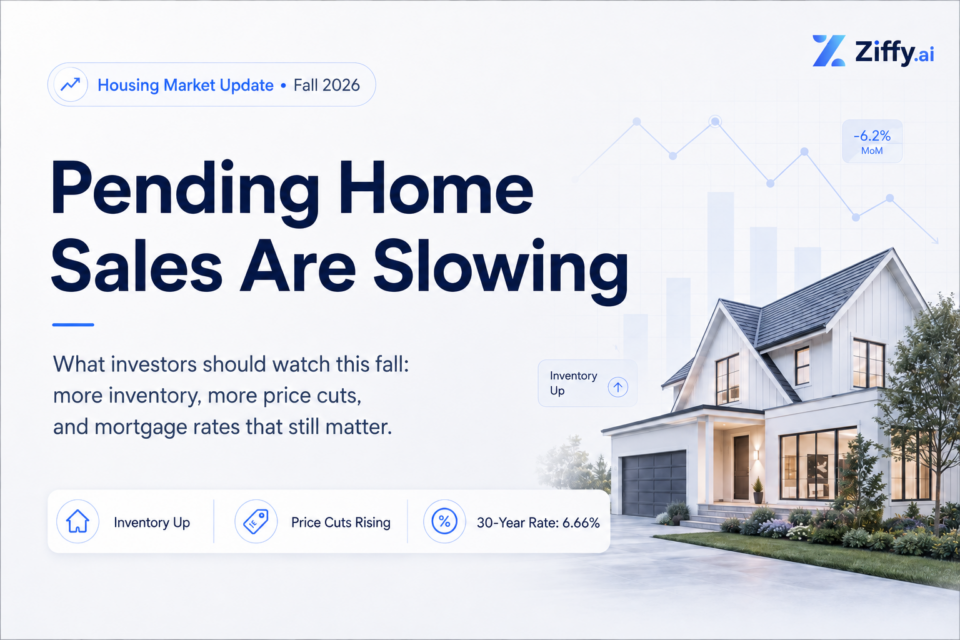
The US housing market is heading into fall with fewer homes going under contract, more properties available for sale, and more sellers reducing asking prices.
For real estate investors, that combination deserves attention. A slower market can create better entry points, but financing costs remain high enough that a discount alone cannot make a weak rental property work.
The latest numbers point toward a fall market where investors can afford to be more selective.
According to the National Association of Realtors’ July Pending Home Sales report , US pending home sales fell 2.3% from June to July 2026 and 2.2% from a year earlier, taking contract activity to its lowest level since January. The Pending Home Sales Index stood at 71.2.
More recent August housing inventory and pending-sales data from Realtor.com points in the same direction. The stock of homes in pending status was 0.2% below August 2025, while new contract signings were down 3.4% year over year. At the same time, active inventory reached 1.14 million listings, up 3.6% annually, and 20.4% of listings had a price cut.
For investors, slower contract activity can mean more room to negotiate. The catch is financing. According to Freddie Mac’s Primary Mortgage Market Survey , the average 30-year fixed mortgage rate was still 6.66% on August 27, 2026.
Pending home sales weakened in July , while more recent August contract data also showed softer activity going into fall.
Higher housing inventory and widespread price reductions can give investors additional negotiating room.
The market is highly regional. July pending sales increased annually in the Midwest but declined in the Northeast, South, and West .
Mortgage rates remain a major constraint, so investors still need realistic rent, tax, insurance, and financing assumptions.
For rental investors, a lower purchase price can improve cash flow and DSCR, especially when the reduction also lowers the required loan amount.
Table of Contents
What Are Pending Home Sales and Why Do Investors Watch Them?
A pending home sale occurs after a purchase contract has been signed but before the transaction closes.
The Pending Home Sales Index methodology from NAR makes the measure particularly useful because contract activity generally leads completed existing-home sales by one or two months. NAR notes that more than 80% of pending transactions in its sample settle within two months.
That gives investors an earlier look at demand than closed-sales data.
If pending sales are rising rapidly while inventory is tight, investors may encounter more competition. When pending sales weaken while listings accumulate, buyers can gain more time to evaluate properties and negotiate price.
Pending sales should still be treated as one input. They do not tell you whether a particular rental will cash flow, whether rents are sustainable, or whether a property’s operating expenses have been estimated correctly.
Why Are Pending Home Sales Falling in 2026?
Mortgage rates are one of the clearest explanations for the summer slowdown.
The National Association of Realtors reported a 5.4% monthly decline in pending sales in June, followed by another 2.3% decline in July. In its July report, NAR linked weaker contract activity to the rise in mortgage rates during the summer.
The Freddie Mac 30-year mortgage-rate series available through FRED shows the average rate reaching 6.69% on August 6 before ending August at around the same level. Freddie Mac reported a 6.66% average on August 27.
The slowdown carried into the following month. Realtor.com’s August 2026 housing report found that pending listings had slipped below their year-earlier level and new contract signings were down 3.4%.
Affordability pressure has reduced the number of buyers willing or able to move at current prices and financing costs.
Are Buyers Getting More Negotiating Power This Fall?
There are more signs of negotiating room than there were during stronger seller markets, although conditions vary sharply by metro.
According to Realtor.com’s August housing inventory data, the US had 1.14 million active listings, 3.6% more than a year earlier. Inventory increased annually in all four US regions, while 20.4% of active listings had experienced a price cut.
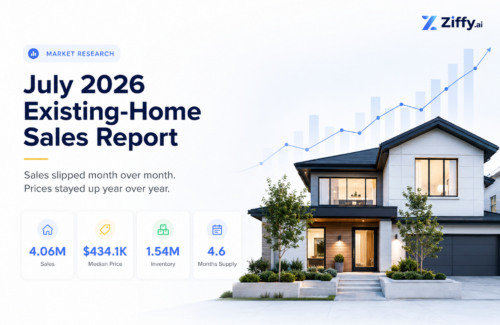
Existing-home data adds another piece. The National Association of Realtors’ July existing-home sales report showed 1.54 million homes available for sale, representing a 4.6-month supply at the current sales pace.
For an investor, the useful question is how that extra negotiating room changes the deal.
A lower acquisition price reduces the amount of capital required and, when financing is used, can reduce the loan balance and monthly payment. That can improve the rental property’s coverage ratio.
Ziffy’s analysis of seller price cuts versus builder rate buydowns also found substantial differences from one metro to another. That is another reason investors should compare actual property economics instead of treating national housing numbers as a buying signal.
Does Falling Pending Home Sales Mean Home Prices Will Fall?
No direct relationship guarantees that lower pending sales will produce falling home prices.
July illustrates the problem with making that assumption. The July existing-home sales report showed sales falling 1.7% from June, while the national median existing-home price still reached $434,100, up 2.0% from July 2025.
The August listing-price data from Realtor.com tells a slightly different story. The median list price was $424,500, down 1.3% year over year, while price per square foot fell 1.8%.
The numbers can move differently because they measure different parts of the market.
For investors, local rent-to-price economics are more useful than trying to turn a national pending-sales decline into a national price forecast.
Which US Regions Have the Strongest Pending Home Sales in 2026?
The Midwest held up better than the other major regions in July.
The July Pending Home Sales report from NAR recorded the following year-over-year changes:
- Midwest: +1.7%
- Northeast: -0.2%
- South: -3.0%
- West: -7.1%
On a monthly basis, all four regions declined, with the West recording the steepest drop at 4.7%.
The same NAR pending-sales data showed even larger differences at the metro level. Pending sales were up 17.2% in Virginia Beach-Chesapeake-Norfolk, 11.8% in San Antonio-New Braunfels, 6.2% in Cincinnati, and 3.7% in Pittsburgh from a year earlier.
An investor therefore needs to go below the regional headline. A metro can have rising inventory and softer pricing while an individual neighborhood continues to see strong rental demand and fast-moving listings.
Investors comparing locations can also use Ziffy’s 2026 multifamily investment market analysis alongside live property-level numbers.
How Do Mortgage Rates Affect Real Estate Investors in Fall 2026?
Higher rates reduce the amount of debt a property’s rent can comfortably support.
That becomes especially important with rental-property financing because investors need to look beyond the purchase price. Taxes, insurance, HOA dues where applicable, rent support, and the proposed loan structure all affect the final economics.
“A slower market can give an investor leverage on price, but that only helps if the property works at the rent we can actually document. I would rather see someone negotiate $15,000 off the purchase price and improve the DSCR than stretch the rent assumption just to make the deal qualify. The best opportunities are the ones where the financing still makes sense after you take the optimism out of the numbers.
Steven GlickDirector of Mortgage Sales, Ziffy Mortgage | NMLS #1231769

That is particularly relevant in a market with more price reductions. A discounted property may look appealing, but the investor still needs to check whether realistic rental income supports the payment after taxes, insurance, and other housing costs are included.
Investors can use Ziffy.ai to compare rental income, cash flow, ROI, and DSCR while evaluating investment properties.
How Should Real Estate Investors Use Pending Home Sales Data Before Buying?
Start by using pending sales as a measure of competition.
If local pending activity is slowing, inventory is rising, and properties are receiving price cuts, buyers may have more time to investigate the deal before making an offer. That creates room to examine recent comparable sales, rent support, property taxes, insurance, HOA costs, repairs, and financing.
Then run the property at the price you are actually prepared to pay.
For rental investors, one of the most useful tests is DSCR:
PITIA includes principal, interest, property taxes, insurance, and association or HOA dues when applicable.
In this illustrative calculation, the property’s gross monthly rental income is 1.25 times its monthly PITIA.
This gives the investor a way to translate a negotiated purchase price into the monthly economics of the property.
A seller reducing the price by several thousand dollars is useful only to the extent that the new basis improves the investment.
How Can DSCR Financing Help Real Estate Investors in a Slower Market?
A DSCR loan qualifies an investment property primarily through its rental income instead of the borrower’s personal debt-to-income ratio.
At Ziffy, eligible investors can access DSCR purchase financing at up to 85% LTV, with a 620 minimum credit score, loan amounts from $100,000 to $10 million, and a reserve requirement starting at two months.
Investors can review the complete Ziffy DSCR loan guide to understand how property income, PITIA, leverage, reserves, and ownership structure affect qualification.
The fall market may give investors more properties to choose from and more sellers willing to discuss price. Financing still has to work after the negotiation is over.
In The End
Fall 2026 is giving investors something that was harder to find in faster markets: time to compare deals.
Pending sales are slowing, inventory has grown, and price cuts have become more common. Mortgage rates are keeping the economics tight, so disciplined underwriting remains necessary. Investors who use the slower pace to negotiate the purchase price, verify achievable rent, and calculate the complete monthly housing cost can enter the fall market with a much clearer idea of which properties deserve their capital.
FAQs
What Does a Decline in Pending Home Sales Mean?
A decline means fewer existing homes are entering into purchase contracts. According to NAR’s explanation of the Pending Home Sales Index, pending sales typically lead completed existing-home sales by one or two months, which makes them an early indicator of transaction activity.
Are Pending Home Sales Down in 2026?
Yes. The National Association of Realtors reported that July 2026 pending home sales fell 2.3% from June and 2.2% from July 2025. More recent August data from Realtor.com showed pending listings 0.2% below the previous year and new contract signings down 3.4%.
Is Fall 2026 a Buyer’s Market?
National data shows some buyer-friendly conditions, including higher active inventory and a substantial share of listings with price reductions. Local conditions differ considerably, so investors should check metro, neighborhood, property, and rental data before calling a specific market a buyer’s market.
Will Home Prices Fall if Pending Sales Keep Declining?
They can, but falling pending sales alone do not predict a price decline. The July existing-home sales data from NARshowed the median existing-home price still running 2.0% above the previous year even though pending contract activity had weakened.
What Should Investors Look for in a Slower Housing Market?
Investors should pay close attention to purchase price, realistic rent, property taxes, insurance, HOA dues, financing costs, local inventory, days on market, and comparable sales. A slower market becomes useful when it allows the investor to acquire a property at numbers that support the investment plan.
Can I Use a DSCR Loan to Buy an Investment Property?
Yes. DSCR financing through Ziffy Mortgage is designed for investment properties and qualifies primarily through property rental income. Eligible investors can use DSCR financing for purchases and refinances without qualifying through traditional personal-income DTI calculations.