






Editorial Integrity
Making sound real estate investment decisions begins with reliable, data-driven insights. At Ziffy.ai, we offer an AI-native real estate investing, proprietary data-driven trend analysis, investment mortgage programs like DSCR loans, and a network of over 500 investor-friendly real estate agents to deliver the expertise needed for informed decisions. Our content is crafted by experienced real estate professionals and backed by real-time market data, ensuring you receive accurate and actionable information. Through a rigorous editorial process, we strive to empower your investment journey with trustworthy and up-to-date guidance.
Quick Answer:

A seller credit is usually most useful when the buyer needs to preserve cash for closing costs, prepaid expenses, or eligible mortgage charges. A price reduction is more useful when the buyer wants a lower acquisition price, smaller loan balance, or help resolving an appraisal issue. A permanent buydown can provide long-term payment savings when the buyer keeps the mortgage beyond the break-even point. A temporary buydown provides early relief before the payment rises to the full note-rate amount.

There is no universal winner. The right comparison uses the actual Loan Estimate, seller concession limit, expected loan duration, and cash needed at closing.
Key Takeaways
- Seller credits primarily reduce cash to close. They do not automatically reduce the purchase price or loan balance.
- A price reduction lowers the contract price, but the monthly-payment change may be modest unless the reduction is substantial.
- A permanent buydown lowers the note rate for the loan term, while a temporary buydown subsidizes only the opening years.
- Seller-paid discount points and temporary buydowns generally count toward applicable seller concession limits.
- Buyers should ask their lender to price each option before choosing.
A seller agrees to give something up to keep a real estate transaction moving. The next question is where that money should go.
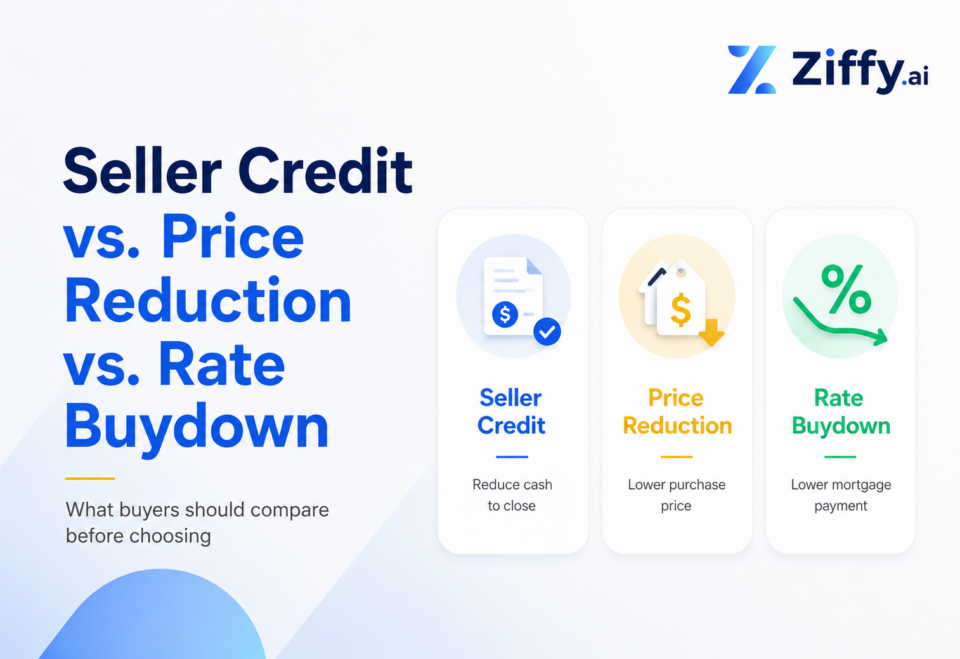
A seller credit lowers the buyer’s cash needed at closing. A price reduction lowers the amount paid for the property. A rate buydown directs funds toward a lower mortgage payment, either temporarily or for the full loan term.
The best choice depends on the buyer’s main constraint: upfront cash, monthly payment, appraisal risk, leverage, or expected holding period.
Seller Credit vs. Price Reduction vs. Rate Buydown: What Is the Difference?
Option | Immediate Effect | Long-Term Effect | Usually Best For |
|---|---|---|---|
Seller credit | Reduces eligible closing expenses | Preserves available cash | Buyers concerned about cash to close |
Price reduction | Lowers the contract price | Reduces the loan balance and interest charged on it | Buyers focused on price, leverage, or appraisal |
Permanent rate buydown | Uses discount points to lower the note rate | Lowers principal-and-interest payments for the loan term | Buyers keeping the mortgage long enough to break even |
Temporary rate buydown | Subsidizes payments during the opening years | Payment rises to the full note-rate amount later | Buyers who can afford the full payment but value early cash-flow relief |
The comparison should begin with the buyer’s actual constraint. A credit may solve a cash shortage, a buydown may reduce monthly debt service, and a price reduction may matter more when the appraisal or leverage is tight.
What Is a Seller Credit and When Does It Help Most?
A seller credit, also called a seller concession or interested-party contribution, allows the seller to pay eligible costs that would otherwise fall to the buyer.
Depending on the loan program, it may cover settlement charges, title expenses, prepaid taxes and insurance, escrow funding, discount points, or an approved temporary buydown.
A seller credit does not normally become unrestricted cash for the buyer. Under Fannie Mae’s interested-party contribution rules, financing concessions cannot exceed the buyer’s eligible closing costs. Fannie Mae also prohibits these contributions from being used for the borrower’s down payment, reserve requirement, or minimum borrower contribution.
If the buyer cannot use the full amount, the parties may need to amend or reduce the credit before closing.
At Ziffy Mortgage, we start by identifying which expense is creating the pressure. When cash to close is the problem, a properly structured seller credit may preserve funds more effectively than a small price reduction.

Steven Glick
Director of Mortgage Sales · Ziffy Mortgage
When buyers compare a seller credit with a price reduction, I first look at what is actually putting pressure on the transaction. A lower price may reduce the payment slightly, but it does not pay the title charges, prepaid taxes, insurance, or escrow deposits due at closing. When liquidity is the concern, directing the seller’s contribution toward eligible closing costs can leave the buyer in a much stronger position after the keys are handed over.
Buyers who are unfamiliar with prepaids, escrow funding, discount points, or loan-to-value ratio can review the Ziffy mortgage and real estate glossary.
How Does a Price Reduction Affect the Mortgage?
A price reduction changes the property’s contract price. When the down payment is calculated as a percentage of that price, the required down payment and resulting loan amount may also decline.
It may reduce the financed principal, improve the loan-to-value ratio, and help resolve a low-appraisal negotiation. It is also the clearest concession for a cash buyer with few lender-approved costs.
However, buyers sometimes overestimate how much a moderate price cut will change the monthly payment. The reduction is spread across the mortgage term, while a closing-cost credit delivers its value at settlement.
Compare the price reduction against the amount by which it changes the loan, not only the seller’s proceeds.
How Does a Mortgage Rate Buydown Work?
A mortgage rate buydown uses upfront funds to reduce the buyer’s payment. It can be permanent or temporary.
Permanent Rate Buydown
A permanent buydown uses discount points to secure a lower note rate for the mortgage term.
The Consumer Financial Protection Bureau’s guidance on discount points explains that one point equals 1% of the loan amount, not a guaranteed rate reduction. Pricing depends on the lender, loan type, borrower, and market when the rate is locked.
The key calculation is:
Cost of discount points ÷ monthly payment savings = estimated break-even period
A permanent buydown becomes more attractive when the buyer expects to keep the mortgage beyond that point.
Rates, discount-point pricing, qualification, and payment outcomes vary by borrower, property, market conditions, and loan program. Any comparison is illustrative and is not a commitment to lend.
Temporary Rate Buydown
A temporary buydown does not permanently change the note rate. Funds are placed in a custodial account and applied to part of the scheduled payment during the buydown period.
In a common 2-1 structure, the buyer’s effective payment is calculated two percentage points below the note rate during the first year and one percentage point below it during the second year. The buyer then makes the full note-rate payment.
Under Fannie Mae’s temporary buydown requirements, borrowers must qualify using the full note-rate payment. The temporary subsidy cannot make an otherwise unaffordable loan qualify. Fannie Mae also treats conventional investment properties as ineligible for temporary buydowns under this section.
At Ziffy Mortgage, we evaluate whether the borrower can carry the full note-rate payment after the subsidy ends. A temporary buydown should manage early cash flow, not postpone an affordability problem.

Jeff Larrabee
Sr. Customer Loan Specialist
Ziffy Mortgage
NMLS #482306A temporary buydown should be evaluated using the payment the borrower will owe after the subsidy ends, not only the reduced first-year payment. The lower opening payment can be useful when a buyer is managing moving costs or expects income to increase, but it should not be used to make an unaffordable mortgage appear affordable. We still qualify the borrower based on the applicable full payment and review whether that payment fits the longer-term budget.
Investment-property and non-QM programs can apply different rules. Investors should have the exact loan priced before adding a seller-funded buydown to the contract. Ziffy explains the broader choices in its guide to investment property loans.
How Much Can a Seller Contribute Toward Closing Costs?
Seller concession limits depend on the loan type, occupancy, leverage, and expenses available to be paid. For conventional loans following Fannie Mae requirements, the maximum financing concessions are:
Occupancy and LTV | Maximum Financing Concession |
|---|---|
Principal residence or second home above 90% LTV | 3% |
Principal residence or second home from 75.01% to 90% LTV | 6% |
Principal residence or second home at 75% LTV or below | 9% |
Investment property at any LTV | 2% |
The calculation uses the lower of the sales price or appraised value. A seller-funded temporary or permanent buydown also counts toward the applicable limit.
Other common program rules include:
- FHA guidance generally permits interested parties to contribute up to 6% of the sales price toward eligible borrower costs.
- USDA HB-1-3555, Chapter 6 limits seller and other interested-party contributions to 6% of the sales price and requires the funds to represent an eligible loan purpose.
- VA temporary buydown guidance states that a seller- or builder-funded temporary buydown is a seller concession and that seller concessions are capped at 4% of the property’s reasonable value.
These percentages are program ceilings, not automatic entitlements. The buyer must still have enough eligible costs to use the credit, and individual lenders may apply additional requirements.
Is a Seller Credit Better Than a Price Reduction?
A seller credit is usually better when cash to close is the main concern.
A buyer may qualify and cover the down payment but have little room left after fees, insurance, taxes, and escrow deposits. A price reduction does not directly eliminate those bills. A seller credit does.
A price reduction is usually better when the appraisal does not support the contract price, the buyer is paying cash, improving the loan-to-value ratio has measurable value, or there are too few eligible costs to use the proposed credit.
The lender should calculate both structures before the purchase agreement is amended.
Is a Rate Buydown Better Than a Price Reduction?
A rate buydown can create a larger monthly-payment change than an equal price reduction because it changes the interest applied to the entire loan balance. That does not automatically make it the better financial decision.
Evaluate a permanent buydown against the expected sale or refinance date. A temporary buydown shifts part of the payment burden away from the opening years but does not erase the later payment.
For an investor, we compare three separate outcomes. A credit preserves capital for reserves or the next acquisition. A price reduction improves the entry basis and may strengthen leverage. A permanent buydown improves monthly debt service. The best option depends on whether the investor is protecting liquidity, cash flow, or equity.

For an investor, these options affect different parts of the deal. A seller credit can protect liquidity and preserve funds for reserves, repairs, or another acquisition. A price reduction improves the entry basis and may strengthen leverage. A permanent rate buydown can improve monthly debt service across the outstanding loan balance. I compare the expected holding period, refinance plan, DSCR, and cash remaining after closing before recommending where the concession should go.
Investors can also review how financing affects property performance in Ziffy’s DSCR loan guide.
Can You Combine a Seller Credit, Price Reduction, and Rate Buydown?
Yes. A transaction can include more than one concession if the contract, appraisal, loan program, and seller contribution limits support the structure.
A buyer might negotiate a price reduction after an appraisal or inspection and use a smaller credit for closing costs or discount points.
Finalize the allocation with the lender before the contract is written or amended. Late changes can require revised disclosures, appraisal review, or additional underwriting.
The CFPB Loan Estimate explainer shows where points, lender charges, credits, and cash to close appear.
How Should Buyers Compare the Three Options?
Ask the lender to prepare side-by-side scenarios using the same property, loan program, down payment, rate-lock date, and seller contribution.
Each scenario should show:
- Purchase price
- Loan amount
- Note rate and APR
- Discount-point cost
- Principal-and-interest payment
- Total cash to close
- Seller credit used
- Unused or ineligible credit
- Payment after a temporary buydown ends
- Break-even period before a sale or refinance
At Ziffy Mortgage, we compare the concession against the transaction’s objective. For an owner-occupied buyer, that may be cash to close or long-term payment. For an investor, it may be leverage, reserves, DSCR, cash flow, or capital for the next property.
The strongest negotiation is not necessarily the one with the largest concession. It is the one that directs the seller’s contribution toward the buyer’s real constraint.
FAQs
What Happens to Unused Seller Credits?
Unused credits generally cannot be paid to the buyer as unrestricted cash. The amount may need to be reduced, reassigned to another eligible cost, or handled under the loan program’s excess-contribution rules.
Is a 2-1 Buydown Worth It?
It may be worthwhile when the buyer can afford the full note-rate payment and values lower payments during the first two years. It is less useful when the buyer expects a permanent reduction, cannot afford the later payment, or is financing an ineligible property type.
Should I Choose a Seller Credit or a Lower Interest Rate?
Choose based on the constraint. A seller credit is usually more useful for reducing cash to close. A lower permanent rate may be more useful when monthly payment is the priority and the loan will be kept beyond the break-even period.
Can Investment Property Buyers Receive Seller Credits?
Yes, but the limit and permitted uses depend on the loan program. Fannie Mae limits financing concessions on conventional investment properties to 2%. DSCR and other non-QM programs use lender-specific requirements, so the concession should be reviewed before the offer is finalized.