






Editorial Integrity
Making sound real estate investment decisions begins with reliable, data-driven insights. At Ziffy.ai, we offer an AI-native real estate investing, proprietary data-driven trend analysis, investment mortgage programs like DSCR loans, and a network of over 500 investor-friendly real estate agents to deliver the expertise needed for informed decisions. Our content is crafted by experienced real estate professionals and backed by real-time market data, ensuring you receive accurate and actionable information. Through a rigorous editorial process, we strive to empower your investment journey with trustworthy and up-to-date guidance.
Quick Answer:

Financing a 1031 exchange replacement property should begin before the relinquished property closes. The IRS Instructions for Form 8824 give you 45 calendar days to identify potential replacement property and 180 calendar days to acquire it, but both periods begin when the relinquished property is transferred. The 180-day period may also end earlier if your federal tax return is due before Day 180 and you do not obtain an extension.

The loan therefore has to support two separate decisions. Before Day 45, you need to know whether an identified property is realistically financeable. Before the exchange period expires, the appraisal, title work, insurance, entity documents, underwriting conditions, qualified intermediary instructions, and closing funds must all be ready.

For an income-producing replacement property, a DSCR loan may allow the financing decision to focus primarily on the property’s rental income. A bridge loan may be considered when an investor needs short-term financing for a time-sensitive acquisition or a property that is not yet ready for permanent financing.
A replacement property should be screened for rent support, appraisal risk, property eligibility, leverage, and reserves before it is placed on the identification list.
Financing feasibility should be tested before a property is formally identified, especially when several replacement properties are being considered.
Full tax deferral usually requires the investor to reinvest the exchange proceeds and avoid receiving net debt relief or other taxable boot.
A smaller replacement mortgage does not automatically create a problem if additional cash is contributed in a way that offsets the debt reduction.
The lender, qualified intermediary, title company, insurance provider, CPA, and real estate team need to work from the same closing schedule.
Table of Contents
Why Replacement Property Financing Should Start Before Day 0
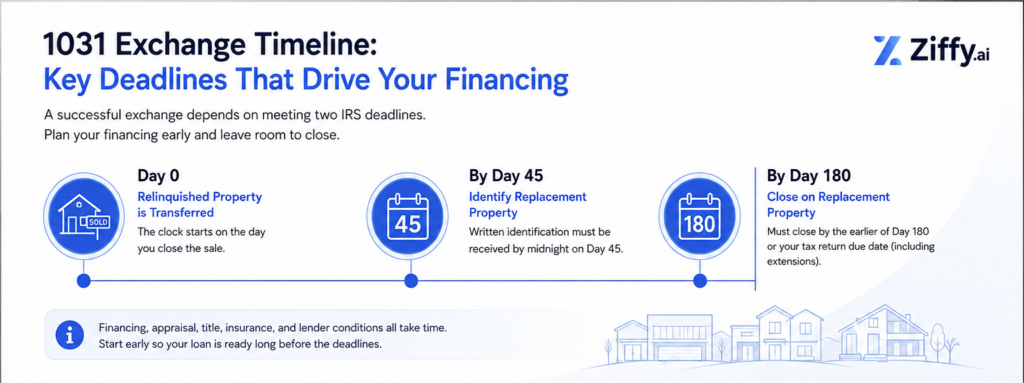
Day 0 is the date the relinquished property is transferred. Waiting until that closing to discuss financing leaves very little room to correct an unsuitable loan structure.
Before the sale closes, estimate the amount of exchange equity, the expected payoff of the existing mortgage, the target replacement value, the cash required outside the exchange, and the likely loan amount. Ziffy’s 1031 Exchange Calculator can help estimate the replacement target and show where cash boot or mortgage boot may appear.
The qualified intermediary should also be brought into the transaction before the relinquished-property closing. In a deferred exchange, the intermediary generally receives and holds the proceeds so the investor does not take control of the money. The Treasury regulations governing deferred exchanges recognize a qualified-intermediary arrangement as a safe harbor when the applicable requirements are followed.
At the same time, the lender can start reviewing:
- The expected exchange proceeds and required down payment
- The borrower’s credit and liquidity
- The proposed ownership entity
- The target property types and markets
- Expected rental income
- Reserve requirements
- The maximum loan-to-value ratio the file can support
This preliminary work will not replace underwriting on the selected property. It does show whether the investor’s buy box and financing plan are compatible before the deadlines begin.
What the 45-Day Identification Rule Means for Your Loan
The replacement property must be identified in writing by midnight on the 45th day after the relinquished property is transferred. According to the IRS identification requirements, the description must be clear enough to identify the real estate, generally through its street address, legal description, or distinguishable name.
Under Treasury Regulation §1.1031(k)-1, an investor may generally identify:
- Up to three properties without considering their combined value; or
- More than three properties when their total fair market value does not exceed 200% of the relinquished property’s value.
A separate 95% rule may apply when those limits are exceeded, but it requires the investor to acquire at least 95% of the value of everything identified. That is a demanding standard and should not be treated as an easy fallback.
These rules make financing analysis part of the identification decision. A property may appear attractive but become difficult to close if:
- Supported rent is lower than the listing projection
- The appraisal does not support the contract price
- Taxes, insurance, or association dues weaken the debt-service coverage ratio
- The property type is not eligible for the intended loan
- The requested leverage leaves insufficient reserves
- The borrower wants to close in an entity that has not been documented correctly
Before identifying a property, ask the lender to test the expected rent, monthly housing expense, loan amount, down payment, and reserves. An identification list filled with properties that cannot support the planned mortgage provides little protection.

How the 180-Day Rule Changes the Mortgage Timeline
The replacement property must be received by the earlier of:
- The 180th day after the relinquished property is transferred; or
- The due date of the federal income tax return for the year of the transfer, including extensions.
An investor who sells late in the tax year may therefore have less than 180 days unless the filing deadline is extended. The IRS Form 8824 instructions set out both deadlines.
The loan closing date should not be scheduled for the final permitted day. The lender may still need time to resolve an appraisal revision, title exception, insurance issue, entity-document discrepancy, rent-support question, or final condition.
A safer internal deadline leaves room between the expected mortgage closing and the exchange deadline. The purchase contract should also reflect a realistic financing period rather than assuming the tax deadline will force every other party to accelerate its work.
Once a property is under contract, the lender should immediately receive:
- The complete purchase contract and amendments
- Qualified intermediary contact details
- Vesting and entity instructions
- Earnest-money documentation
- Current lease or supported market-rent information
- Insurance details
- Access for the appraisal
- Evidence of funds and reserves
The closing agent and lender also need clear instructions showing how the qualified intermediary’s funds will enter the transaction.
How Much Financing Is Needed for Full Tax Deferral?
Section 1031 applies to qualifying real property held for investment or productive use in a trade or business. The IRS explains that receiving cash or other non-like-kind property can produce recognized gain even when the remainder of the exchange qualifies. Net debt relief can also affect the calculation, as detailed in the IRS Instructions for Form 8824.
For full deferral, the financing plan generally needs to:
- Acquire replacement property with sufficient value
- Reinvest the available exchange proceeds
- Replace the relinquished-property debt with new debt or additional cash
- Avoid taking cash from the exchange
The phrase “replace the debt” can be misleading. The new mortgage does not always need to equal the old mortgage dollar for dollar. The IRS calculation considers net liabilities, and additional cash contributed to the acquisition may offset a reduction in replacement debt. The final tax treatment depends on the complete exchange rather than the loan balance alone.
This is why the replacement-value target, exchange equity, mortgage amount, and outside cash should be reviewed together.

Lucas Hernandez
Mortgage Loan Originator
Ziffy Mortgage
NMLS #2171747The financing decision should happen before the identification decision, not after it. A property may satisfy the investor’s exchange value target but still fail as a replacement property if the supported rent, appraisal, insurance cost, or required reserves reduce the loan amount. By testing those numbers before Day 45, the investor can identify properties that are not only tax-compliant on paper but also realistically financeable within the 180-day closing window.
An investor may still complete a valid exchange while receiving boot, but some gain may become taxable. A CPA or tax attorney should calculate that exposure before the financing structure is finalized.
DSCR Loan vs. Bridge Loan for a 1031 Exchange
When a DSCR Loan May Fit the Replacement Property
A debt-service coverage ratio loan is designed for income-producing investment property. Instead of building qualification primarily around the borrower’s employment income, the lender evaluates whether the property’s rent can support its monthly debt obligation.
At Ziffy Mortgage, DSCR analysis considers rental income against principal, interest, taxes, insurance, and applicable association dues. Credit, leverage, reserves, property eligibility, rent support, and ownership structure also remain part of underwriting.
DSCR financing may fit a 1031 exchange when:
- The replacement property is already stabilized or rent-ready
- Rental income can be supported during underwriting
- The investor wants to acquire through an eligible business entity
- Personal tax returns do not present the clearest picture of the investment
- Long-term rental financing is needed at acquisition

Steven Glick
Director of Mortgage Sales · Ziffy Mortgage
A DSCR loan is not approved on the rent number alone. The lender has to test how that rent holds up after taxes, insurance, HOA dues, and the proposed mortgage payment are included. A property can look profitable in the listing and still produce a weaker DSCR once the full housing expense is calculated. That is why the investor should review the loan structure, expected cash flow, and reserve position together before committing to the replacement property.
When a Bridge Loan May Be More Practical
A bridge loan is short-term financing used when the immediate acquisition and the eventual permanent loan require different structures.
It may be considered when:
- The property needs repairs before it can support permanent financing
- The investor needs to purchase before another transaction is completed
- A time-sensitive closing cannot follow a conventional mortgage schedule
- The investment plan includes stabilizing the property and refinancing later
We offer bridge loans for real estate investors, with the exit strategy forming an important part of the file. The planned exit may be a sale or a refinance into longer-term financing such as a DSCR loan.
A short-term loan does not change the IRS exchange deadlines; it only changes how the acquisition is financed. The qualified intermediary and tax adviser should review the proposed structure, particularly in a reverse or improvement exchange.
A Practical 1031 Exchange Financing Schedule
1. Before the relinquished-property sale: Engage the qualified intermediary, estimate the replacement target, review debt and equity requirements, and obtain a preliminary financing assessment.
2. Days 1–20: Search within the approved property and loan parameters. Review likely rent, taxes, insurance, association dues, condition, and appraisal risk.
3. Days 21–35: Request lender feedback on the leading properties. Negotiate enough time for inspections, appraisal, title, insurance, and underwriting.
4. By Day 45: Submit the written replacement-property identification through the proper exchange channel. Keep proof that it was delivered on time.
5. After identification: Complete the loan application, appraisal, title review, insurance, entity documentation, rent analysis, and outstanding conditions.
6. Before Day 180 or the earlier tax-return deadline: Close on qualifying identified property and have the qualified intermediary transfer the exchange funds according to the closing instructions.
The deadlines belong to the tax exchange, but the ability to meet them depends heavily on the financing calendar.
Common 1031 Exchange Financing Mistakes
One frequent mistake is identifying property before confirming that its rent can support the intended loan. Another is assuming that the lender can use the seller’s projected rent without independent support.
Problems can also arise when the transaction:
- Starts the appraisal too late
- Underestimates insurance, taxes, or association dues
- Changes the purchasing entity after underwriting begins
- Depends on maximum leverage without preserving reserves
- Treats Day 180 as the target closing date
- Ignores the earlier tax-return deadline
- Assumes a lower replacement mortgage cannot create boot
- Uses exchange funds for an expense without checking its tax treatment
A lender can advise on loan eligibility and underwriting. A qualified intermediary administers the exchange. A CPA or tax attorney evaluates tax consequences. Keeping those roles separate and coordinated is one of the best ways to prevent a financing decision from disrupting the exchange.
FAQs
Do I Have 180 Days After the 45-Day Period Ends?
No. Both periods start when the relinquished property is transferred. The 45-day deadline falls within the overall exchange period.
What Happens if the Appraisal Is Lower Than the Purchase Price?
A low appraisal may reduce the supported loan amount and increase the cash required to close. It can also change the debt-replacement calculation. The investor, lender, CPA, and qualified intermediary should review the revised structure before proceeding.
Can I Change My Identified Replacement Property After Day 45?
Generally, the identification cannot be changed after the 45-day period expires. The replacement property ultimately acquired must comply with the identification and receipt rules.
Is a 1031 Exchange Tax-Free?
A 1031 exchange generally defers qualifying gain rather than permanently eliminating it. The deferred gain is reflected in the basis of the replacement property and may become relevant in a later taxable sale.