





Editorial Integrity
Making sound real estate investment decisions begins with reliable, data-driven insights. At Ziffy.ai, we offer an AI-native real estate investing, proprietary data-driven trend analysis, investment mortgage programs like DSCR loans, and a network of over 500 investor-friendly real estate agents to deliver the expertise needed for informed decisions. Our content is crafted by experienced real estate professionals and backed by real-time market data, ensuring you receive accurate and actionable information. Through a rigorous editorial process, we strive to empower your investment journey with trustworthy and up-to-date guidance.
Quick Answer: What Is a DSCR Cash-Out Refinance?
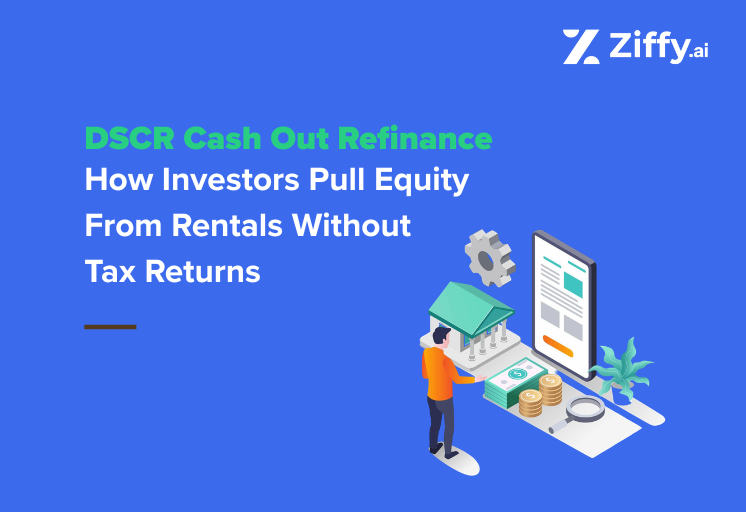
A DSCR cash-out refinance lets you replace the existing mortgage on a rental property with a larger DSCR loan and receive the difference in cash at closing. The main advantage is that qualification is based on the property’s rental income, not your W-2 income, pay stubs, tax returns, or personal debt-to-income ratio.
At Ziffy Mortgage, this is one of the cleanest ways investors can use built-up rental equity without selling the property. The property stays in the portfolio, the old loan gets paid off, and the new loan is sized around value, rent, DSCR, credit, reserves, and program limits.
The key point is simple: cash-out is not only about how much equity you have. It is about how much equity you can pull while keeping the refinanced property strong enough to qualify.
This guide covers how DSCR cash-out refinancing works, how much equity you can access, what DSCR you need after the refinance, what documents matter, and the 12-month seasoning trap that can delay otherwise good deals.
Table of Contents
What Is a DSCR Cash-Out Refinance?
A DSCR cash-out refinance is an investment property refinance where you take out a new, larger mortgage, use it to pay off the existing loan, and receive the remaining proceeds in cash.
The “DSCR” part matters because the loan is underwritten mainly through the rental property’s income. Instead of asking whether your personal tax return supports the new debt, we look at whether the property’s rent supports the new payment.
That is why DSCR cash-out refinancing is a strong fit for investors who:
- Own rental property with built-up equity
- Want to use that equity for another acquisition
- Have tax returns that do not fully reflect their cash position
- Hold rentals in an LLC or plan to
- Want to refinance without personal income documentation
- Need a lump sum rather than staged access to equity
A cash-out refinance is different from a rate-and-term refinance. A rate-and-term refinance changes the loan structure, rate, or term without giving the borrower meaningful cash back. A cash-out refinance increases the loan balance so the investor can access part of the property’s equity.
It is also different from a HELOC on an investment property. A HELOC is a revolving line of credit. A DSCR cash-out refinance is a new mortgage with a lump-sum cash-out amount. For investors who want rental-income-based qualification, LLC compatibility, and a fixed mortgage structure, DSCR cash-out is usually the cleaner path.
How the DSCR Formula Changes After Cash-Out
DSCR stands for debt service coverage ratio. In plain terms, it measures whether the rental income covers the property’s monthly housing expense.
The formula is:
DSCR = Gross Monthly Rent ÷ PITIA
PITIA means principal, interest, taxes, insurance, and association dues when applicable.
This matters because cash-out refinancing usually increases the loan amount. A larger loan usually means a higher monthly principal and interest payment. When the payment increases and the rent stays the same, DSCR goes down.
That is the part investors need to model before they apply.
A property can look comfortable before the refinance and become tighter after cash-out because the post-refi payment is higher. That does not mean the loan will not work. It means the cash-out amount has to be sized around the new DSCR, not the old mortgage payment.
You can test the ratio before applying with Ziffy’s in-built DSCR loan calculator. The useful part is not only seeing whether a property qualifies today. It is seeing how the ratio changes when you adjust loan amount, down payment, interest rate, taxes, insurance, HOA dues, or rent.
DSCR Cash-Out Refinance Requirements at Ziffy Mortgage
At Ziffy Mortgage, the DSCR cash-out review is built around the rental asset. The borrower still matters, but the file does not revolve around W-2s, pay stubs, tax returns, or personal DTI.
Here is the current DSCR cash-out direction investors should understand.
Requirement | Ziffy Mortgage DSCR Cash-Out Refinance |
|---|---|
Qualification method | Property rental income and DSCR |
Personal income docs | No W-2s, pay stubs, or tax returns for the DSCR path |
Minimum credit score | 620 |
Preferred DSCR | 1.0 or higher for the best terms |
No Ratio DSCR | Available for eligible files that do not meet the standard DSCR threshold |
Max cash-out LTV | Up to 75% |
Loan amount range | $100K to $10 million |
Reserves | 2 months |
Property use | Investment properties |
Ownership | Individual or eligible entity structures, including LLCs |
These terms are a starting point, not a promise that every file will qualify at the maximum. A cash-out refinance still has to make sense across the full structure: rent support, property value, credit, reserves, ownership, title, insurance, and appraisal.
What we see often is that investors focus too much on the equity number and not enough on the post-refi payment. Equity opens the door. DSCR decides how far the file can go through that door.
How Much Equity Can You Pull With a DSCR Cash-Out Refinance?
The practical ceiling starts with LTV. At Ziffy Mortgage, DSCR cash-out refinances can go up to 75% LTV, depending on the full borrower and property profile.
The basic calculation is:
Maximum new loan amount = Property value × maximum cash-out LTV
Then:
Estimated cash-out before closing costs = Maximum new loan amount - current payoff
Closing costs, prepayment penalties, escrow adjustments, and other transaction costs can reduce the final amount available to the investor. But maximum LTV is not always the right target. The stronger question is: how much cash can you pull while keeping the property healthy?
A property with strong rent support may be able to handle higher leverage. A property with thin rent coverage, rising insurance, heavy HOA dues, or a below-market lease may need a lower loan amount to keep the ratio workable.
That is why the largest cash-out check is not always the best financing decision.

Lucas Hernandez
Mortgage Loan Originator, NMLS #2171747
Step-by-Step: How to Execute a DSCR Cash-Out Refinance
Step 1: Start with your current value and mortgage payoff
Before you compare rates or request terms, you need a basic equity picture.
Gather:
- Current mortgage statement
- Estimated payoff amount
- Current property value estimate
- Property tax amount
- Insurance premium
- HOA dues, if applicable
- Lease or rent estimate
- Any prepayment penalty on the current loan
The payoff matters because the existing loan must be paid off at closing. If there is a prepayment penalty, it needs to be part of the cash-out decision from the beginning.
Step 2: Check the maximum LTV
Once you have a reasonable value estimate, apply the cash-out LTV limit.
If the property does not have enough equity to support the new loan amount, the refinance may not produce meaningful proceeds after costs. If the equity is there, the next question becomes DSCR.
This is where investors should avoid a common mistake: using the highest possible LTV as the starting assumption. High leverage can increase proceeds, but it also increases the payment. That can weaken the ratio.
Step 3: Calculate the post-refi DSCR
This is the most important step.
Do not calculate DSCR using your current mortgage payment. Use the expected payment on the new cash-out refinance.
The post-refi DSCR should account for:
- New principal and interest payment
- Property taxes
- Insurance
- HOA dues
- Rent used for underwriting
For DSCR underwriting, documented rent matters. If the appraisal rent schedule, lease, or supported market rent comes in lower than expected, the ratio can change quickly.

Steven Glick,
Director of Mortgage Sales, NMLS #1231769
Step 4: Gather the core documents
DSCR cash-out refinancing is lighter than a full-income refinance, but it is not documentation-free.
A clean file usually includes:
- Government ID
- Current mortgage statement
- Payoff information
- Lease agreement or rent documentation
- Bank statements for reserves
- Insurance declaration page
- Property tax information
- HOA information, if applicable
- LLC documents, if the property is held in an entity
For LLC files, the entity documents should match the way title, insurance, and closing will be handled. Small inconsistencies can create delays.
Step 5: Order the appraisal and rent schedule
The appraisal does two jobs in a DSCR cash-out refinance. First, it supports value. That affects the maximum loan amount. Second, it supports rent. That affects the DSCR.
What most guides do not mention is that the rent schedule can matter as much as the valuation. A strong property value does not solve the file if the supported rent does not cover the new payment.
This is especially important when the current lease is below market, the property has recently been renovated, or the borrower is expecting a rent increase that has not been documented yet.
Step 6: Underwriting reviews the full structure
Underwriting reviews the file across multiple points:
- DSCR
- LTV
- Credit score
- Reserves
- Appraisal value
- Rent support
- Insurance
- Title
- Ownership structure
- Property type
- Use of proceeds
- Current loan payoff and prepayment penalty
The DSCR path is cleaner because the property’s income carries the approval logic. But the file still needs to be coherent. The property, loan amount, rent, reserves, and borrower profile all have to work together.
Step 7: Closing and funding
Once the file is cleared to close, you review the Closing Disclosure, confirm the final loan amount, review the cash-out amount, and sign closing documents.
Before you use the proceeds for another acquisition, confirm the exact funding timeline with your loan team. Cash-out funds should not be treated as available until the refinance has funded and the money is actually disbursed.
For a broader view of refinance structures, including conventional, DSCR, rate-and-term, and cash-out paths, use our investment property refinance guide once you are comparing options beyond DSCR cash-out.
What DSCR Do You Need After the Cash-Out Refinance?
At Ziffy Mortgage, a DSCR of 1.0 or higher usually creates the cleanest standard path. A higher ratio can create a stronger file because the property has more room to absorb changes in taxes, insurance, rent support, HOA dues, or interest rate.
No Ratio DSCR may also be available for eligible files where the property does not meet the standard DSCR threshold. That does not mean every below-1.0 property works. It means some files can still be structured when other parts of the deal are stronger, such as lower leverage, stronger reserves, or a better overall borrower profile.
Here is a practical way to read the ratio after cash-out.
Post-Refi DSCR | How to Think About It |
|---|---|
Below 1.0 | Property rental income and DSCR |
1.0 to 1.10 | Workable in many cases, but sensitive to taxes, insurance, rent support, and final payment. |
1.10 to 1.25 | Healthier range for many rental files because the property has more cushion. |
1.25+ | Stronger file structure, especially if reserves, credit, and property condition also support the loan. |
The “right” DSCR depends on the purpose of the cash-out. If the investor is pulling equity to fund a stronger next acquisition, the refinance can make sense. If the investor is pulling the maximum simply because the equity is available, the property may become too leveraged for the actual rental performance.
Lucas Hernandez
Mortgage Loan Originator, NMLS #2171747
What We See in Stronger DSCR Cash-Out Files
The strongest cash-out files usually have one thing in common: the investor does not try to drain the property.
In our experience, the better files tend to preserve three things after the refinance.
1. First, they preserve DSCR. The investor understands that a larger loan increases PITIA, so the cash-out amount is sized around what the rent can support.
2. Second, they preserve reserves. Cash-out proceeds are not a substitute for liquidity already required on the file. The investor still needs enough cash available after closing to handle vacancies, repairs, insurance movement, and operating friction.
3. Third, they preserve portfolio flexibility. The investor knows where the cash is going before refinancing. Maybe it funds a down payment on another rental. Maybe it repairs a property that can support higher rent. Maybe it pays off a short-term loan. The point is that the refinance has a job.
The weaker files are usually the opposite. The investor wants the largest possible check, has not checked the prepayment penalty, does not know whether the rent schedule will support the ratio, and plans to figure out the next purchase later.
The 12-Month Seasoning Trap
The timing mistake investors make most often is trying to cash out too soon after purchase.
Many DSCR cash-out programs require the borrower to own the property for a seasoning period before using the current appraised value for cash-out. In many cases, investors should plan around a 12-month ownership window, although some files may have different rules depending on program guidelines and how the property was acquired.
This matters for investors using a BRRRR-style strategy.
You may buy a rental in January, complete improvements by March, lease it in April, and want to refinance in May. The property may be stronger than it was at purchase, but the loan program may not allow the cash-out structure you expected that quickly.
There are three timing traps to watch.
1. Ownership seasoning
If the property has not been owned long enough, the refinance may be delayed, limited, or sized differently than expected.
2. Reserve seasoning
Cash-out proceeds typically cannot be counted as reserves for the same refinance. You need qualifying reserves outside the proceeds you are trying to pull.
3. Prepayment penalties
Many DSCR loans include prepayment penalties. If your current loan has a 3-year or 5-year step-down structure, refinancing too soon can create a real cost.
One downside to consider: a cash-out refinance can be technically possible and still be the wrong move if the prepayment penalty consumes too much of the benefit.
Lucas Hernandez
Mortgage Loan Originator, NMLS #2171747
DSCR Cash-Out Refinance vs HELOC: Which One Fits Better?
Investors often compare DSCR cash-out refinancing with a HELOC because both use equity. They are not the same tool.
Feature | DSCR Cash-Out Refinance | HELOC on Investment Property |
|---|---|---|
Funding structure | Lump sum at closing | Revolving line of credit |
Qualification focus | Rental income and DSCR | Usually personal income and DTI |
Tax returns | Not required for the DSCR path | Often required |
Rate structure | Mortgage refinance structure | Often variable |
LLC compatibility | Often more workable | Often limited |
Best use case | Larger equity pull with property-income qualification | Flexible access when personal income supports the line |
Main trade-off | Replaces the existing mortgage | Usually depends more on personal income documentation |
For Ziffy investors, the decision usually comes down to the use of proceeds. If you know the amount you need and you want rental-income-based qualification, DSCR cash-out is usually the stronger fit.
Tax Considerations Investors Should Not Skip
A DSCR cash-out refinance is a financing event, not a sale. You are borrowing against equity rather than selling the property.
The tax issue investors should pay attention to is not only whether cash-out proceeds are received. The bigger issue is how the proceeds are used and whether the interest tied to those proceeds can be treated as a rental expense.
IRS Publication 527 states that when a rental property is refinanced for more than the previous outstanding balance, the portion of interest tied to loan proceeds not related to rental use generally cannot be deducted as a rental expense.
That is why investors should keep a clean paper trail.
If cash-out funds are used to improve a rental property, acquire another investment property, or pay rental-business expenses, the tax treatment may differ from funds used for personal spending. Ziffy Mortgage is not a tax advisory firm, so this is a CPA conversation before funds are used, not after tax season starts.
The practical habit is simple: document where the money went.
Common Mistakes Investors Make With DSCR Cash-Out Refinancing
Mistake 1: Using the current payment instead of the new payment
The current mortgage payment does not tell you whether the cash-out refinance works. The post-refi PITIA does.
Mistake 2: Pulling the maximum just because the LTV allows it
Maximum LTV is a ceiling, not a recommendation. A lower cash-out amount may create a stronger DSCR and better portfolio flexibility.
Mistake 3: Ignoring the rent schedule
The appraisal’s rent support can affect the final DSCR. If rent support comes in lower than expected, the loan amount may need to be adjusted.
Mistake 4: Forgetting taxes, insurance, and HOA dues
Taxes and insurance can move the ratio more than investors expect. HOA dues can also make a rental look tighter after the full PITIA is built.
Mistake 5: Not checking the prepayment penalty
A prepayment penalty can reduce or erase the benefit of refinancing. Confirm it before you spend money on the process.
Mistake 6: Treating cash-out as a rescue plan
Cash-out should support a stronger next move. It should not be used to cover chronic negative cash flow or delay a hard decision about a weak rental.
Pro Tips From Ziffy’s Expert Loan Officers
Check the prepayment penalty before you request terms
Do not wait until closing to find out whether your current loan has a penalty. The refinance decision should include the true payoff cost from the beginning.
Pull equity from the right property
If you own multiple rentals, do not automatically refinance the property with the most equity. Look for the property where the new payment does the least damage to DSCR and cash flow.
Bring rent support early
If the lease is below market, understand how that affects the file. If the rent is above market, be prepared for the appraisal rent schedule to challenge it.
Keep reserves separate from cash-out proceeds
Cash-out proceeds are not the same as seasoned liquidity. Underwriting still needs to see reserves that exist outside the proceeds from the refinance.
Know the next use of capital
The investors who use cash-out well usually know exactly what the money is doing before they close. The proceeds should have a purpose: acquisition, renovation, debt restructuring, or another investment move that strengthens the portfolio.

Amresh Singh,
Founder & CEO, NMLS #2549148
Next Steps: Pull Equity Without Weakening the Rental
A DSCR cash-out refinance can help investors turn built-up rental equity into usable capital without selling the property and without relying on tax returns for qualification.
The strongest files usually have three things in place:
- The post-refi DSCR still works
- The investor has reserves outside the cash-out proceeds
- The cash-out funds have a clear investment purpose
If you are planning to use rental equity for another acquisition, renovation, or portfolio move, start with the property math. Check value, payoff, PITIA, rent support, seasoning, and prepayment penalty before deciding how much equity to pull.
FAQs
Can I do a DSCR cash-out refinance without tax returns?
Yes. At Ziffy Mortgage, the DSCR path is built around the rental property’s income rather than personal-income documentation. That means no W-2s, pay stubs, tax returns, or personal DTI checks for the core DSCR qualification path.
What is the maximum LTV for a DSCR cash-out refinance?
At Ziffy Mortgage, DSCR cash-out refinances can go up to 75% LTV, depending on the full file. Credit, property type, reserves, DSCR, appraisal, title, and program guidelines all matter.
What DSCR do I need after a cash-out refinance?
A DSCR of 1.0 or higher usually creates the cleanest standard path at Ziffy Mortgage. Eligible files below that level may be reviewed through No Ratio DSCR, but the overall structure needs to support the loan.
Can I use DSCR cash-out proceeds to buy another rental?
Yes. Many investors use cash-out proceeds for the down payment, closing costs, or reserves on another rental property. The important part is to make sure the refinanced property still works after the new payment.
Is cash-out refinance money taxable?
A refinance is not a sale, but the tax treatment of interest depends on how the proceeds are used. IRS Publication 527 says interest tied to refinance proceeds not related to rental use generally cannot be deducted as a rental expense. Speak with a CPA before using the funds.
Can I cash out if I bought the property recently?
Maybe, but seasoning can be a problem. Many DSCR cash-out programs require the property to be owned for a certain period before cash-out is available based on current value. Investors should plan around a possible 12-month seasoning window unless the loan team confirms otherwise.