


Editorial Integrity
Making sound real estate investment decisions begins with reliable, data-driven insights. At Ziffy.ai, we offer an AI-native real estate investing, proprietary data-driven trend analysis, investment mortgage programs like DSCR loans, and a network of over 500 investor-friendly real estate agents to deliver the expertise needed for informed decisions. Our content is crafted by experienced real estate professionals and backed by real-time market data, ensuring you receive accurate and actionable information. Through a rigorous editorial process, we strive to empower your investment journey with trustworthy and up-to-date guidance.
Key Takeaways
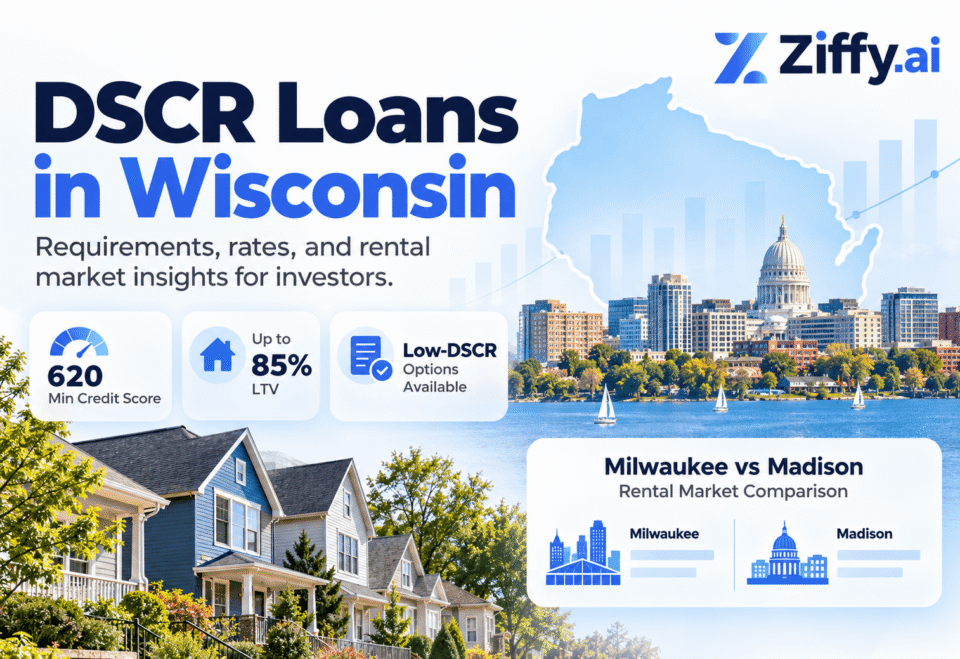
Eligible Wisconsin DSCR borrowers can qualify with a credit score starting at 620.
Up to 85% financing is available for eligible purchases, subject to program conditions.
A ratio of 1.0 means qualifying rent equals the monthly PITIA payment. Lower-ratio options may qualify.
US Census Bureau ACS 2020–2024 benchmark, illustrating Wisconsin’s varied rental markets.
Sources: US Census Bureau. Loan figures represent Ziffy eligibility parameters; final terms depend on underwriting.
Quick Answer: Can You Get a DSCR Loan in Wisconsin?
Yes. Ziffy Mortgage offers DSCR loans in Wisconsin for eligible investment property purchases and refinances. Qualification focuses on the property’s rental income relative to its monthly housing payment rather than requiring personal income documentation such as W-2s or tax returns to establish qualifying income.
Eligible borrowers can qualify with credit scores starting at 620, purchase financing up to 85% LTV, and reserves starting at two months of PITIA. Properties with DSCR below 1.0 may also qualify through lower-ratio financing options.
The right approach depends on the property’s location and operating costs. A Milwaukee duplex, Madison single-family rental, and Wisconsin Dells vacation property may have very different rental income patterns and underwriting considerations.
Wisconsin offers real estate investors several distinct rental markets. Milwaukee has an established stock of older homes and duplexes. Madison presents a different price and rent environment. Green Bay, Appleton, and Oshkosh give investors additional locations to evaluate, while lake communities introduce seasonal rental considerations.
Those differences affect more than property selection. They influence how much an investor can borrow against the rent a property generates.
The US Census Bureau estimates Madison’s median owner-occupied home value at $372,900, compared with $184,000 in Milwaukee, using 2020–2024 survey data. Madison also reports higher median gross rent. Neither number is an investment-property price or current market rent, but the contrast shows why Wisconsin DSCR financing needs a local analysis.
With Ziffy Mortgage, investors can evaluate eligible rental-property financing based on the property’s qualifying income, monthly payment, and the overall strength of the transaction.
Table of Contents
How Does a DSCR Loan Work in Wisconsin?
A Debt Service Coverage Ratio (DSCR) loan evaluates a rental property’s income against its monthly housing payment. Investors can qualify without using their personal debt-to-income ratio as the main income qualification test.
A DSCR of 1.0 means rent equals PITIA. A ratio above 1.0 indicates additional payment coverage, while a ratio below 1.0 means the rent does not fully cover PITIA.
Underwriting uses eligible rental income supported by documentation, such as leases and an appraisal’s rental analysis. Actual cash flow can still be lower after repairs, vacancies, utilities, and property management expenses.
Wisconsin investor insight: For an older Milwaukee duplex, test the property’s heating costs, maintenance condition, and tax bill alongside rent. Passing the DSCR calculation does not automatically mean the property produces the cash flow an investor wants.
Investors can estimate coverage using Ziffy’s DSCR loan guide and investment-property analysis tools.
What Are the DSCR Loan Requirements in Wisconsin?
Ziffy Mortgage offers several DSCR financing structures for eligible Wisconsin investment properties. The terms depend on credit, property type, rental coverage, leverage, and underwriting.
| Requirement | Ziffy Mortgage Wisconsin DSCR Program |
|---|---|
| Credit score | 620 minimum eligible |
| Purchase LTV | Up to 85% for eligible scenarios |
| Down payment | As low as 15% for eligible purchases |
| Rate-and-term refinance | Up to 80% LTV |
| Cash-out refinance | Up to 75% LTV |
| Preferred DSCR | 1.0 or higher, with lower-ratio options |
| Reserves | Starting at 2 months of PITIA |
| Qualifying income | Property rental income rather than traditional personal income documentation |
A lower down payment may increase monthly debt service, making the DSCR harder to satisfy. Investors should compare available leverage with the actual payment and rent supported by the appraisal.
The maximum available LTV is not automatically the most useful LTV. A larger down payment can improve rental coverage and provide more room for expenses, especially when the property’s rent is close to its monthly debt obligation.
Wisconsin Rental Market Comparison: Where Do Rental Income and Property Values Differ?
Wisconsin’s largest rental markets offer different entry costs and income potential. The US Census Bureau’s 2020–2024 American Community Survey provides a consistent historical benchmark for comparing cities.
ACS 2020–2024 | US Census Bureau | USD per month
Source: US Census Bureau QuickFacts. Gross rent includes contract rent and estimated tenant-paid utilities. These figures do not represent current listing rents or property-specific underwriting rents.
Madison leads this comparison in median gross rent, but investors should consider acquisition prices before assuming higher rental yields. Milwaukee’s lower median owner-occupied home value also does not automatically guarantee better cash flow.
For DSCR financing, the useful comparison is the rent an eligible property can support relative to its projected PITIA, not which city has the highest median rent.
Where Are the Best Areas for DSCR Loans in Wisconsin?
Neighborhood selection changes the numbers behind a Wisconsin DSCR loan. Investors should compare rental properties with similar unit counts, conditions, lease terms, and locations rather than applying citywide median rents to individual streets.
Exploration guide by rental strategy. Colored categories describe research priorities, not measured investment yields or neighborhood rankings.
Compare older homes, duplexes, and neighborhood rental demand.
Check: deferred maintenance and unit legalityResearch urban rental comparables and differences between building types.
Check: taxes, parking, and association costsCompare suburban rental houses with city and county-level alternatives.
Check: purchase price relative to rentExamine lease cycles, building restrictions, and unit-level rental evidence.
Check: turnover and property managementEvaluate long-term rental homes and nearby employment access.
Check: property condition and rent compsCompare rental-property supply across Fox Valley municipalities.
Check: municipal tax and insurance differencesCompare residential rental options within southeastern Wisconsin.
Check: neighborhood-specific rent and upkeepResearch vacation-rental licensing, seasonal demand, and lender income rules.
Check: legal STR use and off-season revenueMethod: Qualitative location and property-type screening. No unverified ZIP-code rents, appreciation rates, vacancy rates, or projected yields have been assigned to these neighborhoods.
For neighborhood-level analysis, compare current lease evidence, rental appraisal findings, public property records, and local regulations. Ziffy’s investment search tools can help organize the property comparison.
Investment Properties on Sale in Wisconsin Today


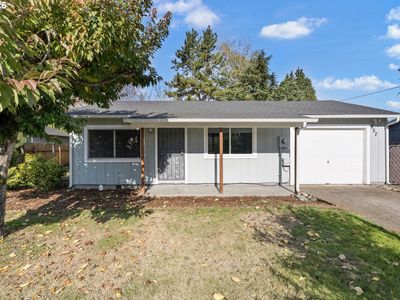
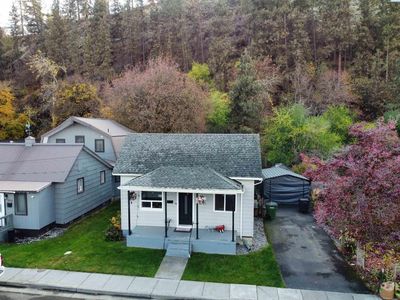
DSCR Loans in Milwaukee vs. Madison: Which Market Fits Your Investment Strategy?
Milwaukee and Madison have different housing economics. According to the Census Bureau’s 2020–2024 estimates, Milwaukee’s median owner-occupied home value was $184,000 and median gross rent was $1,059. Madison’s figures were $372,900 and $1,413, respectively.
Research older homes, legal duplex configurations, and renovation or maintenance exposure.
Assess purchase prices, campus-area leasing, and suburban single-family rental comparables.
Madison’s higher rent benchmark comes with a substantially higher home-value benchmark. These two citywide statistics should not be combined to calculate property yield because they measure different housing populations.
Investor takeaway: Milwaukee warrants close attention to rehabilitation and operating costs, while Madison requires careful testing of rental income against acquisition price and financing payments.
Source: US Census Bureau, ACS 2020–2024.
How Do Wisconsin Property Taxes Affect Your DSCR Loan?
Property taxes directly affect Wisconsin DSCR qualification because they form part of PITIA. A property can support an attractive monthly rent but still have weaker coverage if its tax or insurance expense is high.
Wisconsin taxes vary by municipality and taxing district. The Wisconsin Department of Revenue’s 2025 Town, Village and City Taxes Bulletin reports municipal property values, taxes, and rates. Parcel-specific tax bills remain essential for evaluating an individual property.
Wisconsin’s winters also make heating systems, insulation, roof condition, and utility responsibilities worth examining. Some costs affect the lender’s PITIA calculation directly, while others affect the investor’s actual net cash flow.
Before committing to a purchase, request current taxes, insurance estimates, and any association documents. Avoid assuming the seller’s existing tax expense will remain unchanged.
Can You Use a DSCR Loan for Airbnb or Short-Term Rentals in Wisconsin?
Wisconsin investors can explore DSCR financing for eligible short-term rental properties, but the property’s legal rental use and the lender’s accepted income documentation must be established before relying on vacation-rental revenue.
Under Wisconsin Statute 66.1014, municipalities generally cannot prohibit residential rentals lasting seven consecutive days or longer. They may, however, regulate qualifying short stays and impose certain annual rental-day limits. Operators also face state licensing requirements.
The Wisconsin Department of Agriculture, Trade and Consumer Protection administers tourist rooming house rules, including updated operational requirements effective January 25, 2026.
Madison’s short-term rental rules generally require the tourist rooming house to be the host’s primary residence, with limitations on unhosted stays and additional provisions for certain longer short-term stays. A non-owner-occupied investment property should not be assumed eligible for nightly Airbnb operation.
For Wisconsin Dells, Lake Geneva, and other tourism-oriented markets, examine local permits, association restrictions, seasonal expenses, and the availability of qualifying rental documentation. Projected peak-season income alone is not a substitute for acceptable underwriting evidence.
Investors can review Ziffy’s investment strategy resources while comparing long-term and short-term rental approaches.
Can You Get a Wisconsin DSCR Loan With a Ratio Below 1.0?
Yes. Ziffy Mortgage offers eligible lower-ratio DSCR financing, including options for properties whose rental income does not fully cover PITIA.
Qualifying rent meets or exceeds the monthly PITIA payment.
Eligible properties may qualify with additional pricing or leverage considerations.
No-ratio structures may be considered where available, subject to separate underwriting requirements.
Investors may be able to improve DSCR by reducing the loan amount, comparing eligible financing structures, or documenting higher supportable rent. Any increase in rent used for qualification must satisfy underwriting requirements.
Financing perspective: A property with a 0.9 DSCR is not necessarily a bad investment, but it needs more cash-flow scrutiny. The gap between rent and the mortgage payment must be covered, and the investor still needs funds for vacancies, repairs, and other operating expenses.
See Ziffy’s DSCR loan financing guide for additional qualification considerations.
Wisconsin DSCR Loan Rates: What Determines Your Interest Rate?
Wisconsin DSCR loan rates depend on the borrower’s credit profile, loan-to-value ratio, property type, DSCR, loan amount, and selected mortgage structure. A single advertised rate cannot represent every investment property.
Credit strength and available equity can affect pricing. Properties with lower rental coverage may also have different terms from properties that comfortably meet the preferred DSCR threshold.
Compare the interest rate, APR, lender fees, available fixed-rate or adjustable structures, prepayment provisions, required reserves, and total monthly PITIA. The lowest initial rate does not always produce the best financing arrangement for the planned holding period.
Ziffy Mortgage evaluates eligible Wisconsin DSCR financing based on the complete transaction rather than using a uniform rate for every borrower or rental property.
DSCR Purchase Loans, Refinancing, and Cash-Out Options in Wisconsin
Wisconsin investors can use DSCR financing for more than an initial rental-property purchase. Ziffy Mortgage offers eligible purchase, rate-and-term refinance, and cash-out refinance structures.
Eligible LTV for buying rental properties using qualifying rental income.
Eligible LTV for replacing an existing mortgage under applicable program rules.
Eligible LTV for accessing rental-property equity, subject to seasoning and underwriting rules.
For a refinance, investors should examine how the new loan balance changes PITIA and DSCR. Accessing equity can support another acquisition, but increasing debt may reduce the property’s monthly payment coverage.
How to Apply for a DSCR Loan in Wisconsin
Before applying for a Wisconsin DSCR loan, investors should establish both the property’s likely rental income and its complete monthly ownership payment.
Ziffy Mortgage can review eligible Wisconsin DSCR transactions without requiring traditional personal income documentation as the basis for rental-income qualification.
Wisconsin DSCR Loan FAQs
What credit score do I need for a Wisconsin DSCR loan?
Ziffy Mortgage offers eligible Wisconsin DSCR loans for borrowers with credit scores starting at 620. Specific financing terms depend on the full loan profile.
How much down payment is required for a Wisconsin DSCR loan?
Eligible purchases can qualify with as little as 15% down, corresponding to 85% LTV. Other scenarios require more equity depending on underwriting.
Can I get a Wisconsin DSCR loan without tax returns?
Yes. DSCR loans use qualifying property rental income rather than requiring personal tax returns to establish borrower income. Other financial and property documentation is still required.
Can I buy a duplex in Milwaukee with a DSCR loan?
Eligible rental duplexes may qualify, subject to property type, legal unit status, appraisal, credit, and rental-income underwriting requirements.
Can I qualify for a Wisconsin DSCR loan below a 1.0 ratio?
Potentially. Ziffy Mortgage offers eligible lower-ratio and no-ratio financing structures. The available loan amount and terms may differ from standard DSCR financing.
Are Wisconsin DSCR loans available for Airbnb properties?
Eligible short-term rental properties may qualify, but the intended use must satisfy local regulations and lender income requirements. Madison, for example, imposes significant primary-residence restrictions on many tourist rooming houses.
Can an LLC qualify for a Wisconsin DSCR loan?
Eligible LLC ownership structures may be permitted, subject to borrower, guarantor, title, and underwriting requirements.
Can I refinance a Wisconsin rental property using a DSCR loan?
Yes. Ziffy Mortgage offers eligible rate-and-term refinancing up to 80% LTV and cash-out refinancing up to 75% LTV. Final eligibility depends on property and underwriting requirements.