


Editorial Integrity
Making sound real estate investment decisions begins with reliable, data-driven insights. At Ziffy.ai, we offer an AI-native real estate investing, proprietary data-driven trend analysis, investment mortgage programs like DSCR loans, and a network of over 500 investor-friendly real estate agents to deliver the expertise needed for informed decisions. Our content is crafted by experienced real estate professionals and backed by real-time market data, ensuring you receive accurate and actionable information. Through a rigorous editorial process, we strive to empower your investment journey with trustworthy and up-to-date guidance.
Key Takeaways
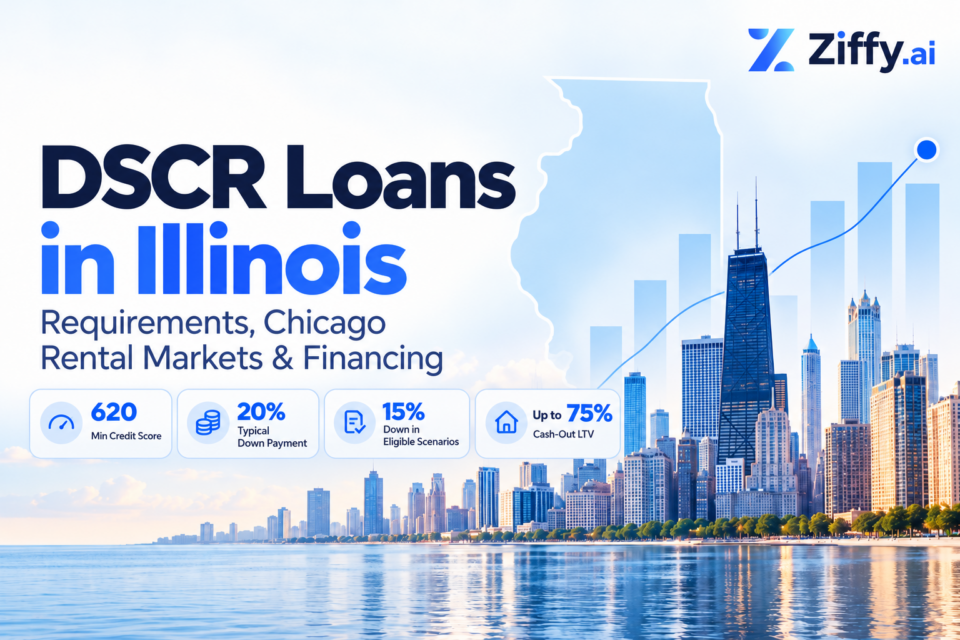
Minimum credit score for eligible Ziffy DSCR financing.
Maximum purchase LTV for qualifying scenarios; standard purchases generally allow up to 80%.
Preferred DSCR, with alternative options for eligible lower-ratio properties.
Monthly difference between selected Chicago two-bedroom HUD rent benchmarks.
Lending figures reflect Ziffy’s DSCR program; qualifying scenarios vary. Rental comparison: HUD FY 2027 Small Area Fair Market Rents.
What Is a DSCR Loan in Illinois?
An Illinois DSCR loan is a mortgage for an investment property that allows investors to qualify primarily using the property’s rental income instead of personal salary, employment income, or debt-to-income ratio.
Ziffy offers Illinois DSCR loans for qualifying rental property purchases, rate-and-term refinances, and cash-out refinances. Credit scores start at 620, standard purchases generally require 20% down, and eligible scenarios may qualify with as little as 15% down. Properties below a 1.00 DSCR may also be eligible for alternative financing.
The main calculation compares qualifying gross monthly rent with the property’s full monthly housing payment, including property taxes, insurance, and applicable association dues.
Chicago has a way of making real estate investing look different from one neighborhood to the next. A two-flat in Logan Square, a condo near the lakefront, and a single-family rental on the South Side may all produce rental income, but the costs of buying and financing them can be considerably different.
And Illinois doesn’t end at Chicago. Investors looking toward Rockford, Peoria, or Champaign-Urbana have a different set of property prices, tenants, maintenance considerations, and rental expectations to evaluate.
That’s where DSCR financing becomes useful. Rather than starting with an investor’s employment history, the loan starts with the rental property’s income. But Illinois investors need to pay particular attention to property taxes, the rent each unit can support, and the amount of debt required to purchase it. A promising rental property isn’t necessarily a strong DSCR property until those numbers have been considered together.
Table of Contents
How Does a DSCR Loan Work in Illinois?
DSCR stands for debt service coverage ratio. For Ziffy’s residential DSCR financing, it measures how much qualifying gross monthly rental income a property generates relative to its principal, interest, taxes, insurance, and applicable association dues (PITIA).
DSCR Formula
PITIA includes principal, interest, property taxes, insurance, and applicable association dues.
A ratio of 1.00 means gross qualifying rent equals the monthly housing payment. At 1.25, the qualifying rent is 25% greater than PITIA. That excess is not the investor’s actual cash profit because maintenance, vacancies, management, and other operating costs still need to be considered.
Ziffy evaluates supportable rental income alongside the property appraisal, loan amount, credit profile, reserves, and ownership structure. Personal W-2s or tax returns aren’t required to establish income for DSCR qualification.
Investors can learn more about the calculation and underwriting process through Ziffy’s DSCR loan guide.
Ziffy Mortgage Illinois DSCR Loan Requirements
Ziffy offers financing for eligible Illinois rental properties without requiring borrowers to qualify using traditional employment income. Approval still depends on the property’s financial performance, borrower credit, available assets, and loan structure.
| Requirement | Ziffy DSCR Program |
|---|---|
| Minimum credit score | 620 |
| Preferred DSCR | 1.00 or higher |
| Below 1.00 DSCR | Eligible lower-DSCR and No-Ratio options |
| Typical purchase down payment | 20% |
| Maximum purchase LTV | Up to 85% for eligible scenarios |
| Rate-and-term refinance | Up to 80% LTV |
| Cash-out refinance | Up to 75% LTV |
| Minimum loan amount | $100,000 |
| Cash reserves | Starting at 2 months |
| Personal income documentation | No W-2s, pay stubs, or personal tax returns for DSCR income qualification |
| Property use | Eligible non-owner-occupied investment properties |
Terms vary by credit score, property type, DSCR, leverage, reserves, and underwriting. Maximum LTV is not available for every borrower or property.
DSCR Loans in Chicago: How Rental Income Varies by ZIP Code
Chicago’s rental market can change considerably within a few miles. Lincoln Park and Lakeview have different property values, housing stock, and financing considerations from Greater Grand Crossing or Chicago Lawn.
HUD’s FY 2027 Small Area Fair Market Rents help illustrate how two-bedroom rental benchmarks differ across ZIP codes. They are housing-program benchmarks rather than guaranteed market rents, but they provide a consistent geographic comparison.
FY 2027 Two-Bedroom HUD Rent Benchmarks
Selected Chicago ZIP codes. Darker blue represents a higher rent benchmark, not a higher investment return.
A considerable difference in two-bedroom rental benchmarks within the same city.
Source: HUD Small Area Fair Market Rents, FY 2027. ZIP-code benchmarks are not lender-approved rental income, individual property appraisals, or estimates of investment returns. Neighborhood names identify representative areas; ZIP boundaries do not exactly match neighborhood boundaries.
A higher rent benchmark doesn’t necessarily make a property easier to finance. Higher acquisition costs can increase the loan payment, while property taxes, insurance, and association fees can add substantially to PITIA. For DSCR qualification, both sides of the calculation need to be considered.

“When investors compare Chicago neighborhoods, I always encourage them to look beyond which ZIP code commands the highest rent. A property bringing in $3,000 a month isn’t necessarily a better investment than one bringing in $1,800. What did you pay for each property? How much are you financing? What are the taxes and insurance? Those numbers tell us whether the rent can support the loan. Sometimes the less expensive property can have a stronger DSCR, even though it brings in less rent. That’s why I wouldn’t make a financing decision based on neighborhood rental averages alone.”
Dorian Adams-WalkerWhich Chicago Neighborhoods Should DSCR Investors Consider?
For an investor financing a Chicago rental property, the useful question isn’t simply which neighborhood has the highest rent. It’s which available property has a purchase price, rental income, and cost structure that can support the proposed mortgage.
Lincoln Park and Lakeview
Consider condo association dues, rental restrictions, acquisition costs, and financing leverage. A stronger rental benchmark can be offset by a larger purchase loan or higher ownership costs.
Logan Square and Humboldt Park
Two-flats and three-flats require careful evaluation of legal unit counts, condition, and each unit’s supportable rent. A property’s advertised combined rent may not match qualifying rental income.
Greater Grand Crossing and Chatham
Compare single-family and smaller multifamily properties using recent local leases, required repairs, insurance, property taxes, and the amount of financing needed.
Chicago Lawn and the Southwest Side
Pay attention to acquisition costs, building condition, property assessments, and rental comparables. Lower rent benchmarks do not establish whether a property’s DSCR will be lower or higher.
A Chicago multifamily consideration: If you’re buying a two-flat or three-flat, confirm the legal number of rental units before relying on the property’s total advertised rental income. Underwriting and appraisal requirements can differ from a listing’s description.
Where Can Investors Use DSCR Loans Outside Chicago?
Illinois investors aren’t limited to Chicago-area rental properties. Rockford, Peoria, Champaign-Urbana, Bloomington-Normal, and Metro East communities offer different types of rental housing and different financing considerations.
| Illinois Market | What Investors Should Examine |
|---|---|
| Rockford | Comparable leases, property condition, tax burden, and minimum loan requirements. |
| Peoria | Acquisition costs, maintenance needs, insurance, and rental income relative to debt service. |
| Champaign-Urbana | Student-oriented tenancy, lease structures, turnover costs, and rental demand outside the academic calendar. |
| Bloomington-Normal | Proximity to employment and education centers, tenant demand, and property-specific comparable rents. |
| Metro East | Municipal rental requirements, local assessments, building condition, and submarket-specific lease evidence. |
What HUD Rent Data Shows in Champaign-Urbana and Peoria
The FY 2027 HUD two-bedroom Small Area Fair Market Rent is $1,480 for ZIP 61822 in Champaign and $1,140 for ZIP 61802 in Urbana. That’s a $340 monthly difference between selected ZIP codes within the broader Champaign-Urbana market.
For Peoria ZIP 61604, the corresponding benchmark is $1,220. This doesn’t establish what any individual rental property will earn, but it helps illustrate why local rent evidence matters even outside Chicago.
The loan amount matters, too. A lower-cost acquisition can still face a financing constraint if the proposed mortgage falls below Ziffy’s $100,000 minimum.
Sources: HUD Small Area Fair Market Rents and FY 2027 Champaign County ZIP-level rent data.
How Do Illinois Property Taxes Affect DSCR Loan Approval?
Property taxes are one of the first expenses an Illinois rental property investor should examine. They’re included in PITIA, meaning higher taxes can lower the DSCR even when rental income and the mortgage’s principal-and-interest payment stay the same.
The Illinois Department of Revenue explains that there is no single statewide property-tax rate. The amount depends on the property’s assessment and the levies imposed by local taxing districts. Cook County also uses a property-classification assessment system that differs from the system in most other Illinois counties.
Investors shouldn’t automatically assume the previous owner’s tax bill will continue after closing. Assessment changes, exemptions, and local tax circumstances can affect the amount ultimately payable. Your qualifying PITIA needs to reflect the applicable underwriting figures.
Check These Before Financing an Illinois Rental

“One thing I would tell any investor looking at property in Illinois is to pay close attention to the tax bill before getting too comfortable with the rental numbers. You might find a property with good rental income, but once you factor in property taxes, insurance, and the actual mortgage payment, the DSCR can look quite different. And if you’re buying in Cook County, don’t just assume the seller’s current tax bill is what you’ll be paying after closing. I’d rather have an investor discover that difference before making an offer than have it become a problem halfway through financing.”
Steven GlickIf a property’s DSCR falls below the desired threshold, start by checking whether the qualifying rent and PITIA have been calculated correctly. These two numbers determine the ratio, and both may change as the loan progresses through underwriting.
Support the Rental Income
Check comparable leases, existing rental agreements, permitted units, and the property’s condition. Any proposed rent must be supported through documentation acceptable to underwriting.
Review the Mortgage Structure
A larger down payment may reduce the monthly principal-and-interest payment. Compare financing structures, available pricing, and cash requirements without exhausting needed reserves.
Check Taxes and Insurance
Verify property assessments and obtain realistic insurance quotes. Correcting inaccurate assumptions can materially change the payment used for DSCR calculations.
Evaluate the Purchase Price
A lower acquisition price may reduce the amount borrowed. Compare a proposed offer against actual comparable sales and projected property-level cash flow.
Lower maintenance or management costs may improve an investor’s actual profitability, but they do not directly increase the gross-rent-to-PITIA ratio. DSCR and net operating cash flow should be reviewed separately.
Can You Get an Illinois DSCR Loan Below a 1.00 Ratio?
Yes. Ziffy offers financing options for qualifying Illinois investment properties with DSCR below 1.00, including No-Ratio DSCR structures.
A below-1.00 ratio means the property’s qualifying gross rental income is less than its monthly PITIA. Such properties may still qualify with adjusted leverage, additional reserves, or different loan pricing. Financing eligibility doesn’t necessarily mean the property will generate positive cash flow.
How Ziffy Evaluates Different DSCR Ranges
| 1.00+ | Preferred range for standard DSCR qualification. |
| 0.75–0.99 | May qualify through an eligible lower-DSCR structure. |
| Below 0.75 | May require an eligible No-Ratio program and stronger compensating factors. |
The appropriate structure depends on the complete loan file. Investors should consider how a lower DSCR affects loan costs, equity requirements, and the property’s ability to withstand unexpected vacancies or expenses.
Ziffy offers financing for qualifying single-family rental homes, condos, townhouses, two-to-four-unit residential properties, and eligible short-term rentals. Investors can use DSCR financing for purchases and qualifying refinances.
Illinois DSCR Cash-Out Refinance
Eligible investors can refinance an existing rental property and access equity with up to 75% LTV. Available proceeds depend on the property’s appraised value, outstanding debt, closing costs, and loan terms.
Chicago Two-to-Four-Unit Buildings
Eligible two-flats, three-flats, and four-unit buildings may qualify. Legal unit count, property condition, appraisal requirements, and supportable rental income remain important to underwriting.
What About Illinois Airbnb and Short-Term Rental Properties?
Eligible short-term rental properties may qualify for DSCR financing, but loan eligibility and permission to operate are separate considerations.
Chicago requires registration or applicable licensing for covered short-term rental properties. Restrictions may also apply to certain buildings or residential areas. Before purchasing a property for Airbnb-style rental income, confirm municipal requirements, association restrictions, and the income documentation accepted for financing.
Source: City of Chicago, Municipal Code Chapter 4-14: Shared Housing Units.
Is a DSCR Loan Right for Your Illinois Investment Property?
Illinois offers rental property investors more than one type of market. A Chicago two-flat, a Peoria single-family rental, and a property near the University of Illinois require different approaches to estimating income, expenses, and financing costs.
A DSCR loan can make sense when the property’s rental income provides a better basis for mortgage qualification than the borrower’s personal income. But successful financing still requires realistic rental estimates, a sustainable monthly payment, and enough available capital to manage the property after closing.
For Illinois investors, property taxes, legal rental units, building condition, and the difference between neighborhood rent benchmarks and property-specific qualifying rent deserve particular attention.
Ziffy offers eligible Illinois investors DSCR purchase loans, refinancing, and alternative loan structures for properties that do not meet standard rental coverage requirements. Before deciding how much to borrow, compare the property’s supportable income with its full financing costs and the actual expenses of owning it.
Illinois DSCR Loans FAQs
What is the minimum credit score for an Illinois DSCR loan?
Ziffy’s minimum credit score starts at 620 for eligible DSCR loans. Specific loan structures may require a higher score depending on LTV, property type, DSCR, and additional underwriting considerations.
How much down payment is required for an Illinois DSCR loan?
A standard Ziffy DSCR purchase generally requires 20% down. Eligible purchase scenarios may qualify with 15% down, while other property or borrower profiles may require a higher contribution.
Can I get a DSCR loan in Illinois without tax returns?
Yes. Ziffy’s DSCR program does not require personal tax returns, W-2s, or pay stubs to establish qualifying income. Other documentation, including identification, assets, property details, and appraisal information, may still be required.
Can I finance a Chicago two-flat or three-flat with a DSCR loan?
Yes, qualifying two-to-four-unit investment properties may be eligible. Ziffy evaluates legal unit count, appraisal, condition, qualifying rental income, and borrower eligibility.
Can I refinance an Illinois rental property with a DSCR loan?
Yes. Ziffy offers eligible rate-and-term refinances up to 80% LTV and cash-out refinances up to 75% LTV, subject to the property’s value and the final loan structure.
Can first-time real estate investors qualify for DSCR loans in Illinois?
First-time investors may be eligible, depending on the loan program. Credit, reserves, property income, down payment, and any applicable experience requirements are considered during underwriting.
Can I use an Illinois DSCR loan for a primary residence?
No. DSCR loans are intended for eligible non-owner-occupied investment properties. A borrower purchasing a home to live in should explore an appropriate owner-occupied mortgage.
Can I get an Illinois DSCR loan through an LLC?
Eligible DSCR loans may be structured through an LLC, subject to entity documentation, borrower guarantees, ownership requirements, and underwriting. Investors should discuss the intended ownership structure before preparing the purchase contract.
Is a DSCR loan better than a conventional investment property mortgage?
It depends on the borrower and property. DSCR financing can suit investors whose property income supports the mortgage but whose personal income documentation is less suitable for conventional qualification. Compare interest rates, down payments, total borrowing costs, and applicable prepayment terms before choosing.