


Editorial Integrity
Making sound real estate investment decisions begins with reliable, data-driven insights. At Ziffy.ai, we offer an AI-native real estate investing, proprietary data-driven trend analysis, investment mortgage programs like DSCR loans, and a network of over 500 investor-friendly real estate agents to deliver the expertise needed for informed decisions. Our content is crafted by experienced real estate professionals and backed by real-time market data, ensuring you receive accurate and actionable information. Through a rigorous editorial process, we strive to empower your investment journey with trustworthy and up-to-date guidance.
Key Takeaways
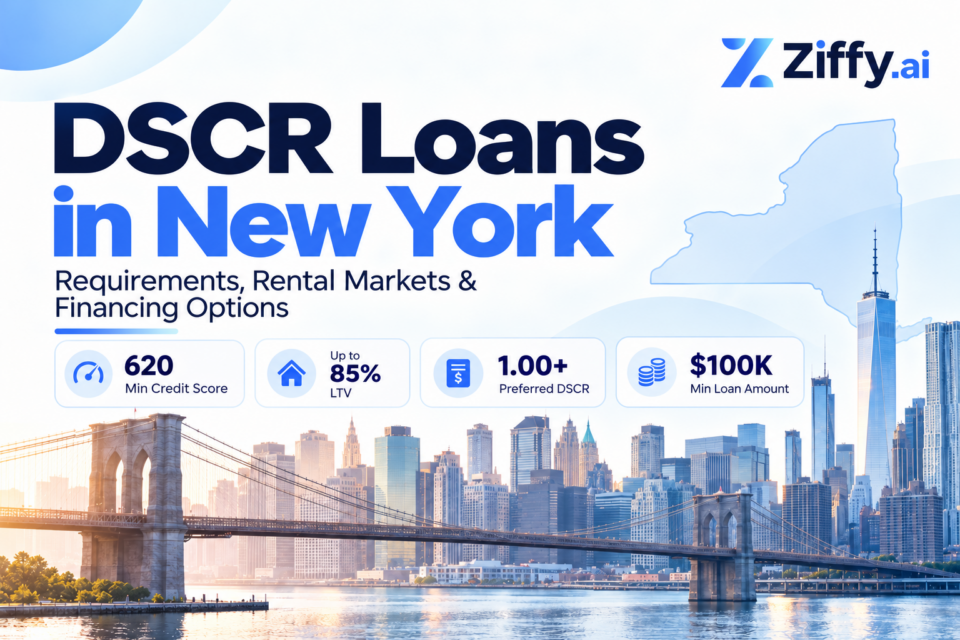
Minimum eligible credit score
Maximum purchase LTV for eligible scenarios
HUD FY 2026 two-bedroom New York metro rent benchmark
Preferred DSCR benchmark, with lower-ratio options
Source: HUD FY 2026 Fair Market Rents. Financing figures describe Ziffy’s eligible programs; approval depends on underwriting.
Quick Answer: Can You Get a DSCR Loan in New York?
Yes. Ziffy offers DSCR loans in New York for eligible investment properties. Rather than qualifying primarily through the borrower’s personal income, DSCR financing uses the property’s rental income and monthly housing payment to evaluate its ability to support the loan.
Ziffy offers eligible purchase financing up to 85% loan-to-value (LTV), rate-and-term refinancing up to 80% LTV, and cash-out refinancing up to 75% LTV. The minimum eligible credit score is 620, and reserve requirements start at two months.
New York investors must also consider local property taxes, building restrictions, rental regulations, and closing costs. A property with strong advertised rent may still have a weak DSCR once its complete monthly payment is calculated.
Table of Contents
How Does a DSCR Loan Work in New York?
A DSCR loan evaluates whether a property’s qualifying rental income can support its monthly housing payment. This allows investors to finance eligible rental properties without relying on traditional W-2s, pay stubs, or personal tax returns to establish qualifying income.
The Debt Service Coverage Ratio is calculated by dividing qualifying monthly rental income by PITIA: principal, interest, property taxes, insurance, and applicable association dues.
DSCR FORMULA
Qualifying Monthly Rent ÷ PITIA = DSCR
Qualifying rent exceeds the monthly housing payment.
Qualifying rent exactly equals the monthly housing payment.
Rent does not fully cover PITIA; eligible No-Ratio options may apply.
In New York, where taxes, insurance, and common charges can differ considerably between properties, the monthly payment deserves as much attention as the rent itself.
Investors should also calculate operating cash flow separately. A property’s DSCR does not necessarily account for every vacancy, maintenance, management, or capital-improvement expense.
Use Ziffy’s DSCR loan calculator to evaluate the relationship between rent and financing costs.
Ziffy Mortgage New York DSCR Loan Requirements
Ziffy offers DSCR financing for eligible non-owner-occupied residential investment properties throughout New York. The property’s rental performance, borrower credit profile, loan amount, and requested leverage determine which financing options are available.
| Requirement | Ziffy DSCR Financing |
|---|---|
| Minimum credit score | 620 |
| Preferred DSCR | 1.00 or higher |
| Lower DSCR | Eligible below-1.00 and No-Ratio options |
| Purchase financing | Up to 85% LTV on eligible scenarios |
| Rate-and-term refinance | Up to 80% LTV |
| Cash-out refinance | Up to 75% LTV |
| Minimum loan amount | $100,000 |
| Reserves | Starting at two months |
| Loan term | 30-year fixed options |
| Qualifying income | Property rental income |
| Property occupancy | Non-owner-occupied investment property |
Traditional personal income documentation is generally not necessary for DSCR qualification. Borrowers still provide identification, asset information, purchase contracts where applicable, and documents needed for property underwriting.
Eligible property types can include single-family rentals, condos, townhomes, and qualifying two-to-four-unit properties. Property type and building-specific restrictions must be checked before proceeding.
Maximum LTVs are program ceilings rather than guaranteed financing terms. Credit, DSCR, occupancy, property eligibility, and other underwriting factors affect the final loan structure.
New York Rental Market Comparison: Where Are Rent Benchmarks Higher?
New York is not one rental market. The economics of a Brooklyn condo, a Long Island single-family rental, and a Buffalo duplex differ considerably.
For a consistent regional comparison, the chart below uses HUD’s FY 2026 two-bedroom Fair Market Rents. These are federal housing-program benchmarks, not actual asking rents or appraised rental incomes.
Two-Bedroom Rent Benchmarks Across New York
HUD FY 2026 · Monthly Fair Market Rent · Selected metropolitan areas
Source: HUD FY 2026 Fair Market Rent Schedule. Bar lengths are proportional to the highest benchmark shown. Metropolitan areas may cover several counties. These figures do not measure investment yields or property-specific qualifying rents.
The New York metro benchmark is $1,567 per month higher than Buffalo’s. That is a considerable difference in rental benchmarks, but it does not establish which market generates the stronger investment return.
For DSCR financing, the more useful comparison is how much rental income a property can support relative to its acquisition price, taxes, insurance, and monthly financing obligation.
DSCR Loans in NYC: Manhattan, Brooklyn, Queens, the Bronx, and Staten Island
New York City is not one rental market. An investment property in Manhattan can have a very different financial profile from a two-family home in Queens or a single-family rental on Staten Island. Although the same basic DSCR formula applies across the city, the expenses, rental regulations, and property characteristics that influence the calculation can vary considerably.
For investors using DSCR loans in NYC, the starting point should be the property’s lawful rental income, actual monthly carrying costs, and eligibility for non-owner-occupied financing, rather than a borough-wide rental average.
Manhattan
Monthly condo common charges, special assessments, property taxes, and building rental policies deserve particular scrutiny. High rental income may not translate into strong debt coverage when recurring ownership expenses are substantial. Investors should also distinguish eligible condos from co-ops, which involve different ownership and financing considerations.
Brooklyn
Small multifamily buildings and condos require careful review of existing leases, lawful unit counts, and rental restrictions. Investors evaluating neighborhoods such as Williamsburg, Bushwick, or Bedford-Stuyvesant should use comparable rents for the specific property rather than assuming the same rental income applies throughout the borough.
Queens
Property configurations and rental characteristics differ between areas such as Astoria, Flushing, and Jamaica. Before calculating DSCR, investors should confirm legal occupancy, verify qualifying rental income, and review the property’s actual tax and insurance obligations.
The Bronx
Investors considering multifamily properties should review rent-stabilization status, lawful rents, documented tenancy, property condition, and capital-improvement requirements. Projected market-rate income should not replace legally collectible rent when evaluating a regulated unit.
Staten Island
Single-family homes and small residential investment properties present a different ownership profile from many Manhattan condos. Investors should evaluate local rental comparables, property taxes, insurance, maintenance obligations, and the property’s ability to support its full monthly payment.
Why ZIP-Level Rental Research Matters in NYC
HUD’s metropolitan Fair Market Rent provides a useful regional benchmark, but it cannot tell an investor what a particular apartment in Astoria, Bushwick, or Harlem should rent for.
The more useful approach is to compare properties at the ZIP-code and neighborhood level. HUD’s Small Area Fair Market Rents provide ZIP-code-level rental benchmarks where available, allowing investors to examine differences within larger metropolitan areas.
These benchmarks should be supplemented by current leases, comparable rental listings, appraisal-supported market rents, and an assessment of the property’s condition and amenities. HUD benchmarks are not guarantees of achievable rent or lender-approved qualifying income.
What Investors Should Compare Before Making an Offer
- Actual lease income versus the property’s supported market rent.
- Legally permitted rental units versus the advertised unit configuration.
- Monthly property taxes, insurance, and association assessments.
- Existing rent restrictions and permitted future adjustments.
- Required repairs, reserves, and recurring operating expenses.
How Rent Stabilization Can Affect DSCR Loan Qualification
Rent stabilization deserves particular attention when purchasing an investment property in New York City. A buyer cannot necessarily increase an apartment’s rent to match nearby market-rate listings, even when demand supports a higher advertised figure.
For covered rent-stabilized apartment leases commencing between October 1, 2026, and September 30, 2027, the New York City Rent Guidelines Board adopted a 0% guideline increase for both one-year and two-year leases. These adjustments apply to the covered leases specified in the order, not every rental apartment in the city.
The financing implication: A property’s legal rent may be lower than its estimated unrestricted market rent. Investors should establish which income is legally collectible and acceptable for underwriting before calculating DSCR or assuming future rent increases will support a larger mortgage.

“When I’m reviewing a New York City investment property, I want to know which rental income the borrower can actually collect and what it costs to keep that property running. Take a rent-stabilized apartment, for example. The investor might see nearby market-rate units renting for considerably more, but those comparable rents don’t change what the existing tenant is legally required to pay. Then you’ve got property taxes, insurance, and possibly substantial condo charges affecting the monthly payment. I would rather work through those numbers before an investor commits to a purchase than have them discover later that the rental income they expected cannot support the loan they wanted.”
The practical takeaway is to establish the property’s permitted and supportable rental income before choosing a financing structure. A higher advertised rent does not compensate for an understated monthly payment or an income assumption that cannot be supported during underwriting.
For NYC investors, evaluating a potential purchase means looking beyond the address and the asking rent. The strongest financing decisions begin with accurate property-level numbers, legal rental eligibility, and a loan structure that fits the property’s actual income.
Where Can Investors Find DSCR Loan Opportunities Outside NYC?
New York’s investment opportunities extend well beyond the five boroughs. The Capital Region, Western New York, Central New York, Hudson Valley, and Long Island each require a different approach to rental underwriting.
Buffalo and Rochester: Evaluate the Property Before the Price Tag
HUD’s FY 2026 two-bedroom rent benchmark is $1,343 in Buffalo–Cheektowaga and $1,573 in Rochester.
Investors should examine neighborhood-level rental evidence, building condition, repair requirements, and property taxes before deciding whether a lower acquisition price translates into a stronger investment.
Albany and Syracuse: Compare Long-Term and Student-Oriented Rentals
The Albany–Schenectady–Troy metropolitan area has a $1,702 two-bedroom benchmark, compared with $1,392 in Syracuse.
Investors considering student-oriented housing should evaluate lease structures, turnover, and the lender’s accepted rental-income documentation. Seasonal occupancy assumptions cannot automatically replace documented qualifying rent.
Hudson Valley: Evaluate Rent Against Carrying Costs
The Poughkeepsie–Newburgh area’s FY 2026 two-bedroom benchmark is $1,979. Property taxes, insurance, commuting accessibility, and municipal rental restrictions should be considered alongside local rental demand.
Ithaca and Long Island: Higher Rents Do Not Eliminate Expense Risk
Ithaca’s two-bedroom benchmark is $1,753, while Nassau–Suffolk’s is $2,747.
These figures provide regional context, but neither establishes investment returns. The purchase price, insurance, taxes, property condition, and accepted rent are all necessary to assess whether a particular investment can support DSCR financing.
How Do New York Property Taxes and Mortgage Recording Taxes Affect DSCR Loans?
New York investors need to distinguish costs that affect the monthly DSCR calculation from costs paid during the transaction.
Property taxes and qualifying insurance costs are included in PITIA, meaning they directly affect the property’s debt service coverage ratio. Mortgage recording taxes and applicable transfer taxes generally affect the cash required to close rather than the recurring DSCR calculation.
Monthly Carrying Costs
Property taxes, insurance, principal, interest, and applicable association dues determine PITIA and therefore affect the DSCR calculation.
Transaction Costs
Mortgage recording taxes, applicable transfer taxes, title charges, and other settlement costs determine how much cash may be needed to complete the transaction.
The New York State Department of Taxation and Finance explains that mortgage recording taxes can include state and local components. The amount depends on the location and nature of the transaction.
New York also imposes a real estate transfer tax, and additional taxes may apply to certain higher-value residential purchases.
Before making an offer, request a property-specific closing estimate and review the actual tax assessment. Preserving sufficient reserves after closing is particularly important when financing an older property or one with substantial recurring assessments.
Can You Use a DSCR Loan for Airbnb or Short-Term Rentals in New York?
Ziffy offers financing for eligible short-term rental investment scenarios. However, the property’s legal ability to operate as a short-term rental must be evaluated separately from its mortgage eligibility.
This distinction is especially important in New York City.
New York City’s Short-Term Rental Restrictions
Under NYC Local Law 18 guidance, most unhosted rentals of entire residential units for fewer than 30 days are prohibited. Permitted short-term stays generally require the permanent resident host to remain present, registration, and compliance with guest limits and other rules.
As a result, a typical investor-owned apartment intended exclusively for short-term guest stays may not qualify as a lawful operating model in New York City.
Outside NYC, municipalities have their own zoning, registration, licensing, and occupancy requirements. An investor purchasing in the Hudson Valley, Finger Lakes, or another visitor-oriented region should review local rules before relying on short-term rental revenue.
Even where the use is lawful, the projected income must satisfy the lender’s accepted underwriting methodology. Revenue estimates from booking platforms do not automatically establish qualifying income.
Can You Get a New York DSCR With a DSCR Ratio Below 1.00?
Yes. A DSCR below 1.00 does not automatically disqualify an investment property from financing. Ziffy offers eligible below-1.00 and No-Ratio DSCR loan options for New York investors whose properties do not generate enough qualifying rental income to cover the full monthly housing payment.
A DSCR below 1.00 means the property’s qualifying monthly rent is lower than its principal, interest, property taxes, insurance, and applicable association dues (PITIA). This can occur even when a property generates substantial rental income, particularly in markets with high acquisition costs, property taxes, or condo assessments.
Instead of rejecting every property that falls below the standard coverage benchmark, Ziffy evaluates eligible financing structures based on the borrower’s credit profile, down payment, available reserves, property characteristics, and overall loan scenario. Lower-ratio financing may involve reduced leverage, higher reserve requirements, or different pricing.
Preferred DSCR
Qualifying rental income covers or exceeds the monthly housing payment.
Below-1.00 DSCR
Eligible lower-coverage properties may qualify with adjusted financing terms.
Alternative Financing
Certain eligible scenarios may qualify without meeting a minimum rental coverage threshold.
What Can Improve a Property’s DSCR?
Improving DSCR involves increasing supportable rental income, reducing the qualifying monthly payment, or both. New York investors should focus on changes that are financially realistic and supported by property documentation.
Verify Qualifying Rental Income
Review current leases, legally collectible rent, and market-rent evidence. For rent-stabilized properties, projected unrestricted market rents should not replace lawful rental income.
Review Taxes and Insurance
Confirm that the property tax assessment and insurance quote are accurate. Correcting an overstated expense can improve the calculation, but projected tax reductions should not be assumed.
Compare Loan Structures
Evaluate eligible interest rates, loan terms, and down payment options. A lower monthly principal-and-interest payment can improve coverage.
Balance Equity and Reserves
A larger down payment may reduce the monthly mortgage payment, but investors should retain sufficient funds for vacancies, maintenance, and unexpected expenses.

“When a New York investment property comes in below a 1.00 DSCR, I don’t automatically look at it as a deal that can’t be financed. I look at why the ratio is low and whether there’s a better way to structure the loan. Sometimes the property’s rent is strong, but the purchase price, property taxes, or monthly assessments are pushing the payment above what that rent can cover. We can evaluate a larger down payment or a loan program that accepts lower coverage, but I always want investors to look at what they’re giving up in return. Putting more money down might improve the DSCR, but if it leaves you without enough cash for a vacancy, a major repair, or an unexpected assessment, you haven’t necessarily made the investment safer. The goal is to find financing that works for the property without putting the investor in a difficult position after closing.”
Steven’s point highlights an important distinction between loan eligibility and investment performance. A property may qualify under a lower-DSCR program while still requiring the owner to contribute funds toward monthly expenses.
In New York, where property taxes, insurance, maintenance, and building assessments can significantly influence ownership costs, investors should calculate expected cash flow separately from the lender’s qualifying DSCR.
For properties that cannot achieve a 1.00 ratio, the next step is to compare the total cost of available financing options, the additional equity required, and the reserves remaining after closing. A lower-DSCR loan can provide an alternative path to financing, but it should still support a sustainable investment strategy.
DSCR Purchase, Refinance, and Cash-Out Loans in New York
New York property investors can use DSCR financing to acquire eligible rentals, refinance existing investment mortgages, or access accumulated property equity.
Purchase
Finance an eligible rental property using supportable property income rather than traditional personal income qualification.
Rate-and-Term Refinance
Replace existing financing on an eligible investment property while meeting the applicable rental-income and underwriting requirements.
Cash-Out Refinance
Access eligible property equity while accounting for the resulting loan payment, DSCR, and reserve requirements.
For cash-out refinancing, the increased loan balance can raise the monthly payment and reduce the property’s debt service coverage ratio. The amount of equity available is therefore not determined by property value alone.
Investors can review the broader mechanics of property-based qualification in Ziffy’s DSCR loan guide.
All maximum LTV figures are subject to scenario-specific eligibility and full underwriting.
New York DSCR Loan FAQs
Can I get a DSCR loan in New York with an LLC?
Yes. Ziffy considers eligible LLC-owned investment properties. Borrowers must provide applicable entity documents and satisfy guarantor, ownership, title, and underwriting requirements.
What credit score is needed for a New York DSCR loan?
Ziffy’s minimum eligible credit score is 620. The credit profile can affect pricing, leverage, and the financing options available.
How much down payment do I need for a DSCR loan in New York?
A purchase at 80% LTV requires a 20% down payment. Certain eligible purchase scenarios may reach 85% LTV, equivalent to 15% down. The actual requirement depends on underwriting.
Can I get a DSCR loan in New York without tax returns?
Yes. Ziffy generally does not require personal tax returns, W-2s, or pay stubs to qualify for a DSCR loan. Identification, asset verification, property documentation, and other underwriting requirements still apply.
Are Airbnb properties eligible for DSCR loans in New York?
Eligible short-term rental properties can be considered, but the proposed rental use must comply with local law. New York City substantially restricts unhosted rentals of fewer than 30 days.
Can I finance a New York co-op with a DSCR loan?
Co-ops have different ownership structures and building approval requirements from ordinary fee-simple property. Eligibility must be evaluated for the specific building and loan program; it should not be assumed.
What happens if the property’s DSCR is below 1.00?
Ziffy offers eligible below-1.00 and No-Ratio DSCR options. These loans may require lower leverage, higher reserves, or different pricing based on the complete scenario.
Can I refinance an investment property in New York using DSCR?
Yes. Ziffy offers eligible rate-and-term refinancing up to 80% LTV and cash-out refinancing up to 75% LTV, subject to the property’s rental-income support and underwriting requirements.