





Editorial Integrity
Making sound real estate investment decisions begins with reliable, data-driven insights. At Ziffy.ai, we offer an AI-native real estate investing, proprietary data-driven trend analysis, investment mortgage programs like DSCR loans, and a network of over 500 investor-friendly real estate agents to deliver the expertise needed for informed decisions. Our content is crafted by experienced real estate professionals and backed by real-time market data, ensuring you receive accurate and actionable information. Through a rigorous editorial process, we strive to empower your investment journey with trustworthy and up-to-date guidance.
Quick Answer:

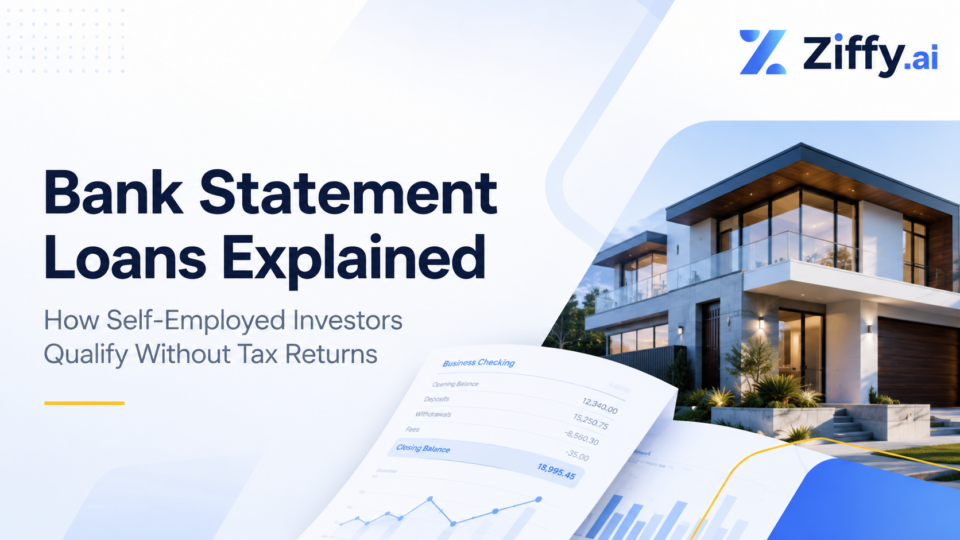
A bank statement loan allows a self-employed borrower to qualify using deposits shown on personal or business bank statements instead of relying on tax returns, W-2s, or pay stubs to calculate income. The lender reviews recurring deposits, removes transfers and other non-income items, accounts for business expenses, and uses the resulting monthly income to evaluate the borrower’s debt-to-income ratio.

For real estate investors, this can make sense when the business produces reliable cash flow but tax deductions reduce the income shown on the return. It is still a documented loan rather than a stated-income or no-doc mortgage.
Bank statement loans commonly review 12 or 24 months of personal or business statements.
Recurring, traceable deposits matter more than the account’s ending balance.
Business statements normally require an expense factor before deposits become qualifying income.
Transfers, loan proceeds, refunds, and unsupported one-time deposits generally do not count as recurring income.
Investors should compare a bank statement loan with full documentation and DSCR financing before choosing an underwriting path.
Self-employed investors can have steady revenue, strong liquidity, and a reliable payment history while still looking weaker on a tax return. The IRS allows eligible business deductions, while traditional self-employed underwriting often starts with taxable income and then analyzes whether it is stable and available to the borrower.
A bank statement loan starts somewhere else: actual deposits. The lender asks how much of that cash flow can reasonably support the mortgage.
Table of Contents
What Is a Bank Statement Loan?
A bank statement loan is an alternative-income mortgage designed mainly for self-employed borrowers, business owners, freelancers, independent contractors, and other applicants without a regular payroll pattern.
The borrower provides bank statements as the core income evidence. Depending on the program, the lender may review personal accounts, business accounts, or both. These loans are commonly categorized as non-qualified mortgages, or non-QM loans, because they do not follow the standard agency documentation framework used for many conventional mortgages.
“Without tax returns” does not mean “without verification.” The lender still reviews income, debts, assets, credit, the property, and the overall ability to repay. For covered consumer mortgages, the CFPB’s Ability-to-Repay rule requires a reasonable, good-faith determination that the borrower can repay the loan.
How Do Bank Statement Loans Work?
Underwriting starts by identifying deposits that appear to come from normal business activity. The lender removes items that do not represent recurring earnings, including transfers between accounts, loan proceeds, tax refunds, and one-time asset sales.
When business statements are used, gross deposits are not automatically treated as personal income. The lender applies an expense factor or reviews supporting expense documentation to estimate the revenue available to the borrower. The eligible amount is averaged over the required statement period and used in the debt-to-income calculation.
The process is generally:
- Add eligible income-producing deposits.
- Exclude transfers, reversals, borrowed funds, and unsupported one-time deposits.
- Apply the required business-expense treatment.
- Average the resulting income over the review period.
- Compare qualifying income with existing debts and the proposed housing payment.
Two businesses with similar deposits can produce different qualifying income because operating costs, ownership percentages, revenue patterns, and account structures differ.
What Do Mortgage Lenders Look for in Bank Statements?
1. Consistent, Traceable Deposits
The deposit pattern should connect logically to the business. Seasonal income can work when the statements show a repeatable cycle.
2. Stable Revenue
A recent decline may prompt questions, especially when the latest months are materially weaker. Contracts, invoices, or year-to-date financials can help explain a temporary slowdown.
3. Clean Account Activity
Repeated transfers between personal and business accounts can inflate totals unless duplicates are removed. Frequent overdrafts or insufficient-funds activity may also weaken the file.
4. Documented Large Deposits
A large deposit is not automatically usable income. The lender may request an invoice, contract, settlement statement, or other evidence showing the source of a large deposit and whether it is likely to continue.
12-Month vs. 24-Month Bank Statement Loans
A 12-month bank statement loan uses the most recent year of deposits. It may better reflect recent growth, but it gives the lender a shorter period for judging stability.
A 24-month bank statement loan smooths out more seasonal variation and provides a longer revenue history. Older low-revenue periods, however, can reduce the average.
The better option is the period that presents the most accurate and supportable picture of current income under the available program. Bank statement programs commonly use a one- or two-year bank statement review period.
Personal vs. Business Bank Statement Loans
Personal Bank Statements
Personal statements may work when business income is paid into the borrower’s personal account consistently and the source is traceable. Gifts, refunds, borrowed money, and transfers must be separated from earnings.
Business Bank Statements
Business statements show revenue where it enters the company. Because the account also supports operating expenses, the lender normally needs an expense analysis before treating deposits as qualifying income.
Some files also require proof of business ownership and current self-employment, a business license, a CPA or tax-preparer letter, a profit-and-loss statement, or similar records showing that the company is active.
Bank Statement Loan Requirements for Self-Employed Investors
Exact standards vary, but a complete file commonly includes:
- 12 or 24 months of consecutive statements
- evidence of established self-employment
- proof of business ownership and current operation
- credit and housing-payment history
- funds to close and post-closing reserves
- an appraisal and property documentation
- explanations for unusual deposits or account activity
Credit score, down payment, reserve, loan amount, property type, and debt-to-income limits are program-specific. A strong deposit average does not override the rest of the bank statement loan requirements.
Why Tax Returns Can Undersell a Self-Employed Borrower’s Income
Taxable income and mortgage qualifying income answer different questions.
A tax return calculates income under tax rules after eligible deductions. A mortgage underwriter is trying to determine stable income that can support the proposed debt. Under Fannie Mae’s self-employed borrower guidance, lenders analyze income stability, business strength, distributions, and the company’s ability to keep generating income.
That framework can become restrictive when legitimate deductions reduce taxable income far below the cash entering the business.
A bank statement loan does not ignore expenses. It uses a different evidence set to estimate income while still accounting for the cost of running the business.
Bank Statement Loan vs. DSCR Loan: Which Is Better for Investors?
Both reduce dependence on tax-return income, but they qualify different parts of the deal.
Feature | Bank Statement Loan | DSCR Loan |
|---|---|---|
Main qualifying strength | Borrower’s business or personal cash flow | Property’s rental income |
Tax returns used to calculate income | Generally not required | Not required |
Personal DTI | Usually reviewed | Generally not used |
Best fit | Self-employed borrower with supportable deposits | Investor with a rental that supports its debt |
Income review | Personal or business statements | Lease or market-rent documentation |
Property use | Depends on program | Investment properties |
A bank statement loan is an alternative-documentation product offered by some mortgage lenders. It should not be confused with simply providing bank statements as one part of a full documentation mortgage application.
Ziffy Mortgage currently offers four primary investor financing programs: DSCR Loans, Fix & Flip Loans, Bridge Loans, and Full Documentation Loans. Under Ziffy Mortgage’s Full Documentation Loan, bank statements may be accepted as one form of income documentation alongside documents such as W-2s, pay stubs, 1099s, and a CPA letter for self-employed borrowers. This remains a full documentation loan rather than a standalone bank statement mortgage.
Ziffy Mortgage’s DSCR Loan qualifies eligible investment properties primarily through rental income rather than personal income. Our Full Documentation Loan verifies the borrower’s income, assets, debts, and financial history.
A self-employed investor should ask what is easiest to prove cleanly.
Strong business deposits may support a bank statement loan through a lender that offers the program. Strong rental coverage may favor DSCR. If standard income records already show stable earnings, full documentation may be the more straightforward path.
How to Prepare Bank Statements Before Applying
Keep business and personal accounts separate. Reduce unnecessary transfers. Deposit revenue consistently. Retain invoices and contracts for large payments. Address overdrafts before they become a pattern. Make sure the business name, ownership records, and account titles match the application.
Do not move money merely to make statements look stronger. Duplicated transfers and unexplained deposits create more underwriting work, not more qualifying income.
A prequalification review with a lender that offers bank statement loans can identify the usable statement period, likely expense treatment, documentation gaps, and whether the borrower meets that lender’s program requirements.
For an investment property, investors should also compare whether the transaction may be better suited to DSCR financing or a Full Documentation Loan.
When a Bank Statement Mortgage May Not Be the Best Fit
A bank statement loan may be less attractive when:
- the borrower qualifies cleanly for conventional or full-doc financing
- deposits fluctuate sharply without a supportable pattern
- business and personal funds are heavily mixed
- operating expenses consume a large share of deposits
- the property has strong rental coverage and DSCR offers a cleaner structure
Alternative documentation can carry different pricing, down-payment, reserve, or underwriting requirements. Compare the full bank statement loan structure, not just the paperwork.
Choose the Underwriting Path That Matches the Deal
A bank statement loan gives self-employed investors another way to document income when they work with a lender that offers the program. It does not turn a weak file into a strong one. The statements still need to show stable, traceable cash flow, and the borrower still needs the credit, equity, reserves, and overall profile required by the program.
Compare the three main qualification stories available to an investor: business cash flow through a bank statement program, personal income through full documentation, or property income through a DSCR loan. The best mortgage is built around the strongest verifiable part of the transaction.
FAQs
Can I Get a Bank Statement Loan Without Tax Returns?
Yes. These programs generally calculate income from personal or business deposits instead of tax returns. The lender may still request business-verification records.
How Many Months of Bank Statements Do I Need?
Programs commonly use 12 or 24 consecutive months of bank statements. The period depends on the lender, self-employment history, and income pattern.
What Deposits Count as Income?
Recurring deposits tied to business or professional activity are the strongest candidates. Transfers, borrowed funds, refunds, and unsupported one-time deposits are generally excluded or require documentation.
Do Business Bank Statements Count as Gross Income?
Not automatically. Business deposits reflect revenue before operating costs. The lender normally applies an expense factor or reviews supporting financial information to estimate usable income.
Is a Bank Statement Loan the Same as a No-Doc Loan?
No. Bank statements are income documentation. The lender still reviews the borrower, property, credit, assets, debts, and the source and stability of deposits under applicable Ability-to-Repay requirements.
Is a Bank Statement Loan Better Than a DSCR Loan?
It depends on what supports the file. Bank statement loans rely on the borrower’s cash flow. DSCR loans rely mainly on the rental property’s income.