






Editorial Integrity
Making sound real estate investment decisions begins with reliable, data-driven insights. At Ziffy.ai, we offer an AI-native real estate investing, proprietary data-driven trend analysis, investment mortgage programs like DSCR loans, and a network of over 500 investor-friendly real estate agents to deliver the expertise needed for informed decisions. Our content is crafted by experienced real estate professionals and backed by real-time market data, ensuring you receive accurate and actionable information. Through a rigorous editorial process, we strive to empower your investment journey with trustworthy and up-to-date guidance.
Quick Answer:

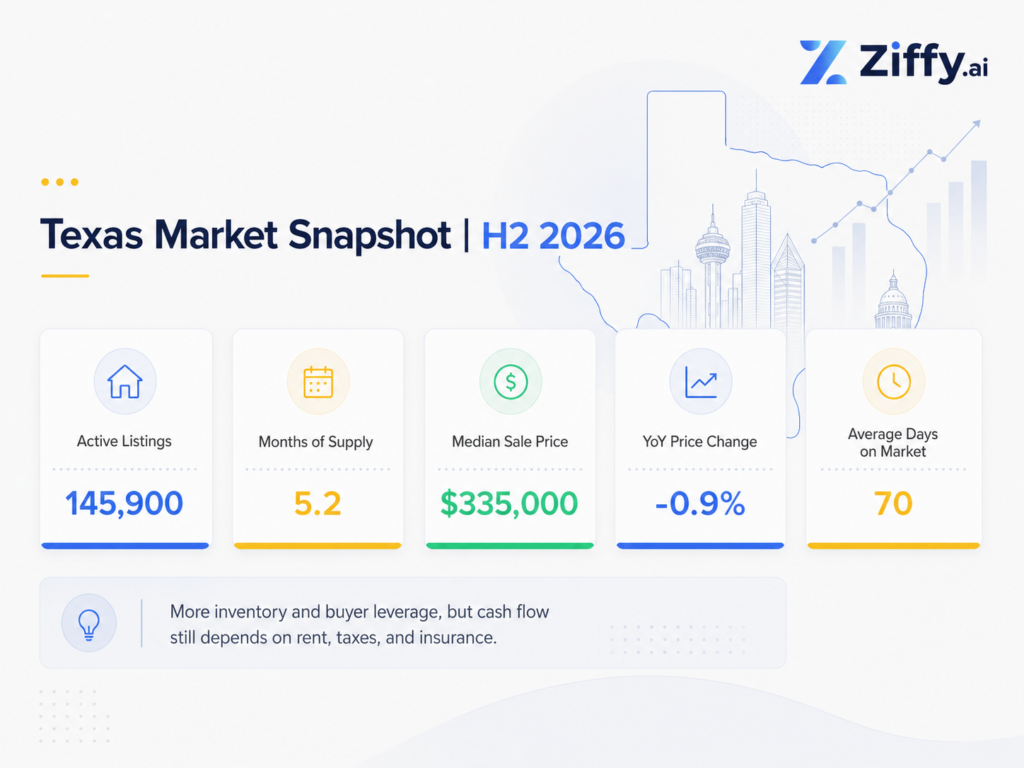
The Texas investment property market in H2 2026 favors selective buyers rather than aggressive market-wide buying. Statewide inventory reached 5.2 months in April, the median sale price was $335,000, and prices were 0.9% lower than a year earlier. Investors may find stronger negotiating room, particularly in Austin, Houston, and San Antonio, but should not underwrite deals around rapid appreciation or automatic rent growth.

The best opportunities are likely to be well-located single-family rentals and small residential properties with verified demand, conservative vacancy assumptions, and fully quoted taxes and insurance before the offer is finalized.
Texas has moved closer to a balanced or buyer-friendly housing market, with 145,900 active listings and longer marketing times.
Dallas-Fort Worth still has a powerful population-growth story, but much of that growth is occurring in outer-ring communities where supply can expand quickly.
Austin and San Antonio investors should assume rent competition and concessions will remain part of the market.
Property taxes, insurance, wind, hail, and flood exposure can change both cash flow and debt service coverage ratio.
H2 2026 deals should be underwritten on current rent and current expenses, not on hoped-for appreciation, a future refinance, or a best-case lease.
Texas enters the second half of 2026 with more listings, softer prices, and greater buyer leverage than investors saw during the pandemic-era rush. That does not make every rental a bargain. A property still has to hold its rent, absorb taxes and insurance, compete with new construction, and produce acceptable cash flow at today’s financing cost.
Table of Contents
Is Texas a Good Place to Buy an Investment Property in H2 2026?
Texas remains investable, but the easy statewide thesis has weakened. According to the Texas Real Estate Research Center’s June housing update, April ended with 145,900 active listings, 5.2 months of supply, and an average of 70 days on market for sold homes. The statewide median sale price was $335,000, while the Center’s price index showed an annual decline of 0.9%. Austin recorded the sharpest major-metro decline at 3.3%, followed by San Antonio at 1.9%, Houston at 1.7%, and Dallas at 1.3%.
Those numbers create room to negotiate, but not automatic cash flow. Texas sellers were making median price cuts of $12,500 statewide. Investors should use that leverage to offset weak rent coverage, high taxes, deferred maintenance, or insurance costs. A discount matters only when it improves the final return.
The state economy is still adding jobs. According to the Texas Workforce Commission, Texas added 17,800 nonfarm positions in May and reached 14.42 million jobs, while unemployment held at 4.3%.
Texas Housing Market Forecast for H2 2026
The statewide outlook is more stable than dramatic. The 2026 Texas Real Estate Forecast projects roughly 349,000 home sales for the year, a median price near $334,000, and statewide single-family rent around $2,200. It also expects fewer than 35,000 new multifamily units to be delivered in 2026, down sharply from 93,000 units delivered during the prior 12 months. Even with that slowdown, the Center expects little rent growth in stabilized apartment properties, with many seeing no growth at all.
Single-family rentals may hold up better than apartments in some markets, but investors still need to compare them with nearby new homes, build-to-rent communities, and apartments offering concessions. Listings that miss the spring and early-summer buyer pool may become more negotiable later in the year, although well-priced homes in durable rental neighborhoods can still move quickly.
Best Texas Markets for Rental Property in H2 2026
Investment Properties on Sale in Texas Today



1. Dallas-Fort Worth: Follow Growth, but Price in New Supply
Dallas-Fort Worth has the strongest large-metro demographic argument. The US Census Bureau estimates the metro reached 8.5 million residents in 2025, up 11% from 2020. It gained about 270,000 residents through domestic migration during that period, and growth was concentrated heavily in outer-ring communities. Celina’s population rose 276.8% from 2020 to 2025.
Fast-growing exurbs can support new renters, but they can also produce large pipelines of subdivisions and rental competition. Compare the property with builder incentives, apartment deliveries, commute patterns, school enrollment, and similar rentals already available.
2. Austin: Better Entry Prices, Weaker Rent Momentum
Austin has undergone the clearest repricing among the major Texas metros. Home prices were down 3.3% year over year in April, and our reports showed Austin rents falling more than 5% year over year in spring 2026.
That can create opportunities for investors who were priced out earlier, but Austin remains rent-competitive. Use recent leased comparables, identify concessions, and stress-test a slower lease-up rather than relying on an older lease or the highest active listing.
3. Houston: Broad Demand, Property-Level Climate Risk
Houston offers scale and a wide range of acquisition prices. Its housing inventory was up 7% year over year in April, while prices were down 1.7%, creating more choice for buyers.
The underwriting challenge is location-specific insurance and flood exposure. An affordable property can produce a much higher payment after landlord coverage, wind, flood insurance, and deductibles are added. Review flood history and drainage, not only the mapped flood zone.
4. San Antonio: Buyer Leverage Meets Rent Competition
San Antonio had the largest annual inventory increase among the four major metros at 12.6% in April. Home prices were down 1.9%, and local rent data showed year-over-year declines during spring 2026.
The opportunity is affordability and negotiating leverage. The risk is assuming that a low purchase price guarantees yield. Ask property managers about days to lease, concessions, turnover, and new-apartment competition.
5. Fort Worth and Selected Secondary Markets: Watch Liquidity
Fort Worth-Arlington showed early signs of price stabilization, with its annual decline narrowing to 0.4% in April. That may make parts of the western DFW market worth closer review. Smaller Texas markets can also offer lower prices and stronger headline yields, but investors should check employer concentration, resale liquidity, property-management depth, and the number of true rent comparables before treating affordability as demand.

The Biggest Texas Investment Property Risks in H2 2026
Property Taxes Can Erase a Cheap Purchase Price
Texas has no state property tax. Local taxing units set rates and county appraisal districts determine taxable value, which means the burden can vary materially by address. The Texas Comptroller’s property-tax guidance is the starting point, but an investor should pull the current appraisal record, identify every taxing entity, and estimate taxes without assuming an owner-occupied homestead exemption will continue.
Insurance Should Be Quoted Before the Offer
The Texas Department of Insurance reported an average annual homeowners premium of $3,291 for 2024. A landlord policy can price differently, and the statewide average says little about a specific roof, claims history, coastal location, or wind deductible. In 14 coastal counties and parts of Harris County, separate Texas Windstorm Insurance Association coverage may be relevant.

Steven Glick
Director of Mortgage Sales · Ziffy Mortgage
Insurance is one of the fastest ways a rental file can change late in the process. A property can look strong with a placeholder premium, then become much tighter once the actual binder arrives. Investors should treat insurance as part of the offer analysis, not something to solve three days before closing.
Rent Growth May Not Rescue a Thin Deal
Austin and San Antonio already show why investors should not rely on automatic rent increases. In a market with concessions and new supply, renewing a tenant at the same rent can be a better outcome than raising rent and creating a vacancy. Run a rental vacancy stress test using current rent, realistic turnover, management, repairs, capital expenditure reserves, taxes, and insurance.

The investors who buy well out of state are not guessing on markets. They usually screen three or four metros against population trends, job base, landlord rules, rent support, and tax exposure before they ever look at a specific address. That first layer of discipline saves a lot of bad offers.
How to Underwrite a Texas Rental Property in H2 2026
Start with the address, not the metro headline. Verify leased comparables, current competition, tenant profile, employment access, property taxes, landlord insurance, flood and wind exposure, HOA restrictions, and likely repairs.
Then run the full monthly housing expense. On a debt service coverage ratio loan, rent is compared with PITIA: principal, interest, taxes, insurance, and association dues. At Ziffy Mortgage, we offer DSCR loans for eligible investment properties using the property’s rental income as the central qualification measure rather than a traditional personal debt-to-income calculation.
The offer should still work if rent comes in below the optimistic estimate, the property takes longer to lease, insurance is higher than expected, or the appraisal does not support the contract price. If one modest change breaks the deal, the problem is not the market forecast. It is the margin of safety.
Bottom Line
The Texas real estate market in H2 2026 offers investors time to compare properties and negotiate, not permission to buy on population growth alone. DFW has the strongest expansion story, Austin the deepest repricing, Houston the greatest climate-cost diligence, and San Antonio the strictest vacancy test. The stronger deal is the one that works on today’s rent, taxes, insurance quote, and financing cost.
FAQs
Will Texas Home Prices Fall in H2 2026?
Statewide prices were already modestly lower year over year in April, while the full-year forecast called for a median near $334,000. Local performance will vary, so investors should expect continued negotiation and uneven metro-level movement rather than a single statewide crash.
What Is the Best Texas City for Rental Property in 2026?
There is no single best city. DFW offers strong population growth, Austin offers lower entry prices than its peak, Houston offers scale and economic depth, and San Antonio offers affordability. The best choice depends on rent support, supply, taxes, insurance, property condition, and the investor’s strategy.
Are Texas Rents Going Up or Down?
The statewide forecast expects single-family rent to rise slightly toward $2,200, while stabilized multifamily properties may see little or no rent growth. Austin and San Antonio had year-over-year rent declines in spring 2026, showing why investors need neighborhood-level leased data.
Are Texas Property Taxes High for Investors?
They can be. Texas property taxes are imposed locally, and an investment property generally cannot rely on the seller’s homestead treatment. Investors should calculate taxes from the expected taxable value and local rates rather than copying the seller’s current tax bill.
Can I Use a DSCR Loan to Buy a Texas Rental Property?
Yes, eligible Texas investment properties may be financed with a DSCR loan. Qualification focuses mainly on the property’s rental income relative to PITIA, while credit, leverage, reserves, property type, and the full file still affect approval and pricing.