





Editorial Integrity
Making sound real estate investment decisions begins with reliable, data-driven insights. At Ziffy.ai, we offer an AI-native real estate investing, proprietary data-driven trend analysis, investment mortgage programs like DSCR loans, and a network of over 500 investor-friendly real estate agents to deliver the expertise needed for informed decisions. Our content is crafted by experienced real estate professionals and backed by real-time market data, ensuring you receive accurate and actionable information. Through a rigorous editorial process, we strive to empower your investment journey with trustworthy and up-to-date guidance.
Quick Answer:

Hold the rental if after-reserve cash flow is durable, the existing loan is valuable, major expenses are manageable, and the equity is still earning an acceptable return.

Refinance if a new loan solves a defined problem, such as replacing short-term debt, changing the payment structure, reducing personal-income underwriting friction, or releasing equity for a planned investment.

Sell if the property’s investment thesis has weakened, return on current equity is poor, large costs are approaching, or the after-tax proceeds would improve the portfolio more than continued ownership.
Compare all three options using the same rent, vacancy, expense, value, and tax assumptions.
A low-rate mortgage does not make an underperforming property worth holding indefinitely.
A cash-out refinance exchanges equity for debt; its value depends on what the proceeds accomplish.
Base the selling decision on net, after-tax proceeds, not gross equity.
National data provides context, but the property’s submarket and operating numbers decide the outcome.
Rental property owners have three choices when a deal no longer feels automatic: keep the existing structure, replace the debt, or exit. In H2 2026, none should be made from a national headline alone. Mortgage rates remain elevated, home-price performance varies by market, and modest rent growth may not rescue weak underwriting.
The better question is: which option leaves you with the strongest after-tax return, liquidity, and risk position?
Table of Contents
What Does the H2 2026 Housing Market Mean for Rental Property Owners?
As of July 16, 2026, Freddie Mac’s average 30-year fixed mortgage rate was 6.55%. The Fannie Mae July 2026 Housing Forecast projected the 30-year fixed-rate mortgage to average 6.3% for 2026. These are broad mortgage benchmarks, not direct quotes for investor or debt service coverage ratio loans, whose pricing also depends on leverage, credit, property type, loan size, and structure.
Price growth remains positive nationally but uneven. The Federal Housing Finance Agency reported that US home prices increased 1.7% year over year through Q1 2026. Prices rose in 42 states, while eight states and the District of Columbia declined. Of the 100 largest metropolitan areas, 65 appreciated and 35 did not.
Rent assumptions also deserve restraint. The Bureau of Labor Statistics reported that its rent index rose 0.1% in June 2026, while shelter costs were up 3.3% over the year. That does not predict one property’s rent, but it argues against making a borderline deal work through aggressive future increases.
For owners, the H2 2026 backdrop favors property-level analysis rather than waiting for a nationwide rate drop, price surge, or rent rebound.
Step 1: Calculate the Rental Property’s Real Cash Flow
Begin with the trailing 12 months, not the acquisition spreadsheet.
Monthly cash flow = Effective gross income − Operating expenses − Debt service
Effective income should reflect collected rent and realistic vacancy. Expenses should include taxes, landlord insurance, HOA dues, management, repairs, owner-paid utilities, leasing costs, and recurring compliance expenses. Keep a separate capital reserve for major systems and replacements.

By the time a rental reaches underwriting, the issue is rarely the headline rent. It is usually the expenses the investor left out: taxes after reassessment, the next insurance renewal, HOA dues, management, vacancy, and major repairs. I have seen properties that appeared comfortably cash-flow positive lose most of that margin once the full cost structure was added. That is why I tell investors to evaluate the property they will actually own, not the simplified version that made the purchase look attractive.
The full expense stack matters under every option. Ziffy’s rental property calculator guide explains how cash flow, ROI, and break-even rent work together.
Step 2: Measure Return on Current Equity
Cash-on-cash return measures performance against the cash originally invested. Years later, return on current equity is often more useful.
Current equity = Current property value − Current loan balance
Return on equity = (Annual after-reserve cash flow + Principal paydown) ÷ Current equity
Keep assumed appreciation separate. Otherwise, a forecasted price increase can hide a weak operating return.
A property may have positive cash flow while using capital inefficiently. Compare its return with realistic after-tax alternatives that have similar risk, effort, liquidity, and holding periods.
When Should You Hold a Rental Property in H2 2026?
Holding is usually strongest when:
- Cash flow remains positive after vacancy, maintenance, and capital reserves.
- Existing fixed-rate debt is materially better than replacement financing.
- Tenant demand and achievable rent remain supportable in the submarket.
- Major repairs, insurance costs, and regulatory risks are manageable.
- Current equity is producing a satisfactory risk-adjusted return.
- The property still serves a portfolio purpose, such as income or diversification.
Do not treat a low mortgage rate as the sole reason to hold. Favorable debt attached to deteriorating cash flow, repeated management problems, or a weak location may preserve the wrong asset.
Give the hold decision a review date tied to the next lease, insurance renewal, tax assessment, or major repair cycle.
When Does Refinancing a Rental Property Make Sense?
A refinance should have a specific job: reducing the payment, replacing adjustable or short-term debt, changing amortization, reducing personal-income constraints, or accessing equity for another investment.
For a rate-and-term refinance, calculate:
Refinance break-even period = Total refinance costs ÷ Monthly payment savings
Compare that period with the expected remaining hold. Review total interest, the amortization reset, prepayment penalties, and cash due at closing. A lower payment may come from extending the debt, not from obtaining a cheaper loan.
For a cash-out refinance, rerun the property using the proposed balance and full PITIA: principal, interest, taxes, insurance, and association dues. The proceeds should have a defined use that justifies their cost without leaving the rental exposed to vacancy or repairs.
For eligible scenarios, Ziffy offers DSCR loans from $100,000 to $10 million, with a 620 minimum credit score, up to 80% loan-to-value for rate-and-term refinances, up to 75% for cash-out refinances, and two months of reserves. Pricing, leverage, and availability depend on underwriting.
How One Investor Used a Refinance to Keep a Rental and Redeploy Equity
A recently completed Ziffy Mortgage case study shows what a purpose-driven refinance looks like in practice.
The investor owned a long-term single-family rental in Sumter, South Carolina, with an original purchase basis of $295,000. At refinancing, the property supported a value of approximately $351,000. The completed DSCR cash-out refinance included:
- New loan amount: $263,250
- Loan-to-value ratio: 75%
- Interest rate: 6.490%
- Monthly rent: $2,150
- Monthly PITIA: $1,362
- DSCR: 1.58
- Clear to close: 27 days
- Total closing timeline: 32 days
The property’s underwriting cushion was:
$2,150 monthly rent − $1,362 monthly PITIA = $788
That equals $9,456 per year before vacancy, maintenance, management, utilities, and capital reserves. It is not full rental cash flow because it compares rent only with PITIA. It does show that the rent exceeded the housing payment used in the DSCR review.
The refinance had a defined purpose: the investor intended to use the proceeds toward another investment-property acquisition while keeping the Sumter rental.

Lucas Hernandez
Mortgage Loan Originator
Ziffy Mortgage
NMLS #2171747Cash-out refinances are strongest when the property supports the request from both sides: current value and rental income. In this file, the Sumter rental had enough equity for the refinance and enough rent coverage to support the payment. That gave the investor a clear path to pull capital from the property and use it toward the next deal.
The case does not prove that refinancing always outperforms holding the existing loan or selling. A complete comparison would also require the previous loan terms, refinance costs, selling expenses, adjusted tax basis, estimated taxes, and the projected return from the next acquisition.
It does demonstrate the pattern investors should look for: the new debt solved a defined capital need, the property supported the payment, and the released equity had an identified use.
When Is It Time to Sell a Rental Property?
Selling becomes stronger when future return no longer compensates for the capital and risk tied up in the property. Warning signs include persistent negative cash flow, an unfunded capital expense, declining tenant demand, repeated insurance difficulties, excessive concentration, or a management burden that no longer earns its keep.
Calculate:
Estimated net sale proceeds = Expected sale price − Selling costs − Loan payoff − Estimated taxes
Taxes can depend on adjusted basis, depreciation, improvements, holding period, state law, and the owner’s tax position. IRS Publication 551 explains basis and adjustments, while IRS Publication 544 covers sales and other dispositions of investment property. A CPA should estimate the tax outcome before the listing decision is final.
A Section 1031 exchange may defer recognition of gain when qualifying investment or business real property is exchanged for like-kind real property. It does not erase tax, and property held primarily for sale does not qualify. Replacement property generally must be identified within 45 days and received within 180 days, subject to the tax-return deadline rule.

Steven Glick
Director of Mortgage Sales · Ziffy Mortgage
The exchange structure is often decided by what can realistically close inside the 45- and 180-day windows. I have seen investors identify a replacement property first and only then discover that the appraisal, title work, insurance, or loan approval cannot be completed on the schedule they assumed. We work backward from the sale date, confirm when financing must be ready, and make sure the qualified intermediary is in place before the investor receives any proceeds. In a 1031 exchange, the best property on paper is not useful if the financing timeline cannot support the closing.
Because the structure must be arranged before sale proceeds reach the taxpayer, involve a qualified intermediary, tax professional, lender, and title team before closing. Ziffy’s 1031 exchange guide covers the deadlines and financing coordination.
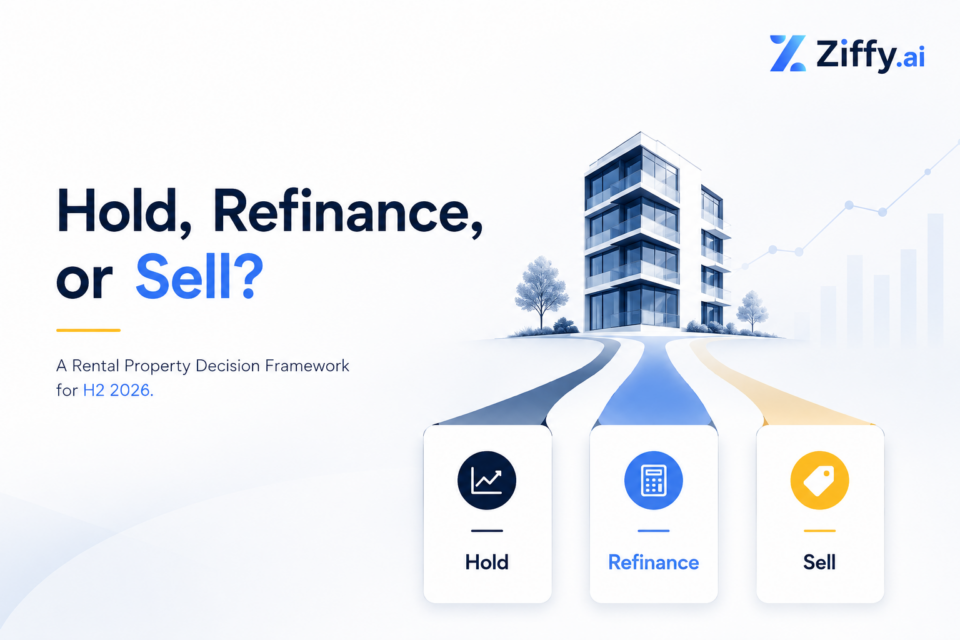
Hold, Refinance, or Sell: The H2 2026 Decision Scorecard
Decision Question | Hold | Refinance | Sell |
|---|---|---|---|
Is after-reserve cash flow durable? | Yes | Yes, after new debt | No or worsening |
Is the existing loan an advantage? | Strong advantage | Replaceable or mismatched | Not enough to save the asset |
Is current equity earning enough? | Yes | Yes, after equity release | No |
Are major capital costs manageable? | Funded | Financeable without weakening cash flow | Disproportionate to return |
Does the local market support the thesis? | Yes | Yes | No |
Is there a better use for the capital? | No clear alternative | Yes, while retaining the asset | Yes, after taxes and costs |
Does the property still fit the portfolio? | Yes | Yes, with a better structure | No |
No single row should make the decision. The answer becomes clearer when one option wins across operations, financing, equity efficiency, taxes, and portfolio strategy.
A 30-Day Rental Property Decision Process
- Gather trailing 12-month income and expenses, the lease, loan statement, tax bill, insurance renewal, HOA information, repair history, and capital schedule.
- Obtain a supportable value range, current refinance quote, and estimated seller net sheet.
- Ask a tax professional for a taxable-sale estimate and, when relevant, a 1031 comparison.
- Model all three options using the same property value and operating assumptions.
- Stress-test holding and refinancing for vacancy, repairs, tax or insurance increases, and rent below the optimistic case.
- Choose the strongest after-tax outcome that preserves enough liquidity for the rest of the portfolio.
The goal is not to predict H2 2026 perfectly. It is to choose an option that still works when the next 12 months are less convenient than expected.
FAQs
Is It Better to Refinance or Sell a Rental Property?
Refinance when the property still deserves to be owned and a new loan improves its structure or funds a justified use. Sell when the asset no longer earns an acceptable return or fits the portfolio. Compare post-refinance cash flow with after-tax sale proceeds.
Does Refinancing Make Sense When Mortgage Rates Are High?
It can. A refinance may solve an adjustable-rate reset, a maturing bridge loan, a short amortization period, or a qualification problem. The new payment, fees, prepayment terms, DSCR, and expected hold must support the decision.
What Is a Good Return on Equity for a Rental Property?
There is no universal threshold. It depends on property risk, leverage, condition, management effort, liquidity, local prospects, and available alternatives. Compare investments with similar risk and effort.
Should I Sell a Rental Property With Positive Cash Flow?
Positive cash flow is only one input. A sale may still make sense when return on current equity is weak, a large repair is approaching, the market thesis has changed, or the after-tax capital has a stronger use elsewhere.
Can I Avoid Capital Gains Tax With a 1031 Exchange?
A qualifying 1031 exchange can defer recognition of gain; it does not automatically eliminate tax. Strict rules and deadlines apply, and receiving cash or other non-like-kind property can create recognized gain.