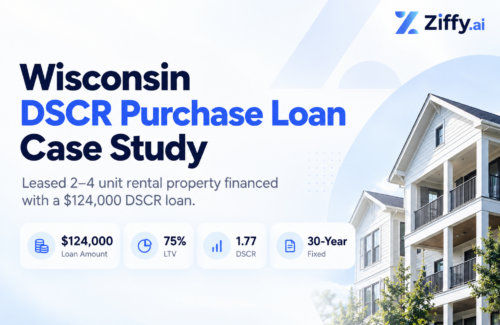
On paper, this Wisconsin rental purchase had the ingredients of a strong DSCR file. The property was already leased, qualifying monthly rent was well above the proposed housing payment, and the appraisal ultimately supported a value higher than the original estimate.
But a good DSCR did not mean the property automatically sailed through closing.
The initial appraisal identified a property-condition item that had to be resolved before underwriting could clear the transaction. That added another step to what otherwise looked like a straightforward rental-property purchase: the issue needed to be addressed, the appraiser needed access again, and a follow-up inspection had to confirm the condition was satisfied.
The financing itself did not need to be restructured. Once the appraisal condition was cleared, the domestic investor closed with a $124,000 DSCR purchase loan through Ziffy Mortgage.
Investment Highlights
- The Rental Was Already Producing Income
- How the Wisconsin Purchase Was Financed
- Why the Property Produced a 1.77 DSCR
- The Appraisal Added Another Step Before Closing
- Why a 1004D Follow-Up Inspection Was Needed
- How the File Moved Back Toward Closing
- The $124,000 Funded Result
- What Investors Can Take From This Deal
The Rental Was Already Producing Income
The investor was purchasing an already-leased 2–4 unit property in Wisconsin.
That changed the financing conversation. Instead of building the mortgage qualification primarily around personal income documentation, the transaction could be evaluated through a DSCR loan , where the rental income associated with the property is measured against its monthly housing obligation.
The property itself gave the file a strong starting point. Qualifying monthly rent was $1,950, while monthly PITIA was $1,098.95. That produced considerably more rental coverage than a property sitting close to a 1.00 DSCR.
For a rental investor, that is one of the practical advantages of DSCR financing. The mortgage structure can be aligned with the economics of the rental asset rather than asking the investor to fit the purchase into a conventional owner-occupant income framework.
How the Wisconsin Purchase Was Financed
Ziffy Mortgage structured the transaction as a 30-year fixed DSCR purchase loan. The investor brought a documented $31,000 down payment and maintained three months of reserves.
| Loan Detail | Funded Transaction |
|---|---|
| Borrower | Domestic Investor |
| Property | Leased 2–4 Unit Rental, Wisconsin |
| Loan Purpose | Purchase |
| Loan Program | DSCR Loan |
| Loan Amount | $124,000 |
| Appraised Value | $165,000 |
| LTV | 75% |
| Qualifying Monthly Rent | $1,950 |
| Monthly PITIA | $1,098.95 |
| DSCR | 1.77 |
| Interest Rate | 6.49% |
| Loan Term | 30-Year Fixed |
| Documented Reserves | 3 Months |
| Down Payment | $31,000 |
The appraisal ultimately came in at $165,000, approximately 6.5% above the property’s initial estimated value of $155,000. The higher appraisal supported the value side of the transaction, but it did not remove the separate property-condition requirement identified during the appraisal.
Why the Property Produced a 1.77 DSCR
DSCR compares qualifying rental income with the property’s monthly PITIA: principal, interest, property taxes, insurance and applicable association costs included in the housing payment.
A 1.00 DSCR means qualifying rent and the monthly housing obligation are equal. In this transaction, the 1.77 DSCR meant qualifying rent was approximately 1.77 times monthly PITIA.
Put another way, this was not a file sitting just above the coverage line. The rental-income side of the transaction had substantial room relative to the mortgage payment used for qualification.
That did not make every other underwriting requirement disappear. DSCR addresses how the property supports the debt. The property itself still has to satisfy appraisal and condition requirements.
The Appraisal Added Another Step Before Closing
This was where the transaction changed course.
The initial appraisal did not come back as-is. The appraiser identified a property-condition item that had to be addressed before the loan could clear underwriting.
The Property Condition Had to Be Resolved
Strong rental coverage did not override the appraisal condition. Before the transaction could continue toward final approval, the flagged item had to be addressed and documented.
This distinction is useful for rental investors because a property can generate enough rent to produce a healthy DSCR and still encounter a separate appraisal issue.
The DSCR answers one underwriting question: does the property’s qualifying income support the housing obligation?
The appraisal answers additional questions about value and property condition. Those reviews affect the same loan, but they are not measuring the same thing.
Why a 1004D Follow-Up Inspection Was Needed
After the property-condition item was addressed, the lender ordered a 1004D follow-up inspection.
The Appraiser Needed Access Again
The appraiser needed to regain access to the basement and a bedroom so the follow-up review could confirm that the condition identified in the original appraisal had been resolved.
Once the completed 1004D report was submitted, the file could move into clear-to-close review.
The financing did not have to be redesigned because of the appraisal condition. The original qualifying structure remained workable. What the file needed was verification that the property issue had been corrected.
For an investor, that is very different from discovering late in underwriting that rent is too low, the payment is too high, reserves are insufficient or leverage needs to change.
How the File Moved Back Toward Closing
The $124,000 Funded Result
The transaction ultimately funded at $124,000.
The domestic investor completed the purchase with a 30-year fixed DSCR loan at 6.49%, an underwritten DSCR of 1.77, 75% LTV, three months of documented reserves and a $31,000 down payment.
Leased 2–4 unit rental property in Wisconsin
What makes this transaction useful as a case study is not simply that the loan funded. It shows that a strong DSCR and an appraisal issue can exist in the same file at the same time.
The rental economics supported the financing. The property-condition review created a separate closing requirement. Once that requirement was documented as resolved, the loan could move forward on the original qualifying terms.
What Investors Can Take From This Deal
Rental-property financing is rarely defined by one number.
This Wisconsin property produced a 1.77 DSCR, but the transaction still had to satisfy the appraisal process before it could close. The condition did not make the underlying deal unworkable, and it did not require the investor to change the loan structure. It created a documentation and verification step that had to be completed correctly.
Ziffy Mortgage structured the purchase around the property’s rental income, while the appraisal condition was handled as a separate requirement rather than being confused with the economics of the deal.
For investors evaluating rental-property financing through Ziffy , this case shows why both sides of the transaction need attention: the property must support the proposed debt, and the property itself still has to clear appraisal and underwriting requirements before funding.