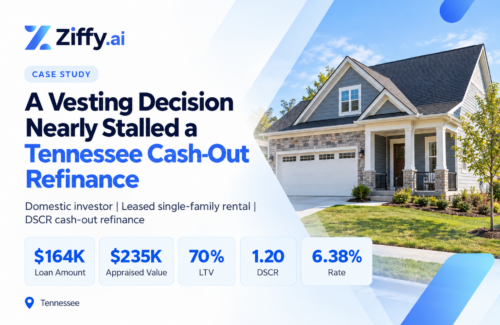
On paper, this Tennessee refinance had the numbers to work. The property was already leased, the rental income covered the proposed monthly housing expense, and the requested loan sat at approximately 70% loan-to-value.
But the part that nearly slowed the transaction to a standstill had little to do with rent, appraisal value, or DSCR.
The investor had to make a decision that many rental-property owners eventually face: should the property remain in an individual name, or should it be held through an LLC?
The answer affected how title would be handled at closing. Until the borrower was comfortable with the ownership structure, the refinance could not move forward. Once that decision was settled, Ziffy was able to complete the DSCR cash-out refinance on the original qualifying structure.
Table of Contents
Deal at a Glance
| Borrower | Domestic real estate investor |
|---|---|
| Property | Leased single-family rental in Tennessee |
| Loan Purpose | Cash-out refinance |
| Loan Program | DSCR loan |
| Loan Amount | $164,000 |
| Appraised Value | $235,000 |
| Loan-to-Value | 70% |
| Qualifying Monthly Rent | $1,700 |
| Monthly PITIA | $1,422 |
| DSCR | 1.20 |
| Interest Rate | 6.38% |
| Term | 30-year fixed |
| Final Title Vesting | LLC |
What the Investor Needed From the Refinance
The borrower already owned a leased single-family rental in Tennessee and wanted to refinance it while pulling equity out of the property.
For an investor in that position, a conventional refinance can put considerable weight on personal income, employment documentation, tax returns, and debt-to-income calculations. A DSCR loan approaches qualification differently by placing the property’s rental income at the center of the analysis.
Here, the Tennessee rental was already producing qualifying rent. That allowed the refinance to be structured around the performance of the asset rather than requiring the borrower to qualify primarily through personal income.
Why the Rental Numbers Worked
The property had $1,700 in qualifying monthly rental income. Monthly PITIA was approximately $1,422.
The $278 figure is the approximate difference between qualifying rent and PITIA for the DSCR calculation. It should not be interpreted as the property’s net monthly cash flow because maintenance, management, vacancies, utilities, and other operating costs are not reflected here.
The Decision That Held Up the File
The financial side of the refinance was not the main obstacle. The ownership structure was.
During underwriting, the borrower had to determine how the Tennessee property would be titled going forward. One option was to hold it personally. The other was to vest the property through an LLC.
That was not a decision the investor wanted to make casually. Questions came up around the tax and transfer implications of the two approaches and whether transferring the property back into an LLC after closing could create complications for the loan.
The key issue: the borrower needed to settle the vesting structure before the refinance could move to closing. The property had qualifying rent and the loan had workable leverage, but the file still could not be completed while ownership remained undecided.
Eventually, the borrower decided to hold title through an LLC. With that decision made, the remaining path to closing became much clearer.
Why the LLC Question Had to Be Settled Before Closing
Investors sometimes think of vesting as paperwork that can be dealt with after the financing is approved. In practice, the way an investment property is held can affect title, closing documents, entity documentation, and the way the loan file is prepared.
That makes the ownership decision especially important when an investor is refinancing a rental that is already operating. Changing title before or after a transaction can raise legal, tax, insurance, and loan-document questions that should be resolved with the appropriate professionals rather than assumed to be interchangeable.
In this transaction, the final decision was straightforward once it was made: the property would be vested in the borrower’s LLC.
How the Loan Structure Held Together
The useful lesson from this file is that the title question did not require the investor to abandon the underlying financing structure.
Ziffy structured the refinance as a DSCR loan using the rental property’s qualifying income. At an appraised value of $235,000, the $164,000 loan represented approximately 70% LTV.
Separately, the property’s $1,700 qualifying monthly rent against approximately $1,422 in PITIA produced a 1.20 DSCR.
Once the vesting decision was resolved and the file cleared final underwriting review, those figures remained the basis of the funded loan.
Final Loan Terms
What Rental Investors Can Take From This Deal
This refinance is a useful reminder that a DSCR file is not only about getting the ratio above a particular number.
The Funded Outcome
Once the borrower resolved the vesting question, the file cleared final underwriting review and Ziffy funded the Tennessee rental refinance at $164,000.
The final loan carried an approximately 6.38% fixed rate over 30 years, at approximately 70% LTV. The property’s $1,700 qualifying monthly rent against approximately $1,422 in PITIA produced a 1.20 DSCR.
The numbers supported the refinance. The part that required the most thought was how the investor wanted to own the property after closing. Once those two parts of the transaction aligned, the refinance could move to funding with title held in the LLC.