Buying a rental property is one thing. Buying a vacant property with plans to turn it into a short-term rental creates a different financing conversation.
That was the situation for a domestic investor purchasing a single-family property in coastal North Carolina. The home was vacant at closing, and there was no existing long-term lease that could simply be used as the property’s rental-income basis.
The investor’s plan, however, was clear: operate the property as a short-term rental. That meant the financing needed to account for the rental strategy the property was actually being purchased for.
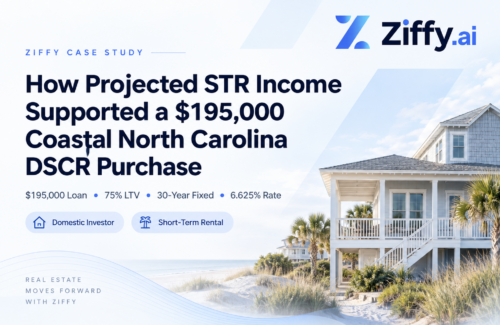
The transaction ultimately used projected short-term-rental income data to support the DSCR purchase structure. Ziffy Mortgage funded a $195,000, 30-year fixed DSCR loan at 75% LTV, allowing the financing structure to align with the investor’s intended use of the property.
The Funded Transaction at a Glance
The Property Was Vacant And The Investment Strategy Already Defined.
The investor was acquiring a single-family property in coastal North Carolina, but this was not a rental with a tenant already in place and monthly lease income already coming through the door.
The property was vacant at closing. The investor intended to use it as a short-term rental rather than place a traditional long-term tenant in the home.
That created the central question in the transaction. The property had an income-producing strategy, but it did not yet have an existing lease that could establish the rental income for the DSCR file.
There Was No Existing Lease to Establish Rental Income
For a traditional occupied rental, the financing conversation may begin with rent that is already documented through an existing lease.
This property presented a different scenario. It was vacant, and the investor planned to generate income through short-term stays rather than a conventional long-term tenancy.
The file therefore needed a rental-income approach that fit the property’s intended short-term-rental use.
Projected Short-Term-Rental Income Supported the DSCR Structure
Instead of relying on income from an existing tenant lease, the file used projected short-term-rental income data to support the DSCR purchase.
That allowed the income discussion to reflect the rental model the investor actually intended to operate after acquiring the property.
For investors evaluating a similar opportunity, this distinction can be important. The financing conversation should account for both the property’s current condition and the rental strategy the investor plans to pursue.
Ziffy Mortgage Funded $195,000 at 75% LTV
With the property’s intended rental strategy and projected STR income support established in the loan file, Ziffy Mortgage funded the purchase through a 30-year fixed DSCR loan.
How the Transaction Came Together
A Vacant STR Purchase Can Require a Different Income Approach
An investment property does not always come with an existing lease or established rental history. Investors may be purchasing properties that are vacant, transitioning between rental strategies or being acquired specifically for short-term-rental use.
In those situations, the income documentation used in the financing process becomes an important part of the transaction.
This North Carolina case shows how projected STR income support, the property’s intended rental strategy and the final loan structure could be brought together within one DSCR purchase transaction.
Start With the Property. Then Look at the Financing.
Financing is only one part of an investment-property decision. Investors also need to understand the property itself, its rental strategy and how the projected economics fit their investment goals.
Ziffy brings property discovery and real estate investment analysis closer to the financing process, giving investors a place to evaluate opportunities before moving forward with a mortgage.
Once an investor has identified a property and understands the intended rental model, Ziffy Mortgage can evaluate the financing options available for that specific transaction.
The vacant coastal property was financed through a DSCR purchase structure supported by projected short-term-rental income data, aligning the loan with the investor’s intended rental strategy.