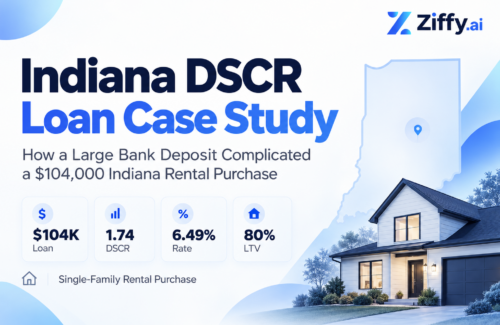
An Indiana real estate investor secured a $104,000 DSCR purchase loan through Ziffy to acquire a single-family rental under an LLC. The property supported a strong 1.74 DSCR, and the appraisal came in well above the purchase price. But before the loan could close, the investor needed to explain a large deposit appearing on a bank statement.
Imagine finding a rental property where the numbers work comfortably. The qualifying rental income supports the mortgage payment, the appraisal validates the purchase, and the financing has already been structured around the property’s cash flow.
Then an underwriter asks about a deposit in your bank account.
It is not a question about whether the property can generate enough rent. It is a question about where the money came from, and the answer needs to be documented before the loan can move forward.
That is the kind of situation this Indiana transaction illustrates. The investor was purchasing a single-family rental through an LLC using a DSCR loan. The property’s qualifying rent and mortgage payment supported the financing, but a separate asset documentation requirement still had to be satisfied.
Ziffy helped bring the transaction through underwriting, with the deposit documented, insurance bound, and remaining conditions cleared before funding. The resulting loan was $104,000 at a 6.49% fixed rate over 30 years, with no prepayment penalty.
Investment Properties on Sale in Indiana Today



Investment Highlights
The Investor Had a Property That Made Financial Sense
For rental-property investors, the attraction of a purchase often comes down to a simple question: does the income justify taking on the debt?
The Indiana property offered a favorable answer. Qualifying monthly rental income was $1,465, while the monthly principal, interest, taxes, insurance, and applicable association expenses totaled $840.25.
That left a meaningful margin between the qualifying rent and the housing payment used to underwrite the mortgage.
The property had another favorable feature. Although the contract purchase price was $130,000, the appraisal returned a value of $160,000. The investor was therefore purchasing the property for $30,000 less than its appraised value.
Appraisal Advantage
$30,000
Appraised value above the contract purchase price
A higher appraisal does not put additional cash in an investor’s bank account. But it can indicate that the negotiated purchase price is supported by the property’s appraised market value.
With both the rental coverage and appraisal supporting the deal, the investor had strong reasons to continue. The more complicated question would emerge from the financial documents, not from the house.
How Ziffy Structured the Indiana DSCR Purchase
Ziffy arranged a DSCR purchase loan for the domestic investor, with the property acquired under the investor’s limited liability company.
Unlike a conventional mortgage that relies heavily on an individual’s employment income and personal debt-to-income ratio, a DSCR loan places the investment property’s qualifying rental income at the center of the mortgage analysis.
| Borrower | Domestic Real Estate Investor |
|---|---|
| Property | Single-Family Rental, Indiana |
| Loan Purpose | Purchase |
| Loan Program | DSCR Mortgage |
| Ownership | Investor LLC |
| Purchase Price | $130,000 |
| Loan Amount | $104,000 |
| Appraised Value | $160,000 |
| Purchase LTV | 80% |
| Qualifying Monthly Rent | $1,465 |
| Monthly PITIA | $840.25 |
| DSCR | 1.74 |
| Interest Rate | 6.49% |
| Loan Term | 30-Year Fixed |
| Documented Reserves | 12 Months |
| Prepayment Penalty | None |
At a $130,000 purchase price, the $104,000 loan represented 80% purchase LTV. The difference was $26,000 in purchase equity, before any additional closing costs.
The appraisal also established a wider difference between the property’s value and its loan balance at closing.
Why the Property’s 1.74 DSCR Was a Strength
The debt service coverage ratio measures how much qualifying rental income is available relative to the monthly housing payment used for loan qualification.
DSCR Calculation
$1,465 ÷ $840.25 = 1.74
The property’s qualifying monthly rent was approximately 1.74 times its housing payment, with a $624.75 monthly difference between qualifying rent and PITIA.
A DSCR of 1.00 means qualifying rent equals PITIA. At 1.74, this Indiana rental sat comfortably above that point.
The $624.75 difference should not be mistaken for net cash flow or profit. Operating expenses such as maintenance, vacancy, management fees, and repairs may still reduce the investor’s actual earnings.
Nevertheless, the strong rental coverage helped establish the property’s ability to support the proposed mortgage structure.
The investor also had 12 months of documented reserves in addition to the funds required for closing. Those reserves strengthened the overall asset position reviewed during underwriting.
The Bank Deposit That Needed an Explanation
The transaction’s main documentation challenge arose during the review of the borrower’s funds.
One bank statement contained a large deposit that required further verification.
From an investor’s perspective, it can be surprising to hear that money already sitting in a bank account needs an explanation. A borrower may assume that showing an adequate balance is all the lender needs.
Mortgage underwriting works differently.
When funds are being used to qualify for a mortgage or complete a purchase, the lending team may need to establish where a significant deposit originated. An unexplained deposit can raise questions about whether the funds are borrowed, whether additional obligations exist, or whether the assets satisfy the loan program’s documentation requirements.
The issue was documentation, not rental performance.
The Indiana property’s qualifying rent supported the proposed mortgage. But a strong DSCR did not eliminate the need to verify the investor’s funds.
Ziffy’s lending team requested a newer bank statement covering the deposit and asked the investor to document its source.
The distinction is important. A request for additional documentation does not automatically mean the funds are unacceptable or the borrower cannot qualify. It means the underwriter needs evidence before treating those assets as verified.
In this case, the deposit was documented, allowing the asset review to move toward completion.
Why the Deposit Could Not Simply Be Ignored
Investors sometimes expect a DSCR loan to involve almost no financial paperwork because qualification focuses on property income instead of personal employment income.
That is only part of the picture.
A DSCR mortgage can reduce reliance on traditional personal-income documents, but underwriting still examines the borrower’s available assets, funds needed to close, reserves, property details, and applicable loan conditions.
The Indiana investor’s situation is a useful example of why these reviews are separate.
Property Review
1.74 DSCR
Did qualifying rental income support the proposed mortgage payment?
Asset Review
Source of Funds
Were the funds presented for qualification and closing properly documented?
Both needed to be satisfactory before the loan could fund.
How the Loan Moved From Underwriting to Funding
The documented sequence shows how an otherwise strong investment-property purchase encountered an asset verification condition and ultimately moved through final underwriting.
The Purchase Was Structured
Ziffy arranged $104,000 in DSCR purchase financing for an Indiana single-family rental acquired through the investor’s LLC.
Rental Coverage Supported the Loan
The property’s $1,465 qualifying monthly rent against $840.25 PITIA produced a 1.74 DSCR.
The Appraisal Supported Additional Equity
The appraisal returned at $160,000, above the $130,000 purchase price used to establish the 80% purchase LTV.
The Asset Review Flagged a Deposit
A large bank deposit required an updated statement and an explanation of the funds’ source.
The Deposit Was Documented
The required deposit documentation was provided. Twelve months of reserves were also documented beyond the amount needed for closing.
Closing Conditions Were Cleared
With the asset documentation addressed, insurance bound, and underwriting conditions satisfied, the file proceeded through clear-to-close review.
Ziffy Funded the Purchase
The investor closed with a 30-year fixed DSCR loan at 6.49%, without a prepayment penalty.
What Ziffy’s Financing Approach Meant for This Purchase
The important part of Ziffy’s role was not simply making a $104,000 mortgage available. It was bringing together two different sides of an investment-property transaction.
The first was the property’s performance. The rental income supported the proposed loan, and the appraisal exceeded the contract price. These factors made the purchase a strong candidate for DSCR financing.
The second was making sure the supporting documentation satisfied underwriting requirements. The borrower had adequate documented reserves, but the large deposit still needed to be explained before the asset review could be completed.
Ziffy’s lending team identified the documentation needed for that condition. With the deposit verified and the remaining closing requirements satisfied, the financing could proceed.
The transaction also closed without a prepayment penalty, a feature that can be particularly relevant to real estate investors who value flexibility when considering a future sale or refinance.
For investors exploring rental properties, Ziffy combines investment-property discovery and analysis with access to investor-focused mortgage financing.
This Indiana case demonstrates how the financing process can accommodate strong property economics while still addressing the documentation requirements that accompany an actual loan closing.
The Funded Outcome: A $104,000 Indiana DSCR Loan
The Indiana investor successfully completed the single-family rental purchase under an LLC.
Funded DSCR Purchase Loan
$104,000
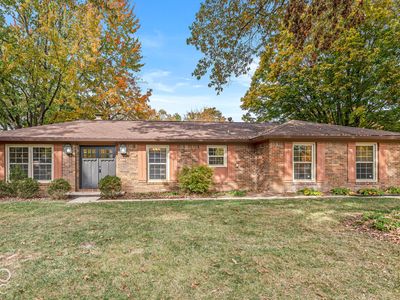
Single-Family Investment Property in Indiana
The property was appraised at $160,000 against a $130,000 purchase price. Qualifying rent of $1,465 comfortably exceeded monthly PITIA of $840.25.
What made this transaction worth examining, however, was not just the favorable financing figures. It was the way a relatively ordinary documentation issue had to be resolved before those figures could translate into a completed purchase.
What Rental Investors Can Learn From This Deal
A strong rental property can still encounter underwriting questions unrelated to its cash flow. The best preparation is to examine both the property and the funds supporting the purchase.
Check Large Deposits Early
If a bank statement contains a significant recent deposit, prepare documentation showing its source before the lender requests it.
Keep Funds and Reserves Documented
Having enough money is not the same as providing acceptable evidence of those funds. Maintain clear records for closing funds and reserves.
Know What Your DSCR Measures
A healthy DSCR demonstrates rental coverage relative to PITIA. It does not establish net cash flow or replace other underwriting requirements.
Review the Entire Loan Structure
Beyond rate and loan amount, consider leverage, reserves, ownership structure, loan term, and prepayment provisions.
In this Indiana purchase, the property had strong numbers from the outset. The appraisal supported additional equity, the DSCR was comfortably above 1.00, and the borrower had substantial documented reserves.
The final requirement was to verify the source of a large bank deposit.
Once that documentation was addressed and the other conditions were satisfied, Ziffy completed the financing.
For another investor considering a rental purchase, the lesson is straightforward: a good deal starts with sound property economics, but a successful closing also depends on having the paperwork to support it.