


Editorial Integrity
Making sound real estate investment decisions begins with reliable, data-driven insights. At Ziffy.ai, we offer an AI-native real estate investing, proprietary data-driven trend analysis, investment mortgage programs like DSCR loans, and a network of over 500 investor-friendly real estate agents to deliver the expertise needed for informed decisions. Our content is crafted by experienced real estate professionals and backed by real-time market data, ensuring you receive accurate and actionable information. Through a rigorous editorial process, we strive to empower your investment journey with trustworthy and up-to-date guidance.
North Carolina offers investors several very different rental markets. Charlotte has a large metropolitan rental market, Raleigh and Durham have their own neighborhood-level dynamics, and Wilmington and Asheville attract buyers evaluating both residential rentals and vacation properties.
For investors using a debt service coverage ratio (DSCR) loan, the location alone does not determine whether a property qualifies. Its rental income, monthly mortgage payment, property taxes, insurance, and eligible financing structure must work together.
Quick Answer: Can You Get a DSCR Loan in North Carolina?
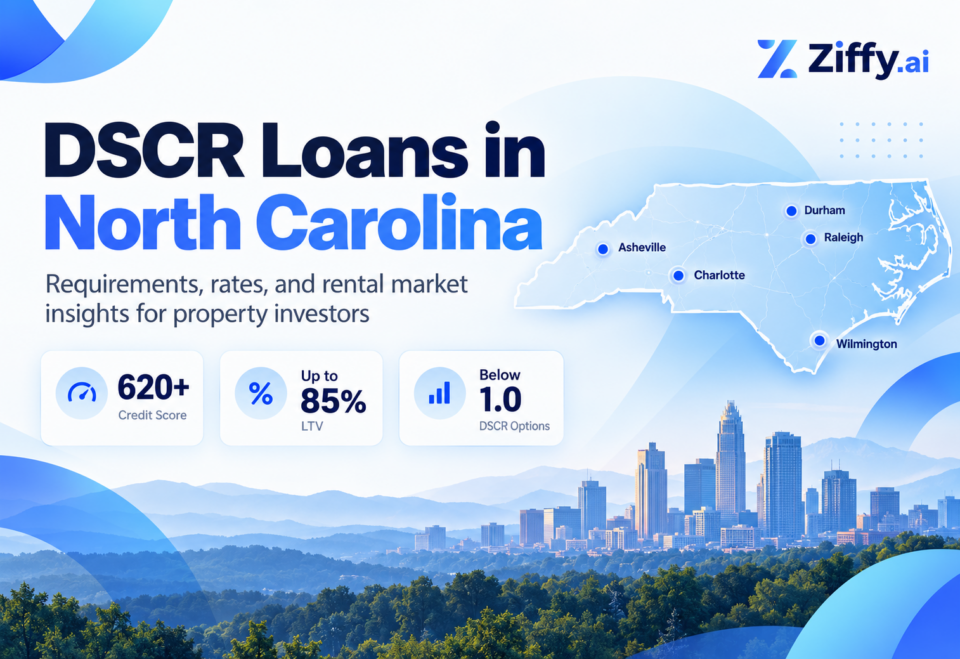
Yes. Ziffy Mortgage offers DSCR loans in North Carolina for eligible non-owner-occupied investment properties. Qualification focuses on the property’s qualifying rental income rather than traditional employment income or personal debt-to-income ratios.
Eligible borrowers can qualify with a credit score starting at 620, purchase financing up to 85% LTV in qualifying scenarios, and reserve requirements starting at two months of PITIA.
A DSCR of 1.0 or higher is generally preferred, although Ziffy also offers eligible below-1.0 and No-Ratio financing options. Final eligibility depends on underwriting, property characteristics, and the selected loan program.
Key Takeaways
Source: HUD FY 2027 Fair Market Rents. Financing figures represent Ziffy Mortgage program parameters; maximum financing is subject to eligibility and underwriting. HUD figures are housing-program benchmarks, not appraised rental income.
Table of Contents
How Does a DSCR Loan Work in North Carolina?
A DSCR loan uses the qualifying rental income of an investment property to determine whether it can support the proposed mortgage payment. Instead of primarily examining personal salaries, W-2s, or tax returns, the lender evaluates the property’s income against its monthly housing expense.
Rent exceeds PITIA.
Rent equals PITIA.
Rent is below PITIA.
A North Carolina property’s DSCR may change substantially when insurance, county taxes, or association dues change. This is particularly relevant for coastal homes exposed to wind and flooding risks and condominiums with substantial association expenses.
Investors should calculate operating cash flow separately. The lender’s DSCR calculation does not necessarily deduct vacancy, maintenance, property management, and future repairs.
Use our DSCR loan calculator to examine the relationship between rental income and housing payments.
What Are the DSCR Loan Requirements in North Carolina?
Ziffy Mortgage offers DSCR financing for eligible residential rental properties across North Carolina. Credit score, property rental income, down payment, requested loan amount, and property characteristics determine the available financing structure.
| Requirement | Ziffy Mortgage DSCR Program |
|---|---|
| Minimum credit score | 620 |
| Preferred DSCR | 1.0 or higher |
| Below-1.0 financing | Eligible lower-ratio and No-Ratio options |
| Purchase LTV | Up to 85% for eligible scenarios |
| Rate-and-term refinance | Up to 80% LTV |
| Cash-out refinance | Up to 75% LTV |
| Cash reserves | Starting at two months of PITIA |
| Loan amounts | $100,000 to $10 million |
| Loan term | 30-year fixed options |
| Primary qualifying income | Eligible property rental income |
| Occupancy | Non-owner-occupied investment property |
Eligible properties may include single-family rentals, townhomes, approved condominiums, and qualifying two-to-four-unit properties. Property condition, appraisal, association rules, and insurance requirements also affect eligibility.
An eligible 85% LTV purchase can require a 15% down payment. However, not every North Carolina property or borrower qualifies for maximum leverage. A lower LTV may be necessary depending on credit, DSCR, property type, and program restrictions.
For a broader explanation of underwriting and documentation, read our DSCR loan guide for real estate investors.
North Carolina Rental Market Comparison: Where Are Rent Benchmarks Higher?
North Carolina’s rental markets differ considerably. A rental property in Asheville cannot be evaluated using the same income assumptions as a property in Greensboro, even when both have two bedrooms.
The comparison below uses HUD’s FY 2027 two-bedroom Fair Market Rents (FMRs). These federal housing-program benchmarks include a utility component and provide a consistent regional reference. They are not current advertised rents, property appraisals, or guaranteed rental income.
Two-Bedroom Rent Benchmarks Across North Carolina
HUD FY 2027 | Monthly Fair Market Rent | Selected metropolitan areas
Source: HUD FY 2027 Fair Market Rent Schedule, effective October 1, 2026. Bar lengths are relative to Asheville, the highest benchmark displayed. HUD metropolitan areas may cover multiple counties.
North Carolina Rental Benchmark Heat Matrix
The matrix groups the same HUD benchmarks into rent bands. Darker cells represent higher two-bedroom benchmarks, not stronger cash flow or a higher expected return.
Selected metro-area FMRs, not city-limit estimates or neighborhood-level rent maps. This matrix does not represent property yields.
Asheville’s two-bedroom benchmark is $595 higher per month than Greensboro–High Point’s. That difference helps establish the rental-income landscape, but investors still need property prices, verified rents, insurance quotes, and tax estimates to compare the actual financing potential of two properties.
For neighborhood-level research, HUD also publishes Small Area Fair Market Rents by ZIP code. These can help identify local variation, but underwriting should use the qualifying rent supported by the property’s actual documentation.
DSCR Loans in Charlotte, NC: Which Neighborhoods Should Investors Compare?
Charlotte is a useful starting point for North Carolina rental property searches because investors can compare central neighborhoods, established residential districts, and surrounding suburban communities within the larger metropolitan area.
According to the North Carolina Office of State Budget and Management, Charlotte reached approximately 945,000 residents in July 2024. Population size offers market context, but it does not establish the rental performance of individual properties.
NoDa and Plaza Midwood
Compare purchase prices, rental comparables, renovation costs, and property type. Older homes may require additional maintenance or rehabilitation allowances.
South End and Dilworth
For condos and townhomes, examine association dues, rental restrictions, special assessments, and whether the building is eligible for DSCR financing.
University City
Check actual lease income, property condition, tenant turnover expectations, and whether projected rents reflect the property’s configuration.
Concord, Gastonia, and Matthews
Compare suburban single-family rentals using municipality-specific taxes, insurance, purchase prices, and nearby rental listings.
Why Charlotte ZIP Codes Matter for DSCR Qualification
Properties in ZIP codes 28202, 28205, and 28262 can have very different characteristics. A central condominium, an older detached home, and a newer townhome should not be valued or underwritten using one broad Charlotte rent assumption.
Investors should establish an address-specific rental estimate, confirm legal occupancy, and calculate PITIA using the property’s actual location and insurance profile. The metro-wide FY 2027 two-bedroom HUD benchmark of $1,785 provides context, not an underwriting substitute.
DSCR Loans in Raleigh and Durham: How Do Triangle Rental Markets Compare?
The Research Triangle is another major area for North Carolina rental property investors. Raleigh, Durham, Cary, and surrounding communities have different rental housing profiles, even though buyers often consider them within the same regional search.
HUD’s FY 2027 two-bedroom Fair Market Rent is $1,689 for the Raleigh–Cary area and $1,745 for Durham–Chapel Hill. These figures describe different HUD metropolitan rental areas, not individual city or neighborhood rental rates.
For a more detailed comparison, investors can examine ZIP-level data through HUD’s Small Area Fair Market Rent resources, then verify achievable rental income using current comparable leases and local property management information.
A higher rent benchmark does not automatically mean a stronger DSCR. A lower-priced property with manageable taxes and insurance may support a different financing structure than a more expensive home with higher rent.
DSCR Loans in Raleigh and Durham: How Do Triangle Rental Markets Compare?
The Research Triangle is another major area for North Carolina rental property investors. Raleigh, Durham, Cary, and surrounding communities have different rental housing profiles, even though buyers often consider them within the same regional search.
HUD’s FY 2027 two-bedroom Fair Market Rent is $1,689 for the Raleigh–Cary area and $1,745 for Durham–Chapel Hill. These figures describe different HUD metropolitan rental areas, not individual city or neighborhood rental rates.
For a more detailed comparison, investors can examine ZIP-level data through HUD’s Small Area Fair Market Rent resources, then verify achievable rental income using current comparable leases and local property management information.
A higher rent benchmark does not automatically mean a stronger DSCR. A lower-priced property with manageable taxes and insurance may support a different financing structure than a more expensive home with higher rent.
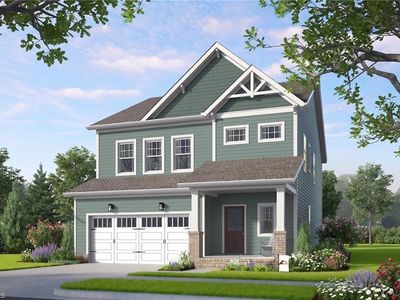
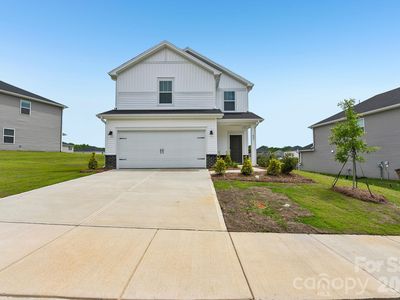
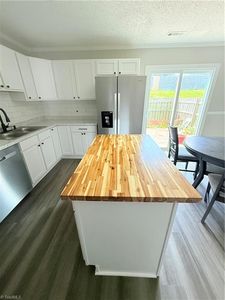
Investment Properties on Sale in North Carolina Today


Where Else Can Investors Use DSCR Loans in North Carolina?
Charlotte and the Triangle receive considerable attention, but North Carolina investors can also evaluate residential rentals in the Triad, Fayetteville, Wilmington, Asheville, and smaller surrounding communities.
Greensboro, High Point, and Winston-Salem
Compare long-term residential rental properties using verified rents and complete ownership expenses. Investors evaluating older homes should pay attention to renovation budgets and deferred maintenance. HUD’s FY 2027 two-bedroom benchmarks are $1,271 in Greensboro–High Point and $1,332 in Winston-Salem.
Fayetteville
Investors can compare single-family homes and other eligible rentals near different employment and residential districts. The FY 2027 two-bedroom HUD benchmark is $1,476. Verify comparable rents and potential maintenance expenses before assuming a property can cover its proposed loan payment.
Wilmington and Coastal Communities
In addition to rental income, analyze flood exposure, wind coverage, property insurance availability, and association rules. Seasonal rental assumptions should be supported by property-specific information rather than annualized peak-season rates.
Asheville and Western North Carolina
Asheville has the highest two-bedroom HUD benchmark among the selected markets in this article. Investors considering vacation rentals must verify zoning before proceeding, while all property buyers should review building condition, access, insurance, and relevant flood risks.
The appropriate market depends on the investment strategy and the property’s financial performance. A regional rent benchmark is only the first research step. Each property needs a separate financing and cash-flow analysis.
How Do North Carolina Property Taxes, Insurance, and Flood Risks Affect DSCR Loans?
A rental property’s monthly expenses can change significantly depending on its county, municipality, insurance requirements, and physical location. Those differences directly influence the PITIA used to calculate DSCR.
Property Taxes Vary by County and Municipality
North Carolina property taxes are assessed locally. Investors should verify the applicable county and municipal rates rather than applying a statewide estimate to every rental property.
The North Carolina Department of Revenue maintains county and municipal property tax information. The applicable tax bill may also be affected by reassessment and any relevant special districts.
Insurance Needs More Than a Generic Estimate
Coastal homes, flood-prone properties, mountain homes, and ordinary suburban rentals may have very different coverage requirements. Investors should request property-specific insurance quotes before committing to a financing structure.
- Check the property’s flood designation and documented flood history.
- Obtain a current landlord insurance quote and any required supplemental coverage.
- Confirm county, municipal, and applicable district taxes.
- Review association assessments and insurance responsibilities.
- Recalculate PITIA using verified expenses, not listing estimates.
North Carolina provides an official Flood Risk Information System for address-specific flood hazard research.
Insurance and property taxes can affect DSCR even when the rent stays unchanged. For that reason, the most useful financing estimate is one that accounts for the actual property, rather than relying on broad market averages.
Can You Use a DSCR Loan for Airbnb or Short-Term Rentals in North Carolina?
Yes, eligible short-term rental properties in North Carolina may qualify for DSCR financing. However, short-term rental eligibility depends on the property, local regulations, the selected loan program, and the acceptable method of documenting rental income.
Vacation rental markets require more than an attractive nightly rate. Investors need to consider permitted use, seasonal revenue, occupancy, insurance, management expenses, and the lender’s underwriting rules.
Asheville
Zoning is a crucial consideration. The City of Asheville states that short-term vacation rentals of entire dwellings are permitted only in its resort zoning district. Its homestay rules are different and require qualifying owner occupancy.
Wilmington and Beaches
Review the specific municipality’s rental rules, permitted occupancy, association restrictions, flood exposure, and insurance costs. A beach-area address alone does not establish short-term rental eligibility.
Outer Banks
Check county and town requirements, property access, coastal insurance, seasonal revenue documentation, and any restrictions attached to the property or community.
The City of Asheville’s official homestay and short-term vacation rental guidance is an example of why investors should check local rules before purchasing a property for Airbnb use.
A DSCR lender may evaluate an eligible short-term rental using acceptable appraisal-supported rent, existing rental documentation, or another permitted underwriting method. Projected Airbnb revenue is not automatically qualifying income.
Investors can also use the Ziffy investment research resources to assess rental strategies before selecting financing.
Can You Get a North Carolina DSCR Loan With a Ratio Below 1.0?
Yes. Ziffy Mortgage offers eligible financing options for North Carolina properties with DSCR ratios below 1.0, including No-Ratio programs. A property does not necessarily need to produce qualifying rent equal to its entire monthly mortgage payment to be considered.
Lower-ratio financing may involve different down payment requirements, pricing, reserves, or other underwriting conditions. Approval depends on the complete loan scenario.
What Can Improve a Property’s DSCR?
- Make a larger down payment: A smaller mortgage can reduce monthly principal and interest.
- Negotiate the purchase price: A lower acquisition cost may improve the proposed financing structure.
- Review qualifying rental income: Use supportable rents based on the property’s condition, lease terms, and applicable underwriting method.
- Compare insurance costs: Obtain accurate coverage quotes and evaluate available policies that satisfy lender requirements.
- Examine association expenses: Recurring dues and special assessments can influence both underwriting and investment returns.
DSCR Purchase, Refinance, and Cash-Out Loans in North Carolina
Ziffy Mortgage supports eligible investment property purchases, rate-and-term refinancing, and cash-out refinancing in North Carolina. Each financing purpose has different leverage limits and underwriting considerations.
Purchase
Maximum for eligible purchase scenarios, subject to underwriting.
Rate-and-Term Refinance
Maximum eligible rate-and-term refinance leverage.
Cash-Out Refinance
Maximum eligible cash-out refinance leverage.
For existing landlords, a refinance can be evaluated using updated property values, qualifying rent, outstanding mortgage balances, and the proposed new payment. Cash-out financing additionally depends on available equity and program rules.
The most useful starting point is to calculate whether the revised loan payment remains compatible with the property’s rental income and the investor’s broader cash-flow goals.
What Should North Carolina Investors Check Before Applying for a DSCR Loan?
The strongest DSCR loan application starts with realistic rental assumptions and a complete picture of the property’s expenses. In North Carolina, an investor buying a coastal rental may need to investigate different risks from someone buying a suburban home near Raleigh.

“If an investor brings me a North Carolina property, I want to see the rent support alongside the actual monthly costs. In Charlotte, that might mean taking a closer look at condo dues or the condition of an older home. On the coast, I want to know what the insurance is going to cost. Those expenses can change the loan calculation quite a bit. I’d rather identify that early so we can structure the financing around numbers the property can realistically support.”

“I don’t think investors should dismiss a property simply because its DSCR comes in slightly below 1.0. We have financing options that can accommodate lower ratios in eligible situations. But there’s a difference between qualifying for a loan and having an investment that makes financial sense. I still want the borrower to understand the cash flow, reserves, and potential expenses after closing. That becomes especially relevant if they’re planning to hold several rental properties.”
Before submitting a loan application, investors should confirm qualifying rental income, the property’s occupancy and permitted use, insurance requirements, cash reserves, and the amount of financing needed. Addressing these questions early can help identify a workable loan structure and avoid unnecessary surprises during underwriting.
North Carolina DSCR Loan FAQs
What is the minimum credit score for a DSCR loan in North Carolina?
Ziffy Mortgage offers eligible DSCR financing beginning at a 620 credit score. Higher credit scores may provide access to different financing structures. Final eligibility depends on the property, DSCR, requested leverage, and other underwriting factors.
How much down payment do I need for a North Carolina DSCR loan?
Eligible purchase scenarios can offer up to 85% LTV, equivalent to a 15% down payment. Other scenarios may require a larger down payment depending on credit, rental income, property type, and loan program.
What are DSCR loan interest rates in North Carolina?
DSCR loan rates vary according to credit score, loan-to-value ratio, DSCR, property characteristics, loan term, and market pricing. Because rates change, investors should obtain a scenario-specific quote rather than rely on a fixed statewide rate.
Can I get a North Carolina DSCR loan without tax returns?
Yes. DSCR qualification generally does not require personal tax returns, W-2s, or pay stubs to establish qualifying income. Borrowers must still provide required identity, asset, property, and transaction documentation.
Can an LLC get a DSCR loan in North Carolina?
Eligible borrowers may be able to finance investment property through an LLC, subject to the loan program and entity documentation requirements. The entity structure, ownership information, and applicable guarantees should be reviewed before closing.
Can I finance an Airbnb property with a DSCR loan in North Carolina?
Eligible short-term rental properties may qualify. The property must satisfy local zoning and rental-use requirements, and the rental income must be supported using an acceptable underwriting method. Short-term rental restrictions vary by municipality.
Which North Carolina city is best for a DSCR investment property?
There is no single best city for every investor. Charlotte, Raleigh, Durham, Greensboro, Winston-Salem, and other markets have different purchase prices, rents, taxes, and insurance requirements. Compare individual properties using verified income, complete PITIA, and expected operating expenses.
Can I refinance a North Carolina rental property using a DSCR loan?
Yes. Ziffy Mortgage offers eligible rate-and-term refinancing up to 80% LTV and cash-out refinancing up to 75% LTV. Available financing depends on property valuation, rental income, credit, and underwriting conditions.
Can I qualify for a DSCR loan below a 1.0 ratio?
Yes. Eligible below-1.0 and No-Ratio financing options are available through Ziffy Mortgage. Different down payment, pricing, credit, and reserve requirements may apply.
Can I use a DSCR loan to buy my primary residence in North Carolina?
No. The DSCR investment property programs discussed here are intended for eligible non-owner-occupied properties, not primary residences.