


Editorial Integrity
Making sound real estate investment decisions begins with reliable, data-driven insights. At Ziffy.ai, we offer an AI-native real estate investing, proprietary data-driven trend analysis, investment mortgage programs like DSCR loans, and a network of over 500 investor-friendly real estate agents to deliver the expertise needed for informed decisions. Our content is crafted by experienced real estate professionals and backed by real-time market data, ensuring you receive accurate and actionable information. Through a rigorous editorial process, we strive to empower your investment journey with trustworthy and up-to-date guidance.
Key Takeaways
Minimum eligible credit score
Maximum purchase LTV in eligible scenarios
Preferred DSCR, with lower-ratio options available
Kansas City median gross rent, Census 2020–2024
Sources: US Census Bureau and Ziffy DSCR financing guidelines. Program maximums are subject to eligibility and underwriting.
Quick Answer: Can You Get a DSCR Loan in Missouri?
Yes. Ziffy offers DSCR loans in Missouri for eligible residential investment properties. Investors qualify primarily through the property’s rental income rather than W-2 earnings, personal tax returns, or traditional debt-to-income calculations.
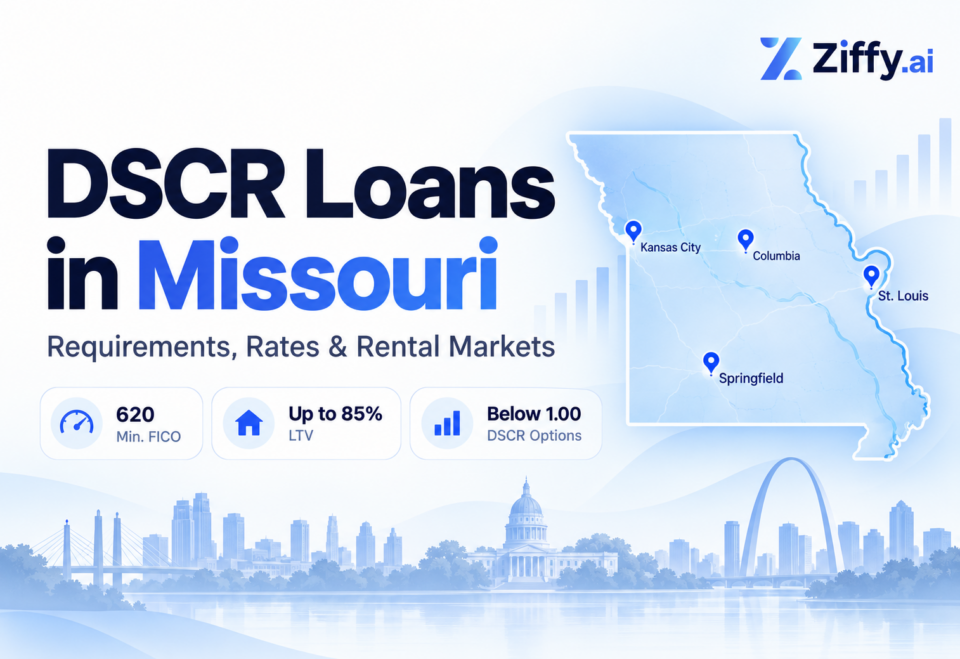
Eligible borrowers can access purchase financing up to 85% loan-to-value (LTV), with a minimum credit score of 620 and reserve requirements starting at two months. Ziffy also offers financing options for properties with a DSCR below 1.00.
For Missouri investors, the main consideration is whether the property’s supportable rent can cover its monthly mortgage obligation after property taxes, insurance, and applicable association dues are included.
A rental property in Kansas City and one in Springfield can have completely different economics, even when their asking prices appear reasonable. The rent each property can support, the repairs it needs, and the cost of financing it may tell very different stories.
That is where a DSCR loan becomes useful. Instead of making an investor’s personal salary the primary basis for qualification, the financing focuses on income generated by the rental property.
Missouri deserves a more local approach than a single statewide rent estimate. This guide examines Ziffy’s DSCR loan requirements, compares four Missouri rental markets using Census data, identifies neighborhoods worth researching, and explains the financing details that can change the outcome of an investment-property purchase.
Table of Contents
How Do DSCR Loans Work in Missouri?
A Missouri DSCR loan is an investment-property mortgage that measures how much qualifying rental income is available to cover the property’s monthly housing payment. This makes it useful for self-employed borrowers, LLC investors, and landlords who own multiple rental properties.
The calculation uses monthly qualifying rent divided by PITIA, which includes principal, interest, property taxes, insurance, and association dues when applicable.
Qualifying rent exceeds PITIA.
Rent equals the monthly housing payment.
Rent falls short of PITIA; alternative loan options may apply.
A DSCR of 1.00 does not mean the property breaks even after every expense. Maintenance, vacancy, property management, and major repairs still affect actual investment cash flow.
Investors can evaluate a property’s rent-to-payment relationship using Ziffy’s DSCR financing guide and the Ziffy investment-property platform.
Missouri DSCR Loan Requirements: Credit Score, Down Payment, and LTV
Ziffy offers Missouri DSCR financing for eligible non-owner-occupied investment properties. Credit score, leverage, rental coverage, property type, and loan purpose determine which program is appropriate.
| Requirement | Ziffy DSCR Financing |
|---|---|
| Minimum credit score | 620 |
| Preferred DSCR | 1.00 or higher |
| Lower-DSCR financing | Eligible below-1.00 and No-Ratio programs |
| Purchase LTV | Up to 85% in eligible scenarios |
| Rate-and-term refinance | Up to 80% LTV |
| Cash-out refinance | Up to 75% LTV |
| Minimum loan amount | $100,000 |
| Reserves | Starting at two months |
| Loan structure | 30-year fixed options |
Eligible property types can include single-family homes, townhomes, condominiums, and qualifying two-to-four-unit properties. The loan is intended for investment properties rather than primary residences.
A maximum purchase LTV of 85% does not mean every borrower can purchase with 15% down. A 20% down payment is a more typical starting point, while higher leverage depends on the complete underwriting scenario.
Missouri Rental Market Comparison: Kansas City vs. St. Louis, Springfield, and Columbia
Missouri’s rental markets differ considerably in both housing costs and rents. The US Census Bureau’s 2020–2024 American Community Survey data provides a consistent starting point for comparing four major cities.
Median Gross Rent Across Missouri Cities
US Census Bureau | ACS 2020–2024 | Monthly median gross rent
Bar widths are proportional to Kansas City’s $1,238 benchmark. Median gross rent includes applicable utilities and covers occupied rental housing of different sizes and types. It is not a current asking rent or a property-specific underwriting figure.
| City | Median gross rent | Median owner-occupied home value |
|---|---|---|
| Kansas City | $1,238 | $242,900 |
| St. Louis city | $997 | $197,500 |
| Springfield | $964 | $177,700 |
| Columbia | $1,097 | $284,600 |
Sources: US Census Bureau QuickFacts for Kansas City, St. Louis, Springfield, and Columbia.
Kansas City’s median gross rent exceeded Springfield’s by $274 per month during the survey period. However, Columbia had the highest median owner-occupied home value among these four cities.
Neither observation establishes the best city for rental yields. Median owner-occupied home values are not investment-property acquisition prices, and citywide median rents cannot substitute for comparable rental properties. DSCR underwriting requires an address-specific analysis of supportable income and actual monthly carrying costs.
Missouri Rental Market Heatmap: How Do City Rent Benchmarks Compare?
The following heatmap-style comparison places Missouri’s four selected cities into rental benchmark bands using the same 2020–2024 Census dataset. Darker blue indicates a higher historical median gross rent, not a higher return on investment.
This is a city comparison, not a geographic heatmap. Colors reflect only the four historical Census median gross rents shown. They do not measure vacancy, yield, home appreciation, or DSCR qualification.
Why ZIP-Code Research Still Matters
A metro-wide average can conceal meaningful differences between rental submarkets. Investors comparing the Crossroads and Waldo in Kansas City, or the Central West End and Dutchtown in St. Louis, should not assume that similar floor plans produce identical rents.
HUD’s Small Area Fair Market Rent datasets provide ZIP-level benchmarks for covered metropolitan areas. These are useful for geographic comparisons, but lenders still evaluate the rental income supportable for the individual property.
Best Cities in Missouri to Research for DSCR Investment Property Loans
Missouri investors have several different market types to evaluate. Kansas City and St. Louis offer large metropolitan rental markets, while Columbia and Springfield have their own tenant profiles and property characteristics. Rather than selecting a market solely by rent, match the property’s acquisition cost, condition, and realistic income to the financing structure.
Kansas City: Neighborhood-Level Rent and Operating Costs
Kansas City recorded a $1,238 median gross rent in the 2020–2024 Census data. Its larger market makes it important to analyze individual neighborhoods rather than use a citywide estimate.
Areas to compare: Waldo, Brookside, North Kansas City, and the Crossroads vicinity. North Kansas City is a separate municipality, so local regulatory and tax assumptions should not automatically carry across the boundary.
DSCR consideration: Compare the supported lease rate, taxes, insurance, building condition, and rental registration requirements before deciding how much debt the property can carry.
St. Louis: Older Housing and Small Multifamily Opportunities
St. Louis city’s Census median gross rent was $997. The city and surrounding St. Louis County are separate jurisdictions with different property characteristics and local requirements.
Areas to compare: Tower Grove South, Dutchtown, Benton Park, and the Central West End.
DSCR consideration: Older properties call for careful inspection of roofing, mechanical systems, deferred repairs, and insurability. Duplex investors should also verify that every rentable unit is legally permitted.
Springfield: Rental Demand Beyond the Citywide Average
Springfield’s median gross rent was $964, with a median owner-occupied home value of $177,700 during the same Census period.
Areas to compare: Rountree, Phelps Grove, and neighborhoods around Missouri State University.
DSCR consideration: For student-oriented properties, examine lease duration, occupancy patterns, turnover, lawful room configurations, and who is responsible for utilities.
Columbia: University-Adjacent vs. Conventional Rentals
Columbia had a $1,097 median gross rent and a $284,600 median owner-occupied home value in the Census dataset. Those figures should not be treated as a ready-made rental yield.
Areas to compare: Benton-Stephens, East Campus, and southwest Columbia.
DSCR consideration: University-adjacent leases and conventional family rentals may have different turnover and management requirements. Review actual leases, approved occupancy, and appraiser-supported rent.
Neighborhoods are research starting points, not a performance ranking. Local rental income, property prices, vacancy, and cash flow must be established for each property.
How Do Missouri Property Taxes, Insurance, and Rental Regulations Affect DSCR?
Rental income is only half the DSCR calculation. Missouri investors should also examine property-specific taxes, insurance, association dues, and recurring costs that can affect the monthly payment or actual cash flow.
Property Taxes
Property taxes vary by jurisdiction and assessed property characteristics. Review the appropriate county assessor and collector records rather than applying a statewide tax percentage to every deal. A purchase can also warrant a review of future assessment assumptions rather than relying entirely on the seller’s historical tax bill.
Insurance and Property Condition
Roof condition, age, replacement cost, flood exposure, and property location can affect insurance availability and premiums. Obtain a property-specific quote before relying on an estimated DSCR, especially when evaluating older homes or properties requiring repairs.
Kansas City Rental Registration
Kansas City requires rental-property owners within its jurisdiction to register through the Healthy Homes Rental Inspection Program.
For 2026, the city lists an annual permit fee of $25 per unit and a one-time application fee of $25. Registration and compliance expenses belong in the investor’s operating budget, even when they are not included directly in PITIA.
A property may meet a lender’s DSCR requirement but still need substantial repairs, insurance adjustments, or local rental-registration compliance before it becomes a practical investment.
Missouri also restricts local governments from regulating the amount of rent charged for covered privately owned properties under RSMo Section 441.043. That does not eliminate lease obligations, building codes, inspection requirements, or other applicable landlord responsibilities.
Can You Get a DSCR Loan for Airbnb or Short-Term Rentals in Missouri?
Yes. Ziffy offers DSCR financing for eligible short-term rental investment properties in Missouri. However, a property’s ability to qualify for financing and its legal ability to operate as a short-term rental are separate questions.
Kansas City requires short-term rental registration for covered rentals involving stays of fewer than 30 consecutive days. The city’s official short-term rental registration guide explains its application requirements.
Investors evaluating properties in St. Louis, Branson, Lake of the Ozarks communities, or other Missouri locations should verify the applicable municipal or county requirements and any HOA or condominium restrictions before purchasing.
Before Financing a Missouri Short-Term Rental
- Confirm that short-term rental use is permitted at the address.
- Check registration, licensing, zoning, and occupancy restrictions.
- Review HOA or condominium rental policies.
- Determine which rental-income documentation the loan program accepts.
- Evaluate cleaning, furnishing, utilities, management, and seasonal vacancy separately from DSCR.
Projected nightly revenue should not automatically be treated as qualifying income. Lender documentation standards and supported rental estimates determine the income that can be used for loan qualification.
Can You Get a Missouri DSCR Loan With a Ratio Below 1.00?
Yes. Ziffy offers eligible below-1.00 and No-Ratio DSCR loan programs for investment properties that do not meet the standard 1.00 coverage benchmark.
A lower DSCR means the property’s qualifying rent does not fully cover its monthly PITIA payment. Approval may require a larger down payment, lower leverage, additional reserves, or different pricing.
Best suited to properties whose supported rental income meets or exceeds the monthly housing payment.
May accommodate eligible properties with lower rental coverage, subject to additional underwriting requirements.
What Can Improve a Missouri Investment Property’s DSCR?
- Verify the highest qualifying rent supported by appropriate comparables or lease documentation.
- Confirm property taxes and obtain an accurate insurance quote.
- Compare available loan structures and the effect of a larger down payment.
- Review whether association fees or other recurring housing charges have been omitted.
- Preserve enough liquidity for property operations and unexpected expenses.

“When a rental property falls below a 1.00 DSCR, I wouldn’t automatically dismiss it. I’d first want to understand whether the shortfall comes from the rent, the financing structure, or the property’s carrying costs. Sometimes adjusting the leverage can make a meaningful difference. But I also want the investor to understand the trade-off. Using more cash to improve the loan’s debt coverage doesn’t necessarily improve the overall investment if it leaves them short of reserves for repairs or vacancy.”
The goal is to find a financing structure that supports the investment without relying on unrealistic rent increases or exhausting the investor’s available cash.
Missouri DSCR Purchase Loans, Refinancing, and Cash-Out Options
Ziffy’s Missouri DSCR programs support several common investor financing needs, from acquiring a first rental property to restructuring debt on an established portfolio.
Finance eligible Missouri rental acquisitions using property income, with up to 85% LTV in qualifying scenarios.
Replace an existing investment mortgage or restructure its terms, with eligible financing up to 80% LTV.
Access qualifying investment-property equity, with cash-out options up to 75% LTV, subject to loan terms and available equity.

“With a cash-out refinance, I’d start by asking what the investor plans to do with the equity and whether the property’s income can comfortably support the replacement mortgage. Pulling equity out may create buying power for another rental, but it also changes the payment and the debt coverage on the property they already own. I don’t think investors should look at the cash available in isolation. They need to compare the financing cost with what they expect that capital to accomplish.”
An investor considering a Missouri cash-out refinance should compare the new debt service, available proceeds after closing costs, liquidity needs, and expected return on the capital being released. Ziffy’s DSCR loan guide explains the broader financing process.
Missouri DSCR Loan FAQs
What credit score do I need for a DSCR loan in Missouri?
Ziffy offers eligible Missouri DSCR loans starting at a 620 credit score. Higher credit scores may provide access to additional financing structures or different loan pricing. Approval also depends on the property, leverage, and other underwriting requirements.
How much down payment is required for a Missouri DSCR loan?
A 20% down payment is a common starting point. Ziffy also offers purchase financing up to 85% LTV on eligible scenarios, potentially allowing 15% down. The amount required depends on credit, DSCR, property type, and program eligibility.
Can I get a DSCR loan in Missouri without tax returns?
Yes. Ziffy DSCR financing generally does not require personal tax returns, W-2s, or pay stubs to establish qualifying income. Investors still need to provide relevant identity, asset, property, and transaction documentation.
Can an LLC get a DSCR loan in Missouri?
Yes. Eligible LLC ownership structures may be accommodated under Ziffy’s DSCR programs. The lender will review the borrowing entity, its ownership, required guarantees, and applicable closing documentation.
Are Missouri DSCR loans available for duplexes and fourplexes?
Yes. Eligible residential properties can include duplexes, triplexes, and fourplexes. Investors should confirm the property’s legal unit count, supported rental income, condition, and program-specific eligibility.
Can I qualify for a Missouri DSCR loan if the property is vacant?
Potentially. Eligible programs may consider an appraiser-supported market rent when an existing lease is unavailable. The acceptable documentation and rent calculation depend on the property and loan program.
What are Missouri DSCR loan interest rates?
Missouri DSCR loan rates depend on credit score, LTV, DSCR, loan amount, property type, and market pricing when the loan is quoted. There is no single interest rate that applies to every Missouri investment-property borrower.
Are DSCR loans available for short-term rentals near Lake of the Ozarks?
Eligible short-term rental properties may qualify for Ziffy DSCR financing. Investors must confirm local rental permissions, association restrictions, property eligibility, and the rental-income documentation accepted by the applicable loan program.
Which Missouri city has the best DSCR loan opportunities?
No city guarantees a stronger DSCR. Kansas City, St. Louis, Springfield, and Columbia have different rental and housing-cost characteristics. Compare the actual purchase price, supportable rent, taxes, insurance, property condition, and financing terms before deciding where to invest.