





Editorial Integrity
Making sound real estate investment decisions begins with reliable, data-driven insights. At Ziffy.ai, we offer an AI-native real estate investing, proprietary data-driven trend analysis, investment mortgage programs like DSCR loans, and a network of over 500 investor-friendly real estate agents to deliver the expertise needed for informed decisions. Our content is crafted by experienced real estate professionals and backed by real-time market data, ensuring you receive accurate and actionable information. Through a rigorous editorial process, we strive to empower your investment journey with trustworthy and up-to-date guidance.
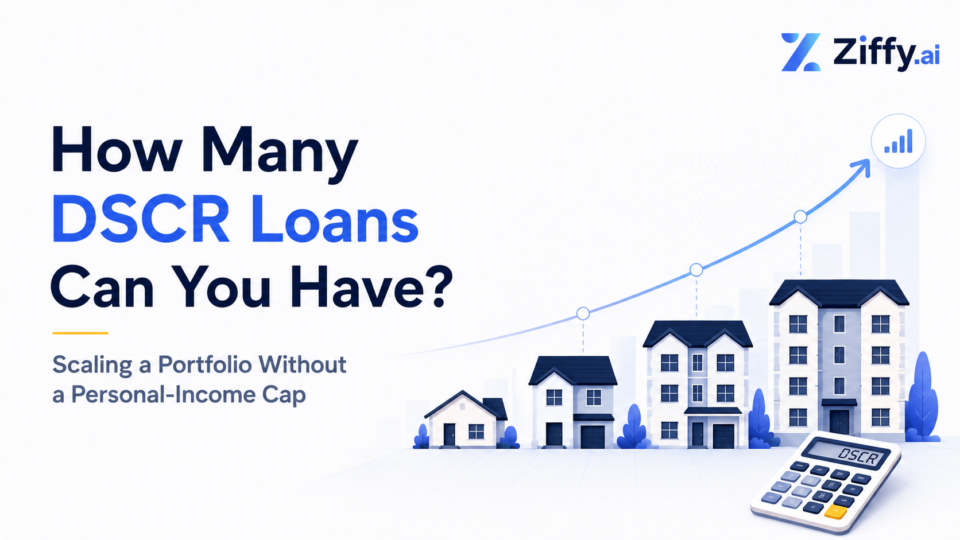
How Many DSCR Loans Can You Have?
There is no universal Fannie Mae-style limit on the number of DSCR loans an investor can hold. DSCR programs are investment-property financing, and qualification is generally driven by the rental property’s cash flow along with credit, leverage, reserves, property characteristics, and the lender’s own exposure rules.
At Ziffy Mortgage, we qualify DSCR loans primarily using the property’s rental income rather than W-2 income, pay stubs, tax returns, or personal debt-to-income ratio. Our current DSCR loan requirements start at a 620 credit score, with a DSCR of 1.0 or higher generally receiving our best terms. Eligible properties below 1.0 may have a path through our No-Ratio DSCR program.
The practical question, then, is not simply how many DSCR loans can you have? It is whether loan number six, ten, or fifteen still works under the underwriting rules that apply to that property and borrower.
What to Know About Multiple DSCR Loans
There is no industry-wide DSCR loan-count ceiling equivalent to Fannie Mae’s 10-financed-property limit for second-home and investment-property transactions under Desktop Underwriter.
DSCR qualification is based primarily on the rental property’s income rather than the investor’s personal income or DTI.
Having several existing DSCR loans does not remove normal underwriting. Credit, DSCR, leverage, reserves, rent support, and lender exposure still affect the next loan.
Under Ziffy Mortgage’s current DSCR program , eligible purchase financing is available up to 85% LTV, the minimum credit score is 620, and the standard reserve requirement starts at two months.
A DSCR-financed property can still affect a later conventional mortgage application if the investor is personally obligated on that mortgage. The ownership and debt structure matter under Fannie Mae’s multiple financed properties policy .
An investor buying a second rental and an investor buying a twelfth rental do not necessarily have the same financing problem.
With conventional financing, the number of properties already financed can eventually become part of the eligibility equation. With a DSCR loan, the next rental is primarily judged on whether its rental income supports its mortgage payment, rather than whether the investor’s salary can carry another property.
That distinction gives rental investors considerably more room to scale. It does not mean every additional DSCR loan is automatic.
Table of Contents
Is There a Limit to How Many DSCR Loans You Can Have?
There is no single federal or agency number that says an investor may hold only five, ten, or twenty DSCR loans.
One reason is that financing used to acquire or maintain a non-owner-occupied rental property is treated as business-purpose credit under the Consumer Financial Protection Bureau’s Regulation Z commentary. The CFPB specifically includes a single-family house rented to another person within that treatment. See the CFPB’s current Regulation Z guidance on business-purpose rental-property credit.
That still leaves each additional transaction subject to the lender’s underwriting rules. As portfolios become larger, reserve requirements can change based on factors such as leverage, DSCR strength, borrower profile, and the number of financed properties already owned. Ziffy’s investment-property cash reserves guide explains how portfolio reserves can enter the review as an investor adds financed properties.
So “unlimited DSCR loans” is too loose a description. There is no universal loan-count cap, but there can still be a practical borrowing limit on any particular file or with a particular lender.
How DSCR Loans Compare With the 10-Property Conventional Mortgage Limit
This is the comparison behind much of the search interest around multiple DSCR loans.
Under Fannie Mae’s current multiple financed properties policy, a borrower purchasing or refinancing a second home or investment property through Desktop Underwriter can have a maximum of 10 financed properties. Fannie Mae also imposes additional reserve calculations as the number of financed properties rises.
DSCR financing does not use that 10-property ceiling as its own program limit.
There is an important catch that is often missed in articles comparing the two.
Fannie Mae does not count only Fannie Mae mortgages. Its calculation includes financed one-to-four-unit residential properties where the borrower is personally obligated on the mortgage, regardless of whether that mortgage was sold to Fannie Mae. Fannie Mae’s own guide gives an example in which LLC-owned investment properties are excluded because the individual borrower is not personally obligated on those mortgages.
That means an investor should not assume that every DSCR loan disappears from a future conventional financed-property calculation. The loan and ownership structure determine how the property is treated.
For a deeper comparison of the two underwriting models, see our DSCR loan vs. conventional loan guide.
Why DSCR Loans Can Scale Without Personal-Income Qualification
With personal-income underwriting, each additional rental can make the borrower-side calculation more complicated. Income has to be documented, liabilities have to be accounted for, and rental income has to fit the applicable conventional guidelines.
DSCR changes the center of gravity. Under our DSCR loan requirements, we calculate:
DSCR = Gross Monthly Rental Income ÷ PITIA
PITIA includes principal, interest, taxes, insurance, and applicable association dues. A 1.0 DSCR means the gross qualifying rent equals the property’s monthly PITIA.
Investors can run those numbers using our DSCR loan calculator before deciding whether a property fits their financing strategy.
Because personal income and DTI are not the basis of DSCR qualification, acquiring another rental does not require the investor to keep producing a higher W-2 salary simply to support a larger portfolio. The new property’s rental economics carry much more of the qualification burden.
What Actually Limits How Many DSCR Loans You Can Get?
Once there is no fixed universal count to plan around, several other constraints become more important.
1. The next property’s DSCR comes first. Adding five strong rentals to a portfolio does not make the sixth property’s rent higher or its PITIA lower. Each new acquisition still needs a financeable income profile.
2. Leverage affects the ratio. A larger loan produces a larger payment, all else equal, which feeds directly into PITIA. Ziffy Mortgage currently allows eligible purchase financing up to 85% LTV, but maximum available leverage and the leverage that produces a healthy DSCR are not necessarily the same thing.
3. Credit still matters. DSCR removes personal-income qualification, not borrower review. Ziffy’s current minimum credit score for DSCR financing is 620.
4. Liquidity has to survive the acquisition. Our standard DSCR program starts with a two-month reserve requirement. Investors planning several acquisitions should therefore think beyond the next down payment and consider how repeated closings affect the liquidity left behind. Our investment-property cash reserves guide covers that planning in more detail.
5. Portfolio-level underwriting can become more important. Ziffy’s reserve guidance notes that multiple financed properties can bring portfolio reserves into the review. Higher leverage, weaker liquidity, lower DSCR strength, or several financed properties can also increase reserve expectations. That is why the absence of a universal DSCR loan-count cap should not be confused with guaranteed approval for every subsequent transaction.
Can You Have Multiple DSCR Loans at the Same Time?
Yes. Multiple DSCR loans can be held simultaneously, subject to the program and underwriting requirements applying to each transaction.
The useful way to plan a multi-property portfolio is to evaluate each new acquisition on two levels.
- First, ask whether the property works. Check supported rent, full PITIA, DSCR, price, leverage, taxes, insurance, and HOA costs.
- Then ask whether the portfolio can absorb the acquisition. Check available cash to close, reserves after closing, existing debt exposure, entity structure, and whether the next purchase leaves enough room for the acquisition after it.
Those two tests help prevent a common scaling problem: owning several financeable properties while gradually running out of flexibility to finance the next one.
Can You Use an LLC for Multiple DSCR-Financed Rental Properties?
DSCR financing can accommodate LLC borrowers, and investors building larger portfolios often have ownership-structure questions alongside financing questions.
An LLC does not change the underlying DSCR calculation. The property still needs supported rental income, and underwriting still considers the rest of the file. At Ziffy Mortgage, LLC ownership can be accommodated within DSCR financing, with the intended entity structure handled as part of the transaction.
An LLC also should not be formed simply as a way to try to bypass loan limits. Entity ownership carries legal, tax, title, financing, and administrative consequences of its own. Investors considering that structure can review our current LLC for rental property guide before deciding how future properties should be held.
How to Scale a Rental Portfolio With DSCR Loans
Scaling works better when financing capacity is treated as a portfolio resource rather than something considered only after an offer is accepted.
Before adding another property, run the actual rent against full PITIA. Check what happens to DSCR at the intended down payment. Preserve enough liquidity for the required reserves and for ownership after closing. Keep entity and title structures organized before submitting contracts. If a property needs rehabilitation before it can operate as a rental, short-term financing followed by a DSCR refinance may fit the sequence better than forcing permanent rental financing too early.
Investors using a buy, rehab, rent, refinance, repeat strategy can also review our BRRRR method guide, while investors comparing financing across different stages of a portfolio can start with our investment property loan guide.
A scalable DSCR strategy is therefore less about chasing a particular number of mortgages and more about making sure every acquisition leaves enough financial capacity for the one that follows.
Build the Portfolio Around the Next Deal, Not a Loan Count
For rental investors, the main advantage of DSCR financing is not simply the absence of a conventional 10-property ceiling. It is the ability to keep evaluating new acquisitions around property income instead of continually stretching personal-income qualification.
That can support a portfolio far beyond the point where conventional financing becomes cumbersome, provided the rental math, leverage, credit, liquidity, and loan structure continue to work.
At Ziffy Mortgage, we offer DSCR financing from $100,000 to $10 million, with qualification centered on rental-property performance. Investors can use Ziffy.ai to evaluate potential rentals and run the DSCR before deciding which property deserves to become the next one in the portfolio.
FAQs
Is There a Maximum Number of DSCR Loans I Can Have?
There is no universal DSCR loan-count maximum comparable with Fannie Mae’s 10-financed-property DU limit for second homes and investment properties. Individual lender and underwriting limits can still apply.
Can I Have More Than 10 DSCR Loans?
There is no industry-wide rule that stops a DSCR borrower at 10 loans. Approval for additional properties still depends on the applicable loan program, property cash flow, credit, leverage, reserves, and portfolio-level underwriting.
Do DSCR Loans Count Toward Fannie Mae’s 10 Financed Properties?
They can. Fannie Mae counts one-to-four-unit financed residential properties where the borrower is personally obligated on the mortgage. Its guide separately illustrates that LLC-financed investment properties are not counted when the borrower is not personally obligated. The specific debt structure therefore needs to be reviewed rather than assuming every DSCR property is excluded.
Does My Personal Income Limit How Many DSCR Loans I Can Get?
Ziffy Mortgage does not qualify DSCR loans using personal income or DTI. W-2s, pay stubs, and tax returns are not required for our DSCR income qualification. Credit, DSCR, leverage, reserves, property eligibility, and the rest of the loan structure still apply.
What DSCR Do I Need to Keep Buying Rental Properties?
At Ziffy Mortgage, a DSCR of 1.0 or higher generally receives our best terms. Eligible properties below 1.0 may still qualify through our No-Ratio DSCR option, although the loan may require a stronger structure elsewhere, such as more equity.
Can I Get Two DSCR Loans at the Same Time?
Multiple DSCR loans are possible, but simultaneous transactions need to satisfy the underwriting requirements that apply to each property and borrower. Before committing to several closings, the lender should review the complete portfolio, available funds, reserves, and transaction structure.