In 42 U.S. markets, there are zero listings under $300K: Saving 20% Down Can Take Over 10 Years in High-Cost Metros
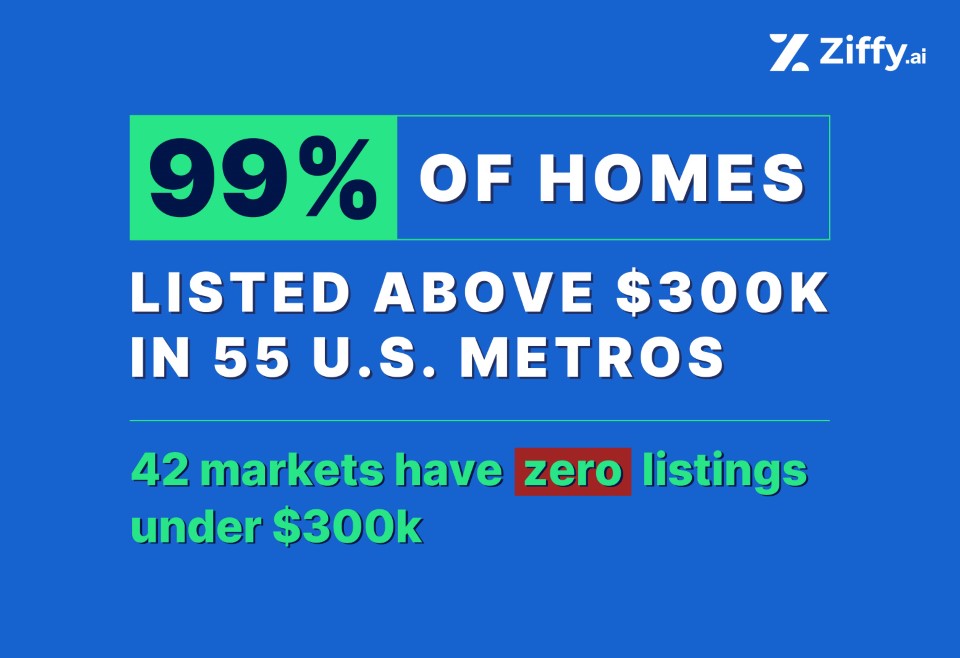
Starter homes priced under $300,000 have hit zero listings in 42 major U.S. housing markets, despite a national median existing-home sale price of roughly $409,000. Another 13 markets sit below 1% under-$300K inventory, bringing the total to 55 markets where 99%+ of listings are above $300,000. In the highest-priced markets, saving a 20% down payment on a starter-tier home can take more than a decade, assuming households save 10% of local median income.
Making sound real estate investment decisions begins with reliable, data-driven insights. At Ziffy.ai, we offer an AI-native real estate investing, proprietary data-driven trend analysis, investment mortgage programs like DSCR loans, and a network of over 500 investor-friendly real estate agents to deliver the expertise needed for informed decisions. Our content is crafted by experienced real estate professionals and backed by real-time market data, ensuring you receive accurate and actionable information. Through a rigorous editorial process, we strive to empower your investment journey with trustworthy and up-to-date guidance.
The sub-$300,000 starter home is going extinct across American housing markets.
In 42 markets, there are zero active house or townhome listings under this traditional entry-level threshold, and in another 13, under-$300K homes account for less than 1% of available inventory. For buyers shopping under $300,000, inventory isn’t just tight in many places; it has effectively vanished.
In the highest-cost markets, the affordability gap is stark: even saving a 20% down payment on a starter-tier home can take roughly a decade or more, based on median household income and a 10% annual savings assumption.
This analysis measured starter-home availability across 855 housing markets using an active-listings snapshot captured on Dec. 23, 2025. Starter availability is defined as the share of active for-sale house and townhome listings priced under $300,000 (this is listing inventory, not closed sales). Nationally, 63.45% of active inventory is priced at $300K+, and in 55 markets, under-$300K supply has collapsed to below 1% or to zero.
Table of Contents
Key Highlights
42 markets have zero homes listed under $300,000. Examples include Steamboat Springs, CO (116 listings), Barnstable Town, MA (155), and Santa Cruz, CA (77)- markets with active inventory, but none priced below $300k.
Los Angeles and New York combine for 7,720 active listings-only 64 under $300,000. In Los Angeles, just 35 of 3,867 listings are under $300k (0.91%). In New York, 29 of 3,853 are under (0.75%). In both metros, starter-home inventory is effectively absent.
Price metrics can suggest “affordability” even where listings don’t. Miami’s bottom-tier home value is $255,161, but only 20 of 2,196 listings (0.91%) are priced under $300k. Inventory is far more expensive than the entry-tier value signal implies.
The 3 Zones of Starter Home Availability
To show where starter homes still exist and where they’ve disappeared, these 855 markets are grouped into three zones based on their typical starter-tier value, measured using Zillow’s bottom-tier ZHVI (homes in roughly the 5th–35th percentile of local values).
Zone
Starter-Tier Value Range
Markets
Inventory-Weighted Under-$300k Availability
Zone 1: Extinct
Above $450,000
33
1.23%
Zone 2: Endangered
$300,000 – $450,000
78
4.06%
Zone 3: Still Attainable
Below $300,000
744
42.31%
Pattern: Once a market’s entry tier crosses $300,000, under-$300K listings don’t just shrink, they nearly disappear.
(Income figures below are a simple rule-of-thumb: starter-tier value ÷ 3, for context – not underwriting.) Rule-of-thumb income (price ÷ 3) is only a context marker; ACS median household income is used for the Zone 1 down-payment timing estimates
Zone 1: Starter-tier values average $596,000 (rule-of-thumb income $199K), and under-$300K availability is 1.23% – about 1 under-$300K listing per 81 listings.
Zone 2: Starter-tier values run $300K-$450K (rule-of-thumb income $100K-$150K), and availability improves to 4.06% – about 1 per 25 listings, but remains critically low.
Zone 3: Starter-tier values average $151,000 (rule-of-thumb income $50K), and only here does under-$300K availability rise above 40%.
Amresh Singh
Founder and CEO | Ziffy.ai
“
Once a metro’s starter-tier pricing crosses $300,000, availability doesn’t decline gradually; it collapses. The difference between Zone 2 and Zone 3 isn’t incremental. It’s a cliff.
Starter Home Extinction in America Statistics [855 Metros Analyzed]
1) Across 855 housing markets, nearly two-thirds of active house and townhome listings are priced at $300,000 or higher.
In the Dec 23, 2025 Zillow snapshot, there were 228,257 active house + townhome listings across the 855 markets in this analysis. Only 83,421 were priced under $300,000, meaning just 36.55% of active inventory falls below the starter-home benchmark. The flip side is the headline: 63.45% of listings are now priced at or above $300,000.
2) In 55 markets, under-$300K listings have effectively disappeared: 99%+ of homes for sale are priced above $300,000.
In 55 markets, fewer than 1% of active house and townhome listings are priced under $300,000, meaning 99% or more are above that threshold. In practical terms, buyers shopping at $300k are not facing “tight supply” in these places; they are facing an almost empty category.
3) In 42 markets, there were zero active house or townhome listings under $300,000 none at all.
Within the same Dec 23 snapshot, 42 markets recorded active inventory overall, but not a single listing under $300,000. In these markets, the starter-home benchmark isn’t competitive; it’s simply absent on the market at the time of capture.
4) When starter-tier prices rise above $300K, under-$300K inventory falls off a cliff only 2.77% of listings remain below the benchmark in those markets.
In markets where starter-tier values are above $300,000, there are 33,274 active listings, but only 921 are under $300K (2.77%). That’s roughly 1 starter-priced home per 36 listings. At that point, $300K often stops aligning with local incomes and financing norms.
Debjit Saha
Co-Founder and CTO | Ziffy.ai
“
We’re watching the housing market split in two. Affordable inventory still exists but it’s concentrated in markets that most buyers aren’t searching. The gap between where people want to live and where they can afford to buy has never been wider.
5) In the most expensive tier of markets, under-$300K listings are nearly extinct: 188 out of 15,227 across Zone 1.
Zone 1 markets where starter-tier values exceed $450,000 contain 15,227 active listings in total, but only 188 are under $300,000. That’s 1.23% availability, averaging fewer than 6 under-$300k listings per market across some of the country’s most expensive housing areas.
6) In 102 markets, fewer than 5% of listings are under $300K turning a starter-home search into long odds.
Beyond the 55 markets that fall below 1% availability, another 47 markets sit between 1% and 5%. In these places, finding an under-$300k home can mean scanning 20 to 100+ listings to locate a single qualifying option, scarcity levels that materially change buyer behaviour and outcomes.
7) New York and Los Angeles list thousands of homes yet fewer than 1% are under $300K in each metro.
In Los Angeles, only 35 of 3,867 listings are under $300,000 (0.91%, roughly 1 in 110). In New York, only 29 of 3,853 listings are under $300,000 (0.75%, roughly 1 in 133). Together, the two metros have 7,720 listings but only 64 under the benchmark.
8) Even where under-$300K listings exist in major coastal metros, they’re still “needle-level” scarce Seattle, Boston, and San Francisco sit near 1–2%.
In the snapshot, Seattle has 9 of 860 listings under $300k (1.05%), Boston has 3 of 203 (1.48%), and San Francisco has 3 of 191 (1.57%). These aren’t zero-markets, but for shoppers at $300k, the odds remain extremely low.
9) Miami’s starter-tier value is below $300K, but listings under $300K are still under 1% – a sharp mismatch between price signals and real inventory.
Miami’s starter-tier value is $255,161, which can suggest entry-level affordability. Yet only 20 of 2,196 active listings are under $300,000 (0.91%, about 1 in 110). The result is a market where “starter-tier” value metrics and what’s actually available to buy do not align.
10) Several headline metros are already on the “wrong side” of the $300K line Denver, Las Vegas, DC, Nashville, Phoenix, Austin, and Portland all have single-digit under-$300K availability.
These are large, heavily covered markets where under-$300k options exist but scarcity is built into the inventory: Denver (3.49%), Las Vegas (3.99%), Washington, DC (5.37%), Nashville (3.79%), Phoenix (5.76%), Austin (6.61%), and Portland (7.41%). This cluster illustrates the report’s core pattern: once starter-tier values cross $300k, under-$300k availability becomes structurally rare rather than gradually constrained.
11) Florida shows the market split in real time: Miami is near-extinct under $300K, while Tampa and Orlando still have double-digit starter availability.
In this snapshot, Miami sits at 0.91% under-$300k availability (20 of 2,196). Meanwhile, Tampa has 12.07% (230 of 1,906) and Orlando has 10.61% (248 of 2,338). Same state, radically different starter-home reality useful for localised stories across Florida newsrooms.
12) Some major metros still have meaningful starter inventory – Philadelphia, Chicago, and Houston keep large volumes of listings under $300K.
Not every big market is near-extinct at this benchmark. Philadelphia has 2,385 of 3,781 listings under $300k (63.08%), Chicago has 972 of 1,750 (55.54%), and Houston has 5,249 of 11,320 (46.37%). These markets anchor the “still attainable” side of the national split.
13) In fast-growing Sun Belt hubs, under-$300K inventory is still present but no longer dominates, Atlanta and Dallas sit near 26–31%.
Two widely covered growth metros illustrate the “middle zone” reality in still-attainable markets: Atlanta shows 30.60% under-$300k availability (786 of 2,569), and Dallas shows 26.41% (726 of 2,749). The benchmark category hasn’t vanished but it is no longer the default share of inventory.
14) Among large metros, Detroit and Baltimore show what “starter inventory still exists” looks like at scale, most listings are under $300K.
At the high-availability end, Detroit has 94.44% under-$300k availability (2,686 of 2,844), making benchmark-priced inventory the norm rather than the exception. Baltimore also stands out as a large market with strong availability: 78.21% (1,784 of 2,281). These metros reinforce the broader point: affordable inventory still exists, but it’s concentrated in a different set of markets than where many buyers are focused.
15) In the highest-cost markets, saving a 20% down payment on a starter-tier home can take 10+ years, based on median household income (assuming 10% annual savings).
In Zone 1 markets, starter-tier values average about $596,000, which puts a 20% down payment at around $119,000. Using median household income for Zone 1 and assuming households save 10% of income annually, the time required to accumulate that down payment alone can exceed 10 years, before factoring in closing costs, debt obligations, or any home-price appreciation during the saving period.
Starter Home Extinction Rankings by Metro
Zone 1 (Extinct): Starter-Tier Home Values Above $450,000
*Median household income source: U.S. Census Bureau, American Community Survey (ACS) 1-year.“Years to save” assumes 20% down and saving 10% of median household income annually; closing costs and debt obligations are not included.
Zone 2 (Endangered): Starter-Tier Home Values $300,000- $450,000
*Income estimates shown above are a rule-of-thumb (starter-tier value ÷ 3), not underwriting.
The Zero-Listing Markets (Under $300k = 0)
Forty-two markets across Zones 1, 2, and 3 recorded zero active under-$300k listings on Dec 23, 2025.
Markets with Home Prices Above $450K
Vineyard Haven, MA
Santa Cruz, CA
Kapaa, HI
Edwards, CO
San Luis Obispo, CA
Kahului, HI
Steamboat Springs, CO
Breckenridge, CO
Hailey, ID
Barnstable Town, MA
Glenwood Springs, CO
Markets with Home Prices Between $300K-$450K
Metro
Metro
Metro
Oak Harbor, WA
Kill Devil Hills, NC
Los Alamos, NM
Bellingham, WA
Ocean City, NJ
Portland, ME
Ukiah, CA
Worcester, MA
Wenatchee, WA
Prineville, OR
Kennewick, WA
Helena, MT
Merced, CA
Hilo, HI
Montrose, CO
Laconia, NH
Madera, CA
Hilton Head Island, SC
Burlington, VT
Yuba City, CA
Eureka, CA
Newport, OR
Brookings, OR
Easton, MD
Hudson, NY
Longview, WA
Boone, NC
Jefferson, GA
Shelton, WA
Sheridan, WY
Markets with Home Prices Below $300K
Dalton, GA
Methodology
Data Sources
This analysis uses three primary data inputs:
Starter-tier home values (bottom-tier ZHVI): Zillow Home Value Index for bottom-tier homes (approximately the 5th–35th percentile of values in each market). Value date: November 2025 (Nov 2025 bottom-tier series used).
Active listing inventory (houses + townhomes): Active for-sale listing counts captured from Zillow search result totals for each Zillow-defined metro geography. Snapshot date: December 23, 2025.
Median household income (Zone 1 down-payment timing): American Community Survey (ACS) 1-year estimates (U.S. Census Bureau) Income year: 2024 (ACS 1-year). Used only to estimate “years to save” in Zone 1 under a 20% down payment and 10% savings-rate assumption.
Definitions
Term
Definition
Starter home threshold
$300,000 benchmark price point used for under-$300k inventory measurement
Availability rate
(Listings under $300k) ÷ (Total active listings)
Extinction rate
1 − Availability rate (share priced at or above $300k)
Zone 1 (Extinct)
Starter-tier value > $450,000
Zone 2 (Endangered)
Starter-tier value $300,000–$450,000
Zone 3 (Still attainable)
Starter-tier value < $300,000
Income estimate (rule-of-thumb)
Price ÷ 3; not median household income; not underwriting/qualification.
Years to save (Zone 1 estimate)
(20% down payment) ÷ (10% of median household income); excludes closing costs and debt obligations.
Inventory Collection Steps (for each of 855 markets)
Zillow search geography matched to the metro/market name in the dataset (Zillow-defined “msa” regions)
Filters applied: For Sale → Active Listings → Houses + Townhomes
Record total listing count
Apply additional filter: Max Price = $300,000
Record under-$300k listing count
Compute availability: Under-$300k ÷ Total
Weighting Approach
National and zone metrics are inventory-weighted- (Sum of under-$300k listings) ÷ (Sum of total listings) This ensures larger markets contribute proportionally more to aggregate rates.
Market-level rankings- use each market’s own availability rate (scarcity-first ordering).
Limitations
Point-in-time snapshot: inventory changes daily; this reflects Dec 23, 2025 only.
Geography alignment: Zillow “msa” boundaries may differ from official MSA definitions.
Property type scope:condos/co-ops excluded by design; condo-heavy metros may appear more constrained under this definition.
Low-count markets: some small markets show very low listing totals in the snapshot; their rates can be volatile day-to-day.
Off-market inventory: coming-soon, pocket listings, and FSBO not syndicated to Zillow aren’t captured.
List price vs sale price: list prices can be stale, inaccurate, or updated after snapshot.
Replicability
To replicate any single market’s calculation:
Go to Zillow.com
Search for the market name (e.g., “Denver, CO”)
Apply filters: For Sale → Houses + Townhomes
Record total listing count
Add filter: Max Price $300,000
Record under-$300k listing count
Compute: (Under-$300k ÷ Total) × 100
Notes
This analysis does not factor in future home price inflation. Down payment timelines are based on today’s prices and incomes. Accounting for inflation would increase required down payments over time, meaning actual savings timelines could be longer than those shown.
This report includes down payment savings estimates for Zone 1 metros only. Comparable data for Zones 2 and 3 is available upon request at contact@ziffy.ai
About Ziffy
Ziffy is an all-in-one AI-powered real estate investment platform offering AI-powered property search, detailed data investment analysis, and investor mortgage products including DSCR, fix-and-flip, and bridge loans. This research was produced by Ziffy’s data analytics team to provide transparency into housing market conditions affecting buyers nationwide.
About the author:
Michele Lawrie, a seasoned real estate professional with licenses in New York and Florida, serves as the Real Estate Consultant at Ziffy. With over 15 years of experience and specialized certifications from the NAR (National Association of Realtors), Michele is a trusted expert for investors buying US real estate.
"Ziffy.ai helps investors discover, analyze, and finance cash-flowing investment properties faster. With AI-native real estate investing, real-time cash flow insights, and built-in mortgage financing, you can move from browsing to closing, all in one place."
We use cookies to ensure that we give you the best experience on our website. If you continue to use this site we will assume that you are happy with it.







 42 markets have zero homes listed under $300,000.